Those April showers that come our way They bring the flowers that bloom in May. And when it’s raining, let’s not forget, It isn’t raining rain at all, it’s raining violets. ~From a song by Al Jolson~
Maureen Haseley-Jones is “The English Lady.”
April is the month of activity in the garden, and our old nemesis, weeds are beginning to rear their heads, so we need to extract the little devils before they take hold and are difficult to remove.
Having said that, I must point out the benefits of many weeds. Nettles are food for butterflies, clover extracts nitrogen from the air which is then absorbed into the soil and the oil from jewel weed soothes poison ivy rash. The young foliage of Dandelions is great in salads and when lightly cooked it tastes like spinach with the added advantage of containing many healthy nutrients.
In this group, I do not want to forget our songbirds and other wildlife who depend on weed seeds as a food source.
Weed removal – weeds must be pulled gently so that the weed and roots do not break apart, because if this happens, thousands of weed seeds will reseed and you will find yourself with an endless cycle of unnecessary weeding. When careful weeding has been accomplished, apply an organic weed pre-emergent, with a corn gluten base by Bradfield Organics; this natural product will keep weeds at bay for about six weeks. :
The end of April is the time to plant bare-root roses. Photo by Bailey Chenevey on Unsplash.
Plant bare-root roses at the end of April and plant container roses in mid-May. In the middle of May when the soil temperature has reached 55 degrees, add manure and on top of the manure add a fine bark mulch about one foot from the base of the roses. Check my March tips to remind yourself on pruning roses.
Be careful clearing winter debris from around rhododendrons, mountain laurel and azaleas; these evergreens have shallow roots and do not appreciate having their roots exposed. If winter weather did erode soil around some roots, add soil to cover the exposed roots and at the same time resettle the plant in place. In the middle of May apply manure and fine bark mulch as well as some peat, which adds much needed acidity for evergreens.
Plant Gladioli corms at two-week intervals in late April. Planting in two- week intervals ensure you will get a succession of bloom. Plant the corms eight inches below the surface; this extra depth helps to keep the heavy blooms erect.
The Red Lily Beetle will soon appear and I suggest applying organic Neem oil on the Lilies when they are about four inches above ground which helps to halt this beetle problem.
SOIL SOLARIZATION is an effective way to control many soil- borne problems, specifically the tomato blight that causes fruit rot. Covering the soil with clear plastic at the end of April, for one to two months can generate high enough temperatures in the top six to 12 inches of soil to kill pests, nematodes, weed seeds and many disease organisms like the tomato blight. This process has proved invaluable for home gardeners and the beneficial effects last for several seasons.
To solarize, dig a trench several inches deep around the soil bed, and spread a thin, clear plastic film (1-4mils) over the bed. Press the plastic into close contact with the soil and seal the edges by filling the trench with soil. Leave the plastic on the soil until you are ready to plant tomatoes or other vegetables in about six weeks.
When the soil temperature reaches 55 degrees, manure all the borders with composted manure in bags from the garden center or aged manure from the bottom of the farmer’s pile, then mulch with a fine brown hardwood mulch.
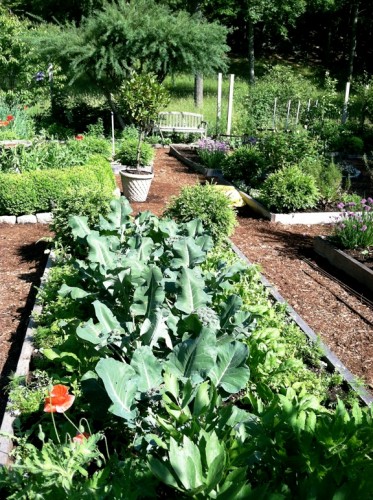
Mulch in April with composted manure in order to achieve a vegetable patch like this later in the season.
In the vegetable garden after preparation and planting, then it is time to mulch. Mulch with the composted manure, which will not ‘cap’—this means, that it does not form a crust like other mulches so that air and water can get through to the roots of the plants where it is needed.
If you did not apply an organic grub control on the grass in March, apply now to reduce the grubs, which are the food source for Moles and therefore cut down on the mole population.
Soil is the most important component of production in the garden; with compost, organic manure and peat to amend soil and rebuild its structure. The ratio to use is one part compost to three parts manure and apply peat to the planting mix in the ratio of one part peat to three parts manure when planting evergreens. And as mentioned above, peat adds the acidity which evergreens require.
Good soil structure assists with drainage, prevents compaction, and the rich nutrients with the amendments break down and encourage the soil animals beneath the surface to work at full capacity. In a sandy soil, humus is needed to produce micronutrients for this soil, which are the combination of manure, mulch and carbon from the atmosphere that binds the sand particles together therefore producing a healthy workable soil. In heavy soil such as clay, the humus separates the clay particles which allows for air and drainage.
GROWING CONDITIONS IN APRIL are very favorable for new plant-root development. This month is the best time to transplant evergreen shrubs and plant new evergreens. Apply composted manure and peat together with the topsoil in the planting hole. Then give the roots a workout with your hands before planting. Separating the roots in this way gives them the freedom to reach into the surrounding soil for nutrients and water and not dry out in the heat of summer.
Many years ago, when I moved into my farmhouse on the shoreline, I discovered that my soil was sandy, which is good for drainage but sadly lacking in nutrients. I began adding a few inches of manure to all planted borders in April, July and October. The result today is when I put a spade in the ground to check the color of the soil in spring it’s ‘black gold’.
Gloves should be worn when handling manure which contains bacteria; the bacteria is great for the plants and the soil but not good for your health. These natural soil amendments tend to be slow acting; gradually making the nutrients available to the plants and the rewards are infinite. Composted manure is applied in spring around mid May when the soil temperature has reached 55 degrees and when the plant shows about six inches of growth. This method allows for the nutrients and soil animals to become active at the time when plant growth is occurring at a rapid pace.
DAFFODILS, which are my favorite flower, are appearing in gardens and on roadways, which is a lovely sight. When the Daffodil bloom has past, do not cut the leaves from Daffodils or any of your spring flowering bulbs, the leaves send down energy into the bulbs to store for next season’s bloom.
April is the time to tackle a new lawn or patch seed, use only good quality grass seed, organic fertilizers and lime, which provides the alkaline and not acid for the grass.
Do not be lulled into complacency with a few back-to-back warm days; we can still get frost, so I caution that you not to plant annuals until Memorial weekend. Do not cultivate around the perennials in the borders until mid-May.
Do not panic if you were not able to get the April tasks done until May, your garden will wait for you and the constancy that is Mother Nature will continue to keep your patch of earth flourishing.
Enjoy the pleasure of being outdoors in warmer temperatures, inhaling the pungency of awakening soil and your connection with Mother Nature. Do not overdo it; warm up the body before the garden labor and stay well hydrated with lots of water.
We are inexorably entwined with the earth and know that even the smallest gesture of a garden has positive rewards; the effects are not only on you but on our planet.
It is important to have a well thought out plan before creating a new garden or landscape. My son Ian is a landscape designer and creator for the last 30 years and you can arrange your consultation at LandscapesByIan.com
I will see you in your garden with more gardening tips in May and if you have any gardening questions, please email MaureenHaseleyJones@gmail.com
About the author: Maureen Haseley-Jones is a member of a family of renowned horticultural artisans, whose landscaping heritage dates back to the 17th century. She is one of the founders, together with her son Ian, of, The English Lady Landscape and Home Company. Maureen and Ian are landscape designers and garden experts, who believe that everyone deserves to live in an eco-conscious environment and enjoy the pleasure that it brings. Maureen learned her design skills from both her mother and grandmother, and honed her horticultural and construction skills while working in the family nursery and landscape business in the U.K. Her formal horticultural training was undertaken at the Royal Botanic Gardens at Kew in Surrey.
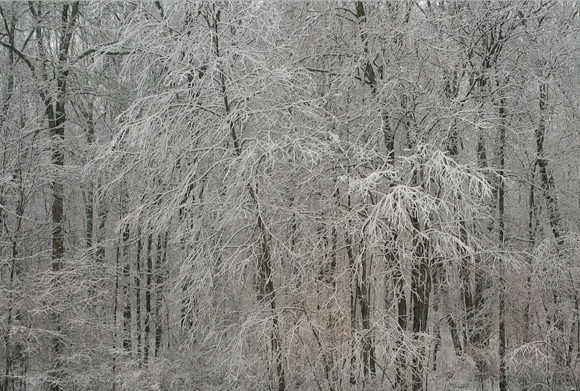
‘Those March winds shall blow, and we shall have snow and what will the Robin do then poor thing? He’ll hide in the barn and keep himself warm and hide his head under his wing’.
Maureen Haseley-Jones is “The English Lady.”
March is a month of ‘wait and see’ as we anticipate walking around our gardens. This morning, I walked outside, into a westerly breeze and a gentle sun. I took a deep breath and as I did, I caught the rich fragrance of the soil beginning to awaken.
All of us are itching to get into the garden and I believe that foray will be earlier than last year since frost did not penetrate deep into the ground.
The sodden soil will dry out in the next few weeks, but I urge you to tread gently as you tend the soil, which is the precious commodity of Mother Nature. Pertaining to that, I am suggesting that you do not till the soil, as tilling damages soil structure and can break friable root systems.
Please be patient right now! I know you are chafing at the bit to get your hands into the soil, but, at this moment, continue planning for the upcoming season. Planning means organizing, which helps to prevent costly gardening mistakes during the growing season.
On a pleasant afternoon, when you go outdoors, check on the trees in your garden and decide what you think, which trees might need pruning. That is which limbs might need to be removed or the canopy lifted to allow more sunshine into a shady area of the garden. Having made some of those decisions, I suggest that you call in an arborist, as tree branches without foliage takes less time for arborists to do the work and is therefore less expensive.
What to look for:
Are there broken or dead limbs?
What branches require cabling?
If a tree appears to be 50% dead, then it should be removed.
A medium shade area can be changed to a dappled shade area, allowing more sunlight in by thinning out the upper tree branches or tree canopy.
Perhaps you would like a tree removed to transform a shade area to a sunny spot ,which allows for a larger choice of plants available to you.
I always hesitate to remove a healthy tree but sometimes a tree has been planted too close to the house and consequently the roots have undermined your home’s foundation and the shading over the roof has resulted in mold and mildew.
There is an art to tree work knowing how, when and why to cut. Work on the trees should be carried out by a professional so that at the completion of the work, the effect is both practical and aesthetically pleasing. An experienced arborist will also take into consideration the health of the trees. Having the work done by an arborist avoids injury, falling from ladders or perhaps tree branches or trees falling on you.
PRUNING – is a task that you may feel you are able to accomplish yourself.
March is the month to prune evergreens before the new growth appears.
Hedges can be sheared for shape, so that any stubby ends will be concealed by new spring growth.
Please keep to the natural shape of the shrub – no round balls.
Prune Spirea to six inches from the ground.
In April, prune Lavender to three inches.
In late March, prune Sweet Pepper Bush (Clethra), cutting out the oldest branches.
Lilac – Prune back all old branches to various lengths before leaf growth begins, from two to five feet, keeping to a natural shape. Sprinkle lime around the base of the Lilac and add manure in May. Lilacs enjoy alkaline soil and e benefit from a small amount of lime sprinkled about a foot away from the base of the Lilac.
Prune Butterfly bush to two feet from the ground and in May apply composted manure around the base.
Prune forsythia after it has bloomed, pruning out sparse flowering old wood.
Prune roses when the forsythia blooms. If the roses have only been in the ground for one year, do not prune, wait until October.
Do not remove the protective mulch from around the base of the roses, wait until mid May, and then apply a dressing of manure and fine bark mulch, about a foot away from the stem of the rose.
You may be asking, ‘Why wait until May to apply manure’ The answer is that the soil needs to warm up to 55 degrees otherwise the nutrient benefits of the manure bacteria that works with plant roots and soil organisms, are not activated. I suggest you invest in an inexpensive soil thermometer to check the soil temperature. At soil temperature of 55 degrees apply a three to four- inch layer of composted manure.
When April arrives, carefully begin to clear away winter debris, treading carefully on the soil to avoid damaging soil structure and friable root systems. When you have cleared away the debris, make a clean edge to the borders with a sharp spade; this makes such a difference to the look of your garden.
The best tool to use is a sharpened lawn edger, the blade is a half- circle nine inches wide and 4.5 inches deep with a flat top – this tool creates a deep edge. Face the bed and thrust the edger down to its full depth and push the cut soil into the bed. Continue along the soil edge and then remove the spade and surplus clumps of soil and grass.
Edging was one of the first lessons I was taught at our family nursery in England; my great-grandfather was a strict taskmaster standing over me until I got the edge correct.
If you are contemplating the location of a new planting bed or expanding an existing one, here are some tips:
Think in terms of where you spend your leisure time outdoors, and where you may choose to sit, near to the new bed, enjoying the bloom, fragrance and structure of your plantings.
From indoors are you able to view and enjoy the new border?
Is it an area where there will not be drainage problems, erosion concerns or water pooling?
Is it convenient to tend and enjoy where you place a bench or chair?
Will you be able to water it with relative ease?
For an informal garden I prefer a curved bed – a curved line gives grace and fluidity. I lay out a garden hose in the desired shape and size of bed adjusting the hose until you are satisfied with the gentle curves.
MANURE:
Many of you who have been my radio listeners and lecture audiences, know how I feel about that wonderful natural product. Manure is not a fertilizer – it builds soil structure, aids in drainage and its bacteria encourages the millions of soil animals below the surface to come alive and work with the manure bacteria to produce nutrients for the roots of the plants.
TYPES OF MANURE:
Poultry manure – I know the odor can be rather objectionable, however, this manure contains about 2% nitrogen, one of the highest levels in any manure. If you have access to poultry manure, allow it to age for two months and by that time, the odor will have dissipated and then add it to the garden.
Horse manure is about .5% nitrogen. If you obtain horse manure from a stable, which has sawdust on its floors – it should be pretty weed free. What I have done in the past is obtain horse and cow manure from stables and farms in April. When you get it home, spread manure out in a flat area (not in a planting bed) then cover it with a tarp for a month.
Using this method, the tarp will suffocate the weed seeds and the sun on the tarp encourages the manures to continue to decompose. A week before using the horse and cow manure remove the tarp to allow the sun to further decompose it.
Cow manure is .25 % nitrogen and is the most available manure. If you get horse and cow manure from the farm, ask the farmer to give you manure from the bottom of the pile so that it is already partially decomposed.
Compost pile – If you do not have a compost pile, maybe it could go on your list for this season. Vegetable waste from the kitchen, plus grass clippings, and wood pruning can be added to the pile. The high temperature in the compost kills the weed seed and cooks all those other necessary ingredients. The ratio of compost and manure for your garden is 1 part compost to 3 parts manure – but if you do not have compost – manure will do the trick.
**DO NOT apply fresh manure to the garden, as it will burn the plants. If you do not have a source of manure from a farm, purchase composted manure in bags from the garden center.
To produce the best-planting environment, resulting in a soil that is ‘black gold’ apply 3 inches of composted manure to all planted areas in May, July and October.
Natural fine bark Mulch can be added later in May. Do not use buckwheat mulch as it flies everywhere. Do not, I repeat do not use cocoa mulch, which is poisonous to dogs and cats and please do not use the chemically colored red mulch. The benefits of natural fine bark mulch are, that this mulch helps to retain the beneficial moisture in the soil and aids to retard weeds as does Bradfield organics, a corn gluten weed pre- emergent.
THE HUMUS COMPONENT:
I know I have written about the importance of the Humus component for the soil but I feel I must continue to stress this fact.
In 1937 Franklin D Roosevelt told us ‘that the nation that destroys its soil destroys itself.’
Unfortunately, America has not heeded that warning. Precious soils in this country and around the world are being destroyed by dangerous practices used in industrialized agriculture as well as poisonous chemicals, which completely disrupts our eco system and poisons all living things.
In your own garden you can build and retain a rich growing environment by building the Humus component -We are all carbon-based creatures as is all life on earth. Not only humans but also our soil microbes need carbon to flourish. To attract carbon from the atmosphere into your soil you need to build the humus component.
HOW TO BUILD THE HUMUS COMPONENT:
Do not till soil – tilling breaks up soil structure.
First step – Add composted manure three times – in spring when the soil has reached a temperature of 55 degrees. If the soil has not reached that temperature, the soil organisms are not able to work with the bacteria in the manure to produce nutrients for the roots of the plants.
This year, as we have not experienced deep frost therefore, the soil temperature may reach 55 degrees by the end of April or early May. Add the manure again in July to continue to nourish your growing plants and again in October to protect and nourish your plants and roots through winter. Manure is not a fertilizer; it builds soil structure and works with all the soil animals to keep a healthy disease- free growing environment.
Second step – Add wood chips in the form of brown fine bark mulch or wood chips that you produce from your garden; these are aged wood chips combined with leaves, twigs and branches.
These two major steps build the humus component. If you do this in your own garden – not only, will you be helping to heal the planet but also produce the healthiest of gardens.
A question I am often asked is ‘can I put manure over mulch in my summer garden’? The answer is ‘yes’ – the manure together with nature’s moisture and your own irrigation enables the manure to find its way easily into the soil and to the roots of your plants.
WHAT EXACTLY DOES HUMUS DO?
Humus acts like a sponge and can hold 90% of its weight in water.
Because of its negative charge – plant nutrients stick to humus for nitrogen, calcium, phosphorus and minerals, which prevents these from washing away and acts as nature’s slow- release fertilizer throughout the year.
Humus improves soil structure making it loose and friable, which helps plants to root in this soil to get better access to nutrients, water and oxygen.
Humus also helps to filter toxic chemicals from the soil, mulch, like carbon-based water filtration systems filter toxins from your water.
We are not able to control industrialized agricultural practices – but in your own garden you can make a difference, if you feed the soil, it will feed the plants.
Once again, I’m getting a little ahead of myself. So back to a cloudy day at the end of March, when you may gradually begin to remove protective covering from shrubs and small trees. In exposed garden areas, where wind is a problem, leave the covering on until mid April. Cold wind is more damaging and drying to plants than extreme cold and frost.
FROST HEAVE: If some perennials, trees and shrubs have heaved out of the ground, cover the roots with fresh topsoil or mulch until mid May when they can be settled back in place.
An established clematis makes a delightful combination if paired with with roses.
I just walked around the corner of my house to check on my trellis on the chimney where I have roses and clematis planted together. Roses and clematis are a delightful combination in a companion planting. This planting method means that the rose and the clematis planted together have the same growing needs, ‘feet in the shade and heads in the sun’.
Beginning in May, add manure and mulch around the base of both. Discontinue feeding roses and clematis in mid August; this enables both plants to go into a necessary slow dormancy.
BACKSCRATCH: When the lawn has dried out in April, rake lightly and remove excess debris such as leaves and dead twigs. Raking gently raises the mat of the lawn, which enables the emerging grass to breathe again. Aerating machines are useful to develop a healthy lawn.
Puncture holes with the aerator and pull out plugs of soil every four to six inches; following this treatment, root development takes off and thatch is reduced. Do not use the large thatching machines, as these machines damage the grass.
GRASS FERTILIZER: In April, apply organic fertilizer, lime and organic grub control before the grass begins to grow. Reseed bare or sparse spots after gently loosening the soil, liming and fertilizing, then cover the seed with salt hay to keep the seed warm and to prevent wind from blowing the seed away. Water the seed for the first three weeks. Do not blast the area with water, which scatters the seeds. As with lilacs, grass enjoys alkaline soil which is why we use lime together with the fertilizer and grub control.
MOLES: To keep the mole population to a minimum in your garden; apply organic grub control once a month from March for two months which results in less grubs, less food for the moles. When you see signs of moles, find the mole holes and insert Exlax, which contains Senna, an organic herb. The moles eat the Exlax and become dehydrated from defecation and die.
Apply organic pre-emergent crabgrass killers in March and April.
VOLES : Spread castor oil around the base of plants and keep mulch away from the base of the plants so that voles, which are canny creatures, are not able to hide there and gnaw on plants and roots.
DEADHEAD: Do not cut off the leaves of the crocus as they bloom; the leaves make food for the bulbs for next season’s bloom.
DAFFODILS: When the green shoots emerge, spread composted manure around the plants.
DAFFODILS FOR DISPLAY INDOORS: The stems release a sap like “goop” that harms other flowers. Before adding Daffodils to an arrangement, cut the stems at an angle, and leave them in a vase half filled with lukewarm water for a couple of hours. Discard that water and add the Daffodils to the other flowers. If you recut the stems you will need to repeat the process. Change the water in the vase often.
PERENNIALS: In May, when perennials are about four inches above soil level and when the soil is 55 degrees, apply composted manure around them to encourage healthy growth.
DIVIDING PLANTS: At the end of April or beginning of May, you can divide late blooming perennials that have been in the ground for four years or more; these new divisions encourage stronger bloom.
Discard the older, inner parts of the clumps and plant the new outside portions. Do not plant the new divisions any deeper than they were originally in the ground.
Pick pansies frequently in April to promote more flowers.
Pansies: pick the flowers regularly to encourage more bloom.
When dividing Irises – barely cover the root system so they do not fall over – if Irises are planted too deep in the soil, they will not bloom.
March is the time to plant the following seeds indoors: gaillardia, salvia, marigold, zinnia, petunia, snapdragon, stock and verbena. Before planting these seeds, soak them in warm water and plant them in sphagnum moss or coir. Coir is the outer shell or fiber of the Coconut, either of these two mediums prevents a disease called “damping off”, which can cause seeds to rot before germination.
Cover pots and seed trays loosely with plastic wrap, which creates a mini greenhouse, providing moisture which seeds require to germinate.
NOTE: Remove the plastic once the seeds have germinated, as the soil needs to drain and needs air circulation around the emerging stems.
If you are going away on business, or on vacation reapply the plastic wrap over the pots and trays and prop some sticks or skewers in the corners. While you are away the seedlings will stay moist, and the sticks or skewers ensure that the seedlings do not encounter the plastic.
March is the time to start tuberous begonias, and caladiums indoors.
DORMANT SPRING SPRAYING of fruit trees, flowering cherry, crabapple, hawthorn, mountain ash and lilac can be done before the leaf buds open.
Call a professional company and request that they use only organic products.
Houseplants – repot them if they need repotting in April.
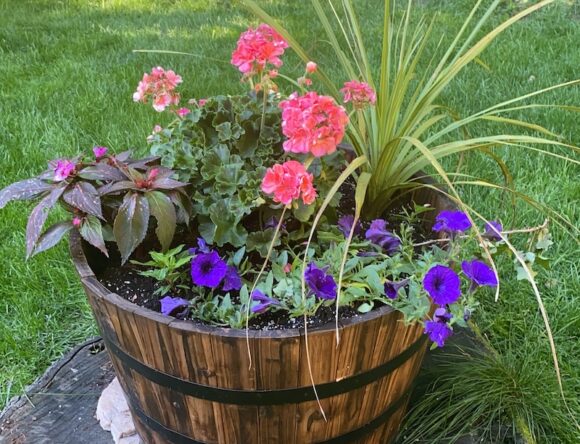
Pink geraniums in the center set off this planter beautifully.
GERANIUMS: The plants that you brought indoors at the end of last season, check them for new side shoots, then cut them back to four inches and repot them in clean pots about an inch and a half larger with fresh potting soil.
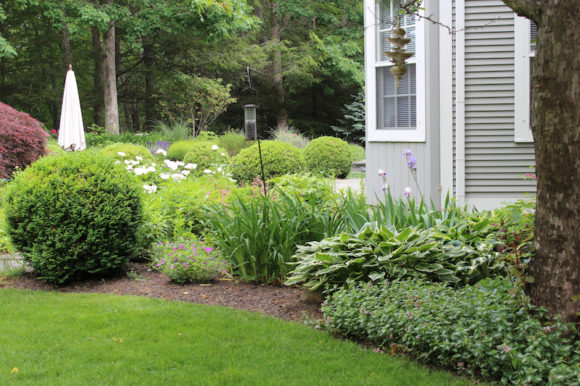
Well, fellow-gardeners, I know you are getting excited to be in your gardens this season and I hope that these tips have given you plenty to think about to keep you busy for a while. Enjoy photos of lovely gardens that my son Ian has designed and if you wish contact Ian for a consultation and enjoy the photos on his website LandscapesbyIan.com.
Enjoy being outdoors in spring sunshine and I look forward to seeing you in your garden in April.
About the author: Maureen Haseley-Jones is a member of a family of renowned horticultural artisans, whose landscaping heritage dates back to the 17th century. She is one of the founders, together with her son Ian, of, The English Lady Landscape and Home Company. Maureen and Ian are landscape designers and garden experts, who believe that everyone deserves to live in an eco-conscious environment and enjoy the pleasure that it brings. Maureen learned her design skills from both her mother and grandmother, and honed her horticultural and construction skills while working in the family nursery and landscape business in the U.K. Her formal horticultural training was undertaken at the Royal Botanic Gardens at Kew in Surrey.
Paper-white narcissi have a beautiful fragrance, which can make you “feel refreshed and ready for the February day.” Photo by Ashkan Forouzani on Unsplash
This winter, as in other winters; when I need a blossom boost, I enjoy the fragrance of paper white narcissus that I planted in tall glass vases. I surrounded the bulbs with seashells from White Sand Beach here in Old Lyme and kept them in a dark cool area keeping the shells and the bulbs moist as the roots developed.
Maureen Haseley-Jones is “The English Lady.”
When the bulb foliage reached about six inches, I moved the bulbs in their vases into indirect light, which encourages the blooms to open. Each morning on entering my lounge, I am met with the fragrance of these beautiful bulbs, which makes me feel refreshed and ready for my day.
I keep extra bulbs in a brown paper bag in the vegetable retainer in the refrigerator. I plant these bulbs when the first blooms have gone by and with this method, I have a succession of blooms and fragrance permeating my home into spring.
Before you know it, spring will be upon us together with the anticipation that resides in all of us gardeners, which is to get outdoors and plunge our hands into the soil.
That being said, there is so much to look forward to and I feel I must once again stress the importance for all of us to garden organically.
In this country and around the world, the results of pollution and chemicals are just some of the factors that are causing climate change. We are in a crisis, with invaders that have already battered down the gates and invaded our gardens. These invaders are destroying Mother Nature and your health in the form of poisonous pesticides and herbicides. The main producers of these poisons are Monsanto, Bayer and other biological monsters, who have been decimating our planet, our soil, human health and committing all those crimes purely for selfish profit.
Bees, for example, have been killed in the millions, because the EPA under the Trump administration allowed the spraying of over 14 million acres of land, with poisonous chemicals. Please note folks, that bees pollinate 70 percent of the world’s food and their demise is our demise.
Last year was recorded as the hottest year on record. Drought in the west of this country, resulted in dry tinder conditions, causing devastating fires that brought death and destruction to people in California, Oregon and Colorado. This extreme weather pattern continues here, bringing tornadoes and extreme flooding, followed by even stronger hurricanes due to the rise of our oceans, which is the result of warming water.
The effects of drought caused by climate change can be devastating. Photo by Markus Spiske on Unsplash.
Across the world, extreme weather patterns have also had a tragic effect on extreme drought in Africa causing famine and death to that region and terrible earthquakes as we have seen in Turkey, Northern Syria, Japan and China. I am glad that the government in this country has begun to seriously address the Climate Crisis, but much more needs to be done.
As gardeners, it is our task to help counteract these negative changes by using only organic methods of gardening on our own plots of land; what we do in our own gardens contributes to healing the planet. Over the span of 25 years on my radio show WRCH 100.5 FM and through my Garden Earth lectures, I have received a commitment from thousands of people to discard all poisonous herbicides and pesticides and to garden organically. The response had been tremendously positive in the production of organic gardens grown in healthy soil.
It begins with what you put into the soil for the growth of the plants, and this is accomplished by adding liberal doses of my favorite stuff – aged manure, which is manure that you may procure, either from the farm or in bags from the garden center.
The following, is a paragraph from a book I am writing on gardening and the vital importance of the humus component to our gardens:
In 1937, Franklin D Roosevelt said that ‘the nation that destroys its soil destroys itself’
America has not heeded that warning. Precious soils in this country and around the world are being destroyed by dangerous practices in industrialized agriculture and poisonous chemicals, which completely disrupts our ecosystem and poisons all living things.
In your own garden you can build and retain a rich growing environment by building the humus component—we are all carbon-based creatures as is all life on earth. Not only humans but also our soil microbes need carbon to flourish. And to attract carbon from the atmosphere into your soil, you need to build the humus component.
HOW TO BUILD THE HUMUS COMPONENT
Do not till soil—tilling breaks up soil structure.
First step – Add composted manure three times each season—beginning in spring when the soil has reached a temperature of 50 degrees. If the soil has not reached that temperature, the soil organisms are not able to work with the bacteria in the manure to produce nutrients for the roots of the plants. Purchase a soil thermometer to check the soil’s temperature. This year, following deep frosts, the soil temperature may reach 50 degrees by the end of April to early May. Add the manure again in July to continue to nourish your growing plants and again in October to protect and nourish the roots of your plants through the winter. Manure is not a fertilizer; it builds soil structure and works with all the soil animals to keep a healthy, disease-free growing environment.
Second step – Add wood chips in the form of brown, fine bark mulch or wood chips that you produce from your garden or aged wood chips with a combination of leaves, twigs and branches.
These two major steps build the humus component. If you do this in your garden, not only will you help to heal the planet but you will also produce the healthiest of gardens.
A question I am often asked is, ‘Can I put manure over mulch for example on my midsummer garden in July?’ The answer is a resounding ‘Yes’ – the manure together with nature’s moisture and your own irrigation enables the manure to find its way easily into the soil and the roots of your plants.
WHAT EXACTLY DOES HUMUS DO?
Humus acts like a sponge and can hold 90 percent of its weight in water.
Due to its negative charge, plant nutrients stick to humus for nitrogen, calcium, phosphorus and other elements,. This, in turn, prevents these nutrients from washing away and acts as nature’s slow-release fertilizer throughout the year.
Humus improves soil structure making it loose and friable, which helps plants root in the soil with better access to nutrients, water and oxygen.
Humus also helps to filter’ toxic chemicals from the soil, much like carbon-based water filtration systems that filter toxins from your water.
We cannot control industrialized agricultural practices, however, in your own garden you can make a difference. Feed the soil, and it will feed the plants.
This week I spoke with my friend Ann, who lives in Cheshire, in England, which is next door to my home county of Shropshire. Ann is an avid gardener and she told me that her daffodils are well above the soil and last week she started to plant seeds in the greenhouse. I was so envious, when Ann told me of her garden bloom, but our time will soon come.
PLANTING SEEDS
February 20 to March 20 is the time for serious indoor seed planting here. Check which garden centers are stocking organic seeds or go online for the organic varieties – one company that I use is “Botanical Interests”. Do not go overboard when buying packs of seeds as there are about 500 seeds in each packet. If you do purchase too many – have a seed sharing party with gardening friends.
Equipment to have on hand for seed planting are cheap envelopes (you probably have envelopes you discard from your mail), fresh sterilized potting soil mix, and sphagnum moss. Also seed trays, egg cartons and cardboard milk containers that are cut down also work well. Make sure all containers are scrupulously clean. Sphagnum moss works well as a planting medium as the moss can prevent a soil born fungus that causes “damping off” which causes seeds to rot before germination. I have, together with many gardening friends, used this method for years and have not lost seeds to “damping off”.
It is recommended to have a good supply of moss on hand for seed planting. Photo by Zach Reiner on Unsplash.
For tiny seeds, I use the moss as the planting mix and for larger seeds, I install a topsoil base and a layer of the moss on top of the soil. I mix fine seeds with sand before I sow; this method helps to loosen them up. Soak the seeds overnight before planting and just before planting spray them with warm water, never cold as cold water can delay germination. When they have germinated, water gently.
The best method of watering seedlings is to water from the bottom. But, if you feel you must top water, just mist with a fine sprayer, otherwise you will drown the delicate seeds, washing them out of the planting mix. Use new sterilized soil when seeding and do not use any leftover soil from last season, Leftover soil from the previous year can develop disease, which can ruin your seedling crops. If you are growing seedlings on a windowsill, place them on a south or west-facing sill; seedlings need light, not heat to thrive.
WINTER CARE OF HOUSEPLANTS
I love my houseplants year round but in winter the blooming ones in particular lift my spirits. I talk to my plants enjoying my cyclamen and my blooming cacti, and the different foliage on the ivy, philodendron and spaphyllum which also clean the air in a stuffy home environment.
Keep your houseplants away from draughts and direct heat. If you are able, place humidifiers and air purifiers in the rooms of your home, which will benefit not only the plants but also your own health. Place pebble trays under the plants and keep the pebbles moist for additional humidity.
Spray houseplants every few days with lukewarm water and once every couple of weeks, put the plants in a sink or bathtub and allow lukewarm water to run freely over the plant to remove dust from the leaves and clean salt residue from the soil. The exception to the spray or soak rule is African violets, as African violets do not do well with wet leaves.
Aphids and white fly thrive indoors in winter and an organic sulphur solution called Safer works well to clean the soil of insect eggs and from the foliage. Perhaps you are fortunate like me to have Ladybugs in your home in winter; if so, allow these useful creatures to roam freely; the ladybug menu is aphids and white flies.
The best time to repot houseplants is from April through June but if a plant has become root bound with no visible soil, then you can repot them in February. Water the plant to loosen the roots from the soil, turn it sideways on a newspaper and gently slide it from the pot.
Cut away any dead roots and repot in fresh potting soil in a clean pot that is only two inches larger than the original. With the plant firmly in place and the soil one inch from the rim, water it gently and do not fertilize with an organic fertilizer until April. Plants need this dormant period to recharge.
A few suggestions for trouble free foliage plants in the home are Rubber plants, Spider plants, Ivy, Philodendron, Monstera and Spaphyllum. If you have a sunny window Aloes, Succulents and Cacti do great and are a trouble- free variety.
Blooming plants sitting side by side with foliage plants, enjoying one another’s company, give one an impression of a miniature garden.
A few suggestions of houseplants that bloom are Cyclamen, African Violets, Kalanchoe, Primulas and Paper white narcissus. To prevent pets from chewing on the plants, add some cayenne pepper to the water when watering. I also enjoy my herbal plants, which sit in a sunny window. My favorites are Rosemary, Basil and Parsley which are great additions to any recipe.
POWER TOOLS
Check any power tools that require maintenance or repair. February or March is the time to get them into the repair shop, because as soon as the weather breaks the shops get busy and you may not get your lawn mower back until August.
Check all tools and implements in the garage or shed. If you did not clean them off at the end of last season, plunge the shovels and spades into a bucket of sand; sand is an abrasive and will clean off any leftover soil and manure residue. Oil the wooden handles of tools with Linseed oil or some inexpensive vegetable oil; oil feeds the wood and keeps the handles splinter free. At the same time, check your hoses and fittings that may have sprung leaks since last year.
Make a shopping list of new tools that are needed – there are lots of sales in late winter for you to get a good deal. However, I suggest that you buy only quality tools and hoses; as the saying goes, “you get what you pay for”. Also check that there is enough twine, bamboo rods, wire ties or nails and peat on hand.
BUYING MANURE
In March or early April, when soil and manure are available. purchase bags of composted manure from the garden center. On the other hand, if you have a farm close in your local area, that sells aged manure, acquire a small truck to acquire a load. If you decide on that method, ask the farmer for manure from the bottom of the pile – aged stuff. Manure needs to be at least six months old before applying to your soil, as fresh manure will burn your plants.
ALL THINGS PAINT-RELATED
Check the paintwork on your wooden fences, arbors, decks and any other outdoor wooden structures. Then, purchase paint supplies so that on a dry day in March for painting, everything will be on hand.
It is time to think about painting those fences. Photo by duong chung on Unsplash
Don’t forget to put paintbrushes on your list – I have a feeling you forgot to clean your old brushes last season, which means they are stiff as a poker, also remember sandpaper, brush cleaner and if possible, buy eco conscious paint. If you are painting benches and garden seats on a dry day, put them under cover before sundown.
White walls in the greenhouse reflect light so any areas that need retouching, use white paint. It’s so rewarding to see how much lighter and brighter the greenhouse is after a touch of paint and the glass is cleaned. However meticulously clean and tidy your greenhouse, you may find that white fly, greenfly and scale insects have found their way inside the greenhouse for warmth and so it may be necessary to spray with an organic spray. I mix an organic spray of orange peels in white vinegar and allow it to sit for two weeks before spraying – this works well and is very economical.
Walking around a garden that looks and feels good in mid-winter is a real pick-me-up. Patterns emerge created by paths, walls and hedges. As you walk, enjoy the shapes of shrubs, the shadows of evergreens and the strong silhouettes of tree trunks and enjoy their shape and bark without foliage.
BIRD-FEEDERS
I love to watch the birds in their quick flights across the garden to alight on the feeders, and their sudden bursts of song when the sun peaks through. It is so much fun to watch the “pecking” order and see the blue jays, who can be bullies and red cardinals, who—like the blue jays—can be rather territorial. Bringing up the rear, come the finches and house sparrows. And sometimes a bird appears that I do not recognize and out come my binoculars and Peterson bird book.
Keep your bird-feeders well-stocked to ensure you enjoy visits from as many feathered friends as possible. Photo by elvis bueno on Unsplash.
If you notice squirrels swarming the bird feeders, add some cayenne pepper to the birdseed; if that occurs do not be concerned as the heat from the cayenne does not affect birds. And you may choose a spot away from the feeders to sprinkle cayenne-free birdseed on the ground so the squirrels can also enjoy a meal.
Winter has its own distinctive fragrance, the fog, in the morning when the air is very heavy, thick and damp—a dampness even more bone-chilling than rain. I can deal with that for a while in the knowledge that in about six weeks I will be inhaling the healthy nose-clearing fragrance of the soil, rich and brown, well manured or covered with wood mulch, shredded leaves or salt hay.
Winter fragrances are a potpourri, one moment sharp and cold like the north wind, whereas spring’s flavors are light and sweet.
If you find you have spent year after year throwing good money after bad, then it may be time to get a professional design. If that is so, don’t hesitate! If you want work to begin in the spring, a design takes time to complete. You may want to contact a professional landscape designer like my son Ian, whose company website LandscapesbyIan.com shows his lovely, natural landscape creations. Ian will work with you and your budget.
Have a great month and I’ll see you in your garden in March.
About the author: Maureen Haseley-Jones is a member of a family of renowned horticultural artisans, whose landscaping heritage dates back to the 17th century. She is one of the founders, together with her son Ian, of, The English Lady Landscape and Home Company. Maureen and Ian are landscape designers and garden experts, who believe that everyone deserves to live in an eco-conscious environment and enjoy the pleasure that it brings. Maureen learned her design skills from both her mother and grandmother, and honed her horticultural and construction skills while working in the family nursery and landscape business in the U.K. Her formal horticultural training was undertaken at the Royal Botanic Gardens at Kew in Surrey.
Well, here we go, as you sit in your arm chair and dream about fragrant bloom and delicious vegetables in your garden. However, it is never too early to plan for this season in your garden. My motto has always been to plan, before action and production.
Mother Nature is waiting for us with her gifts of renewal, growth and nourishment as we begin to plan for the coming season. She tells us that in this wonderful pastime called ‘gardening,’ we can escape from the trials and tribulations of our world. Each day we move gradually from the dark into the light to a longer, brighter day to welcome spring.
A few weeks ago, I retrieved my second batch of Narcissi from the brown paper bag in the refrigerator and planted them on pebbles, with just enough pebbles to anchor the bulbs in place, or you may use potting soil. I use tall glass vases, and make sure to keep the pebbles moist with just enough water to cover the bottom of each bulb.
I brought my Rosemary plant indoors in September; Rosemary is not hardy outdoors in Zone 6. I spray the plant twice weekly with warm water and run a cold-water humidifier and two germ guardian air cleaners with UV lights for personal health and the health of my plants.
Photo by Jonathan Diemel on Unsplash.
After planting the paper white Narcissi, I placed them in a dark, cool closet until the foliage was about four inches tall. Today I moved them from the dark closet to a cool room, that has indirect light and where the temperature remains at about 65 degrees.
When the buds are almost ready to open, I will place them in a brighter area to be enjoyed, not only for their bloom but also the heady fragrance which permeates the house. The new bloom draws me out of the winter doldrums and their gentle fragrance lifts my spirits.
As you know the severe negative changes that are occurring with global warming, together with pollution in the air, water and the earth, are severely damaging our planet. Your personal contribution to saving our planet is to tend the soil organically with compost, manure and natural brown mulch, which builds the humus component in your soil. With this organic method, your plants and vegetables will thrive … as will you.
Throughout the year, allow your garden to anchor you, connecting heart, body, mind and spirit to Mother Nature’s life-giving bountiful gifts and spiritual energy.
The cold harsh winds of January and February extract moisture from trees and shrubs, especially the evergreens. These winds are more harmful to plants than cold temperatures, not only causing plant breakage but also soil erosion. To help counteract these effects, it’s useful to have a few bags of topsoil and mulch in the garage. With these items on hand, any roots can be covered after they become exposed by wind or frost heave. Roots exposed to the elements for any length of time can kill the plant, so when you notice exposed roots, quickly cover exposed areas with the soil and mulch. When spring arrives and the earth warms up, the plant can be resettled in place together with composted manure and natural brown mulch to provide protection and nutrition.
On a sunny day this January, take a walk round the garden and breathe in the freshening air—as you walk, make some notes and decide what worked for you last year and what you will never try again.
Later, back indoors, relaxing in your armchair, browse through the catalogues that began arriving a few months ago. You have already begun making lists of plants that you are thinking of buying. However, a word of caution when gazing at the photos, which are meant to tempt you with their lovely but “doctored” pictures of plants. Do not allow your imagination to run amok and be caught up in the fantasy of the high-maintenance garden pictures you see in the catalogues.
Instead, suit your garden to your lifestyle as to what will work within your own time-frame and physical abilities. If you follow that construct, you will have the time to sit, relax and smell the roses, and not being exhausted by too much garden toil and quite often disappointed in the final results.
As you sit and plan for the coming season, it’s important to keep your budget in mind. It’s hard to believe as you look outside at the muted landscape, that in a few months, sunshine and gentle breezes will warm the soil and new growth will appear.
When the soil is dry enough to tread on, winter debris can be carefully be cleared away. Then, cut a clean edge on the borders; this simple task makes such a difference to the look of a garden. Then in mid-April, add that lovely layer of manure and compost (the ratio being three parts manure to one part compost). With that preparation completed, you are ready for the fun stuff—the placing and planting!
For those of you, who are vegetable gardeners and look forward to a bountiful year with fruits and vegetables, spring rain, extra irrigation and sunshine will produce that delicious bounty.
As spring advances so will the appearance of both good and bad insects—moles, voles and other critters—that can be dealt with naturally. I will share my remedies for this problem in an upcoming gardening letter.
Your memory of your garden from last season may be lost in the enthusiasm of a new season, therefore, I am asking you to be kind to yourself. If last year you became overwhelmed with too much work labor and no time to relax and enjoy your garden; the following are some ideas, you can enact to rectify that problem:-
A prairie meadow-type border can still include color. Photo by Calin Oancea on Unsplash.
For example, send some of your borders back to grass, and if you are tired of grass-mowing, spread wildflower seeds in the grass and enjoy the pleasure of a prairie meadow.
Also, make some of the high-maintenance perennial borders into mixed shrub borders. To accomplish this, take out some of those perennials and donate them to a worthy cause. In their place, plant small and medium size evergreen shrubs; some green, blue and some of the lovely gold species of evergreens. With these shrubs, which display all-season beauty, add small flowering deciduous trees and shrubs that begin flowering in April and successively through June.
The Carlesii viburnum, also known as Korean Spice, is a favorite small shrub of mine, with its white buds that open to a pale pink with the most delightful fragrance.
Plant a Ben Franklin tree with its white cup like blooms and gold center that flowers in August through September.
Nestle three Blue Mist shrubs in the mixed border; this plant will delight with purple blooms and fragrant leaves into September.
On a fence or trellis, plant white autumn clematis.
Add a groundcover as an evergreen framework – my favorite is Myrtle with its glossy leaves and miniature blue flowers that bloom in April.
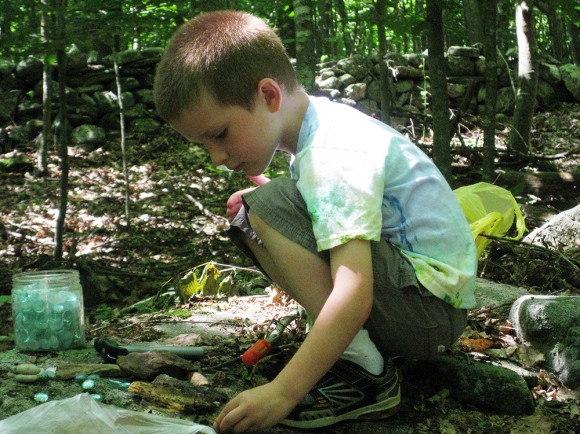
This youngster is looking for fairies in Hartmann Park. Photo by Lisa Niccolai.
For the children or grandchildren in your family, I believe it is never too soon to introduce your children and grandchildren to the wonders of the garden by bringing garden fairies into their lives. Through the years I have asked children to draw a picture of the garden fairy and make a list of questions to ask the fairies, who live in the wild patch in the garden. We all have a wild patch in the garden; and at this point you may be saying, “Maureen, my garden is one large ‘wild patch!’
Children became so excited and enthused about their lists and pictures of the fairies; as what you are showing them is nature’s transformation of science into magic. These days we seem to have forgotten about fairy tales, dreams and magic; it’s way past time to bring those wonderful energies back into our lives and into the lives of our children.
In spring and through summer, I would find my children or their friends impatiently checking the garden wanting to see their own planting efforts come into bloom. In the vegetable garden they gathered to check what was ready to eat from the produce they had planted. I have found that this introduction to the garden has inspired the children and when they become adults, they enthusiastically plant and tend gardens of their own.
My son Ian is a great example of this as he has partnered with me through the years in the garden and is living proof of the old adage, ‘The student is better than the teacher.’ Ian is a designer par excellence and I invite you to check his website at LandscapesbyIan.com and his Facebook page for lovely examples of his work.
In my March gardening tips, I’ll offer you some suggestions of ornamental trees, shrubs and long blooming perennials. With that list in hand, I suggest that you buy your plants from local garden centers as these centers carry tried and true plants that will flourish in Zone 6.
Mixed shrub borders are often a good solution for low-maintenance gardens.
On the other hand, if you feel that over the years, you have been throwing good money after bad and you are becoming desperate as you feel that your garden, no matter what you do, never looks right. Then, get in touch with a landscape company, who will keep your budget in mind whether you want to do your own work, or wish for a design to install yourself.
On the other hand, when you are planning your garden for this coming season, there are important facts to keep in mind:
What are the requirements for sun, shade, soil, and water of the plants?
Will they survive in this zone, Zone 6?
What are the growth patterns of the plants? Do they grow fast or slow?
You do not want a 50 ft.tree up against the house with tremendous roots that will play havoc with the foundation of your home. Or do you want that lovely but very large, Catawbiense Rhododendron, all 10 ft. of it, climbing through your dining room window in five years?
To find those facts, either check the plants in a book, on the Internet or read the labels attached to the plants in the nursery.
Check every aspect of the plant before you buy. The red or green Lace-Leaf Japanese Maple looks lovely in spring but is it something you can enjoy, without its leaves in the winter? Personally, I not only enjoy the foliage of plants and trees, but also the shape and bark of trees without foliage in winter.
For those of you just beginning to garden, I must be honest and dispense with the myth that gardening is always a relaxing hobby. At the end of that first day of digging, lugging soil, manure and fertilizer, and planting everything at the proper depth; you will feel somewhat exhausted.
At that juncture, you remember that you still need to water the newly-installed plants as you drag your tired body to switch on the hose. Thank goodness, the mulching can wait until tomorrow or next weekend.
Watering the garden can be truly meditative to some. Photo by Markus Spiske on Unsplash.
Watering can be meditative to some of us, myself included. Imagine that the hose is your umbilical cord so that as you nourish the earth and the plants, the earth can nourish you.
By now the sun has gone down, and you trudge indoors muttering to yourself, “What the heck did I get myself into?” To this comment I say, “You did not have to tackle all of the garden in one day”.
In gardening, there is always tomorrow, or next week, and even though the label says to plant it by the end of May or June, believe me folks, a few weeks later does not matter, the garden will wait for you.
You may be saying to yourself at this point, “Maureen, are you trying to put us off gardening”? No folks, but I would remiss, as someone who has gardening in my blood (as well as manure!) for over 400 years to tell you, however reluctantly, not only the pleasures, but some of what can cause aches and pains.
The idea is not to bite off more than you can chew. For first-time gardeners, don’t scatter your energies all over the garden, rather tackle and complete one area at a time. That area should be priority one until it is complete.
If you have a new home with no landscaping, some hardscape may be required. Hardscape is walls, walkways, patios, ponds, decks and so on. The sound and look of a water feature in the garden is delightful and need not be elaborate—a fountain is fine—the reflection of water is Mother Nature’s mirror. If you are not able to do this construction yourself, get in touch with a landscape contractor now, so that a plan can be done now, installed and ready by spring. I say to connect now as Ian tells me that many landscape products are short on supply this year.
These endeavors mean you getting yourself in shape physically, so get off that couch, put away the catalogues and your plant lists, stretch, then wrap yourself up in warm gear and take that walk.
As you walk, look at the trees in winter, the elegant shape of them, the lichen on the stonewalls, and the moss tucked in cracks and crevices. Clear your mind and allow nature’s spirit to surround you. As you walk, look at a few gardens in your neighborhood; gardens that you have admired when they were in bloom, and see what they look like in winter.
I remember one of my professors saying to me when I studied at the Royal Botanic Gardens at Kew, “In winter, you can tell a really good landscape by its bones, without the flesh of flora and foliage.” In spring, get in touch with those neighbors whose gardens you admired and ask them some of the secrets of their garden. They will be happy to talk with you, not only of their successes but their failures—true gardeners are realists when they speak about their gardens and love to share.
Well folks, I’ve given you plenty to think about right now so enjoy your daydreaming of the season to come and I’ll see you next month in your garden.
About the author: Maureen Haseley-Jones is a member of a family of renowned horticultural artisans, whose landscaping heritage dates back to the 17th century. She is one of the founders, together with her son Ian, of, The English Lady Landscape and Home Company. Maureen and Ian are landscape designers and garden experts, who believe that everyone deserves to live in an eco-conscious environment and enjoy the pleasure that it brings. Maureen learned her design skills from both her mother and grandmother, and honed her horticultural and construction skills while working in the family nursery and landscape business in the U.K. Her formal horticultural training was undertaken at the Royal Botanic Gardens at Kew in Surrey.
Hello everyone; so much to do and so little time in this holiday season …
Maureen Haseley-Jones is ‘The English Lady’
Remember, to breathe, stretch and take time out for yourself each day. On a pleasant December day, go out into the garden. There is still time to plant your spring bulb; the earth is still workable so enjoy the fresh air and the gentle exercise.
Plant the bulbs three times as deep as they measure in their upright position. For example, Daffodils should be planted nine inches down below the frost line, spread composted manure, which hopefully you stored in the shed or garage, on the soil where the bulbs are planted.
Don’t worry if you do not have the manure now, as when the bulbs peak up from the soil in spring, you can obtain the composted manure then and spread it around the emerging bulbs at that time.
Right now, it is a sunny afternoon, and I am sitting in my armchair with a delicious cup of Earl Grey tea, inhaling the air wafting from the kitchen, bringing with it the fragrance of cloves. Clove fragrance is an old family tradition that I follow each December, when I fill my great-grandmother’s brass saucepan with water, then add whole cloves, bring the water to the boil, then turn it down to simmer gently.
The fragrance is a special memory of Christmas in the kitchen of Gran’s thatched roof cottage on the grounds of our plant nursery in England.
On this side of ‘The Pond’, in early winter before snow falls or even on a sunny day with snow on the ground, there are construction projects that can be accomplished with patios, decks, ponds, and dry stonewalls to repair and build. By accomplishing these tasks in winter, you will be ready to plant in spring.
If you are not into heavy work, I suggest you call a landscape company that you trust to give you an estimate for your project. In fact, if you would like to get in touch with my son Ian, at LandscapesByIan.com for an estimate or a consult on stonework work or a design for the spring. Ian has been telling me that there is a scarcity of building supplies right now, which might hinder your projects for your garden, unless you act early, like right now.
‘The English Lady’ is sure that snow will soon be with us. This view looking up Maywood in Old Lyme was taken a few years ago by Beth Sullivan.
I am sure that snow will be with us before long, so I hope you have the snow shovel handy or perhaps you decide you need a new one? If so, buy a lightweight wood- handle and plastic shovel instead of heavy metal.
When the storm has passed and you are ready for clearing the paths and driveways, don’t load the shovel heavily, scoop lighter loads. You will get done faster and with less aches and pains, or chance of injury.
If you are not able to clear the snow yourself from driveways, walkways and steps; I’m sure there are some teenagers in your neighborhood who would be willing to help you out.
We need the moisture from the snow for the soil and plants and I hope that we also get a good amount of rain to carry us through to spring.
If you have not already done so, mulch around the trunks of roses, mounding at least six to nine inches up the stems. As I mentioned earlier, buy a few extra bags of mulch and topsoil, and store them in the garage or shed.
Tie down the long whip-like rose canes of climbers to supporting structures so they are not broken off by strong winds. If the shrub roses are planted in an exposed area, cover them with a rose cone or if they are larger, cover them lightly with burlap until April.
I just walked into my living room to check on my Amaryllis bulbs, which have striped blooms. Amaryllis can be enjoyed for a long time with little effort.
Amaryllis in bloom by ‘I Do Nothing But Love’ on Unsplash.
As the flower buds begin to open, remove the pollen bearing anthers with tweezers, before they begin to shed—this will add days to the flowering period and remember to water.
Once the bloom is finished, deadhead it, remove the bulb from the soil and let it dry off. Store in a cool dark basement or some other cool dry place at about 55 degrees for10 weeks without watering. When you want to start it again, pot up the bulb tightly in fresh potting soil and begin to water again.
By the way, Amaryllis is poisonous so do not let children or animals eat the flowers.
Outside my kitchen window I can see the holly bush with lovely red berries, some of which I cut to decorate the house. Holly is a good weather predictor; few berries mean a mild winter, whilst many berries denote a harsh one. My red and black friends, the ladybugs, have begun to come indoors, earning their keep by consuming white fly and aphids, which often gather on houseplants.
This week, in the house, I am planting up my first group of paper white narcissus to get a head start on bloom in about a month. I store two dozen bulbs in the vegetable keeper of the refrigerator, away from the food. I plant half of them now and store the rest in a paper bag in the refrigerator, which I will plant later. With this method I will have continuous bloom and fragrance through the winter months. By keeping the bulbs in the refrigerator, they stay dormant, until planted.
I plant my bulbs in pebbles, with just enough pebbles to anchor the bulbs and enough depth for the roots to grow. Cram a lot of bulbs in the pot so they are touching – the more bulbs, the more vibrant the display. Make sure the bulb pots do not have drainage holes; if they do, cover the holes with shards of broken pottery.
I place the planted bulbs in a dark cool room or cupboard, always keeping the pebbles moist. In a few weeks, when the shoots of the narcissus are about six inches tall, I take the vases into a cool room on the south side of the house and place them about six feet away from the window in indirect light where they remain, keeping the pebbles moist until the buds appear.
When the buds appear and the stems are about 12 inches tall, bring them into the area of the house to be enjoyed. Always place them about six- foot from a sunny window and away from draughts and heat. Keep the soil or pebbles moist throughout the life of the plants.
I know that the stems of paper whites get leggy and often topple over. My tall glass vases do not allow this to occur but if you don’t have tall containers, here is a suggestion to keep the plant upright.
An English gardening colleague of mine gave me his ‘gin tip’. He pours a dessertspoon of gin (not the expensive stuff) on the soil or pebbles around the plants every couple of weeks after he has watered them. This limits the height of the stems, so they do not collapse, and the gin does not affect the bloom.
Regarding alcohol, another tip my grandmother whispered is to add a few drops of brandy or port to invigorate potpourri that has gone stale. Personally, I pour a few drops of either lemon oil or lavender oil on the potpourri.
I know that many of you spread salt on walkways, and driveways to thaw ice. However, the salt ruins plants, when it seeps into borders. Use an alternative like unscented kitty litter or sand that works well. In spring, just hose off steps and paths; the sand and kitty litter are good additions to your soil.
There is still time to prune dead or diseased branches from established deciduous trees and shrubs; it is an easier task to do at this time of year, as you are able to see what needs to be done without foliage obstructing your view. If you would like to have a fall pruning, call a reputable arborist to give you a quote and a team will come and use their practiced eyes to give you a great result.
Last winter, squirrels, raccoons or whomever, got into the birdseed in the milk shed. I bought out the supermarket’s supply of cayenne pepper that week and sprinkled it on my birdseed to keep the marauders at bay. This trick will also keep those critters out of your garbage. I also sprinkle cayenne pepper in the bird seeders for the feeders and on the suet blocks – the heat of the pepper does not affect the birds – they do not feel the heat.
To keep moths and bugs away from cupboards and in clothes; collect some remaining herbs, which may be still available, perhaps sage and lavender. Tie them into bunches with string and slip over a hangar in your closet or in a drawer. This week, I put bunches of dried sage in my closets and drawers—insects do not like fragrance and so the sage or lavender keeps insects away.
A few bags of soil and mulch that you may have stored in the garage or shed will be useful after frost. Often the frost heaves plants above the soil and exposes the roots. The plants roots can be covered and protected with the soil and mulch, until they can be resettled again when spring arrives.
When a plant is knocked askew by wind, ice or snow, do not be in a hurry to straighten it since, quite often, the plant will bounce back on its own. However, uprooted trees or shrubs should be straightened immediately then staked, their roots covered with soil and mulched, then resettle the plant in the spring. When snow is heavy on the branches of the evergreens, gently brush the snow off with a broom — with ‘gently’ being the operative word.
When you receive or buy cut flowers during the holiday, of course you want them to last. To accomplish this, your vases need to be squeaky clean. If there is a build up of dirty residue that regular soap and water won’t budge, try adding a little coarse sand to dislodge the mucky residue, then use soap and rinse well. For a narrow or globe-shaped vase ,use a bottlebrush.
Poinsettias:
Photo by Jessica Johnston on Unsplash.
I receive many questions about how to keep Poinsettias alive. I have a friend who has kept the same poinsettia alive for eight years. After blooming, she places the plant in a cool room, watering when the top of the soil feels dry, then in late May puts it, still in its container in the garden. In September, she brings it into her porch and begins gently watering. A combination I enjoy is poinsettias in a container with ivy and forced spring bulbs.
I was always curious as to how Poinsettias got their name. Last year I heard an old story on that very subject.
‘In a tiny village in Mexico, the tradition on Christmas Eve was to put gifts before the Crèche at the Church. A poor young boy, who had nothing to offer, went outside and knelt in the snow praying for a gift to give the newborn king. Where he knelt, a beautiful plant with vivid scarlet leaves appeared beside him and the boy joyfully presented his gift to the Christ Child. Thus, Mexicans call the plant Flor de la Noche Buena (Flower of the Holy Night), many believe the plant resembles the Star of Bethlehem.
Dr Joel Roberts Poinsett, the first minister to Mexico, brought the plant to the United States in the 1830’s, and it is for him that the plant is now named’.
On a delicious note to end my tips this year – I present my recipe for English trifle – a scrumptious dessert at Christmas.
ENGLISH TRIFLE
This dessert is made of layers, made over a three-day period; it requires this length of time for each layer to set. I use a nine-inch-tall glass bowl, as the appearance of this dessert is as mouth-watering as the taste.
Ingredients: 2 pints of strawberries or raspberries (you can use frozen strawberries or raspberries, and omit the sugar) 2 tablespoons of sugar on fresh fruit 1-package ladyfingers or sponge cake or pound cake 1-cup Harvey’s Bristol Cream Sherry (omit the sherry if you do not want the alcohol) instead use water to make the Jell-O 1 small package strawberry or raspberry-flavored Jell-O 1 small package of vanilla custard mix or Birds English custard (see note) 1 -pint whipped cream
Combine washed and drained fresh strawberries/raspberries and sugar in a bowl and set aside at room temperature for about an hour.
In a 9-inch glass bowl, cover the bottom of the bowl with ladyfingers or sponge cake or pound cake, cut into 2-inch slices. Drain the strawberries and reserve the juice. Cover the cake with the fruit.
Add sherry to the reserved fruit juice to make one cup. Prepare Jell-O using the fruit juice-sherry mixture as the cold-water part of the Jell-O mix, and hot water for the other part. Pour the Jell-O over the fruit and cake layer, then refrigerate until it sets (usually about two hours or overnight).
When the Jell-O is set, prepare the custard and spread over the cake/fruit/Jell-O layer. Refrigerate until custard is set.
The day you serve the trifle spread a thick layer of unsweetened whipped cream over the top.
If you are serving more people, repeat the cake, fruit, and Jell-O layers and top with the whipped cream.
The nine-inch bowl serves 6 to 8.
Note: I use Birds English Custard mix, which can be found in specialty food stores and most supermarkets.
Have a wonderful Holiday and I’ll see you in your garden in January. Be safe, well and enjoy!
About the author: Maureen Haseley-Jones is a member of a family of renowned horticultural artisans, whose landscaping heritage dates back to the 17th century. She is one of the founders, together with her son Ian, of, The English Lady Landscape and Home Company. Maureen and Ian are landscape designers and garden experts, who believe that everyone deserves to live in an eco-conscious environment and enjoy the pleasure that it brings. Maureen learned her design skills from both her mother and grandmother, and honed her horticultural and construction skills while working in the family nursery and landscape business in the U.K. Her formal horticultural training was undertaken at the Royal Botanic Gardens at Kew in Surrey.