Letter to the Editor: An Open Letter to the USPS (Excluding Old Lyme P.O.) — Stop Messing With My Mail

To the Editor:

To Whom it Should Concern at the USPS

Please stop messing with my mail!

Let me remind you: Title 39 of the U.S. Code states that the Postal Service shall have as its basic function the obligation to provide postal services to bind the Nation together through the personal, educational, literary, and business correspondence of the people. It shall provide prompt, reliable, and efficient services to patrons in all areas and shall render postal services to all communities.

Unfortunately, your recent “transformative” initiative has had “unintended” consequences that impacted overall service levels.

Is it possible that these consequences, “unintended” or not; have resulted in an unacceptable degradation of the Postal Service, — which is also relied upon by many Americans for prescription refills, pension checks, and, we thought mail-in absentee ballots in November?

You have already warned many states that those transformative misadventures will likely make USPS compliance with state-mandated deadlines impossible to meet.

This may be another moment in history where “failure is not an option”. God help us if that is not also your goal.

Note that I am not suggesting that this is a local issue at USPO/Old Lyme.

Sincerely,

Thomas D. Gotowka,
Old Lyme.

A View from My Porch: Great Leaders and Great Speeches, Part 4: The Cold War Heats Up

Editor’s Note: This the third part of Thomas Gotowka’s series titled “Great Leaders and Great Speeches.’ The previous three parts can be found at these links:

A View from My Porch:  Great Leaders and Great Speeches, Part 1

A View from My Porch:  Great Leaders and Great Speeches, Part 2

A View from My Porch:  Great Leaders and Great Speeches, Part 3: The Cold War 

Part 3 concluded with President Kennedy’s humiliation with the disaster at the Bay of Pigs, which served to strengthen Castro’s government; and resulted in Cuba’s adoption of communism, and their development of close ties with the Soviet Union.

This essay is a review of two weeks in 1962 that brought the world dangerously close to nuclear war. In the next essay, I will explore the “Visuals” of that period: What were anxious Americans reading and watching during that tense era? I will then review the gradual “wind-down” of Cold War hostilities, and the collapse of the Soviet Union in a following essay.

My goal with these essays is that the reader gets a solid foundation in the fundamentals of the subject matter, which may even pique their curiosity enough to seek additional information.

The Cuban Missile Crisis Thriller:

Fidel Castro was so certain that the United States would make another attempt at military intervention after the Bay of Pigs that he looked to the Soviet Union for military assistance, which they eagerly provided.

Consequently, during routine surveillance flights over the island in September 1962, U.S. Intelligence found evidence of a general Soviet arms build-up on Cuba, including Soviet IL–28 bombers.

So, on Sept. 4, 1962, President Kennedy issued a public, televised warning against the introduction of offensive weapons on Cuba. Our Intelligence services had also discovered that, in July, Soviet Premier Nikita Khrushchev had reached an agreement with Castro to place Soviet nuclear missiles in Cuba to “deter” any future invasion attempt.

Despite the warning, photographs taken by a high-altitude U-2 spy plane over Cuba on Oct. 14 provided indisputable evidence that several missile sites were under construction and nearing completion. These sites could house Soviet medium-range missiles, capable of carrying nuclear warheads, and striking many major cities in the United States, including Washington, DC.

The President convened an emergency meeting of his senior military, political, and diplomatic advisers to discuss these developments and determine America’s response. He ruled out a “surgical” military strike early in the deliberations, concerned that it could miss some of the missile sites and would prompt Soviet retaliation, probably against a vulnerable West Berlin.

In lieu of the military strike, Kennedy and his advisers decided on a Naval quarantine and a “very strong” demand by the President that the bases be dismantled and missiles removed.

In an extraordinarily grave televised speech on Oct. 22, the President revealed the discovery of these missile bases to the American people.

“This Government, has maintained close surveillance of the Soviet military buildup on the island of Cuba. Within the past week, unmistakable evidence has established that a series of offensive missile sites is now in preparation on that ‘imprisoned’ island. The purpose of these bases can be none other than to provide a nuclear strike capability against the Western Hemisphere.”

Then, and evocative of the Monroe Doctrine, he continued with, “It shall be the policy of this nation to regard any nuclear missile launched from Cuba against any nation in the Western Hemisphere as an attack by the Soviet Union on the United States, requiring a full retaliatory response upon the Soviet Union.”

He announced that he was ordering a Naval “quarantine” of Cuba to prevent Soviet ships from transporting any additional offensive weapons to the island, and again affirmed that the United States will not tolerate these missile sites on Cuba. Kennedy said America will not stop short of military action to end this “clandestine, reckless, and provocative threat to world peace.”

Although he had no experience in “reality TV”, Kennedy was highly skilled in the use of that medium to communicate with Americans.  He had already demonstrated his presence and poise in the televised debates with then opposing presidential candidate, Richard Nixon.

The quarantine began on Oct. 23 and, after a few tense days, Soviet ships appeared to reduce speed or change course as they approached the quarantine “line.”

UN Secretary general U-Thant in 1963. Photo from Wikimedia Commons.

United Nations Secretary-General U Thant appealed privately to both Kennedy and Khrushchev at the request of more than 40 non-aligned nations and urged them to “refrain from any action that may aggravate the situation and bring with it the risk of war.”

In what turned into an amazing confrontation on Oct. 25, the usually soft-spoken and consummate diplomat, Adlai Stevenson addressed the United Nations Security Council on “Soviet Missiles in Cuba.”

In response, Soviet ambassador Zorin laced into the United States’ “lies” at great length, and refused to confirm or deny Stevenson’s allegations.

Stevenson responded, “I want to say to you, Mr. Zorin, that I do not have your talent for obfuscation, for distortion, for confusing language, and for doubletalk. And I must confess to you that I am glad that I do not!” Stevenson went on to denounce the Soviets for lying, and said he was prepared to wait for an answer on these missiles, “until hell freezes over, if that is your decision; and I am also prepared to present the evidence in this room.”

Zorin still refused to answer, and Stevenson’s aides placed large U-2 photographs of the Soviet missiles on easels around the room. The delegates in the room, and anyone watching the television coverage, were witness to the Soviets’ brazen provocation. The mild-mannered Stevenson had scored an enormous political and diplomatic victory for the United States. His dramatic and forceful exposure of Soviet duplicity ensured increased international pressure for them to back down.

During this crisis, our military forces went to DEFCON 2 & 3, the highest military alerts ever reached after WWII; and the military prepared for full-scale war with the Soviet Union.

On Oct. 26, the President learned that work on the missile bases was proceeding without interruption, and he considered authorizing bombing and an invasion of Cuba.

However, now under international pressure, the Soviets conveyed a proposal to the President to end the crisis: the missile bases would be removed in exchange for a pledge by the United States to not invade Cuba. They then increased their demands by calling for the dismantling of our missile bases in Turkey, which threatened the Soviet Union. Note that Kennedy and Kruschev communicated directly throughout the crisis.

While Kennedy and his team debated this turn of events, a U-2 spy plane was shot down over Cuba. To the dismay of his military advisers, Kennedy prohibited any military retaliation unless another surveillance plane was fired upon over Cuba.

To defuse the worsening crisis, Kennedy agreed to dismantle the missile bases, but at a later date; which he felt would prevent Turkey, a key NATO member, from protesting.

Finally, on Oct. 28, Khrushchev announced his government’s intent to dismantle and remove all offensive Soviet weapons from Cuba. and the United States stepped back from the brink of nuclear war.

Kennedy called off the quarantine in November, and by year’s end, removed our missiles from Turkey. The removal of what were obsolete Jupiter missiles had no detrimental effect on U.S. nuclear strategy.

The crisis was over, but the danger of nuclear war in the future had not abated.

Unfortunately, after shutting down their missile bases on Cuba, a humiliated Soviet Union began a massive nuclear buildup and eventually reached nuclear parity with the United States in the 1970s. They also built intercontinental ballistic missiles capable of striking any city in the United States.

I believe the following statement from President Kennedy illustrates his guiding principles in resolving this crisis: “Neither the United States of America nor the world community of nations can tolerate deliberate deception and offensive threats on the part of any nation. We no longer live in a world where only the actual firing of weapons represents a sufficient challenge to a nation’s security to constitute maximum peril.”

Kennedy continued, “Nuclear weapons are so destructive and ballistic missiles are so swift, that any substantially increased possibility of their use or any sudden change in their deployment may well be regarded as a definite threat to peace.”

Some Final Thoughts:

As I refreshed my memory of the Cold War era, I couldn’t help but consider Edmund Burke’s warning, which seems very relevant in light of the evidence of foreign interference in the 2016 election, and recent allegations of bounties in Afghanistan. Burke said “Those who don’t know history are doomed to repeat it.”

Kennedy’s interactions with his advisers had changed after the Bay of Pigs. He began to challenge their suggestions and insights to a much greater degree, and he demanded more options and better estimates of possible outcomes. Certainly, in this current COVID-19 crisis, we should better recognize what Adlai Stevenson characterized as “obfuscation, distortion, confusing language, and doubletalk” in our leaders.

Kennedy had been in office less than two years at the beginning of this crisis. However, he clearly demonstrated how great leaders must act in times of overwhelming crisis — accept responsibility, challenge your trusted advisers, communicate, and value your “intelligence gatherers”, but verify.

Kennedy’s strategic use of “quarantine” distinguished his action from a “blockade”, which assumes a state of war; and also enabled the United States to receive the support of the Organization of American States.

A succession of United States’ Administrations honored Kennedy’s pledge to not invade Cuba, but relations with them remained a “thorny” issue for our foreign policy until 2015, when formal “normalization” of relations occurred.

Unfortunately, the current Administration has not seen fit to honor prior agreements and alliances.

If you have any interest in the “art and science” of decision- making, I recommend The Essence of Decision: Explaining the Cuban Missile Crisis, by Graham T. Allison, who used the crisis as a case study for future analyses of governmental decision-making. The book became the founding study of Harvard’s John F. Kennedy School of Government.

God save the United States.

This is the opinion of Thomas D. Gotowka.

Tom Gotowka

About the author: Tom Gotowka’s entire adult career has been in healthcare. He’ will sit on the Navy side at the Army/Navy football game. He always sit on the crimson side at any Harvard/Yale contest. He enjoys reading historic speeches and considers himself a scholar of the period from FDR through JFK.

A child of AM Radio, he probably knows the lyrics of every rock and roll or folk song published since 1960. He hopes these experiences give readers a sense of what he believes “qualify” him to write this column.

A View from My Porch:  Great Leaders and Great Speeches, Part 3: The Cold War 

Editor’s Note: This the third part of Thomas Gotowka’s series titled “Great Leaders and Great Speeches.’ The previous two parts can be found at these links:

A View from My Porch:  Great Leaders and Great Speeches, Part 1

A View from My Porch:  Great Leaders and Great Speeches, Part 2

Part 2 concluded with President Truman’s decision to use the atom bomb to bring the war with Japan to an end; which was “an awful responsibility that has come to us.” This essay continues with several events and associated speeches that illustrate the development and expansion of the Cold War between the United States and the Soviet Union.

Although discussed chronologically, they are not contiguous; and there may be several years between or amongst them.

This essay spans the period from Churchill’s “Iron Curtain” speech in 1946, through American “boots in the sands” of Cuba in 1961. As always, quotation marks delineate a passage taken directly from the text or transcript of a speech; and the essay includes my own, (and others’) analyses of the content. 

This is not intended to be an historical “play-by-play”, but a consideration of the “look and feel” of the United States through a review of some of the key events of that tense Cold War period. 

Some Jargon:

The Cold War was an ongoing and largely, but not always, political and rhetorical period of tension between the United States and the Soviet Union, and their respective allies. The Cold War began after the surrender of Nazi Germany; and continued as the uneasy wartime alliance between the United States and its allies, with the Soviet Union rapidly deteriorated.

The “Cold War” phrase first appeared in a 1945 essay in the London Tribune by George Orwell: “You and the Atomic Bomb,” wherein he expressed his grave concern about life in a troubled world with weapons capable of immense, and almost instantaneous, destruction. 

The “Iron Curtain”:

Sir Winston Churchill. Photo by Yousuf Karsh. Public domain.

On March 5, 1946, Winston Churchill gave a speech in Fulton, Missouri that is considered by many as the West’s earliest volley fired in Cold War hostilities. The now former Prime Minister was in Fulton to receive an honorary degree from tiny liberal arts Westminster College. 

He began with some flattery directed at President Truman, who shared the dais. “The United States stands at the pinnacle of world power. It is a solemn moment for the American democracy; for with this primacy in power is also joined an awe-inspiring accountability to the future”.

He continued: “It is my duty to place before you certain facts about the present position in Europe; from Stettin in the Baltic, to Trieste in the Adriatic; an iron curtain has descended across the Continent; and behind that line lie all the capitals of the ancient states of Central and Eastern Europe”.  All these famous cities. and the populations around them, lie in what I must call the Soviet sphere; and are subject to Soviet influence and a very high measure of control from Moscow”.

His use of the term ”iron curtain” had profound symbolic meaning; and was also used, from then on, in the West, to refer to the Soviet Union and its allies; expressing, as was Churchill’s intent, that those  living in Soviet-controlled Eastern Europe were oppressed, and denied basic human liberties.

Ironically, Nazi Minister of Propaganda Joseph Goebbels, in one of his many “manifestos”, expressed similar concern in the German newspaper, Das Reich, (The Empire) in February 1945. about an iron curtain falling if Germany lost the war. The term only really became in common use after Churchill’s speech.

The Hydrogen Bomb Soap Opera:

On Jan. 30, 1950, President Truman announced the development of a “hydrogen bomb”, which would get a significant portion of its explosive energy from fusion, or the joining of atoms, rather than fission, the splitting of atoms. “I have directed the Atomic Energy Commission to continue its work on all forms of atomic weapons, including the so-called hydrogen superbomb.” He continued, “Like all other work in the field of atomic weapons, it is being, and will be carried forward, on a basis consistent with the overall objectives of our program for peace and security.” 

The Trinity test of the Manhattan Project led by J. Robert Oppenheimer was the first detonation of a nuclear weapon. Photo by the United States Department of Energy / Public domain.

Opponents of development of the hydrogen bomb included J. Robert Oppenheimer, leader of the Manhattan Project to develop the atom bomb. He and others argued that little would be accomplished except the acceleration of the arms race.

The United States accelerated its program to develop the thermonuclear bomb after the Soviet Union detonated an atomic bomb in Kazakhstan in September, 1949, and immediately eliminated the monopoly held by the United States on nuclear weapons 

Then, and just weeks later, United States and British intelligence discovered that Klaus Fuchs, a German-born top-ranking scientist in the U.S. nuclear program, had spied for the Soviet Union, which meant that the Soviets knew everything that the Americans did about how to build a hydrogen bomb. 

About two years later, the United States detonated the world’s first thermonuclear weapon, the 10.4-megaton “hydrogen bomb”, at Eniwetok Atoll in the South Pacific, vaporizing the island and leaving a crater more than a mile wide. The blast measured about 1,000 times stronger than the two atom bombs dropped on Japan ending World War II. 

The detonation only gave the United States a brief advantage in the nuclear arms race with the Soviet Union because, on Nov. 22, 1955, the Soviets detonated their first hydrogen bomb. The nuclear arms race, which became central to the Cold War, had taken a dreadful step forward.

Both America and Russia built up their stockpiles of nuclear weapons. By the late 1970s, seven nations had constructed hydrogen bombs.

“We Will Bury You”:

Soviet First Secretary Nikita Khrushchev was ‘Time’ magazine’s 1957 Man of the Year. Photo by Time Inc., illustration by Boris Artzybasheff.  Time magazine archive, Public Domain.

While addressing the ambassadors from ‘Western Bloc’ nations (i.e., a coalition of countries aligned with the United States) at the Polish Embassy in Moscow on Nov. 18, 1956, Soviet First Secretary Nikita Khrushchev declared, “It doesn’t depend on whether or not we exist. If you don’t like us, don’t accept our invitations, and don’t invite us to come to see you. Whether you like it or not, history is on our side. We will bury you.”

The speech prompted the envoys in attendance from 12 NATO nations and Israel to leave the room. 

“We will bury you” was interpreted as a threat by the Western press. Khrushchev attempted to “walk back” his threat in succeeding years.

While speaking to the National Press Club in Washington on Sept. 16, 1959, Khrushchev stated that “the words, ‘We will bury you,’ should not be taken literally; as is done by ordinary gravediggers who carry a spade and dig graves and bury the dead. What I had in mind was the outlook for the development of human society. Socialism will inevitably succeed capitalism.”

The “Military-industrial Complex”:

In a televised farewell to the American people on Tuesday evening, Jan. 17, 1961, President Eisenhower expressed his concern about the “acquisition of unwarranted influence by what he called “the military industrial complex” This address occurred just days before John F. Kennedy’s inauguration, where he challenged Americans to, “Ask not what your country can do for you; ask what you can do for your country.”  

Eisenhower’s remarks were especially noteworthy because he had served as Supreme Commander of the Allied Forces during WWII. 

He urged his successors to balance a strong national defense with diplomacy in dealing with the Soviet Union. He was concerned about the emergence of a massive and permanent armaments industry; and warned that “the federal government’s collaboration with an alliance of military and industrial leaders, though necessary, is vulnerable to abuse of power”.

Eisenhower believed that the military-industrial complex tended to promote policies that might not be in the country’s best interest; and he specifically cited participation in the ongoing nuclear arms race.

The Bay of Pigs Debacle:

On Jan. 1, 1959, Fidel Castro drove his guerilla army into Havana and toppled the government of General Fulgencio Batista, a corrupt and despotic dictator, but an ally of American business interests. 

Castro proceeded to reduce American influence on the island and nationalized the American-dominated sugar and mining industries. (At that time, American corporations and wealthy individuals owned more than half of Cuba’s sugar plantations.) He also encouraged other Latin American governments to act in a similar manner. 

He established diplomatic relations with the Soviet Union; and the United States, Cuba’s primary sugar importer, responded by prohibiting further import of Cuban sugar. However, the Soviets then agreed to buy the sugar and prevent the collapse of the Cuban economy.

This new order on the island (i.e., “Cuba Sí, Yanquis No”) made American officials very concerned about a potential threat less than 100 miles from our mainland; and the State Department and the CIA began to develop plans to remove Castro. 

Consequently, President Eisenhower authorized the CIA, early in 1960, to train and equip a guerilla army of Cuban exiles that could serve as an invasion force that would overthrow the Castro regime. 

Chief Justice Earl Warren administers the Presidential oath of office to John F. Kennedy at the Capitol, January 20, 1961. Public domain. https://www.archives.gov.

President Kennedy, who was inaugurated on Jan. 20, 1961, inherited Eisenhower’s CIA campaign against Cuba. The new President is said to have had some initial doubts about the wisdom of the plan, and was uncertain whether Castro posed any real threat to the United States. He feared any “direct and overt intervention by the American military in Cuba”, which the Soviets would likely see as an act of war and be forced to retaliate. 

So, he gave his support to the plan, but only if it appeared that the invasion was purely an internal matter of Cuba, and not linked to the United States. The CIA assured him that our involvement in the invasion would be “masked” and remain secret. The action would appear to have been initiated by Cuban dissidents and exiles; and would spark an anti-Castro uprising on the island. They promised him that the invasion would be both “clandestine and successful”.

By April, Kennedy was determined to make an example of Cuba to prevent the spread of communism in the West, and the resultant extension of Soviet influence. He firmly believed that the Cuban leader’s removal would demonstrate to Russia, China, and doubtful Americans that he was serious about winning the Cold War. 

The Administration soon severed diplomatic relations with Cuba and accelerated invasion preparations. However, he raised his concern that the plan might be “too large to be clandestine. and too small to be successful”. The plan was intricate and complicated, and required that every phase work perfectly.

Nonetheless, on April 17, 1961, the CIA launched what they expected to be the definitive strike by “Brigade 2506”, the name given to the force of 1,400 American-trained Cuban exiles. 

Unfortunately, the preliminary stages of the invasion were fraught with failure, and it was too late to apply the brakes. The Brigade was gravely outnumbered by Castro’s troops, who had them pinned on the beach. They surrendered after less than 24 hours of fighting. 114 were killed.  and over 1,000 were taken prisoner.

This was a humiliating defeat for President Kennedy. The incident undermined his new Administration and set the stage for a difficult summit just two months later with Soviet Premier Nikita Khrushchev. The failed invasion also strengthened the position of Castro’s government, which began to openly proclaim its intention to adopt socialism and pursue closer ties with the Soviet Union. 

Note that Kennedy put the blame squarely on the CIA and himself for going along with the ill-conceived plan. On April 20th, he addressed a high-level media gathering: 

“The President of our great democracy, and the editors of such great newspapers, owe a common obligation to the people: an obligation to present the facts, to present them with candor, and to present them in perspective. It is with that obligation in mind that I have decided to discuss the recent events in Cuba. “It is clear that the forces of communism are not to be underestimated, in Cuba or anywhere else in the world. It is clear that this nation, in concert with all the free nations of this hemisphere, must take an even closer and more realistic look at the menace of external Communist intervention and domination in Cuba. We face a relentless struggle in every corner of the globe that goes far beyond the clash of armies or even nuclear armaments.” 

He then went on to detail the Bay of Pigs disaster and the developing threat of Cuba’s alignment with the Soviet Union.

Of some historic note, E. Howard Hunt, the CIA operative behind the development of Brigade 2506, resurfaced later at the center of Watergate, as one of the leading members of Nixon’s Special Investigative Unit, also known as the “plumbers”; who were hired to dig up dirt on Nixon’s opponents or enemies.  Hunt, G. Gordon Liddy, and a few other “plumbers” also plotted the Watergate burglaries and other clandestine operations.

Some Final Thoughts:

Many western observers were concerned with Churchill’s use of the “Iron Curtain” descriptor, as they still viewed Russia as a wartime ally; but the term became synonymous with the Cold War divisions in Europe, just as the Berlin Wall later became the physical symbol of that division. One wonders how Winston Churchill and the President of the United States chose to share the dais at tiny Westminster College to deliver a major policy speech. 

Tension between the United States and the Soviet Union increased steadily after the failed Bay of Pigs invasion. 

The next essay further considers Cold War activities in Cuba, the important “visuals of the Cold War. And the gradual “wind-down” of hostilities, and the collapse of the Soviet Union. God save the United States.”

Tom Gotowka

About the author: Tom Gotowka’s entire adult career has been in healthcare. He’ will sit on the Navy side at the Army/Navy football game. He always sit on the crimson side at any Harvard/Yale contest. He enjoys reading historic speeches and considers himself a scholar of the period from FDR through JFK.

A child of AM Radio, he probably knows the lyrics of every rock and roll or folk song published since 1960. He hopes these experiences give readers a sense of what he believes “qualify” him to write this column.

A View from My Porch:  Great Leaders and Great Speeches, Part 1: Washington’s Farewell through Theodore Roosevelt

Part 1: Washington’s Farewell through Theodore Roosevelt

I enjoy reading historic speeches. I often find them to be inspiring; and they can fill gaps in my understanding of an important event or period in history.

In this essay, I begin my review of these speeches, and provide some context for the events that precipitated their creation.

These essays will not be an exhaustive survey of the speaking arts. My selections are based solely on my judgment that the speech is notable, or makes an important contribution to history. A passage taken directly from the text or transcript of the speech is delineated by quotation marks. Otherwise, the essay includes my own, (and others’) analyses of the content.

These speeches are arranged chronologically, but they are not contiguous. They highlight leadership during periods of conflict and crisis. 

There has been considerable argument in Congress in the past few years regarding “what the founders and framers really meant” when they drafted the principles passed on to us in the Constitution, So, I’ll begin with a review of the first president’s farewell to the nation.

1. George Washington’s Farewell Address:

Portrait of George Washington, circa 1850. Public domain.

Washington wrote his “Address” near the end of his second term as president, working closely with Alexander Hamilton in the final draft. He also had input from James Madison; so, it represents the collective wisdom of some key players in the split from Great Britain and the founding of the United States. His “Address” was never presented as a speech, but was a public letter to the American people; and published in a Philadelphia newspaper, the American Daily Advertiser, on Sept. 19, 1796; and then, in newspapers throughout the country. His letter included three principles:

First, the importance of unity; “You have, in a common cause, fought and triumphed together. Your Union ought to be considered as a main prop of your liberty, and that the love of the one ought to endear you to the preservation of the other”.

Second, he cautioned that “the worst enemy of government is loyalty to party over Nation”. Dominating regional loyalties could lead to factionalism and the development of competing political parties. He warned that, “if Americans voted according to party loyalty rather than the common interest of the nation, it could foster a spirit of revenge”, and “enable the rise of cunning, ambitious, and unprincipled men who would usurp for themselves the reins of government”.

 Third, he warned of the “danger of foreign entanglements” He believed that partisanship would open the door to “foreign influence and corruption.” He advocated that the United States be on good terms with all nations, especially in commercial relationships. “Inveterate antipathies against particular nations, and passionate attachments for others, should be excluded.”  He believed that a foreign policy based on neutrality was the safest way to maintain national unity and stability.

2. Emerging American Foreign Policy – The Monroe Doctrine:

Portrait of James Monroe, 1819. The White House Historical Association. Public domain.

It became evident in the first quarter of the nineteenth century that European powers were trying to reassert their influence in the Americas. Russia had tried to expand eastward into Alaska, and Spain was establishing new colonies in Central and South America.

Consequently, Secretary of State John Quincy Adams, on behalf of President James Monroe, began to articulate America’s foreign policy direction. In an address to the House of Representatives on July 4, 1821, Adams asserted that the United States is “the defender of freedom against the corruption of Europe, and should not let itself fall under the influence of any of those ‘old’ countries.”

“America, with the same voice which spoke herself into existence as a nation, proclaimed to mankind the inextinguishable rights of human nature, and the only lawful foundations of government.” “She has, invariably, though often fruitlessly, held forth to them the hand of honest friendship, and generous reciprocity.”

Two years hence, President Monroe proclaimed, in a Dec. 2,1823 Address to Congress, a new foreign policy initiative, largely drafted by Adams; that will always be known as the “Monroe Doctrine.”

This new policy forbade European interference in the American hemisphere, and also declared America’s neutrality in future European conflicts. It stated that “further efforts by any European nation to take control of any independent state in North or South America would be viewed as “the manifestation of an unfriendly disposition toward the United States”.

3. Abraham Lincoln’s Second Inaugural Address:

Abraham Lincoln, the US’s 16th president. Public domain.

Lincoln delivered his second inaugural address on March 4, 1865. The capital city was a mess at that time, with mud-soaked streets and over-flowing hospitals treating Civil War wounded. The event occurred at a time when victory over the Confederacy was imminent, and slavery in all of the United States was proclaimed “ended”.

Sherman completed his march through the south, and Grant was confronting Lee at Petersburg. There was concern that, because of the teeming rain, Lincoln would not be able to take the oath on the steps of the Capitol. However, the sun appeared as he rose to begin his speech.

In an account of the event in the New York Times, Walt Whitman “noticed that a curious little white cloud, the only one in that part of the sky; had appeared like a hovering bird, right over him.”

Lincoln did not speak of victory, but of sadness. He sought to avoid harsh treatment of the defeated rebels by reminding the thousands in attendance of how wrong both sides had been in imagining what lay before them when the war began. “Both parties deprecated war, but one of them would make war rather than let the nation survive, and the other would accept war, rather than let it perish.” 

Lincoln spoke of the unmistakable evil of slavery. “To strengthen, perpetuate, and extend this interest was the object for which the insurgents would rend the Union, even by war. Neither party expected the magnitude or the duration that the war has already attained. Neither anticipated that the cause of the conflict might cease with, or even before, the conflict itself should cease” … (i.e., The Emancipation Proclamation).

He continued: “Fondly do we hope, fervently do we pray, that this mighty scourge of war may pass away. Yet, if God wills that it continues until every drop of blood drawn with the lash shall be paid by another drawn with the sword; and as was said three thousand years ago, so still it must be said; “the judgments of the Lord are true and righteous altogether.”… (Psalm 19:9)

Lincoln ended his inaugural address : “With malice toward none, with charity for all, with firmness in the right as God gives us to see the right, let us strive on to finish the work we are in, to bind up the  nation’s wounds, to care for him who shall have borne the battle and for his widow and his orphan, to do all which may achieve and cherish a just and lasting peace among ourselves and with all nations.” 

Abolitionist Frederick Douglass noted that the many African Americans in attendance, which included troops who marched in the inaugural parade, applauded vigorously, but were, “wonderfully quiet, earnest, and solemn during the speech.”

4. Booker T. Washington’s Atlanta Compromise Speech:

Booker T Washington. Public domain.

B.T. Washington was born a slave in Virginia in 1856. After Lincoln’s Emancipation Proclamation, he moved with his family to West Virginia, which had joined the Union during the Civil War as a free state.

As a young freeman, he worked his way as a janitor through Hampton Normal and Agricultural Institute (now Hampton University), and attended college at Wayland Seminary (which is now Virginia Union University). In 1881, he co-founded and became the first president and principal developer of what is now Tuskegee University.

He was advisor to several presidents, and the most influential spokesman for black Americans from the latter part of the nineteenth century through the first quarter of the twentieth century.

On Sept. 18, 1895, he gave a speech that would open the “Cotton States and International Exposition” in Atlanta. The “Atlanta Compromise” speech was the first address by an African American to a racially-mixed audience in the South. He asserted that vocational education, which gave black Americans an opportunity for economic security, was more valuable to them than social advantages, higher education, or political office.

In return for African Americans remaining peaceful and socially separate from whites, the white community needed to accept responsibility for improving the social and economic conditions of all Americans, regardless of color. He summarized his concept of race relations in this manner: “In all things that are purely social, we can be as separate as the fingers, yet one as the hand in all things essential to mutual progress.”

Many black leaders opposed Washington’s “accommodationist” form of politics. Some historians cite the “Atlanta Compromise” as being responsible for the founding of both the NAACP and the “Niagara Movement” civil rights organizations.

5. American Imperialism — Theodore Roosevelt’s Corollary to the Monroe Doctrine:

Theodore Roosevelt around 1904. Public domain.

European intervention in the Americas resurfaced as a foreign policy issue at the turn of the 20th century. Three European nations had blockaded Venezuela’s ports in an attempt to force Venezuela to pay its international debts, violating the Monroe Doctrine’s declaration that Europe should not interfere in the Americas.

Further, Roosevelt had recently gained, through hostile action, the right to build the Panama Canal; and he believed that any threat to the canal threatened our strategic and economic interests.

Accordingly, to maintain security and ensure financial solvency in the region, the President announced, in his State of the Union address in December, 1904, that, “Chronic wrongdoing, or an impotence which results in a general loosening of ties of civilized society, may in America, as elsewhere, ultimately require intervention by some civilized nation. In the Western Hemisphere, our adherence to the Monroe Doctrine may force the United States, however reluctantly, in flagrant cases of wrongdoing, to the exercise of international police power.”

Thus, the United States will intervene in conflicts between Europe and Latin America, rather than having the Europeans press their claims directly. 

As a result, Marines were sent into Santo Domingo in 1904, Nicaragua in 1911, and Haiti in 1915; and, several more times in the Caribbean and Central America over the next quarter century. America’s relations with our southern neighbors remained strained for many years; and. in 1934, Franklin D. Roosevelt renounced interventionism and established his “Good Neighbor Policy” within the Western Hemisphere. 

Some Final Thoughts

I am impressed with the eloquence of America’s early leaders. I have included only small portions of the actual transcripts of the historic speeches in the above; but, if I have piqued your interest at all to read the entire texts, they are readily available and require only modest search or library skills. 

Note that George Washington was not restricted to two terms. However, in somewhat failing health, he feared that, if he died in office, it would establish a precedent that the presidency was a lifetime appointment. Instead, he stepped aside to make way for a successor, and demonstrated his commitment to democracy, rather than power.

There is a tradition in the Senate, wherein George Washington’s birthday is celebrated by a reading of his Farewell Address on the floor of the Senate Chamber; with readers coming from alternating parties. Although his warnings are still relevant, attendance at these readings has, unfortunately, shrunk. 

Also note that historians cite Lincoln’s second inaugural address as one of the greatest speeches ever made by an American president. 

Finally, Part 2 of this essay begins with Nazi aggression in Europe, and continues through Hiroshima.

Tom Gotowka

About the author: Tom Gotowka’s entire adult career has been in healthcare. He’ will sit on the Navy side at the Army/Navy football game. He always sit on the crimson side at any Harvard/Yale contest. He enjoys reading historic speeches and considers himself a scholar of the period from FDR through JFK.

A child of AM Radio, he probably knows the lyrics of every rock and roll or folk song published since 1960. He hopes these experiences give readers a sense of what he believes “qualify” him to write this column.


A View from My Porch: The Rising Waters of Long Island Sound — A Primer on Global Warming and Climate Change, Postscript Now Added

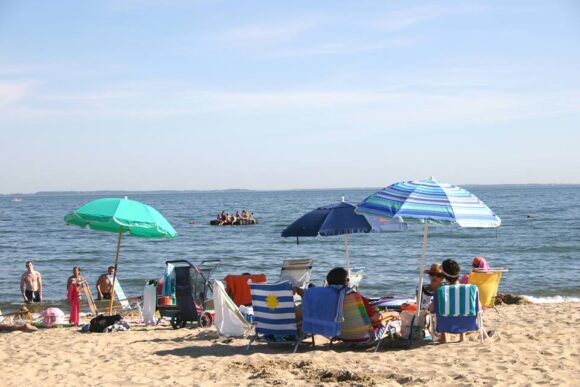
A peaceful summer scene at White Sand Beach in Old Lyme, but what does the future hold for Long Island Sound?

POSTSCRIPT ADDED 04/14: Our home is on a salt marsh alongside a small, tidal river. Over the past several years, we have observed gradual changes in the breadth and height of high tide. Eventually, the borders of our yard directly adjacent to the river were covered with brackish water at high tide to about 25 ft. beyond the riverbank. This occurs regardless of moon phase or the presence of a storm surge.

So, I investigated the scientific literature to seek out the wisdom of the experts in an effort to explain our localized tidal surge. I reviewed reports from respected scientific sources and data from state and federal agencies. The data are troubling. This essay summarizes the conclusions of those scientific and government sources.

I considered postponing this essay pending greater progress on resolution of the COVID-19 crisis, but a recent Mike Lukovich editorial comic in The New London Day showed the “grim reaper” at the front door, complete with hooded black robe and scythe, wearing a sign that says “Climate Change”. The caption reads “Whew, I thought you were coronavirus!”

Life will continue after we finally beat this disease, and return to some sense of normalcy; and we’ll still have those old and ongoing problems like global warming and sea level rise that require our collective attention.

Some Sobering Facts:

The National Oceanic and Atmospheric Administration (NOAA) reports that Long Island Sound’s levels have been rising for decades, and its waters are warming; as is Connecticut’s air temperature. Sea level has risen at a rate of 10 to 11 inches per century along the Connecticut coast, which is faster than the global rate. Longer-range projections are that global sea levels will rise one to four feet by 2100. James O’Donnell, executive director of the Connecticut Institute for Resilience & Climate Adaptation (CIRCA) predicts that Long Island Sound levels could rise by 20 inches by 2050.

There is general agreement among climate scientists in Connecticut and across the world that global warming is occurring and human activity is making it worse. The fear is that, unless more is done to curb pollution, the long-term effects of climate change will be devastating. Although there is some occasional dissent in academic opinion, the majority of climate scientists also agree that the rising seas are linked to warmer global temperatures.

The Fundamental Causes of Global Warming:

The impact of climate change is in our hands. Photo by Bill Oxford on Unsplash.

There are gases in the atmosphere that absorb radiation. These “greenhouse gases” are largely responsible for the “greenhouse effect”, which is the warming that occurs when certain gases in the Earth’s atmosphere trap heat; these gases let in light. but keep heat from escaping.

This concept is not new, and was first studied in the late 19th century by Swedish scientist Svante Arrhenius, who concluded that fossil fuel combustion may eventually result in enhanced global warming. He proposed a relationship between atmospheric carbon dioxide concentrations and temperature. His research was corroborated in the late 1980s, when scientists began investigating the gradual increase in the temperature of the earth’s atmosphere.

Greenhouse gases include carbon dioxide, methane, nitrous oxide, ozone, and water vapor. Of considerable impact are the fluorinated gases, which include the hydrofluorocarbons, sulfur hexafluoride, and several others; all of which are generated as by-products of industrial processes. Although the fluorinates are present in small concentrations, they trap heat very effectively. Note that chlorofluorocarbons, once used as refrigerants and aerosol propellants, were phased out in the 1980s by international agreement.

Other factors that clearly contribute to the Earth’s warming include the accelerated ice loss from the polar ice caps, which are now melting six times faster than in the 1990s. While rising seas may be the most damaging long-term impact of this ice loss, we are also losing the Earth’s natural cooling resource. Finally, the rapid deforestation of the Amazon rain forest in Brazil through unchecked harvesting of trees, clearing and expansion of land for agriculture, and housing development seriously reduces the natural capacity of the rainforest to absorb heat-trapping carbon dioxide; and much more carbon dioxide is released into the atmosphere.

The Carnegie Institution for Science reports that Americans contribute more than twice as much carbon dioxide per capita than the Chinese or the Europeans, and have accounted for most of the greenhouse gas that is currently in the air.

The Impacts of Climate Change:
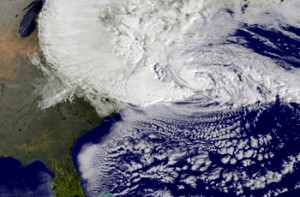
Aerial image of Hurricane Sandy.

New England’s geography makes it particularly susceptible to the impacts of climate change, which include an increased frequency of abnormal and severe weather events. Shoreline flooding is more frequent, and intense wind and rainfall has become much more common across Connecticut.

Long Island Sound is a fairly shallow body of water, averaging just 63 ft. in depth, so small changes in sea levels can have an exaggerated effect when storms come through. Rising water levels, when combined with bigger storms, may produce surges that hit the coast harder and penetrate farther, resulting in flooding that’s more damaging. Two fairly recent examples include Hurricanes Irene and Sandy, which battered our shoreline in 2011 and 2012 respectively, destroying homes, flooding roads and threatening sewage and power plants.

If you want to observe the power of such storms on our local shoreline, walk along White Sand Beach, past the break wall and over our “world class” moon snail shell shingle in a southwest direction up to, and around the Point. You may be astonished with the dramatic changes in beach topography and the amazing size of the timbers that have been deposited far above the high tide mark.

Long Island Sound Lobsters:

In 1999, the lobster population in Long Island Sound crashed; it has never recovered. Although many then considered pesticide pollution as the cause for the dramatic decline in lobsters, most scientists now agree that the warming of the Sound’s waters was the primary cause.

Reversing Global Warming:

Unfortunately, there is no single technological silver bullet emerging to resolve this immense problem. Further, given the geographic, meteorological, and political scope of the situation, it is probably better to focus only on mitigating the problem by stabilizing the concentration of carbon dioxide in the atmosphere.

International Efforts to Curb Climate Change:

The United Nations Intergovernmental Panel on Climate Change (IPCC) has stated that “without rapid cuts to carbon emissions, there could be, by the end of the century, a rise in sea levels that would leave 400 million people exposed to coastal flooding each year. They go further and state that, “Scientific evidence for warming of the climate system is unequivocal. There is direct evidence that humans are the main cause of the rise of atmospheric carbon dioxide.”

Consequently, the Paris Agreement was negotiated by representatives of 196 member nations within the United Nation’s Framework Convention on Climate Change (UNFCCC). The Agreement’s goal was to strengthen the international response to climate change mitigation by keeping the Earth’s temperature increase to less than 2 degrees Celsius above pre-industrial levels, and to pursue efforts to limit the temperature increase even further to 1.5 degrees. The language was adopted by consensus on December 12, 2015, and signed in 2016. As of February 2020, all UNFCCC members have signed the agreement, 189 have become party to it, and the only significant emitters, which were not parties to the agreement, are Iran and Turkey.

Unfortunately, on June 1, 2017, and only about six months past inauguration, a new “science-light” American president announced that the United States would terminate all participation in the Paris Agreement. He stated that withdrawal would be in accordance with his “America First” policy.

This decision stunned our allies, and German Chancellor Angela Merkel said that “it’s time to look ahead. This decision can’t and won’t stop all those of us who feel obliged to protect the planet; on the contrary. we in Germany, Europe and the world will combine our forces more resolutely than ever to address and successfully tackle challenges for humanity such as climate change.”

The President’s decision to withdraw could accelerate and worsen the impacts that global warming is already having on Long Island Sound and Connecticut’s environment. He has also proposed cutting federal funding for environmental programs in Long Island Sound and is easing anti-pollution regulations over various industries. He argued that those changes will help the economy.

Despite that decision, Connecticut, Delaware, Hawaii, Massachusetts, Minnesota, Oregon, Puerto Rico, Rhode Island, Vermont and Virginia have all joined a coalition committed to upholding the Paris Agreement and taking aggressive action on climate change.

A Few Final Thoughts:

These are the data. None of this is really new and much of it factored into the Paris Agreement. I don’t know whether “accepting” climate change and sea level rise require a certain belief system or just the ability to understand and embrace scientific fact.

We’re at the point where we need to cut carbon pollution as quickly as feasibly possible. That’s true, whether Earth has warmed 1.0 or 1.1 or 1.2°C above “pre-industrial” temperatures. I believe that these “seemingly modest” increases have given us an unfortunate sense of security regarding the impacts of our changing climate.

In the speech announcing his decision to leave the Paris Agreement, President Trump argued that “even if all the goals in the agreement were met, it would cut global temperatures by only two-tenths of one degree by 2100.” He did not go further and explain why that supported his decision. In contrast, MIT researchers have said: “The real risk with global warming is if it accelerates so quickly that we can’t respond fast enough.”

My next column will examine some of history’s key speeches. I am a reader of speeches made by both American and World leaders. I often find them to be very inspirational.

In closing, former Connecticut resident Mark Twain is supposed to have said: “Everybody talks about the weather, but nobody does anything about it”. I am not certain that he actually said that, but this is our chance to prove him wrong.

Postscript to: A View from My Porch: A Primer on Global Warming and Climate Change
By Thomas D. Gotowka
Published April 14, 2020

On April 11, the Washington Post, the New York Times, and several other newspapers published the obituary of S. Fred Singer, a scientist who made key advances in rocketry and atmospheric research in the 1950s and 1960s, who died on April 6 in Rockville, Md. According to the Washington Post, he was “President Trump’s most senior expert on climate change,” presumably assisting in decisions regarding termination of America’s participation in the Paris Agreement.

He was better known in the later years of his life for an unrelenting criticism of the scientific consensus surrounding climate change and global warming.

Siegfried Frederick Singer was born Sept. 27, 1924, in Vienna, Austria. However, after the Nazi invasion of Austria, he was sent to England as part of the “Kindertransport” program that resettled Jewish children. 

He came to the United States in the early 1940s and served in the Navy during World War II, and worked on weapons programs.

He received a Bachelor’s degree in electrical engineering from Ohio State University in 1943, and both Master’s and Doctoral degrees in physics from Princeton University in 1944 and 1948 respectively. 

His career was somewhat peripatetic. He conducted some of the initial experiments with high-altitude rockets and satellites, also enabling measurement of cosmic rays and other components of the upper atmosphere. He was a consultant during the start-up of the U.S. space program in the 1950s and later, while working for what is now the National Oceanic and Atmospheric Administration (NOAA), participated in early efforts to use satellites in weather forecasting.

He held senior academic positions at the Universities of Maryland, Miami and Virginia; and was also chief scientist at the U.S. Transportation Department in the late 1980s and a research professor at George Mason University in the 1990s. He also held senior-level positions at the United States Department of the Interior and the Environmental Protection Agency.

He had “very public” views and promulgated predictions that were usually considered as intentionally outside accepted scientific norms.  For example, he wrote that the “melting of ice caps and the redirecting of rivers could help irrigate the arid Southwest and produce a general improvement to the climate of the North American Arctic.” 

As many of his statements were proven spurious, Singer began a new phase in his scientific career. He adopted a new purpose as an “outsider” seeking to denigrate other scientists, who warned the public about secondhand smoke, greenhouse gas emissions, acid rain and the dangers of a steadily warming climate. “It’s all bunk,” he often said.

In a 2011 presentation at Colorado State University, he attempted to convince the audience that climate change is harmless and helpful to humans. He stated, “Stop worrying; nothing you do will have any effect on the carbon dioxide level in the atmosphere; and, even if it did, it won’t affect the planet.” Worrying about climate change, is a “psychosis.”

Singer founded the Virginia-based Science and Environmental Policy Project to “challenge” government environmental policies based on what he defined as “poor science.” In 2007, he also assisted in the launch of the Non-Governmental International Panel on Climate Change (NIPCC), which was a climate change-doubting counterpart to the United Nations’ Intergovernmental Panel on Climate Change (IPCC), which was established by the United Nations Environment Programme (UNEP) and the World Meteorological Organization (WMO), and endorsed by the UN General Assembly in 1988.

Over time, his primary  focus became climate change, becoming perhaps the best-known scientist speaking in opposition to a growing body of evidence that rising global temperatures could have a catastrophic effect on the planet.

As I stated in the original essay, “There is general agreement among climate scientists in Connecticut and across the world that global warming is occurring and human activity is making it worse.”

He had a regular column in the Washington Post. He wrote in 1991 that “There is nothing remotely like scientific consensus that global warming is occurring, or if it is, that it will have disastrous consequences,” and that, “A respectable body of opinion in the international scientific community holds that any climate warming is as likely to be beneficial as harmful, acting as a hedge against global cooling.”

In 1995, he condemned the Royal Swedish Academy of Sciences for making a “political statement” by awarding the Nobel Prize in chemistry to three scientists, who demonstrated that chlorofluorocarbon emissions were depleting the ozone layer. I refer you to my essay, wherein I also note that “chlorofluorocarbons, once used as refrigerants and aerosol propellants, were phased out in the 1980s by international agreement.”

Singer was eventually regarded within the mainstream scientific community as a fringe figure and a crank. 

Britain’s ‘Guardian’ newspaper called him the “grandfather of climate denial.” His false assertions about climate change have been largely discredited by scientists from the American Academy of Sciences, the American Association for the Advancement of Science, NASA and NOAA.

Finally, I am only adding this postscript to the essay because his faulty declarations seemed to be heard by lawmakers and some officials who called for the United States to withdraw from international agreements on climate and the environment. As I stated above, he was “President Trump’s most senior expert on climate change,” presumably assisting in decisions regarding termination of America’s participation in the Paris Agreement.