A View from My Porch: A Letter to President-Elect Biden

An Open Letter to President-Elect Biden:

Why do you even want this job?

To the best of my knowledge, you don’t play golf or enjoy tooling around in a golf cart. I feel that, if you did play, you would probably walk the course, anyways. I doubt that you even anticipate weekends and evenings off. 

When you communicate with us, please use the spoken word, which appears to be one of your strengths; many Americans don’t tweet. I know that, given your family’s sacrifice, the words “suckers and losers” would never, ever come from your mouth. Further, always be truthful with us; let’s reassign some “fact checkers” to productive research. 

Your White House transition doesn’t seem to be moving as fast as it should at this point.

I remember President Obama’s welcome to the then incoming electee just about four years ago. You need to build your team and come up to speed on security issues. 

This is a critical time, and if the current president continues to undermine the election result, it could be a dangerous time. 

I feel that the current president’s post-loss dystopian behaviors and attempts to discredit voters are embarrassing to the United States.

You have identified that getting the COVID-19 pandemic under control is your highest priority; and you’ve already announced that team. As you certainly know, we recently experienced a pandemic-high 126,000 new COVID cases in a single day, nation-wide. We have surpassed 240,000 dead Americans, and well over 10 million infected. Those numbers are increasing across the country as I write this letter.

You will need to rally the many thousands of recalcitrant and selfish Americans, who have been encouraged by the Executive Branch to ignore the recommendations of scientists, and many governors on how to best control the spread of this disease. Fortunately, there are vaccines on the horizon.

You may be presented, if both the current president and some of your former colleagues in the Senate are successful in invalidating the ACA, with the loss of health insurance by millions of Americans — without any replacement plan.

You need to convince our governing bodies that their zero-sum posturing. (i.e., if you gain, I lose) is destructive to the United States. Of course, you have promised that you will be President for all Americans. 

I know that you recall that Majority Leader McConnell demanded in 2010 that Congressional Republicans unite by stifling President Obama on everything, even things Republicans support, saying, “The single most important thing we want to achieve is for President Obama to be a one-term president.” Kind of ironic.

Perhaps his attitude will change after your inauguration. Can we expect agreement on anything? Or at least agree that a hierarchy of governance should be, “What’s good for America,” first and foremost; not, “What’s good for the Party,” and never, “What’s good for me.”

Isn’t he also majority leader for all Americans?  

I am comforted that you have been raised with a strong faith and a strong moral code; and that you can rely on those values and your family in times of difficult decision- making.

I am even comforted that Champ and Major will accompany you and the First Lady to the White House. 

We are counting on you and your team to return America to its former greatness; to regain our status as a world leader, and as a country that stands by its promises and agreements. 

God save the United States of America.

Sincerely,

Thomas D. Gotowka,
Old Lyme.

P.S. The Associated Press (AP) just reported that, after hearing two hours of oral arguments yesterday (Tuesday, Nov. 10), the Supreme Court seemed highly likely to leave the Affordable Care Act including protections for preexisting health conditions and subsidized insurance premiums largely intact.

Both Chief Justice John Roberts and Justice Brett Kavanaugh, who sit among the Court’s conservative justices, were again unwilling to strike down the entire law a Republican goal repeatedly failing in Congress and the courts. This is regardless of the original Law’s now weakened individual mandate, or statutory requirement to purchase health insurance.

The AP estimated that the Law affects 23 million Americans.

This is the opinion of Thomas D. Gotowka.

Tom Gotowka

About the author: Tom Gotowka’s entire adult career has been in healthcare. He’ will sit on the Navy side at the Army/Navy football game. He always sit on the crimson side at any Harvard/Yale contest. He enjoys reading historic speeches and considers himself a scholar of the period from FDR through JFK.

A child of AM Radio, he probably knows the lyrics of every rock and roll or folk song published since 1960. He hopes these experiences give readers a sense of what he believes “qualify” him to write this column.

A View From My Porch: Make America Safe Again, A Primer on Herd Immunity 

Is herd immunity the answer to the current pandemic crisis? Photo by David Todd McCarty on Unsplash.

A lot of people recently started saying, “Herd immunity.”

So, to get up to speed, I reviewed some of my old textbooks and learned (again) that “herd immunity” occurs when a substantial portion of the population (i.e., the “herd”) has, at least in our contemporary medical era, been vaccinated (e.g., MMR.)

This eventually provides protection for vulnerable individuals because, as the number of vaccinated (and presumably immune) persons grows, the likelihood that a susceptible person will come into contact with an infectious person drops; and the chain of infection is broken. 

In the last few weeks, it has been reported (e.g., NYT, WAPO) that the White House has apparently embraced a strategy of enabling deliberate infection of Americans to achieve herd immunity. Campaign rallies?

This approach was proposed in early October in “The Great Barrington Declaration” by a group of “pseudo-scientists”, who argued that government authorities should allow the virus to spread among young, healthy people, while, “in some way”, protecting the elderly and the vulnerable.

So, only people who are at high risk of dying from the disease would be, “somehow”, protected from infection. In other words, achieve a state of “herd immunity” via massive infection, rather than a vaccine. 

The “Declaration” states that those at lower risk of death from infection can, and should, resume normal activities, socialize in crowded bars and restaurants, and gather at sports and other events; and thus, facilitate a rebound of the economy. There is no mention of masks, physical distancing, testing, or tracing.

The “Declaration” was sponsored by the American Institute for Economic Research, whose past work has denied climate change, denied the importance of face masks during this pandemic, and supported personal freedom and limited government. 

Note that, as I write this, the COVID test positivity rate is 38 percent in South Dakota, where personal freedom appears to reign over community safety.  

The White Huse may be aligning itself with this particular “herd immunity” strategy because it supports their false portrayal of mainstream public health experts as supportive of very harsh restrictions, and argues against any and all COVID-related limits on Americans, including face masks. 

Public health and medical professionals do not support this strategy. Dr. Anthony Fauci emerged from exile and called the concept “total nonsense”. 

Others, including the World Health Organization, have stated that the strategy is especially dangerous because it would be nearly impossible to shield those who are medically vulnerable. 

In a letter recently published in The Lancet, 80 scientists stated that “the idea that the public can infect its way out of the COVID-19 pandemic is a dangerous fallacy unsupported by the scientific evidence”. They acknowledged that pandemic restrictions have led to demoralization, but stress that controlling community spread of the virus is the best way to protect the population and the economy until vaccines and treatments are developed.

The scientists continue, “Any pandemic management strategy relying upon ‘immunity from natural infections’ for COVID-19 is flawed.” They add, “Such a strategy would not lead to the end of COVID-19, but result in recurrent epidemics, as was the case with numerous infectious diseases before the advent of vaccination.”

Both the New England Journal of Medicine and The Lancet have published editorials highly critical of the White House’s response to the Covid-19 pandemic in the United States. This was unprecedented for these two prestigious, peer-reviewed medical journals.

COVID-19 cases are increasing in several Connecticut hot spots, and deaths are rising at near-apocalyptic levels across much of the United States, with new cases frequently exceeding 50,000 per day. Public health experts have been warning for months that fall and winter could lead to a spike in cases, and the United States remains unprepared and without a common national strategy. 

Let’s put the idea of natural and uncontrolled infection-based herd immunity behind us.

I believe that safe and well-tested vaccines are on the horizon, maybe by early to mid-2021.  There is also significant activity in the development of therapeutics that could be available for widespread and economical use across the population.

Until then our primary public health strategy remains one of mitigation — slowing the spread now that the virus is so firmly established within the population. 

Continuing restrictions will probably be required in the short term. These non-pharmaceutical methods are simple … you already know them!

Wear a mask and observe physical distancing protocols.

Wash your hands frequently and disinfect work surfaces.

Avoid densely packed crowds, especially indoors.

Expect that some capacity restrictions will remain in place for the foreseeable future.

And for goodness sake, get your information from reputable public health sources. 

And finally, God save the United States of America.

This is the opinion of Thomas D. Gotowka.

Tom Gotowka

About the author: Tom Gotowka’s entire adult career has been in healthcare. He’ will sit on the Navy side at the Army/Navy football game. He always sit on the crimson side at any Harvard/Yale contest. He enjoys reading historic speeches and considers himself a scholar of the period from FDR through JFK.

A child of AM Radio, he probably knows the lyrics of every rock and roll or folk song published since 1960. He hopes these experiences give readers a sense of what he believes “qualify” him to write this column.

A View from My Porch: Great Leaders, Great Speeches; The Finale: Collapse of the Soviet Union.

Editor’s Note: This the sixth and final part of Thomas Gotowka’s series titled “Great Leaders and Great Speeches.’ The previous four parts can be found at these links:

A View from My Porch:  Great Leaders and Great Speeches, Part 1: Washington’s Farewell through Theodore Roosevelt

A View from My Porch:  Great Leaders and Great Speeches, Part 2: Nazi Aggression through “A Rain of Ruin from the Air” on Hiroshima

A View from My Porch:  Great Leaders and Great Speeches, Part 3: The Cold War 

A View from My Porch: Great Leaders and Great Speeches, Part 4: The Cold War Heats Up

A View From My Porch: Great Leaders and Great Speeches. Part 5: Cold War “Visual Aids” 

I will wrap up my Cold War treatise with a review of the events that led to the collapse of the Soviet Union, and apparent end of the Cold War.

I think that Madam Editor is cooling on Cold War nostalgia, and my wife, Christina’s, “Sounds great!” is less enthusiastic. So, I am going to lay this out as an annotated timeline of many of the key events that track the Soviet Union’s progression towards its dissolution and get right to a conclusion. 

I change focus in the next column to works by or about the denizens of our waters.

On Nov. 4, 1956, Soviet tanks and troops invaded Budapest to crush a national protest that began a few weeks before. The protesters had demanded a more democratic political system and freedom from Soviet oppression. 

Prime Minister Nagy was arrested and executed two years later. The Soviets put Communist leader, János Kádár, into the “vacated” position, where he remained for 32 years. Nearly 3000 Hungarians were killed or wounded, and 200,000 fled as refugees. 

The West was shocked by these actions. Earlier that year, Nikita Khrushchev had pledged a retreat from the Stalinist policies and repression of the past. 

In August,1961, the German Democratic Republic (i.e., Soviet-occupied East Germany) erected the Berlin Wall to keep “Western fascists from undermining the socialist state.” The wall mainly served to prevent mass emigration from East to West. Note that the Wall was not funded by West Berlin.

In October, 1962, as noted in an earlier essay, the Soviet Union was compelled by President Kennedy and United Nations outrage to remove their missiles and offensive weapons from Cuba. They then began a massive nuclear arms and military buildup to reach parity with the United States. 

On June 26, 1963, JFK spoke in West Berlin in support of West Germany. His “Ich Bin ein Berliner” address is widely regarded as one of the most powerful anti-communist speeches of that Cold War period. “Freedom has many difficulties and democracy is not perfect. But we have never had to put a wall up to keep our people in; to prevent them from leaving us”. 

“While the wall is the most obvious and vivid demonstration of the failures of the Communist system, we take no satisfaction in it; for it is, an offense, not only against history, but against humanity.” 

“All free men, wherever they may live, are citizens of Berlin; and, therefore, as a free man, I take pride in the words ‘Ich bin ein Berliner.’”

On Oct. 15th, 1964, Nikita Krushchev left office, and was replaced by Leonid Brezhnev, who remained as general secretary for 18 years. In 1968, he introduced a new foreign policy, the “Brezhnev Doctrine,” which asserted that “any threat to socialist rule in any state of the Soviet Bloc was a threat to all, and justifies military intervention.”

During the Soviet invasion of Czechoslovakia, Czechoslovaks carry their national flag past a burning tank in Prague. Public domain photo from “CIA Analysis of the Warsaw Pact Forces: The Importance of Clandestine Reporting” For more information, visit the CIA’s Historical Collections page.

On Aug. 20th 1968, Soviet-controlled Warsaw Pact military forces invaded Czechoslovakia to suppress the “Prague Spring” political reforms initiated by Alexander Dubcek, First Secretary of the Communist Party of Czechoslovakia. He was arrested, and then resigned. The invasion force included 200,000 ground troops and 5,000 tanks. Warsaw Pact troops seized control of television and radio stations.

Journalists at Radio Prague refused to surrender, and more than 20 were killed before it was finally shut down. Some stations went “underground” and succeeded in broadcasting for several days before their locations were discovered and brutally shut down. Much of Czechoslovakia’s intellectual and business elite fled to the West.

On Sept. 7,1978, the Western world witnessed another tool that has been used frequently since then by Soviet successors to stop resistance. 

Georgi Markov was a dissident novelist and playwright in Bulgaria. He had defected to the UK in 1968, and worked as a broadcaster and journalist for the BBC World Service, Radio Free Europe, and “Deutsche Welle.” He used those media to criticize the Bulgarian Communist regime. 

In an incident worthy of a spy thriller, Markov stood waiting for a bus on Waterloo Bridge in central London, on his way to the BBC. He was stabbed in the back of the leg by a man wielding an umbrella with a sharpened tip, who then ran off. Markov became very sick and was rushed to a hospital, where he died a few days later; the autopsy revealed that the cause of death was poisoning from a tiny pellet filled with ricin, an extremely potent toxin. 

Just recently, Russian opposition leader Alexei Navalny was released from a Berlin hospital, where he was being treated for Novichok nerve agent poisoning. 

German Chancellor Angela Merkel had facilitated Navalny’s transfer to a Berlin hospital for treatment, and stressed, “In view of the findings and his prominent role in the political opposition in Russia, I urgently call upon authorities to investigate this crime in full transparency.” The G-7 countries condemned Navalny’s attack.

Note that this was the same agent used to poison ex-Russian spy (and “double agent”) Sergei Skripal and his daughter in the UK in March 2018. Amazingly, both ultimately survived after extended hospital stays. That attack was actually developed into a BBC thriller “The Salisbury Poisonings.”

On Dec. 24th 1979, Soviet troops invaded Afghanistan to preserve the collapsing Communist government that had been established there in the early 1970s. 

Soviet Intelligence remarkably under-estimated the fierce resistance they would face from the mujahideen warriors who defended their country.  

The Soviets were ineffective in their use of conventional tactics against the well-trained and highly-motivated Afghan guerillas.  The tide of the war turned against the Soviets when American shoulder-launched infrared-homing missiles were introduced. The Stinger missiles enabled the mujahideen to shoot down Soviet planes and helicopters almost at will. The invasion evolved into a war of bloody Soviet attrition, although their military remained there for 10 years.

The United States and many allies boycotted the Moscow Summer Olympics in July, 1980 in protest against the Soviet invasion. Some countries, including Great Britain, participated under the Olympic flag rather than their own national flags.

On March 8, 1983, President Reagan, speaking to a religious convention in Orlando, Fla., referred to the Soviet Union as an “evil empire” and “the focus of evil in the modern world.” He had already alluded to that theme the year before in a speech at the British House of Commons, where he also declared that, “The Soviets must be made to understand that “We will never compromise our principles and standards.” The term “evil empire” was inspired by the movie, “Star Wars”. 

In July, 1984, the Soviets and 13 allied countries retaliated by boycotting the Los Angeles Summer Olympics, which was, of course, in President Reagan’s home state.

Mikhail Gorbachev. This file is licensed under the Creative Commons Attribution 2.0 Generic license

On March 11th 1985, Mikhail Gorbachev became leader of the Soviet Union, and began a withdrawal from Afghanistan, which then continued through early 1989. More than 15,000 Soviet soldiers were killed, and about 35,000 wounded. Two million Afghan civilians were killed in that decade-long conflict.

Note that the war also created a breeding-ground for terrorism and the rise of Osama bin Laden, who founded Al Qaeda in 1988.

On April 26th 1986, an explosion at the Chernobyl nuclear power plant in the Ukraine resulted in the worst nuclear disaster in history. Scientists have indicated that the disaster was the product of a flawed reactor design that, against Western standards, was both poorly staffed and maintained. 

Almost 80,000 square miles were contaminated; including some 8,000 square miles of Europe. Although Soviet officials initially put the number of fatalities at just 31, the United Nations estimated that several million people were ultimately affected. 

The Chernobyl disaster had other consequences: The disaster has been estimated to have then cost some $235 billion in damages. The economic and political toll hastened the end of the USSR and fueled a global anti-nuclear movement. 

In June, 1987, Mikhail Gorbachev announced his intention to follow a policy of glasnost – openness, transparency, and freedom of speech; and perestroika, the restructuring of the government and economy. He also advocated free elections and ending the arms race. That same month, President Reagan had called for Gorbachev to open the Berlin Wall: “If you seek peace, if you seek prosperity, if you seek liberalization: Come here to this gate! Mr. Gorbachev, open this gate! Mr. Gorbachev, tear down this wall!”

Gorbachev’s policies relaxed centralized control of much of the Soviet economy, and farmers and manufacturers could now determine what and how much to produce; and what to charge for products. Although Gorbachev had instituted these reforms to accelerate a sluggish economy, they had the opposite effect. Market prices soared to unaffordable levels, Government spending and Soviet debt skyrocketed, and worker demands for higher wages led to dangerously high inflation. 

In 1988, he announced to the United Nations that Soviet troop levels would be reduced, and that the USSR would no longer interfere in the domestic affairs of other countries. 

The Collapse: The Soviet Union was increasingly viewed as a rogue nation by the West. Their economy could not sustain the huge costs of their nuclear weapons buildup, the Afghan Occupation, over 30 years of distant warfare that began in the early 1950s, and Chernobyl. 

President Reagan had actually refused to provide Gorbachev with Marshall Plan-type economic support (similar to the aid provided to rebuild Europe after WW2). 

Then, in the late-1980s, and certainly inspired by the failed perestroika and glasnost reforms, independence movements began to swell in the Soviet sphere; and then, the speed of the collapse of communist rule in Soviet satellite countries stunned the “Free World.” 

On Dec. 25, 1991, Gorbachev resigned and the Soviet Union was dissolved and divided into 15 separate and independent countries. Russia (i.e., formally the “Russian Federation”) was considered the successor state of the Soviet Union, which meant that it kept almost all of their nuclear weapons and the seat on the Security Council of the United Nations. 

The collapse also resulted in the rise of the “Russian Oligarchy”, which, probably too simply, is almost a parallel government of powerful individuals, who accumulated enormous wealth during Gorbachev’s market liberalization and the period of dissolution. 

The failing Soviet state had left ownership of the State’s assets in question, and allowed for “informal” opportunistic deals with former Soviet officials in Russia and Ukraine as a means of “distributing” State property.

The conventional political wisdom (at that time) was that the Cold War ended with the fall of the Soviet Union.

Some Final Thoughts: Unfortunately, Brunhilde never sang. (i.e. “it ain’t over ‘til …”) 

The Cold War only paused after the 1991 Collapse. The battlefield and rules of engagement changed, but, otherwise, it’s the same thugs under a new flag (I apologize for “thugs”, but it seems appropriate.)

Vladimir Putin has served as either Prime Minister or President since 1999, in both the Soviet Union and the Russian Federation.  His key cabinet members and senior department heads largely came with him from the Soviet Union. 

A brilliant tactician, the Stalinist Putin is former KGB, and popular with much of the Russian citizenry, many of whom resent the collapse and the apparent change of Russia’s international standing. He has been described as “the Despot’s despot.”

In his annual address to the Russian Federation in 2005, Putin said ,”The collapse of the Soviet Union was the major geopolitical disaster of the past century. Millions of our co-citizens and co-patriots find themselves outside Russian territory.” He pledged to turn the economy around and restore their status in world affairs.

Putin had already “deked” the West in 2003 by allowing Paul McCartney to perform before thousands of Russians in Red Square, his first-ever concert in Russia. The Beatles had been banned in the Soviet Union in the 1960s, declared to be “an enemy of the Soviet people” by Nikita Kruschev; their music “caused delinquency, alcoholism, vandalism, and rape”. 

I am absolutely certain that my eighth-grade math teacher, Sister Thomas Ann, was unaware that she shared Mr. Kruschev’s opinions on rock music. In Sir Paul’s own words: “The Ukraine girls really knock me out, they leave the west behind; and Moscow girls make me sing and shout, and Georgia, …”.

The Reboot of the Cold War

Hacking and leaking: It is widely accepted and reported by our Intelligence Agencies that Russian agents have interfered in democratic elections across Europe and in the United States. Besides offering assistance to the 2016 campaign of one candidate, they also gained access to voter rolls in two Florida counties. This last breech was revealed by the Florida governor in May, 2019. 

Even more concerning is one conclusion by the bipartisan Senate Intelligence Committee that former campaign chairman, Paul Manafort appears to have been directly connected to the hacking operations conducted by the Russian agents, which exposed large files of internal emails belonging to the DNC.

On Aug. 31, the CIA published an assessment of Russian efforts to interfere in this November’s election in their CIA Worldwide Intelligence Review. CIA analysts compiled the assessment with input from the NSA and the FBI. 

The assessment provides details of the activities of a Ukrainian lawmaker to disseminate disparaging information about candidate Biden to lobbyists, Congress, the media and contacts close to the President. 

Some good, old- fashioned provocation: In late August, USAF  F-22 fighter jets, supported by KC-135 aerial refueling aircraft, intercepted three groups of two Russian Tu-142 patrol jets that entered the Alaskan Air Defense Identification Zone.

In early September, two Russian jets flew within 100 feet of a USAF B-52 bomber in an “unsafe and unprofessional manner”, while the pilot was conducting routine training over international waters in the Black Sea. 

In his recent address to the UN’s General assembly, Putin stressed the need for multilateral cooperation against the pandemic. He also argued that ending “illegitimate sanctions” against countries like his could boost the global economy and create jobs.

I am going to conclude with something that might give you some comfort: A short time ago, in a video conference with elected heads of the Russian regions, President Putin called for “an agreement between Russia and the United States to guarantee not to engage in cyber-meddling in each other’s elections. He called for a “reset” between Russia and the United States and said he wanted an agreement between the two countries to prevent incidents in cyberspace”. What’s done is done?

God save the United States of America.

The era did produce a new literary genre; and, if you have the interest to re-visit those years in fiction, I recommend the novels of John LeCarre’. Len Deighton, Ian Fleming, and Nelson DeMille.

This is the opinion of Thomas D. Gotowka.

Tom Gotowka

About the author: Tom Gotowka’s entire adult career has been in healthcare. He’ will sit on the Navy side at the Army/Navy football game. He always sit on the crimson side at any Harvard/Yale contest. He enjoys reading historic speeches and considers himself a scholar of the period from FDR through JFK.

A child of AM Radio, he probably knows the lyrics of every rock and roll or folk song published since 1960. He hopes these experiences give readers a sense of what he believes “qualify” him to write this column.

Op-Ed: Thoughts on ‘Suckers’ and ‘Losers’

“Suckers and Losers”?

I am outraged; and saddened. 

If you’ve paid any attention to the national news, you know that The Atlantic recently carried a report by editor-in-chief, Jeffrey Goldberg, who cited sources who stated that the president canceled his visit to the Aisne-Marne American Cemetery near Paris in 2018 because he believed the Marines who died in the battle of Belleau Wood during World War I were “suckers.” According to the report, Mr. Trump said, “Why should I go to that cemetery? It’s filled with losers.” 

Mr. Trump lashed out at Goldberg, calling him a “slimeball,” adding that it was, “a fake story and a disgrace,” written by a magazine that probably was not going to be around much longer. He has made similar comments about the New York Times. Unbelievably, he went on to say (i.e., “Tweet”): “Steve Jobs would not be happy that his wife is wasting money he left her on a failing Radical Left Magazine that is run by a con man (Goldberg) and spews FAKE NEWS & HATE. Call her, write her, let her know how you feel!!!” Holy Cow … again, the specter of strong women?

Jeffrey Goldberg is a solid, well-respected journalist. The Atlantic began publication more than 150 years ago. The Atlantic’s founders include Ralph Waldo Emerson and Henry Wadsworth Longfellow. 

The following are my memories, but relevant to how I’ve reacted to this reprehensible White House issue. These memories are special to me, but certainly not unique amongst American families. 

My father’s life was interrupted by some action in “harm’s way” in World War II and the Battle of the Bulge. He was a member of Tom Brokaw’s “Greatest Generation”; my grandparents prayed, and he eventually came home. My Dad was neither a sucker nor a loser.  

I had a close friend growing up, who, when I left for University, made the decision to enlist in the Army. Killed in action, Gary John Shea’s name is engraved on Panel 61E Line 2 of the Vietnam Veterans’ Memorial in Washington, DC. I have visited the Memorial and seen the engraving. His death was a tragedy. He was neither a sucker nor a loser.

Each of our military services has a creed, or oath, that provides a value structure by which our men and women live and serve. 

In Gary’s honor, I paraphrase the Soldier’s Creed: “I am an American Soldier. I serve the people of the United States. I am a guardian of freedom and the American way of life. I will never quit. I will never leave a fallen comrade to fall into the hands of the enemy.” Does the White House know this? Deployment of the military at racial justice protests is not mentioned in the “Creed”, “even as photo op props.” 

I also served, but never in harm’s way. My active duty years were mostly at the Naval Hospital at NAS Pax River, MD. In my clinical capacity, I once had the terrible honor to examine the burned remains of a Naval aviator in order to officially confirm his identity. His A-4 Skyhawk had gone down. His death was a tragedy. He was neither a sucker nor a loser. 

The A-4 is the same aircraft flown by another Naval Aviator and an American hero, Senator John McCain. He was neither a sucker nor a loser.

My son and his wife are graduates of the Naval Academy.  Brendan served on fast attack nuclear submarines. He claims to have once seen the “bright lights” of Murmansk. Emily was involved in missile testing on surface vessels.

Having fulfilled his active duty service commitment, Brendan continues his relationship with the Navy, in his role at JHU’s Applied Physics Laboratory. He works closely with them to develop “strategies and systems that support our Sea Control Mission”.  

My son-in-law is a Royal Air Force squadron leader and recently completed a multi-year tour as RAF liaison officer to the USAF at Seymour Johnson Air Force Base in North Carolina. “Ruggy” has the dubious distinction, as a citizen of the United Kingdom, to have flown his USAF F-15E Strike Eagle over Syria and Iraq with the 336th Expeditionary Fighter Squadron in support of Operation Enduring Freedom. It is a tradition to have an American flag in the cockpit for later presentation to family. We cherish that flag.

Brendan, Emily, and Ruggy are intelligent and honorable leaders and warriors, who have served to defend the United States. They are neither suckers nor losers.

I despair at the utter callousness and disrespect exhibited by a Commander-in-Chief who sees fit to use descriptors like “suckers and losers” as a means of insulting those who served in our military. 

Editor Goldberg had received some criticism for not naming his sources, although the Associated Press has corroborated the report. 

However, the history of disparaging rhetoric that has emanated from Mr. Trump, alone gives credibility to The Atlantic report. I will not bother to cite all of his words and the times that this president has made degrading, and insulting remarks about the military and its leadership.

However, the names that come to my mind include Alexander Vindman, John McCain, Generals Mattis, McMaster, and, just recently, Kelly. His words and feelings are clear.  To the best of my knowledge, nobody in the Trump family has served, which amazes me. Consequently, he has absolutely no reference point on the role or concerns of family who support our men and women, who may serve in harm’s way. How did my daughter, Erin, feel when Ruggy was flying over Iraq and Syria? How did my wife handle Brendan’s undersea deployments during silent periods? 

I have to wonder: “Where are his close advisors?” 

The VP has not served in the military, although his father served in Korea, and his son with the Marines. Mike Pompeo is a graduate of West Point and has served as an Army officer.

Why won’t you guys ask this president to cease his reprehensible insults?

God save the United States of America!

Editor’s Note: This is the opinion of Thomas D. Gotowka, who is a resident of Old Lyme.

A View From My Porch: Great Leaders and Great Speeches. Part 5: Cold War “Visual Aids”

Editor’s Note: This the fifth part of Thomas Gotowka’s series titled “Great Leaders and Great Speeches.’ The previous four parts can be found at these links:

A View from My Porch:  Great Leaders and Great Speeches, Part 1: Washington’s Farewell through Theodore Roosevelt

A View from My Porch:  Great Leaders and Great Speeches, Part 2: Nazi Aggression through “A Rain of Ruin from the Air” on Hiroshima

A View from My Porch:  Great Leaders and Great Speeches, Part 3: The Cold War 

A View from My Porch: Great Leaders and Great Speeches, Part 4: The Cold War Heats Up


The last essay concluded with President Kennedy’s humiliation of the Soviets and the resultant dismantling and removal of their offensive weapons from Cuba.
The United States had stepped back from the brink of nuclear war.

In this essay, I explore the “Visuals” of the Cold War. What were anxious Americans reading and watching during that tense era? I will then wrap up my treatise on the Cold War with a review of the gradual “wind-down” of hostilities, and the collapse of the Soviet Union.

As always, my goal is that the reader gets a solid foundation in the fundamentals of the subject, which may even pique their curiosity enough to seek additional information.

COLD WAR VISUALS & EVENTS:

Images played an important role in waging the Cold War and communicating its possible impacts to Americans. The importance of television, posters, cinema, and political cartoons in representing our Cold War enemy was recognized early. Public Service Announcements and posters often featured mushroom clouds and some reference to “We will bury you”.

I have strong memories of a large portion of the Cold War era, and, being familiar with the demographics of SE CT, I know that I am not unique. 

Americans feared that the Soviet Union would launch an unprovoked attack on the United States with nuclear weapons. I am only providing a small sample of what Americans were reading, watching, or hearing from their leaders during that tense era; and just a few of the events that also affected our collective angst.

Much of the following was created or supported by a series of independent government agencies involved in civil defense.

In the early 1950s, schools performed emergency “Duck and Cover” drills to prepare children to react in a manner that provided some protection in a nuclear attack. The animated character, “Bert the Turtle”, engaged the youngest Americans in preparing for these drills. Students were trained to dive under their desks and cover their heads. Desks were incredibly sturdy back then.

“I Led Three Lives” was a series that aired from 1953 through 1956 on American television, and covered the activities of Herbert Philbrick, a young professional in 1939 Boston, who infiltrated a Communist Party Cell in Cambridge, Mass.; and worked covertly with the FBI for nine years. His cover was so convincing that he was asked by Cell leaders to follow other comrades to assess their loyalty. Hence, his three lives: white-collar worker, Communist agent, and FBI operative thwarting Communist plots.

On Oct. 4, 1957, the Soviet Union successfully launched Sputnik1, the world’s first artificial satellite, and one of three in the Soviet “Sputnik” program that achieved orbit.  Sputnik1 remained in orbit until Jan. 4, 1958, when it dropped and burned in the Earth’s atmosphere. Many Americans feared the potential “sinister” uses that the Soviets could bring to bear on us with this expertise in rocket and satellite technology. 

However, more serious was the perception of American weakness and loss of scientific leadership, which then contributed to Kennedy’s election win, as he had emphasized the “space gap” and the role of the Eisenhower-Nixon administration in creating it.

Our government, the military, and the scientific community were caught off guard by the Soviet technological achievement; and, as a result, combined their efforts to catch and surpass the Soviets, marking the beginning of the “space race”. Our first satellite, Explorer1, was launched on Jan. 31, 1958; and, with more advanced communications technology than Sputnik, provided the first data transmitted from space, revealing the presence of radiation belts encircling the Earth, now known as the Van Allen Radiation Belt. 

In 1958, NBC presented “Ten for Survival”, a 10-episode television series on how to survive a nuclear attack. There were also several pamphlets accompanying the series, published by the Department of Defense Office of Civil Defense.

“AXIOM FOR SURVIVAL: If this country is attacked with nuclear weapons, you can protect yourself. But first, you must know what to do and how to do it.” The associated pamphlets covered subjects ranging from “dealing with the three main effects of a nuclear explosion (i.e., “Heat, Blast, Fallout, Heat”) to “preparing to live in a fallout shelter”.

During the Plenary Meeting of the United Nations General Assembly on Oct. 12,1960, Nikita Khrushchev, Soviet First Secretary of the Communist Party, removed his shoe, and raised it above his head as if to strike the desk, in protest at a speech by another delegate, who stated that Eastern Europe had been “deprived of political and civil rights due to the dominant influence in the region by the Soviet Union”.

Note that it was reported widely that he did strike the desk, but I could only locate photographs of a “threat to pound”, with shoe held above his head.

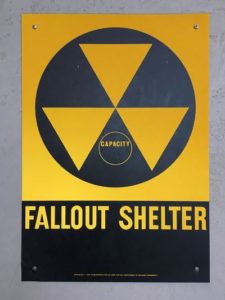
A fallout shelter sign in the United States of America. Photo by Geraldshields11. Published under the Creative Commons license.

Fallout shelters became that generation’s wine cellars and whirlpool tubs in essential home features and improvements. In a speech on “Urgent National Needs” delivered to a joint session of Congress on May, 25, 1961, President Kennedy stated that, “his Administration has been looking hard at exactly what civil defense can and cannot do. It cannot be obtained cheaply. It cannot give an assurance of blast protection that will be proof against surprise attack or guarantee against obsolescence or destruction. And it cannot deter a nuclear attack.” (Holy Cow!) 

Then, in July, after the Soviets imposed a blockade on West Berlin, Kennedy  said in a televised speech, that “in the event of an attack, the lives of those families which are not hit in a nuclear blast and fire can still be saved if they can be warned to take shelter, and if that shelter is available.”

Finally, on Oct. 6, he advised families to build shelters to protect themselves from atomic fallout in the event of a nuclear exchange with the Soviet Union. In another speech on civil defense issues, Kennedy assured the public that the government would soon begin providing such protection for every American.

The President went on say: “We owe that kind of insurance to our families and to our country. The time to start is now. In the coming months, I hope to let every citizen know what steps he can take without delay to protect his family in case of attack. I know you would not want to do less.” 

Congress approved $169 million to locate, mark and stock fallout shelters in existing public and private buildings. Note that this all occurred about a year before the Cuban Missile Crisis.

Periodicals like “Better Homes and Gardens”, “Life Magazine”, and “Popular Science” all included articles on fallout shelters, aimed at readers who were preparing to build the best possible shelter. How-to booklets were widely available, with instructions and diagrams in the finer points of building and equipping your family fallout shelter.

Even earlier, Eisenhower’s Federal Civil Defense Administration (FCDA) had urged American families to maintain a seven-day supply of food and water in case of an atomic emergency. The FCDA launched an initiative called “Grandma’s Pantry”, with slogans like “Grandma was always ready for an emergency.” They produced thousands of “Grandma’s Pantry” exhibits for use in stores, with advice on what should be in every American’s disaster pantry.

The “Mother of All Fallout Shelters”:

In 1955, President Eisenhower instructed the Department of Defense to develop emergency plans to relocate Congress and ensure continuity of government in the event of a nuclear strike. The Army Corps of Engineers selected the Greenbrier Resort property in White Sulphur Springs, W.Va., which was relatively close and accessible to Washington, D.C., but distant enough to be safe from an atomic bomb dropped on the Capital.

The Greenbrier had served as a confinement facility for Japanese, Italian, and German diplomats; and then as a military hospital during the second world war. 

Construction on the “super-bunker” Relocation Center began in 1957; and was completed in October, 1962, just as the Cuban Missile Crisis loomed. The Greenbrier bunker was buried 720 ft. underground. It would not survive a direct nuclear strike, but was capable of withstanding a blast 15 to 30 miles away and protecting its occupants from fallout.

The facility‘s two levels totaled about 115,000 square ft., “roughly the size of two football fields on top of one another”. Although the presence of the bunker was a closely-guarded secret, its largest halls, which were intended for sessions of Congress, were actually depicted as part of the Greenbrier Hotel complex, and would have been sealed off in the event of an attack.

All walls were concrete, three feet thick, and reinforced with steel. The entire structure was covered with a concrete roof and buried beneath 20 ft. of soil. It had a highly sophisticated ventilation system that was designed to circulate air and remove radiation.

The Bunker included a decontamination room, 18 rooms of dormitory space, each housing 60 people in metal bunk beds; a kitchen, and a 400-seat cafeteria, which was decorated with fake windows featuring scenic views. The upper level contained storage space and offices for Congressional leaders.

The bunker also had a hospital, operating room, pharmacy, crematorium, and a vast television, radio, and communications facility. The Relocation Center was maintained in a constant state of “readiness” by Forsythe Associates, which was later described by the Washington Post as an “obscure company ostensibly based in Arlington, Va.” These on-site employees claimed that their purpose was to maintain the hotel’s 1100 televisions.

The bunker remained a closely-guarded secret until 1992, when the Post published “The Ultimate Congressional Hideaway.” Given that its secure location was one of the primary guarantees for its defense, the bunker was quickly decommissioned and became the Greenbrier Cold War theme park. (To schedule a tour, call 844-690-4141. Adults: $39 per person Youth (10-18): $20 per person.)

The “Miracle on Ice” — some Cold War good news:

In 2005, the Olympic Center ice arena in Lake Placid where the Miracle on Ice took place was renamed the Herb Brooks Arena in the US ice hockey coach’s honor.

“Miracle” was a medal-round game between the United States and the heavily-favored Soviet Union that occurred during the men’s ice hockey tournament at the 1980 Lake Placid Winter Olympics. Our team of college players, the youngest team at that tournament, held on to beat the four-time defending gold medalists Soviet Union team of “amateurs” by a score of 4 to 3. 

Two days later, the United States secured the gold medal by beating Finland in their final game. The Soviet Union beat Sweden for the silver. (USA! USA!) 

The United States’ victory over the Soviets became one of the most iconic moments in sports; and, in 1999, was named by Sports Illustrated as the top sports moment of the 20th century. Perhaps as well-known as the final score was the call in the final seconds of the game by Al Michaels for ABC Sports, when he declared: “Do you believe in miracles? YES!” 

Some Final Scary Thoughts:

Most historians doubt that the Greenbrier bunker could have been used effectivelyMissile technology had so decreased the time between a “decision to strike” and the appearance of a bomb crater that a safe relocation of Congress in anticipation of an imminent attack was virtually impossible. An early relocation would have been provocative to the Soviets.

In his May, 25, 1961 speech, Kennedy also stated that “we will deter an enemy from making a nuclear attack only if our retaliatory power is so strong and so invulnerable that he knows he would be destroyed by our response. If we have that strength, civil defense is not needed to deter an attack. If we should ever lack it, civil defense would not be an adequate substitute.”

Thus, it was widely believed by Cold War strategists that war with the Soviet Union was largely prevented by the fear of mutually-assured destruction (i.e., the MAD Doctrine). In simple terms, the theory of deterrence assumes that, because a full-scale use of nuclear weapons by two or more opposing sides would cause the complete annihilation of both the attacker and the defender; the threat of using such weapons against the enemy prevents the enemy’s use of those same weapons. 

This deterrent concept assumes rational calculations by rational people; which I am not convinced that we still possess at the highest levels of Government.

Is “person, woman, man, camera, TV” ever really enough?

This is the opinion of Thomas D. Gotowka.

Tom Gotowka

About the author: Tom Gotowka’s entire adult career has been in healthcare. He’ will sit on the Navy side at the Army/Navy football game. He always sit on the crimson side at any Harvard/Yale contest. He enjoys reading historic speeches and considers himself a scholar of the period from FDR through JFK.

A child of AM Radio, he probably knows the lyrics of every rock and roll or folk song published since 1960. He hopes these experiences give readers a sense of what he believes “qualify” him to write this column.