Letter From Paris: Book That Wins France’s Top Literary Prize Raises Chilling Questions About WWII History

Nicole Prévost Logan

Coincidence or not ?

The prestigious French literary Prix Goncourt came out came just a few weeks before the election of 31-year-old Sebastian Kurtz as chancellor of Austria.  Many would say that election marked another step by the European Union along the road toward nationalism.
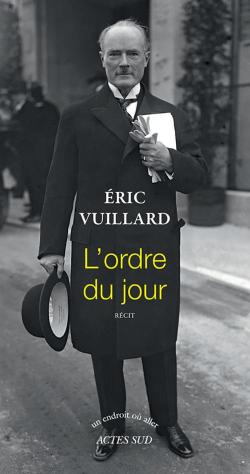
The topic of the novel is the Anschluss.  With devastating sarcasm the author, Eric Vuillard, puts the magnates of German industry on trial for profiting from the Nazi regime and the Austrian people for welcoming the invading German army on March 12  1938. The title itself is ironic since L’Ordre du Jour – which translates as ‘the order of the day’ or ‘the agenda’ – refers to a democratic assembly, which in the book will soon be abolished by Hitler.

It is a very short book (only 150 pages) printed in an unusual miniature format.  But it is a striking story, beautifully written, leading the reader through shocking scenes in which cruel humor is mixed with great despair.  Vuillard, is also a film maker, which explains the way he stages the story as seen through a camera, with colorful images, a sound track, leading actors and supporting crowds.

The action starts on February 20th, 1933, in Potsdam.  Twenty-four managers of the German industry – Gustav Krupp, Wilhem von Opel, Günther Quandt, Kurt Schmitt and others – are waiting in the ante-chamber of the Reichstag at the pleasure of its president, Hermann Goering.  The 24 grey-haired gentlemen, dressed in formal black or brown coats, with stiff shirt collars and striped pants, resemble the bare trees lining the Spree river in the winter.

Goering is late but the visitors wait patiently.

When he finally shows up, the guests raise like lizards on their hind legs.  Hitler – appointed chancellor just one month before – makes his entry and greets his guests.  At the end of the meeting, as expected from them, the managers obsequiously make their meager contribution of several millions Deutschmarks to help the Nazi war effort.

Vuillard turns the Anschluss into a farce. Using threats, lies, and brutal intimidation, Hitler manipulates the Austrian chancellor Kurt von Schuschnigg, making him totally helpless, bulldozed by the Nazi timetable.

February 12, 1938, is the second decisive date in Vuillard’s story.  Hitler has invited Schuschnigg for a secret lunch at Berchtesgaden, his mountain retreat in the Bavarian Alps.  It is an ominous sequence.  When the doors close behind the guest, the reader feels a sense of foreboding.

Overwhelmed by the hypnotic personality of Hitler, Schuschnigg caves in and has to agree to all his  demands: appointment of the Nazi Seyss-Inquart to the post of minister of the Interior;  amnesty of those condemned for the assassination of the Austrian chancellor Dollfuss in 1934; rehabilitation of all national socialist officials.  Having said that, Hitler reaffirms the independence of Austria.  Wasn’t that the ultimate?  asks Vuillard.

On the eve of the planned invasion, Mr and Mrs Ribbentrop (he is the German foreign minister) are invited to dinner at Downing Street.  The author describes in detail the menu of French cuisine and the wine list.  The conversation is light and animated.  All seem interested in tennis and the performance of Bill Tilden, who won the Davis cup seven times.

Toward the end of the dinner, a staff member brings a note to Prime Minister Neville Chamberlain, who becomes preoccupied.  Vuillard writes: “Winston Churchill opens his big cocker spaniel eyes.”  The Chamberlains are getting impatient but, out of sheer British politeness, do not show it.  Guests start leaving but the Ribbentrops linger on, saying endless goodbyes.

The camera jumps to the car where the German couple is now on its way home.  They burst out laughing.  They knew all along what was in the note … German troops have just crossed the Austrian border.

The story reaches its climax when the German forces are ready to pounce on Vienna on March 12, 1938.  The sky is a bright blue but it is freezing cold.  The Panzers are massed by the border but a problem arises — they run out of gas and a monumental traffic jam occurs.  It is hard to pull out a tool kit by the side of the road in sub-zero temperatures.

Hitler, who at first was elated by the prospect of entering Vienna with cheering crowds waving small flags and  blond-braided, young girls throwing flowers at the German soldiers, is now stuck on the road along with hundreds of armored cars.  When an army experiences a breakdown en route, ridicule is guaranteed.

Hitler cannot contain his anger and keeps shouting. By dusk, his Mercedes reaches Linz, the town where he spent his youth.  On March 15, the poor Austrian population, abused, but finally submissive, stands in front of Sisi’s palace to hear Hitler’s hoarse voice vociferate insults.  In a referendum, Austrians voted 99.7 percent in favor of the annexation by the Reich.

What happened to the 24 captains of industry we met in 1933?

During the war years, they made an incredible amount of money by employing cheap labor from Auschwitz, Ravensbrück, Buchenwald or Dachau.  They may have died of old age, but their empires live on, stronger than ever … BMW, BASf, Bayer, IG Farbem, Siemens, Tellefunken, Opel, and Thyssen-Krupp.

Exaggerated or not, the fact is that such a novel gives the reader a major jolt.  It is a literary feat, which revives dark moments of history that one should never forget.
Letter From Paris: The Seine is Flooding … Again

Nicole Prévost Logan

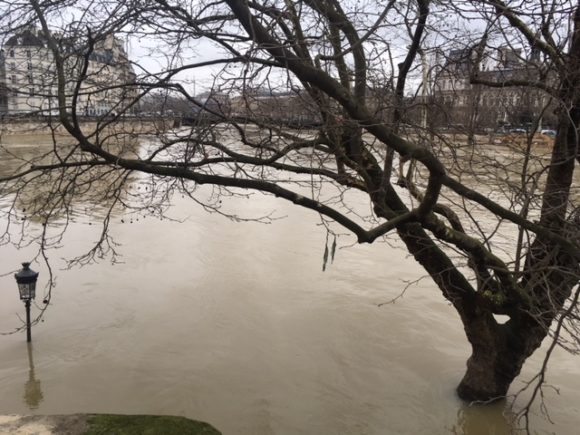
The Paris floods crested Friday, Jan. 26, at almost six meters, therefore slightly lower than in June 2016 . They did not even make the ‘Top 10’ among the most destructive floods of the past 100 years. The monster flood of 1910 saw the river’s level rise eight meters and 60 centimeters.  However, the inhabitants in the communities upstream from the city, who have been underwater for days and have now been flooded twice in 18 months, were certainly entitled to call it a natural disaster brought on by the global warming.

The submerged tree and lamp post in the foreground show the depth of the flooding on the Seine.  The Hotel de Ville stands at right in the background while the Ile de la Cité is at left. Photo by Sylvia Logan.

Monumental work has been done in the past century to protect the capital and the resultant price is paid by the surrounding areas.   Paris is such a strategic place that it has to be protected by a system of locks and reservoirs, both up and down stream. Besides, France is endowed with numerous waterways and this is particularly true in the Paris basin.  The Seine’s tributaries — Marne, Yonne, Aube and Loing — flow toward Paris.  In the case of extreme precipitation, these small rivers easily overflow and submerge their unprotected banks.  The small towns of Champagne, Moret or Thomery, only 30 minutes by train south of Paris, had disappeared underwater by midweek.

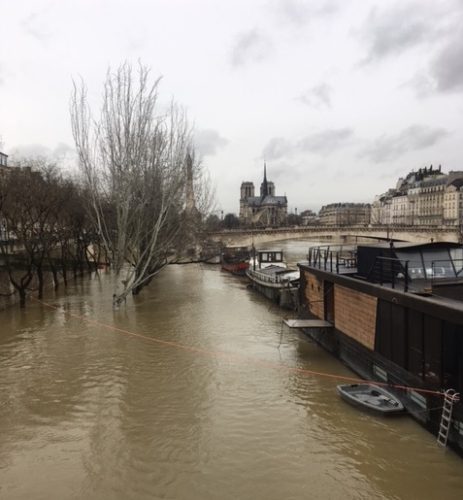
The banks of the Seine are submerged while the Cathedral of Notre Dame still stands proudly in the background. Photo by Sylvia Logan.

In prehistoric times, the Seine was a shallow stream, indolent and undisciplined, moving its bed all over the place.  The most northern of its secondary beds followed what is today the ring of Grands Boulevards and flowed from the Bastille, along the hills of Buttes Chaumont and Montmartre, and back down to the main channel below the hill of Chaillot.   On the Left Bank, the Seine also had a secondary bed, which used to flow under the modern Boulevard Saint Germain. 

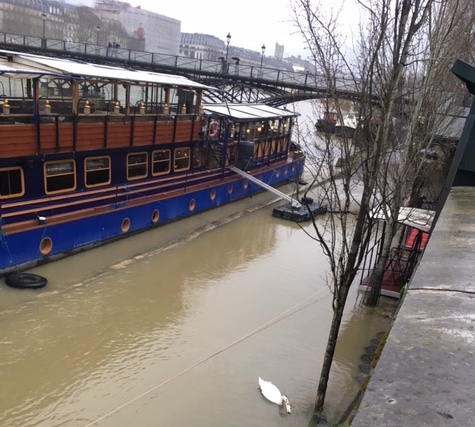
The restaurant ”Calife,” which is moored in the middle of the river near the Pont des Arts, is flooded.  Photo by Sylvia Logan.

Between 1991 and 1993, excavations prior to the building of the new Bercy district, brought to light spectacular remains of human settlements on the banks of the wandering Seine river.  Neolithic pirogues dating back to more than 3,000 years BC are exposed today in the Orangerie of the Carnavalet museum. They are the oldest found in Europe.

The construction of massive stone quays in Paris started in  the 14th century.  In 1991, they became part of the UNESCO World Heritage.

By midweek , as the peak of the floods approached, there was no panic among the city officials, engineers and technicians, but a feverish activity to prevent disaster.  By way of precaution, the RERC running along the river, was closed until the end of the month.  Already the treasures exposed on the lower levels of the Louvre and Orsay museums had been moved to safe locations.  The great danger was that the dense network of cables, pipes and wiring, providing gas, electricity and internet, and lying eight floor deep underground would be reached  by the water.

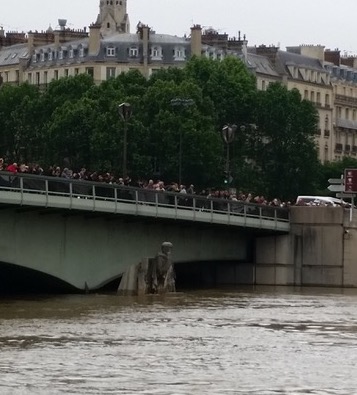
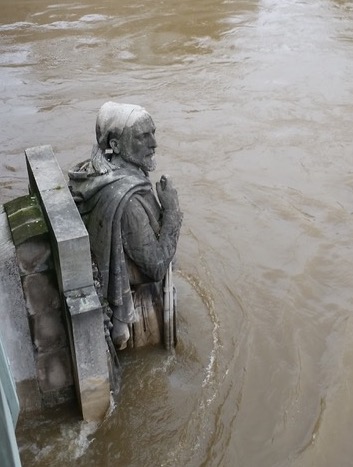
Crowds gather above the famous Zouave statue on the Pont de l’Alma. Photo by Karen Logan

Curious onlookers have been following the progress of water on the statue of the Zouave at the Pont de l’Alma.  The statue was placed below the bridge in 1836 to mark one of the battles at Alma, near Sebastopol, during the Crimean war (1853-56.) 

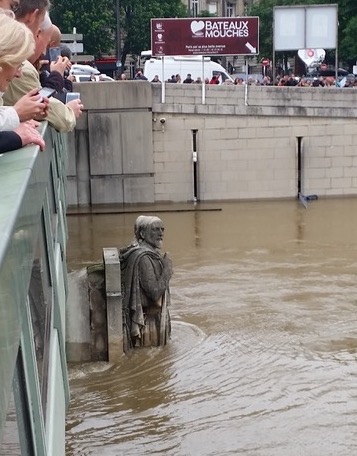
The Zouave at the Pont de l’Alma has been a point of reference for the severity of Seine floods for centuries.. Photo by Karen Logan

The  coalition of France, England and the Ottoman Empire wanted to put a stop to the expansionist policy of the Russian Tsar Alexander II (1856-1881.) The Zouaves were part of the Algerian light brigade in the days of French Algeria — their bright red baggy pants were famous. 

Down he goes!  As the waters rise, the Zouave at the Pont de l’Alma disappears deeper into the River Seine. Photo by Karen Logan

Although not very reliable – since the statue was raised by 40-80 centimeters  in 1970 – the Zouave remains the most popular indicator of the severity of the floods in Paris.

Editor’s Note: This is the opinion of Nicole Prévost Logan.

Nicole Prévost Logan

About the author: Nicole Prévost Logan divides her time between Essex and Paris, spending summers in the former and winters in the latter. She writes a regular column for us from her Paris home where her topics will include politics, economy, social unrest — mostly in France — but also in other European countries. She also covers a variety of art exhibits and the performing arts in Europe. Logan is the author of ‘Forever on the Road: A Franco-American Family’s Thirty Years in the Foreign Service,’ an autobiography of her life as the wife of an overseas diplomat, who lived in 10 foreign countries on three continents. Her experiences during her foreign service life included being in Lebanon when civil war erupted, excavating a medieval city in Moscow and spending a week under house arrest in Guinea.

Letter From Paris: Emmanuel Macron Goes to China

Nicole Prévost Logan

At first sight, the January visit of Emmanuel Macron to meet Xi Jinping might have appeared like the futile encounter between David and  Goliath.  But, in fact, it was a well thought-out strategic move and an illustration of Macron’s personal style of diplomacy.

Never before had any French president gone to China so early in his mandate. He timed his visit to seize the opportunity of a world stage left vacant by most of the players.

He came as an European leader, not as a French one. He stepped into the role Angela Merkel  –– still embroiled in internal political negotiations to create a coalition government — had played for many years.

The trip was put under the symbols of history and culture shared by France and China.  Instead of Pekin, it started in Xi-an, Shaansi province, where the discovery of an imperial tomb made world headlines in 1974.  The tomb contained 8,000 terracotta warriors, horses, and chariots, dating back from the golden age of the Han dynasty (206 BC-220 AD.)

During her several visits to Asia, German chancellor Merkel had openly blamed the Chinese government for its violation of human rights.  Unfortunately, this method did not bring any positive results. 

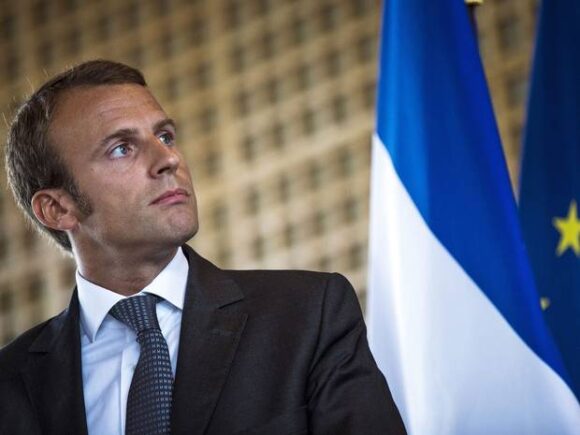
french President Emmanuel Macron

Macron chose a more pragmatic approach, limiting his criticisms to subliminal  remarks.  According to analysts, his diplomacy can be described as “Gaullienne.”  At a press conference in 1964, General de Gaulle abandoned his aloof and philosophical tone and declared that, to talk with leaders having opposing views, did not mean having to agree with or condone them.

Linguistics can create difficulties since the key words used be the two sides may have different meanings.  Take for instance the definition of “terrorism.”  For Xi Jinping, it mostly refers to the activity of the autonomists Ouïgours whereas for  Macron it means the bomb attacks inflicted on the French population by radical followers of Daesch.

To conduct diplomacy with China is to enter a minefield.  Two examples.  One does not attack China frontally for its action in the South China seas because the Chinese government considers this region as its private turf.  Macron would like China to help with the efforts of the G5 to fight terrorism in the Sahel but it might become a two-sided sword because interference by China in the region is not really wanted.

On the crucial topic of the nuclear threat coming from North Korea, the French president could only reinforce the European Union (EU) position.  He complimented Xi Jinping for becoming the world leader in the fight against global warming, and for being a staunch defender of the Paris Accord.

Fifty CEOs of leading French companies were part of the trip, which was marked by the signing of enormous contracts.  The Chinese government ordered 134 A320 Airbus commercial  planes.  AREVA, the French multinational specialized in nuclear power and renewable energy, signed an agreement China National Nuclear Corporation (CNNC) to build facilities for the reprocessing of nuclear waste.  The largest existing plant in the world is located in La Hague, near Le Havre.  Cooperation in the agro-business will be developed.  The Chinese enjoy French beef but since 2011 an embargo had been imposed on the imports following the “mad cow” disease.

The surplus of the Franco-Chinese trade balance amounts to $30 billion in favor of China.  Macron wants too re-equilibrate those figures.  His objective is to widen the types of exports beside foodstuff or cosmetics and include digital technology, artificial intelligence and other sectors.

The silk road sounds like a romantic concept, which makes one dream. but in reality it is pharaonic project where the Chinese plan to invest around $1,000 billions to build a network of rail, maritime, land, or air routes to export its products.  Almost needless to say, this project is worrying many … starting with Macron, who declares that the silk road should be a two-way road.  Historically the silk road was developed in the Han dynasty and its starting point was the town of Xi-an (cf. above.)

During the official visit to Pekin of the French presidential couple, it was impossible not to notice the spectacular redcoat (red is a symbolic color in Chinese, meaning happiness) worn by Brigitte Macron.

Translated into Chinese phonetics, the name Macron means “the horse that dominates the dragon.”  Is that perhaps a good omen for Emmanuel Macron?

Editor’s Note: This is the opinion of Nicole Prévost Logan.

Nicole Prévost Logan

About the author: Nicole Prévost Logan divides her time between Essex and Paris, spending summers in the former and winters in the latter. She writes a regular column for us from her Paris home where her topics will include politics, economy, social unrest — mostly in France — but also in other European countries. She also covers a variety of art exhibits and the performing arts in Europe. Logan is the author of ‘Forever on the Road: A Franco-American Family’s Thirty Years in the Foreign Service,’ an autobiography of her life as the wife of an overseas diplomat, who lived in 10 foreign countries on three continents. Her experiences during her foreign service life included being in Lebanon when civil war erupted, excavating a medieval city in Moscow and spending a week under house arrest in Guinea.

Letter From Paris: Deaths of Two Icons Leave a Nation in Mourning

Nicole Prévost Logan

From Les Invalides to the Champs Elysees, intense emotion grips France at the passing of two iconic personalities.

Within 24 hours France lost two familiar figures: Jean d’Ormesson, 92, man of letters, and Johnny Hallyday, 74, the popular singer who, for almost 60 years, enthralled millions of fans. The intensity of the emotions was incredible. For a week, politics, wars, economic crises, were suspended and replaced by an immense sadness, which united the nation. No matter how different the two men were, they shared a great simplicity and the gift of connecting with the people.

It is not unusual for the French to express their collective grief in the public place. In 1885, two million people attended the national funerals of Victor Hugo. Simone Weil, the courageous woman who showed exceptional fortitude in her public life by being a pioneer of the right to abortion, received the highest honors by being laid to rest in the Pantheon. In 1963, a human tide surged toward the Pere Lachaise cemetery to say goodbye to Edith Piaf.

Count Jean d’Ormesson

Count Jean d’Ormesson, at age 48, was the youngest “immortal” to enter the Academie Française – a literary institution created by Louis XIII to uphold the French language. He died as the dean of that 40-members council. Son of a French ambassador, d’Ormesson was part of the French aristocracy, with degrees in history and philosophy. He directed the conservative daily Le Figaro, became a prolific writer, publishing a book per year, with the last one completed three days before his death. His smiling face and piercing blue eyes were a familiar sight for the viewers of countless televised literary shows, such Bouillon de Culture, Apostrophe or La Grande Librairie.

An elegant conversationalist, he spoke with wit, lightness, and optimism. His remarks, studded with literary quotes, included gems of uplifting philosophy, such as,”Life is beautiful because we are lucky to die”, and “In the New Testament, the myth of the Wandering Jew is condemned to immortality by Jesus.”

During the strikingly sober ceremony, in the courtyard of the Invalides, a small group of guests, representing the world of politics and culture, stood stoically, whipped by a glacial wind. The eulogy given by French president Emmanuel Macron, matched the literary sophistication of the deceased academician.

Johnny Hallyday was a monument in France with an amazing longevity. From the first time he appeared on the stage at age 17, this blond, tall young man became an adulated performer and he remained a star for almost 60 years. For millions of fans, his disappearance meant the loss of a chunk of their own life. Fighting lung cancer for several years, in spite of the terrible pain, he continued performing until the very end. People thought he was indestructible, hence the extreme shock people felt when they learned about his death on Dec. 6th.

Abandoned by his father at the age of eight months, Hallyday did not grow up in the security of a proper family but bounced around from one relative to another. A cousin gave him his stage name.

Facts about his career are staggering: more than 28 million spectators attended the 3,300 concerts he gave in 40 countries; he sold 110 million records. He had a real talent in choosing the best composers and song writers, which allowed him to produce 1,000 songs, many of them in Gold albums.

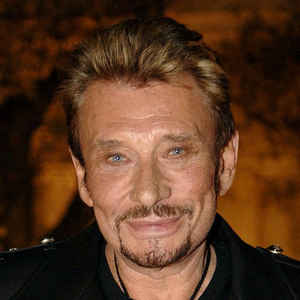
Johnny Hallyday

Hallyday went through all the styles of music from rock n’roll, pop, blues, soul, country, and hard rock. Among the best known hits is, “Ah Marie, si tu savais, tout le mal que l’on m’a fait” (Ah, Marie, if you only knew how much they hurt me) about a young man, fighting in the WWI trenches and writing to his fiancee.

It is a paradox that, in spite of his love for the US, that country barely knew him. Driving full speed on his Harley Davidson with his buddies from the Midwest to California was one of his greatest pleasures. He sang with Sammy Davis Junior. Michel Berger wrote for him a song called “On a tous quelque chose de Tennessee” (We all have something of Tennesse.) The lyrics recall lines from “Cat on a Hot Tin Roof.”

He spent the last 10 years of his life in Los Angeles, Calif., with Tom Hanks and Ben Affleck as neighbors and only returned to France to perform in concerts. Some of his concerts became giant productions of a size never seen before. The absolute zenith of his career was right after France won the soccer World Cup in 1998 when Hallyday flew over the Stade de France by helicopter and was lowered into the hysterical crowd.

The public funeral of Hallyday was an incredible spectacle offered to millions of fans. The cortege moved slowly down the Champs Elysees, led by a white coffin. This was followed by a caravan of black limousines filled with family, close friends and dignitaries and then – even for people who do not particularly like motorcycles – the incredible sight of 700 bikers, who had come from all over France.

On the steps of the Madeleine church, President Emmanuel Macron, paid his respects to the rock star and invited the crowd to bid farewell to “Mr. Johhny Hallyday.”

Editor’s Note: This is the opinion of Nicole Prévost Logan.

Nicole Prévost Logan

About the author: Nicole Prévost Logan divides her time between Essex and Paris, spending summers in the former and winters in the latter. She writes a regular column for us from her Paris home where her topics will include politics, economy, social unrest — mostly in France — but also in other European countries. She also covers a variety of art exhibits and the performing arts in Europe. Logan is the author of ‘Forever on the Road: A Franco-American Family’s Thirty Years in the Foreign Service,’ an autobiography of her life as the wife of an overseas diplomat, who lived in 10 foreign countries on three continents. Her experiences during her foreign service life included being in Lebanon when civil war erupted, excavating a medieval city in Moscow and spending a week under house arrest in Guinea.

Letter From Paris: A Six-Month Performance Review for Emmanuel Macron

Nicole Prévost Logan

Six months into his mandate, French President Emmanuel Macron has been working at a dizzying pace to fulfill his campaign promises.

Hubert Vedrine, former minister of foreign affairs and expert in international and strategic affairs, made the following comment : “Emmanuel Macron immediately embodied the stature of a chief of State. ”

“The French people are impossible to reform”, said Macron during his campaign.  This is why he set out not to reform but to transform France from top to bottom.  First he brought “parity” men/women into the government. 

The “moralization” of the two legislative chambers was his second objective, which meant bringing an end to the opaque system of financial privileges long enjoyed by the deputies.  Like a breath of fresh air, the professional politicians who, since the beginning of the fifth Republic, had been playing musical chairs, faded away .They were replaced by influential members of the civil society, without any political experience.

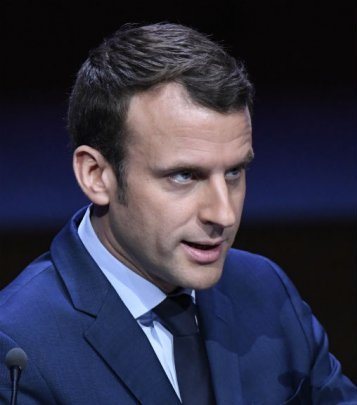
Emmanuel Macron

As a rule, the French do not really like to work during the summer.  Breaking with that tradition, Macron spent four months talking with the trade unions.  He invited – separately – the leaders of the different groups (CGT, FO, CFDT)  in order to hear their demands and make his own proposals.

The result was amazing.

The loud manifs (street demonstrations), which traditionally are the main tool of the trade unions, rapidly run out of steam.   On the basis of the summer negotiations, changes in the labor code were formulated into executive orders before becoming law.

Macron used the same strategy – divide and conquer – to defuse the revolt of the mayors. 

There are 36,000 municipalities in France.  Some of the communes are tiny with as few as 200 inhabitants, and feel unfairly treated as compared to the large and wealthy urban centers like Paris, Lyons or Marseille. When Macron announced he would drastically slash down the dotations (subsidies) made by the State, the local officials went up in arms. 

What did Macron do? 

He invited 1,500 mayors to the Elysée Palace and developed his plan to help the small communes .

Thanks to his work experience in the financial and business world, he focused on a crucial economic problem: the cost of French labor is not competitive enough. The main reason?  The cost of labor is bloated by the inclusion of “social charges.” Macron plans to have the entire population share the burden by paying a general tax.  The other pillar of his financial program is to stop demonizing capital income by reducing the tax to a flat rate of 30 percent  – a win-win system to encourage the French population to invest.

Emmanuel Macron has been described as having a velvet smile contrasting with the steely expression of his blue eyes. From the youthful, exuberant attitude he projected during the electoral campaign, he has evolved into the image of an authoritarian leader. He delegates the day-to-day running of the country to his prime minister Edouard Philippe, who is doing his job efficiently and with discretion.  This leaves Macron time to address the big picture, particularly regarding the new place of France on the world stage.

On Sept. 26, in a major speech at the Sorbonne, Macron showed his unwavering ‘Europhile’ vision. He proposes a ‘re-invention’ of Europe with action led by countries willing to make changes. To ensure the future of the Eurozone, he proposes a single budget, a ‘Super Minister’ of economy and the creation of a European IMF. He wants a “protective Europe” in relation to workers and consumers. He believes strongly in giving a central role to culture in defining the European identity.

During his visit to Abu Dhabi for the inauguration of the new Louvre museum on Nov. 8, Macron met with “MBS” (Saudi Arabia prince Mohammed Ben Salmane ) and with “MBZ” (Abu Dhabi crown prince, Mohammed Bin Zayed)  A feverish round of diplomacy took place in which the president succeeded to  “exfiltrate” the Sunni Lebanese minister Saad Hariri from Saudi Arabia and acted as a mediator in the growing fracture of the Persian Gulf.

On Nov. 28,  after a two-hour speech to 800 students of the Ouagadougou University, in Burkina Faso, the Q and A session turned into an hilarious exchange. “Can you help us fix the frequent power outages on the campus?” asked a student. “But this is not my responsibility,” Macron answered, “Ask your president to deal with this problem.” The reaction of his audience – was at first a roar of laughter then deafening applause. A symbolic detail of the Macron’s visit to Africa was that he was accompanied on his trip by leaders of recent  start-ups instead of the CEOs of large companies such as Areva or Total.

The three-day visit to Africa in late November was an opportunity for the French president to break, not only with the colonial era, but also with the neo-colonial era of Françafrique launched by General de Gaulle in 1960.  At a summit meeting held in Abidjan, Ivory Coast, where the discussions at the summit meeting dealt mostly with the immigration crisis, Macron initiated a partnership whereby Europeans and Africans should share responsibilities.  Macron did not mince words when he told his audience : “The passeurs (smugglers) are not European, my friends , they are African.”

At a time when Angela Merkel is vacillating and Brexit is looming, the role of Emmanuel Macron in Europe is crucial. 

Editor’s Note: This is the opinion of Nicole Prévost Logan.

Nicole Prévost Logan

About the author: Nicole Prévost Logan divides her time between Essex and Paris, spending summers in the former and winters in the latter. She writes a regular column for us from her Paris home where her topics will include politics, economy, social unrest — mostly in France — but also in other European countries. She also covers a variety of art exhibits and the performing arts in Europe. Logan is the author of ‘Forever on the Road: A Franco-American Family’s Thirty Years in the Foreign Service,’ an autobiography of her life as the wife of an overseas diplomat, who lived in 10 foreign countries on three continents. Her experiences during her foreign service life included being in Lebanon when civil war erupted, excavating a medieval city in Moscow and spending a week under house arrest in Guinea.