Letter From Paris: André Derain: Major Artist, “Fauvism” Champion Featured in Parisian Retrospective

Nicole Prévost Logan

André Derain usually evokes cheerful scenes of sailboats bobbing up and down in the bright colors of a Mediterranean fishing port.

Actually, Derain (1880-1954) is a complex artist, who had a strong influence on the evolving avant-garde movements at the start of the 20th century.  The Pompidou Center is currently holding a retrospective titled, “Derain – 1904-1914. The radical decade.”

The curator of the Pompidou exhibit, Cecile Debray, comments, “Derain is the founder with Matisse of Fauvism and an actor of Cezanne’s Cubism with Picasso.” Never before had the artist been attributed such a crucial role. Derain was not only the link between the masters — Gauguin and Van Gogh — and the next generation of artists, but also an explorer of new sources of inspiration, including primitive Italians, along with African and Oceanic art. 

To quote Gertrude Stein (the writer and art collector famous on the cultural Parisian scene in the 1920s and 1930s), “Derain was the Christopher Columbus of modern art, but it is the others who took advantage of the new continents”

Not interested in the career of engineer planned for him by his father, the young Derain preferred to spend all his time at The Louvre, copying  the classics. He shared a studio with his friend Vlaminck on the Chatou island northwest of Paris where he was born. His first paintings had as subjects the Seine river, its banks and bridges, and the activities of workers. He displayed a distinctive technique of fast brush touches, (slightly different from “pointillism“), innovative plunging views and cropping, which give  his works the spontaneity of photographic snapshots.
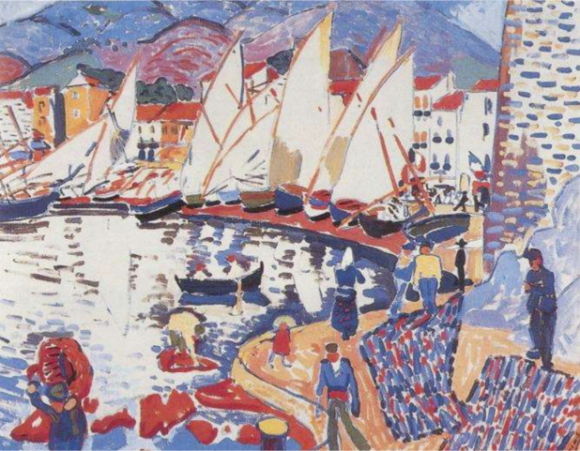
“Collioure, the drying of the sails'” by André Derain.

In the summer of 1905, he spent the summer in Collioure with Matisse and was dazzled by the Mediterranean light. Derain defined light as the negation of shadow.  He writes, “Colors become cartridges of dynamite casting off light.”  The room VII of the 1905 Salon d’Automne, called “la cage aux fauves,” caused a scandal, (fauves mean wild animals.)  In 1907, the Russian art collector Ivan Morozov acquired Derain’s paintings from the merchant Ambroise Vollard for the sum of 600 francs.

The following summer,  Derain continued to work with Matisse at l’Estaque, near Marseille. His compositions became more structured, with strong lines, volumes, perspectives and plans.  He still used arbitrary colors.   
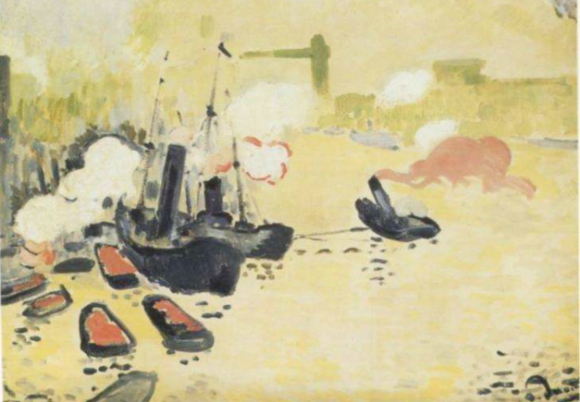
‘London’ by Andre Derain.

During two visits to London, he became fascinated by the bustling traffic of barges and tugboats on the Thames. He used the puffs of smoke mixed with the mist to decline all shades of whites. He found a new inspiration in the representation of water and sky. The apotheosis is an almost abstract sunset with the sun breaking through the dark clouds as if putting the sky on fire.

In 1910, Derain is part of the Cubist movement as shown in his representation of the village of Cagnes – an assemblage of cubes with red roofs scattered on a hilly landscape made of geometric lines and volumes of dense vegetation.

The versatility of Derain seems to be boundless. He played the piano, was  a professional photographer, and enjoyed fast cars (he owned 11 Bugattis.)  Using his virtuosity as a draughtsman, he created illustrations for humor publications along with stage and costume designs (for Diaghilev and the Russian ballets.)
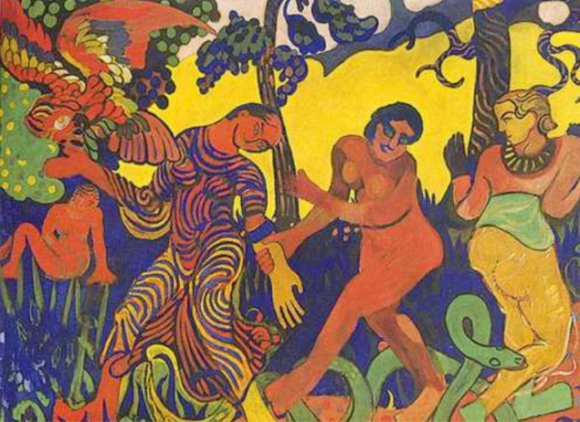
The dance” by André Derain.

Before leaving the exhibit, the visitor will be stunned by The Dance, 1906 – a large (185 x 228 cm) decorative composition of three women undulating in a luxuriant forest.  The work is rarely seen, since it belongs to a private collection.  Derain was inspired by a poem by Apollinaire and called it L’Enchanteur pourrissant (the rotting magician) about three fairies looking for Merlin’s tomb. The gestures of the dancers are reminiscent of Egyptian and Indian art, and could have inspired Nijinsky’s choreography. The mysterious vegetation and the hidden meaning of a snake and a multicolored parrot infuse the ritual scene with symbolism.

Editor’s Note: This is the opinion of Nicole Prévost Logan.

Nicole Prévost Logan

About the author: Nicole Prévost Logan divides her time between Essex and Paris, spending summers in the former and winters in the latter. She writes a regular column for us from her Paris home where her topics will include politics, economy, social unrest — mostly in France — but also in other European countries. She also covers a variety of art exhibits and the performing arts in Europe. Logan is the author of ‘Forever on the Road: A Franco-American Family’s Thirty Years in the Foreign Service,’ an autobiography of her life as the wife of an overseas diplomat, who lived in 10 foreign countries on three continents. Her experiences during her foreign service life included being in Lebanon when civil war erupted, excavating a medieval city in Moscow and spending a week under house arrest in Guinea.
Letter From Paris: To Be or Not To Be [Independent] — The Catalonian Question

Nicole Prévost Logan

The tentative attempt by Catalonia to secede from Spain has failed – at least for now.  But the attachment of the Catalan people to their identity is so strong that the fight for independence is far from over.  The Catalonian regional elections on Dec. 21 are likely to take place in a very agitated, if not violent, context.

The province of Catalonia has just lived through its worst political crisis in decades.  On Aug. 17, the terrorist attack in Barcelona that killed 13 people and injured 113 left the population of that city badly shaken.  On Oct. 1, a referendum showed how divided the population was with 90.2 percent voting for independence … but with a participation rate of only 45 percent.  For several days, the two protagonists – Mariono Rajoy, prime minister of Spain and Carles Puigdemont, the Catalan President – faced off each other, avoiding any dialogue.

Then on Oct.17,  the separatist members of the Catalan parliament announced the declaration of independence by 70 votes to 10.  The situation became untenable for Puigdemont.  He surreptitiously left the country to reappear in Brussels.  For the first time ever, Article 155 of the constitution was activated — Madrid issued an arrest warrant for Puigdemont for espousing rebellion and placed the province under strict supervision. 

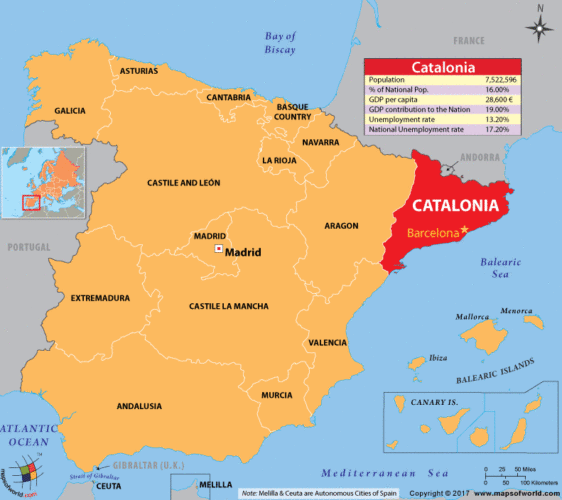
This map shows the location of Catalonia in Spain.

How does one explain the fierce nationalism of the Catalan people?  It is deeply anchored in their history.  Until the early 16th century, the county of Barcelona was at the center of power in Spain and closely united to the Aragon crown.  After the War of the Spanish Succession, the Catalans had to surrender to the Bourbons on Sept. 11, 1714.  The Catalonians remember that heroic battle by naming that day their National Day, calling it Diadia.  The civil war from 1936 to 1939, followed by 39 years of Franco’s fascist dictatorship, crystallized even further the Catalonians’ dream of autonomy.   

The European Union (EU) is keeping silent and uninvolved in what it considers as an internal problem for Spain.  Doomsday commentators had predicted that other regions of Europe such as Venetia, Lombardy or Corsica, would emulate Brexit. It is interesting to note that  Spain never recognized Kosovo for fear that Catalonia would follow suit.

When democracy was reinstated by King Juan Carlos, a new constitution and special self-rule status were granted to the Basque country, Catalonia and Cerdanya in 1978.  It is hard to understand why Catalonia did not accept the  favorable  terms offered by Madrid.  The ETA (Basque independence movement) did thus putting an end to their armed resistance, which had lasted for more than 50 years.

A visit to Barcelona helps understand the dynamic, feisty, almost turbulent temperament of the Catalan people.  Just mingle with the crowds on La Rambia – the heart of the city – or discover the extravagant architecture of Anton Gaudi in the Sagrada Familia cathedral. 

Catalonia can claim three artists, all larger than life and with strong personalities.  Joan Miro, the abstract artist creator of distinctive playful forms, was extremely proud of his Catalan origins.  Picasso spent several years as a teenager in Barcelona.  In 1905, he found the models for his “Les Demoiselles d’Avignon” among the prostitutes of a small street by that name located near the port.  The surrealist Salvador Dali went totally wild with the design of his museum in Figueres, his hometown.

Unfortunately, the project of the Catalan separatists did not take into account the long-term problems.  By early November of this year, 2,000 companies and banks had already left the province: tourism is being affected: the stock market has plummeted, and if Catalonia were to secede from Spain, it could not become part of the EU. 

In the simplest of terms, Catalonia may now, as a result of the most recent developments, find itself in a worse situation than before its declaration of independence.

Editor’s Note: This is the opinion of Nicole Prévost Logan.

Nicole Prévost Logan

About the author: Nicole Prévost Logan divides her time between Essex and Paris, spending summers in the former and winters in the latter. She writes a regular column for us from her Paris home where her topics will include politics, economy, social unrest — mostly in France — but also in other European countries. She also covers a variety of art exhibits and the performing arts in Europe. Logan is the author of ‘Forever on the Road: A Franco-American Family’s Thirty Years in the Foreign Service,’ an autobiography of her life as the wife of an overseas diplomat, who lived in 10 foreign countries on three continents. Her experiences during her foreign service life included being in Lebanon when civil war erupted, excavating a medieval city in Moscow and spending a week under house arrest in Guinea.

Letter From Paris: The State of the Continent – A Snapshot of European Politics

Nicole Prévost Logan

Is the far right forging ahead in Europe?

The political landscape of the European Union (EU) has shifted somewhat to the right during the past few months.  At the core of this trend is the fear of losing one’s identity following the recent surge of migrants.  Angela Merkel’s decision in 2015 to open wide Germany’s borders – and hence Europe’s – has had a lasting impact.  Max Leonard, director of the European Council on Foreign  Relations, based in London, has suggested that the trauma resulting from the decision for Europeans can be compared to that of the 9/11 attack for Americans.

Sebastian Kurz

In Austria , the legislative elections, held on Oct. 17,  gave 31.5 percent of the votes to the conservative People’s Party (OVP) led by Sebastian Kurz.  At age 31, Sebastian Kurz may become the youngest ever Chancellor of that small alpine country of eight million people with a robust economy.  He is not xenophobic nor racist and disapproves of anti-semitism.  However, Kurz may have to strike an alliance with the far right Freedom Party (FPO), which finished in third place behind the declining social democrats (SPO).

To understand Austria, one needs to remember a few facts: it  has been subjected to a flux of Kosovar and Bosniac refugees following  the late 1990s conflict in the Balkans;  it has never been a colonial power and does not have a bad conscience with regard to the economic fate of sub-Saharan migrants. According to French political commentator Christine Okrent, Austria has never gone through the process of “denazification” and considers itself to have been a victim during World War II.  The nostalgia of its past as part of the Habsburg Austro-Hungarian empire still lingers.

Andrej Babis

To complete this snapshot of European politics, the Oct. 20 and 21 legislative elections in the Czech Republic saw Andrej Babis’ party arrive in first place. The 63-year-old tycoon – nicknamed Trump 2 –  proclaims to be anti-immigration, but pro-Europe and pro-NATO. He shares his ideas with the other members of the central European “Visegrad group” (Poland, Hungary and Slovakia.)

Angela Merkel, after her somewhat disappointing results in the last September elections, is reaching out to the Christian Social Union (CSU) and the Greens in order to give her Christian Democrat party (CDU) a comfortable majority. These negotiations may keep her off the front stage until the end of the year.   

In France, Marine Le Pen has practically collapsed after the disastrous debate against Emmanuel Macron on May 3 between the two rounds of the presidential elections. She has become an inaudible adversary in the National Assembly.  Marion, her even more right-wing niece, was clever enough to jump ship last spring.  Marine’s co- president, highly educated Florian Philippot, was ejected from the National Front (FN).  Several legal pursuits for financial “improprieties,” both for her activities as European deputy and in France, are still looming against her. 

After six years of being in the limelight , Marine Le Pen is now in the process of redefining herself. 

Editor’s Note: This is the opinion of Nicole Prévost Logan.

Nicole Prévost Logan

About the author: Nicole Prévost Logan divides her time between Essex and Paris, spending summers in the former and winters in the latter. She writes a regular column for us from her Paris home where her topics will include politics, economy, social unrest — mostly in France — but also in other European countries. She also covers a variety of art exhibits and the performing arts in Europe. Logan is the author of ‘Forever on the Road: A Franco-American Family’s Thirty Years in the Foreign Service,’ an autobiography of her life as the wife of an overseas diplomat, who lived in 10 foreign countries on three continents. Her experiences during her foreign service life included being in Lebanon when civil war erupted, excavating a medieval city in Moscow and spending a week under house arrest in Guinea.

Letter From Paris: (Old Hand) Putin Meets (New Kid) Macron With Surprising Results

Nicole Prévost Logan

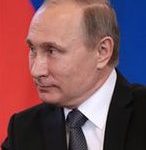
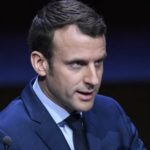
The hour-long press conference held jointly by long-standing Russian President Putin and newly-elected French President Macron in the Palace of Versailles on May 29, was a spectacle not to be missed.

Vladimir Putin

Emmanuel Macron

Putin had been absent from the high-powered week during which US President Donald Trump met with heads of state at the new NATO headquarters in Brussels and at the G7 summit in Taormina, Sicily. Macron seized an opportunity to invite the Russian president. The timing, location and format of the encounter of the two presidents were a smart move on the part of Macron.

He was not organizing a “state visit” – lest he offended Angela Merkel – but asking the Russian leader to be present at the inauguration of an exhibit marking the 300th anniversary of the visit of Tzar Peter the Great to France. The two presidents met in the grandiose 17th century palace of the French monarchs. Putin would probably find similarities between the ornate rooms and his elegant home town of St. Petersburg.

The visit was organized under the sign of culture and meant to revive the historical ties between the two countries. Macron mentioned how much Peter the Great had wanted to open up his country to the West and learn about its military architecture, crafts, and sciences. Putin contributed proudly an even earlier historical fact – the marriage at Queen Ann of Kiev, daughter of Grand Prince Yaroslav the Wise, to French King Henry I, in 1051.

During the press conference, the supposedly “novice” French president appeared self-assured, and totally in charge of the proceedings. He described how he envisaged cooperation with Russia. His road map for Syria was to guarantee humanitarian aid to the population and emphasize that the use of chemical weapons would constitute a red line that would be met with an immediate response from France.

Macron added that failed states lead to chaos. Hence the necessity to keep Bachar el Assad until ISIS is eradicated. In Ukraine, he stressed that an agreement should be reached within the framework of the Minsk accord. The objective there is both to stop progression of the spheres of influence of Russia in the region and the escalation of violence. He did not say the word ‘Crimea,’ however, implying that its return to the Ukraine was not on the agenda.

In his statement, Macron declared that during their three-hour-long conversation they covered all topics, including areas of disagreement. As he mentioned the treatment of homosexuals and transgenders in Chechnia, he turned toward Putin and told him to his face, “We will monitor the progress you make in that area.”

During his talk, Putin looked fidgety, ill-at-ease, squirming, and with shifty eyes. He mumbled his comments. He did say though that he would be ready to engage in a dialogue. Then, turning toward the audience of international media, he almost pleaded with them, saying, “You have to convince public opinion that the sanctions are stifling Russia. Tell the world they have to be lifted.”

French journalists raised questions about the spread of fake news on the social networks and in magazines like Sputnik and Russia Today intended to destabilize the leader of the En Marche movement during the campaign. Macron retorted that those people are not journalists and will not be treated as such.

Journalists also asked what the French government was going to do about the hacking of 70,000 documents belonging to then-candidate Macron 40 hours before the first round of the vote. Macron responded that he was not going to dwell on those events, adding, “What I want to do is to move on.”

From the exchanges between the two protagonists, it was clear that Macron was in control of the situation. His message was clear and direct. The days when Putin disregarded the EU as being too weak were now over. The power dynamic was the correct one for Macron to use and Putin understood that.

This was a textbook situation where the two protagonists, although not liking each other, could work out a resolution from which both could profit. Since 1990, Putin — a major player behind the war in Syria — has been shattered by the implosion of the Russian empire. Moreover, since sanctions are hurting his country severely, the give and take of negotiation is therefore possible.

Now, we can only hope that effective action will match the quality of this performance by Macron.

Editor’s Notes:
i) This is the opinion of Nicole Prévost Logan.
ii) Nicole is, in fact, now back in Essex, but events in France are currently moving so fast that she’s continuing to write for us from this side of the Atlantic in an effort to keep readers over here up to date.  Merci, Nicole!

Nicole Prévost Logan

About the author: Nicole Prévost Logan divides her time between Essex and Paris, spending summers in the former and winters in the latter. She writes a regular column for us from her Paris home where her topics will include politics, economy, social unrest — mostly in France — but also in other European countries. She also covers a variety of art exhibits and the performing arts in Europe. Logan is the author of ‘Forever on the Road: A Franco-American Family’s Thirty Years in the Foreign Service,’ an autobiography of her life as the wife of an overseas diplomat, who lived in 10 foreign countries on three continents. Her experiences during her foreign service life included being in Lebanon when civil war erupted, excavating a medieval city in Moscow and spending a week under house arrest in Guinea.

Letter From Paris: And Then There Were Two … Candidates Left for French President

Nicole Prévost Logan

Out of a chaotic and divisive campaign to elect the president of France came a surprisingly middle-of-the-road and constructive vote.  Emmanuel Macron, age 39, Europhile leader of the En Marche (EM) movement climbed to the first place with 24.01 percent of the votes.  Marine Le Pen (Front National or FN), received 21.3 percent, both therefore qualifying for the run-off election on May 7. For the FN it was an historical feat after a long struggle, started in 1972, to be acknowledged as an honorable political party.  The turn-out was high at 78 percent of the 47 million voters.

Until the last minute, the outcome was anyone’s guess.  The four candidates – two extremists, one conservator, and one center right – were running in a close pack.  “Fasten your seat belts” said a member of The City in London on the very morning of the elections, expressing the anxiety of the whole world.  At stake were a rejection of the Euro and abandoning the European Union (EU.)  “We were on the brink of world-wide financial tsunami” said one of the BFM radio economists.  Many around the globe greeted the result with a sigh of relief.

For the French voters what was happening had a deeper meaning than the one described in the international press.  This moment marks a painful turning point in French politics by ending the traditional pendulum swinging from Right to Left and wiping out the two main parties – the right wing Les Republicains (LR) and the Parti Socialiste (PS), which had been in existance for 30 years. The two winners were outsiders.  This a wrenching process for the French, who love to criticize, but hate change.

The whole campaign was overshadowed by the “Penelope-gate” and Fillon’s other affaires (troubles) [*See Letter from Paris” published on March 5, 2017.]  Bruno Retaillau, Fillon’s spokesman, commented with some bitterness, “This was not a campaign but a trial”.

On election night, as the numbers came up on the screens, political personalities made brief  comments then left to be replaced by others.  The right wing LR members announced they would transfer their votes to Emmanuel Macron.  Jean Pierre Raffarin, prime minister from 2002 to 2005 under president Jacques Chirac, forcefully endorsed  Macron.  Jean François Copé, former president of the UMP (predecessor of LR)  and minister,  agreed that they had to block Marine Le Pen.  He stressed that he would vote for En Marche but with a sinking heart. Alain Juppe, minister of Foreign Affairs under Nicolas Sarkozy and mayor of Bordeaux, also gave his vote to Macron saying “our country needs reforms.”  François Fillon’s words were the best of his campaign, “The defeat of the LR is mine, I take all responsibility. ”

Jean Luc Malenchon, leader of the leftist movement la France Insoumise (rebellious France), was obviously very upset to have lost.  Unlike the other candidates, he did not give instructions on how to vote in the run-off.  Since seven millions supporters voted for him, this question of transfer of votes will greatly tip the scale.

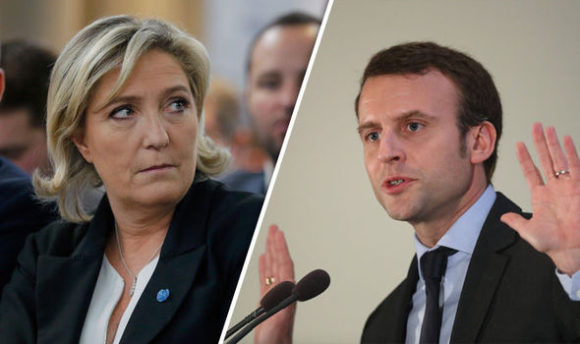
Marine Le Pen and Emmanuel Macron will face off in the final round of the French election on May 7.

On election night, Emmanuel Macron shared his satisfaction with the cheering flag-waving crowd in the huge hall at the Porte de Versailles.  His first words were to thank the other candidates.  Such courteousness is usually seen on the Rolland Garros tennis courts between Federer and Nadal, but certainly not among French politicians!

The electoral campaign took a sharp turn after April 23.  All of a sudden, it became a confrontation between the two candidates, a ruthless fight to the finish.  Macron was blasted for celebrating at the Rotonde brasserie on the first night and then for being invisible during the following two days. In contrast, Marine showed her ability as a superb strategist as she pre-empted the field immediately from the Ringis wholesale food market to a fishing trawler in the Mediterranean.

On April 26,   Macron went to Amiens (90 miles north of Paris) , his home town, to meet with the Whirlpool plant workers due to be laid off in 2018.  After talking with the Union representatives, he plunged into the battlefield and was roughed up by the angry crowd for 45 minutes.

But he stayed.

He talked to the workers, listened to their complaints.  He even had a heated discussion with Jean François Raffin, who is a star in France and won a César (French version of Oscar) in 2017 for his documentary Merci Patron (Thank you, boss.)  It is a satire on the relations between the working class and the super rich employers such as Bernard Arnaud,  CEO of LVMH.  Raffin, like Macron, is a native of Amiens.

Marine Le Pen, decided to drop by the Whirlpool site the same day.  She appeared all smiles, selfie in hand, working the crowds, hugging and kissing, doing small talks.  On an amazing picture she is shown beaming as she embraces a diminutive worker woman, who is in tears.

What happened in Amiens was emblematic of the confrontation between the two candidates in a difficult situation.  The relocation of a profit-making factory to Poland, where salaries are five times lower than in France, is one of the core issues the European Union (EU) is facing.

Le Pen promised the world to the workers, such as keeping the factory in France and, if needed, having it nationalized.  In contrast, the EM leader promised only to assist with the transition to other jobs.  He had the courage to tell an overheated audience that there will be many more similar relocations and one has to adjust to the new economy.

“Çà n’est pas gagné” (we have not won yet) said Macron, getting into his car.  He is right, especially when two people are fighting on different levels — one arousing fear and hatred, the other using pedagogy to propose obtainable solutions.

Editor’s Note: This is the opinion of Nicole Prévost Logan.

Nicole Prévost Logan

About the author: Nicole Prévost Logan divides her time between Essex and Paris, spending summers in the former and winters in the latter. She writes a regular column for us from her Paris home where her topics will include politics, economy, social unrest — mostly in France — but also in other European countries. She also covers a variety of art exhibits and the performing arts in Europe. Logan is the author of ‘Forever on the Road: A Franco-American Family’s Thirty Years in the Foreign Service,’ an autobiography of her life as the wife of an overseas diplomat, who lived in 10 foreign countries on three continents. Her experiences during her foreign service life included being in Lebanon when civil war erupted, excavating a medieval city in Moscow and spending a week under house arrest in Guinea.