Letter From Paris: Macron & Merkel: Can This Power “Couple” Lead Europe?

Nicole Prévost Logan

On Sept. 26, 2017, Emmanuel Macron chose the Sorbonne University to develop his grand vision for Europe.  In that seminal speech he was urging his perceived partner German Chancellor Angela Merkel to join him in tackling the lofty goals of European reforms, speeding up the integration of the Eurozone through the creation of a parliament, a ministry of finances, and its own budget.   

Macron proposed to strengthen the common market and reduce the economic inequalities through the  harmonization of taxes, creation of a minimum wage, and reform of the “detached workers” system, which leads to employment of migrant workers at cheaper rates than would likely be available locally — a practice known as “social dumping.”  His approach is based on several principles: a Europe protected by well-managed  external borders and a strong defense; the opening of Europe to free trade, but with due regard for reciprocity, and solidarity among the European Union (EU) members regarding the treatment of refugees.

After an interminable six months, the “Great Coalition” between German Conservatives and Social Democrats has made it possible for Angela Merkel to start her fourth mandate. Barely a few hours after her confirmation as Chancellor on Friday, March 16, she met with French President Macron accompanied by several ministers.  The speed with which she came to Paris shows how important it was for those two heads of state to get to work. 
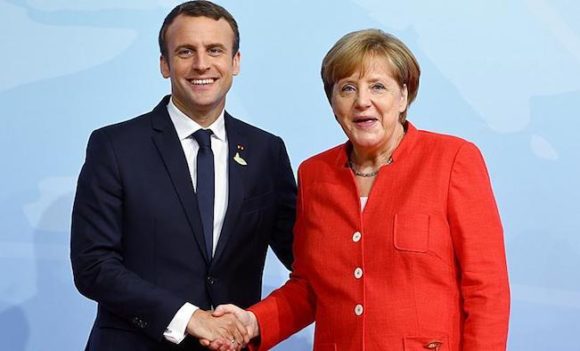
French President Emmanuel Macron and German Chancellor Angela Merkel.

Unfortunately, the geopolitical environment allowing them to be the driving force of a dynamic Europe has shifted and even deteriorated during that long waiting period and their task has become more difficult. Merkel is politically weaker.  The continent is now fragmented and the resistance from newly-created groups within the EU has become more aggressive.  Macron will have to downgrade his proposals and make adjustments.

The political context in which Merkel starts her fourth mandate is quite different from the one existing in 2013.  Only 52 percent of the population supported the new chancellor in 2017 versus 73 percent in the earlier elections.  Compared to the consensus Merkel was able to maintain previously, it is harder now for her to keep the lid over dissenting opinions.

Even though they are part of the “Great Coalition,” several ministers stand in disagreement with the chancellor, including Olaf Scholz (social democrat or SPD), vice-chancellor and minister of finances, who believes in tightening the budget; Horst Seehofer  (head of the conservative Christian Social Union or CSU in Bavaria), who was given the  “super ministry” of the interior, who intends to be harsher toward the immigration policy in the name of the reactivated concept of “heimat” (homeland); Jens Spahn, 37, minister of health (Christian democratic union, CDU or Merkel’s own party), who is also a critic of Merkel’s policy on migrants, and Andrea Nahles, leader of SPD in the Bundestag, wants to rush through social reforms in favor of the workers. 

Even more difficult for Merkel will be the meteoric growth of the far right party (Alternative for Germany or AfD).  In  2013 it did not have enough votes to have representatives  in the Bundestag.  To-day AfD holds 92 seats out of 709.   At a recent news cast on the ARTE channel, the violent tone of a AfD member at the Bundestag was incredible.

The “Countries of the North” (as they are now called) — Ireland, Iceland, along with the Scandinavian and Baltic states, as well as the Netherlands — believe in a strict budget and are inflexible about financial and monetary discipline. Mark Rutte, Prime Minister of TheNetherlands, speaking for the North countries , declared, “We have to adhere to the Maestrich criteria,” namely to keep the public deficit under 3 percent of the Domestic Gross Product.  On March 27, for the first time in 10 years, France saw her deficit fall down to 2.6 percent.  This was a significant accomplishment:  France is now a credible member of the “club.” 

The North countries ask that Italian and Greek banks clean up their toxic debts.  A “mutualization” of the debt (particularly of Greece’s sovereign debt) and financial transfers are a red line conservative parties from Germany or Holland are not willing to cross.  Like Macron and Merkel, however, Rutte sets as a priority a European Stability Mechanism (EMS) and a European Monetary Fund .

The recent Italian elections on March 8 were a blow for moderate centrists like Matteo Renzi, and the victory of two extremist, anti-system and xenophobe parties: the Five Stars (M5S) at the far left, and The League at the far right.  Italy joins now the eurosceptic countries like Austria and the Visegrad group (the former Iron Curtain countries of Eastern Europe.)  All these countries oppose the Macron/Merkel policies on trade, finances, democratic values and attitude toward the migrants.

Given this overview of the political landscape of Europe, it seems that the strategy of Macron and Merkel will be to start from the areas of agreement – passage toward Brexit, defense against terrorism, and protection against excessive Chinese investments in the name of the “Silk Road.”

The reactions of other EU members toward Macron’s “jupiterian” style and desire to reform are ambivalent.  In a March 20 interview published by Le Monde, Xavier Bettel  prime minister of Luxembourg said that a “directorate Paris-Berlin is out of the question, but added”  France and Europe are lucky to have him. Even if we do not agree with all his proposals, they are most welcome.” 

Editor’s Note: This is the opinion of Nicole Prévost Logan.

Nicole Prévost Logan

About the author: Nicole Prévost Logan divides her time between Essex and Paris, spending summers in the former and winters in the latter. She writes a regular column for us from her Paris home where her topics will include politics, economy, social unrest — mostly in France — but also in other European countries. She also covers a variety of art exhibits and the performing arts in Europe. Logan is the author of ‘Forever on the Road: A Franco-American Family’s Thirty Years in the Foreign Service,’ an autobiography of her life as the wife of an overseas diplomat, who lived in 10 foreign countries on three continents. Her experiences during her foreign service life included being in Lebanon when civil war erupted, excavating a medieval city in Moscow and spending a week under house arrest in Guinea.
Letter From Paris: Visit to Franco-American Museum in Blerancourt Sparks Review of Relationship Between the Two

Nicole Prévost Logan

La Fayette nous voilà (La Fayette, here we are) are the famous words General John J. Pershing , commander of the American Expeditionary Forces, is supposed to have pronounced  on July 4, 1917 during the commemoration near the tomb of the Marquis de La Fayette at the Picpus cemetery in Paris. The entry of the Americans in World War I was a way to return the favor to the French for being an ally throughout their history. The Franco-American museum in Blerancourt, in a concrete way, furthered this enduring amity.

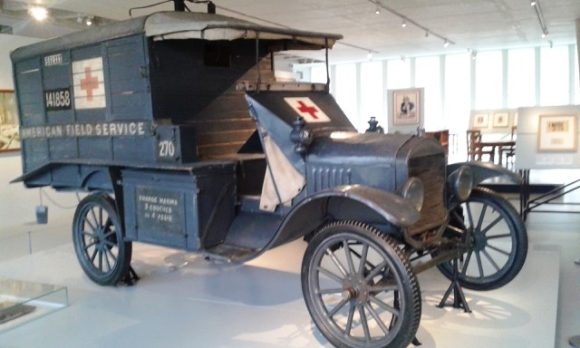
From the outbreak of the war even before America declared war on Germany on April 6, 1917, a segment of US public opinion, wanted the country to enter the conflict. Among the Americans living in Paris (there were 100,000 of them at the time), private associations such as the American Field Service,  intellectuals, writers, and artists offered to join the allied cause. Many young people volunteered as ambulance drivers.

Many volunteers served in ambulances like this one on display in the Museum of Blerancourt during the Great War.

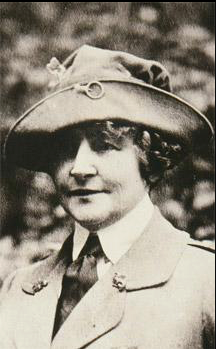
One of them was Anne Morgan (1873-1952)  third daughter of  John Pierpont Morgan, Sr., banker and art collector.

Anne Morgan

She started raising funds to equip the French army as early as 1915, and in 1917 chose the village of Blerancourt, which was in the midst of total devastation, to carry out her humanitarian aid to the wounded soldiers and civilian population. 

The Aisne department (a department in France is the US equivalent of a county) was one of the worst hit battle fields. It is sadly remembered for being the scene of three bloody campaigns all called Chemin des Dames in 1914, 1916 and 1917 . In April 1917 alone, 100,000 French soldiers died on that front. 

Morgan worked from the barracks she erected on the terraces of the Chateau de Blerancourt – a grand 17th century private residence built by the architect who designed the Luxembourg Palace, for Marie de Medicis.  In 1919, Morgan bought the ruins of the chateau and started its restoration. In 1923, she created the association of the Friends of Blerancourt and the following year founded what was to become the Franco-American Museum.

The restored 17th century elegant rooms of the chateau are quite fitting for the historical part of the museum.  French explorers -Jacques Cartier, Father Jacques Marquette-Cavelier de la Salle, Champlain and others  – left their trace in the geography books of the New World. Their names are still vivid but the lands they discovered – from Canada to Louisiana – have long severed ties with France.  Only the St Pierre et Miquelon archipelago remained part of the mother country.

La Fayette was the first Frenchman to enlist in the War of Independence in 1777. With a great deal of panache, in October 1781, the 6,000 men of Count of Rochambeau, joined the Continental Army of George Washington, later the fleet of Admiral de Grasse encircled the English forces.  The combined effort ended in the victorious battle of Yorktown and the rendition of the British.  

Was its support in the conflict beneficial to France?  Some historians do not think so.  Claude Moisy, former president of Agence France Press  (AFP), journalist and specialist in the political history of the US, is one of them and goes as far as to believe that France was caught in a fool’s game.  

During a talk Moisy gave to the France-England Association in 2007, he described the sequence of events, as he sees it: the US Congress had promised not to sign a separate peace with the English, but it did on November 30 ,1782, after secret negotiations.

The real objective for the American government was to resume, as soon as possible, trade and economic relations with Great Britain.  Washington had dispatched Benjamin Franklin to Paris. He soon became the coqueluche (the rage) of the Paris society and suspiciously close to it. The author describes Paris at that time as a “panier de crabes” (can of worms), crawling with spies and foreign agents.

The final peace treaty was only signed 10 months later in September 1783, with the participation of Holland and Spain.

2018, – the year of commemorations marking the 100th anniversary of the Great War- started appropriately with the “Cesars” selecting Au Revoir Là Haut, as best film and best director.  It is based on the 2013 Prix Goncourt novel by Pierre Lemaitre. Two soldiers- nicknamed “poilus” during the Great war-  experience the horror of trench war, including being buried alive .  (the writer may have been inspired by what happened to the poet and art theoretician  Guillaume Apollinaire, who was buried alive three times, underwent trepanation and died in 1918.).  The story continues after the war, when the two heroes, traumatized and disfigured by injuries, witness the sordid traffic of war memorials.

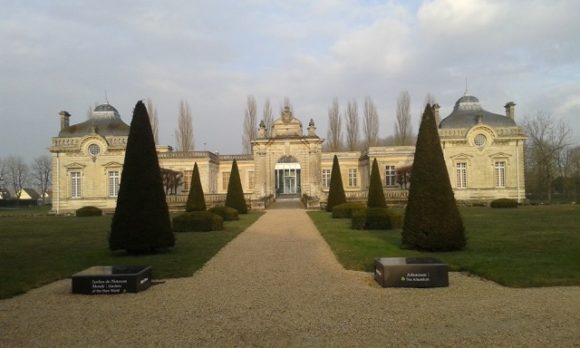
The Chateau de Blerancourt makes a charming picture.

The Blerancourt museum  is a lovely, luminous building,, located at about two hours drive north-east of Paris. The World war I activities of Anne Morgan -including her ambulance, uniform, wartime memorabilia and mobile library- are brought back to life. 

The Art department has just been renovated and contains more than 400 works. The collection  includes paintings by impressionist Childe Hassam, John Singer Sargent and many others.  The arrival of American troops in St Nazaire was caught in Art Deco style by French artist Jean Emile Laboureur in 1918.  Singer and dancer Josephine Baker, appears on the cover of the “Revue Nègre“.  She was born in St Louis, joined the Resistance and is an idol in France.

Editor’s Note: This is the opinion of Nicole Prévost Logan.

Nicole Prévost Logan

About the author: Nicole Prévost Logan divides her time between Essex and Paris, spending summers in the former and winters in the latter. She writes a regular column for us from her Paris home where her topics will include politics, economy, social unrest — mostly in France — but also in other European countries. She also covers a variety of art exhibits and the performing arts in Europe. Logan is the author of ‘Forever on the Road: A Franco-American Family’s Thirty Years in the Foreign Service,’ an autobiography of her life as the wife of an overseas diplomat, who lived in 10 foreign countries on three continents. Her experiences during her foreign service life included being in Lebanon when civil war erupted, excavating a medieval city in Moscow and spending a week under house arrest in Guinea.
Letter From Paris: Annual ‘Salon de l’Agriculture’ Prompts a Peek into Farming in France

Nicole Prévost Logan

The Salon de l’Agriculture (agricultural fair) is the most popular event of the year in Paris.  For two weeks, the Porte de Versailles is turned into an oversize farm   Four thousand animals – bovines, pigs, sheep and fowl – move in for the delight of both children and adults.  It is the largest agricultural show in Europe.

The French are emotional about their relationship with the countryside and never forget that they share a common rural ancestry and that, just a few decades ago, 25 percent of the population lived and worked on the land. The fair is an opportunity for rural and urban communities to get together and have a good time.

Food is a big attraction at the fair.  Thirty seven restaurants offer culinary specialties from each region: trip à la mode de Caen (tripe cooked in cider and calvados), boeuf bourguignon,  tartiflette (Savoyard gratin with Reblochon cheese, cream and pork), Toulouse cassoulet , bouillabaisse and hundreds more dishes, accompanied by the best wines.

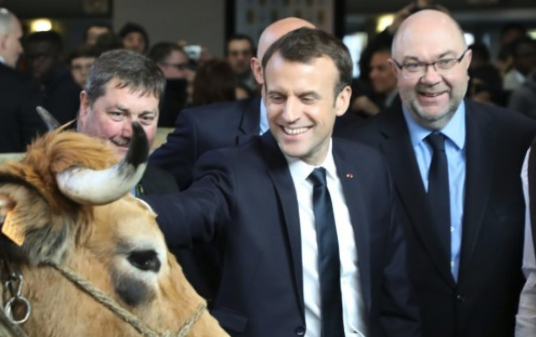
French President Emmanuel Macron meets the much-admired cow named Haute at the Salon de l’Agriculture.

Entertainment reaches its height with the competition for the best animal. This year the star of the show is Haute, a 700 kilo blonde cow of the Aubrac breed raised in Aveyron (a volcanic plateau in the south west), whose big black eyes are made-up with mascara.  Haute has a pedigree in the same way as a racehorse and her offspring are already in line to compete in the 2024 fair – the same year that the Olympics will be held in Paris. 

From the air, the French landscape looks like a beautiful tapestry with colored patches of fields, woods and clusters of roofs huddled around a church steeple. Behind this idyllic picture, it is hard to believe that there is a tough world of fierce competition, hard work, and for some, a struggle to survive . 

Among the 450,606 working farms in France to-day, many of them are small with less than 10 hectares (one hectare is equivalent to 2.47 acres.) Their owners find it hard to make a living. The average income of a farmer is 1,525 euros for month and can be as low as 500 euros, which is well below the poverty threshold.  There are many reasons for this. 

Food today represents only 20 percent of a family budget as compared to 34.7 percent in 1960.   The agri-business and chains of supermarket distributors, in order to increase their profit margin, force the farmers to sell their milk or meat at rock-bottom prices.

Farmers are deep in debt because of the necessity to invest but they have ways to show their anger and frustration, such as pouring manure or truck loads of raw eggs on public squares.  Another effective way is for them to launch an operation escargot (snail offensive.) They bring their five-mile an hour tractors on the highways with the expected result.   

European farmers could not survive without financial subsidies from Brussels.  In 1962, the Politique d’Agriculture Commune (PAC — Common Agricultural Policy) was set up by the European Union (EU) to assist and guide the agriculture of  its members.  The PAC is the second largest item in the EU budget and one of its pillars.  Methods and objectives have changed over the years.  

For a while, it requested farmers to lay fallow their cultivated land.  Quotas for milk were stopped in 2015 and sugar in 2017.  Today the PAC is putting more emphasis on the development of organic food and protection of farmers against the climatic vagaries.  France is the leading agricultural country in Europe with production valued at 71 billion ahead of Germany (56.7 billion), Italy (54.2 billion) and Spain (49 billion.) France remains the top beneficiary of financial assistance from the PAC. 

Most Europeans are hostile to the use of pesticides.  Brussels wanted to set a 10-year-moratorium on the use of the herbicide Glyphosate.  Macron fought and demanded three years.  Finally Brussels decided on a period of five years. 

In France, Monsanto has become the prime bad guy.  Europeans are also against genetically-modified food and the addition of hormones and antibiotics in meat.  The French are getting very finicky about the traceability of products   A couple of years ago, horse meat was found in prepared food produced in Eastern Europe.  The French public went up in arms.   Since then, on every package or can, the geographic origin of the product has to be indicated.

Macron, during his visit to the Agricultural Fair asked the crowd, “Did you know that that 70 percent of the meat you eat in French restaurants is imported?  It makes no sense when French meat is probably the best in the world.”  The president is not a protectionist but, in his eyes, free trade agreements have to be equally  beneficial for both sides.  At present, the signing  of  the Mercosur Treaty between Europe and four South American countries is stalled, leaving Europeans worried.

It is a “must” for each French president to visit the fair.  Macron outdid all his predecessors by mingling with the crowd for more than 12 straight hours.  Always eager to explain his policies, he did not hesitate to plunge into the fray and engage in heated discussions with angry farmers. 

The day before the opening of the Salon, Macron had invited 700 young farmers to the Elysees palace.  As always, his method was not to promise financial assistance, but help his guests find creative solutions to make their farms more competitive.

Editor’s Note: This is the opinion of Nicole Prévost Logan.

Nicole Prévost Logan

About the author: Nicole Prévost Logan divides her time between Essex and Paris, spending summers in the former and winters in the latter. She writes a regular column for us from her Paris home where her topics will include politics, economy, social unrest — mostly in France — but also in other European countries. She also covers a variety of art exhibits and the performing arts in Europe. Logan is the author of ‘Forever on the Road: A Franco-American Family’s Thirty Years in the Foreign Service,’ an autobiography of her life as the wife of an overseas diplomat, who lived in 10 foreign countries on three continents. Her experiences during her foreign service life included being in Lebanon when civil war erupted, excavating a medieval city in Moscow and spending a week under house arrest in Guinea.
Letter From Paris: ‘The Donald’ and Europe Grow Further Apart

Nicole Prévost Logan

In February 2017, the European Union (EU) members, gathered at the Malta summit, were flabbergasted by President Donald Trump’s hostile attitude toward the United States’s traditional allies.  One year later the world has adjusted in the opinion of the seasoned diplomat Hubert Vedrine, France’s Minister of Foreign Affairs (1997-2002).  The French diplomat commented, “One has to get over our initial disbelief as to the unpredictable and apparently erratic policy of the 45th president of the US.”

The European opinion of Trump is not monolithic.  One has to differentiate between the North and South:  heavily indebted Greece and Germany with a flourishing economy will have opposite opinions.  The same divide exists between East and West: for example, nationalist and authoritarian countries like Poland will view Trump differently from the liberal Netherlands.

The Europeans resent Trump’s withdrawal from the Paris Climate Agreement leaving a wide open boulevard for China to become the champion defender of the environment.  Last January, the announcement made by the controversial Ryan Zinke, US Secretary of the Environment, that he would allow oil and gas drilling near almost all US coasts from Alaska to the Gulf of Mexico was considered a mistake.  The French oppose the position of Trump’s administration on the use of coal and other fossil fuel as sources of energy.  France has closed all its coal mines and does not even allow fracking for oil or gas exploration in fear of endangering the environment.

President Donald Trump

The recent financial and tax reforms introduced by the US president were characterized as a fiscal war with the rest of the world by economist and professor Philippe Dessertine.   On Jan. 26,  2018 at the Davos World Economic Forum, Christine Lagarde, head of the International Monetary Fund (IMF), criticized those measures by saying that, subsequent to creating benefits in the short term, they would ultimately impact world  financial vulnerability.  She believes that the increase in both liquidity and the budget deficit, will eventually cause a sudden drop in the stock market.  It is interesting to note that a few days after her speech, the Dow tanked and began a new cycle of high volatility.

French economists commented that lowering corporate taxes to 21 percent in the US – not that far from the 12.5 percent of Irish tax heaven – is placing the competitiveness of countries like France at a disadvantage.  It will take five years of arduous effort by French President Macron to lower French corporate taxes to 25 percent.  The French Minister of Economy and Finances, Bruno Lemaire, criticized these reforms for technical reasons.  He commented that they will penalize European subsidiaries located in the US and also be an incentive for American companies located in France to relocate to the US.

According to French economist Thomas Piketty, 68.1 percent of the US income tax reduction will benefit just 1 percent of the population, thereby increasing the already exisiting inequalities even further.  For Gerard Courteois, editorial writer of the French national newspaper Le Monde, there is an incoherence in the statement,”Make America great again,” particularly in the use of the word “again.”  Does it apply to the boom years after World War II when it actually was a time of high taxes and international trade?

Trump’s foreign policy is scrutinized by French diplomats and geopoliticians.  Vedrine describes the American president’s policy in the Middle East as a disaster.  Trump has created a confrontational axis with Saudi Arabia, Israel, Turkey against Iran and managed to freeze the Israel-Palestine peace process.  Regarding the European Union (EU), Trump’s objective seems to be its deconstruction.  Trump applauded Brexit and asked “Who is next?”  To European satisfaction, Congress has blocked the confirmation of a Europhobe nominee as US Ambassador to the EU.  The post has not been filled to date.

Trump’s diplomacy is not sophisticated.  It is a bully approach, forever brandishing the threat of more and greater sanctions, whether in the Ukraine, Iran or Korea.  Punitive measures are even taken by Trump toward the Palestinians.  He intends to suspend financial aid because they refuse to sit at the negotiating table.

French diplomats prefer pragmatism and negotiations.  Dominique de Villepin, former foreign minister (2002-2004) and prime minister (2005-2007), believes, for instance, that one has to accept the fact that North Korea is a nuclear power and entice that country to join the international community by helping  its economic development .

However, Vedrine says one should not blame Trump for everything.  Being realistic, France and Europe are not at the center of the world today.  If the US is stepping back, it is a chance for Europe to regain its autonomy.  Villepin suggests that Europe needs to break away from US guardianship .

At the annual Munich conference on security, participants showed for the first time their intention to step up the defense of the EU.  Last year Trump had scolded NATO members for not paying their share leading to the irritation of Washington today.  To put a stop to transatlantic polemics, Jens Stoltenberg, NATO Secretary General, wanted to be conciliatory and declared, “The increase in the European defense budget will reinforce the NATO European pillar.”

Judging from this non-exhaustive list of disagreements, relations between Trump and Europe are not particularly warm right now — in fact, one might be tempted to conclude they are well on the way to just plain bad.

Editor’s Note: This is the opinion of Nicole Prévost Logan.

Nicole Prévost Logan

About the author: Nicole Prévost Logan divides her time between Essex and Paris, spending summers in the former and winters in the latter. She writes a regular column for us from her Paris home where her topics will include politics, economy, social unrest — mostly in France — but also in other European countries. She also covers a variety of art exhibits and the performing arts in Europe. Logan is the author of ‘Forever on the Road: A Franco-American Family’s Thirty Years in the Foreign Service,’ an autobiography of her life as the wife of an overseas diplomat, who lived in 10 foreign countries on three continents. Her experiences during her foreign service life included being in Lebanon when civil war erupted, excavating a medieval city in Moscow and spending a week under house arrest in Guinea.
Letter From Paris: Book That Wins France’s Top Literary Prize Raises Chilling Questions About WWII History

Nicole Prévost Logan

Coincidence or not ?

The prestigious French literary Prix Goncourt came out came just a few weeks before the election of 31-year-old Sebastian Kurtz as chancellor of Austria.  Many would say that election marked another step by the European Union along the road toward nationalism.

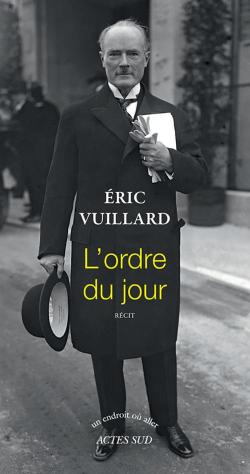
The topic of the novel is the Anschluss.  With devastating sarcasm the author, Eric Vuillard, puts the magnates of German industry on trial for profiting from the Nazi regime and the Austrian people for welcoming the invading German army on March 12  1938. The title itself is ironic since L’Ordre du Jour – which translates as ‘the order of the day’ or ‘the agenda’ – refers to a democratic assembly, which in the book will soon be abolished by Hitler.

It is a very short book (only 150 pages) printed in an unusual miniature format.  But it is a striking story, beautifully written, leading the reader through shocking scenes in which cruel humor is mixed with great despair.  Vuillard, is also a film maker, which explains the way he stages the story as seen through a camera, with colorful images, a sound track, leading actors and supporting crowds.

The action starts on February 20th, 1933, in Potsdam.  Twenty-four managers of the German industry – Gustav Krupp, Wilhem von Opel, Günther Quandt, Kurt Schmitt and others – are waiting in the ante-chamber of the Reichstag at the pleasure of its president, Hermann Goering.  The 24 grey-haired gentlemen, dressed in formal black or brown coats, with stiff shirt collars and striped pants, resemble the bare trees lining the Spree river in the winter.

Goering is late but the visitors wait patiently.

When he finally shows up, the guests raise like lizards on their hind legs.  Hitler – appointed chancellor just one month before – makes his entry and greets his guests.  At the end of the meeting, as expected from them, the managers obsequiously make their meager contribution of several millions Deutschmarks to help the Nazi war effort.

Vuillard turns the Anschluss into a farce. Using threats, lies, and brutal intimidation, Hitler manipulates the Austrian chancellor Kurt von Schuschnigg, making him totally helpless, bulldozed by the Nazi timetable.

February 12, 1938, is the second decisive date in Vuillard’s story.  Hitler has invited Schuschnigg for a secret lunch at Berchtesgaden, his mountain retreat in the Bavarian Alps.  It is an ominous sequence.  When the doors close behind the guest, the reader feels a sense of foreboding.

Overwhelmed by the hypnotic personality of Hitler, Schuschnigg caves in and has to agree to all his  demands: appointment of the Nazi Seyss-Inquart to the post of minister of the Interior;  amnesty of those condemned for the assassination of the Austrian chancellor Dollfuss in 1934; rehabilitation of all national socialist officials.  Having said that, Hitler reaffirms the independence of Austria.  Wasn’t that the ultimate?  asks Vuillard.

On the eve of the planned invasion, Mr and Mrs Ribbentrop (he is the German foreign minister) are invited to dinner at Downing Street.  The author describes in detail the menu of French cuisine and the wine list.  The conversation is light and animated.  All seem interested in tennis and the performance of Bill Tilden, who won the Davis cup seven times.

Toward the end of the dinner, a staff member brings a note to Prime Minister Neville Chamberlain, who becomes preoccupied.  Vuillard writes: “Winston Churchill opens his big cocker spaniel eyes.”  The Chamberlains are getting impatient but, out of sheer British politeness, do not show it.  Guests start leaving but the Ribbentrops linger on, saying endless goodbyes.

The camera jumps to the car where the German couple is now on its way home.  They burst out laughing.  They knew all along what was in the note … German troops have just crossed the Austrian border.

The story reaches its climax when the German forces are ready to pounce on Vienna on March 12, 1938.  The sky is a bright blue but it is freezing cold.  The Panzers are massed by the border but a problem arises — they run out of gas and a monumental traffic jam occurs.  It is hard to pull out a tool kit by the side of the road in sub-zero temperatures.

Hitler, who at first was elated by the prospect of entering Vienna with cheering crowds waving small flags and  blond-braided, young girls throwing flowers at the German soldiers, is now stuck on the road along with hundreds of armored cars.  When an army experiences a breakdown en route, ridicule is guaranteed.

Hitler cannot contain his anger and keeps shouting. By dusk, his Mercedes reaches Linz, the town where he spent his youth.  On March 15, the poor Austrian population, abused, but finally submissive, stands in front of Sisi’s palace to hear Hitler’s hoarse voice vociferate insults.  In a referendum, Austrians voted 99.7 percent in favor of the annexation by the Reich.

What happened to the 24 captains of industry we met in 1933?

During the war years, they made an incredible amount of money by employing cheap labor from Auschwitz, Ravensbrück, Buchenwald or Dachau.  They may have died of old age, but their empires live on, stronger than ever … BMW, BASf, Bayer, IG Farbem, Siemens, Tellefunken, Opel, and Thyssen-Krupp.

Exaggerated or not, the fact is that such a novel gives the reader a major jolt.  It is a literary feat, which revives dark moments of history that one should never forget.

Editor’s Note: This is the opinion of Nicole Prévost Logan.

Nicole Prévost Logan

About the author: Nicole Prévost Logan divides her time between Essex and Paris, spending summers in the former and winters in the latter. She writes a regular column for us from her Paris home where her topics will include politics, economy, social unrest — mostly in France — but also in other European countries. She also covers a variety of art exhibits and the performing arts in Europe. Logan is the author of ‘Forever on the Road: A Franco-American Family’s Thirty Years in the Foreign Service,’ an autobiography of her life as the wife of an overseas diplomat, who lived in 10 foreign countries on three continents. Her experiences during her foreign service life included being in Lebanon when civil war erupted, excavating a medieval city in Moscow and spending a week under house arrest in Guinea.