Letter from Paris: ‘Loi Macron’ Indicates a Sea Change in French Politics

Nicole Prévost Logan

Nicole Prévost Logan

In January 2015, in a forceful declaration, French president François Hollande officially announced a break with the Socialist program, which had been the basis of his 2012 presidential campaign.  It was a sharp turn toward a more liberal, market-oriented policy.  The Loi Macron, named after the young (33-year-old) Minister of Economy Emmanuel Macron, was to embody the new trend.
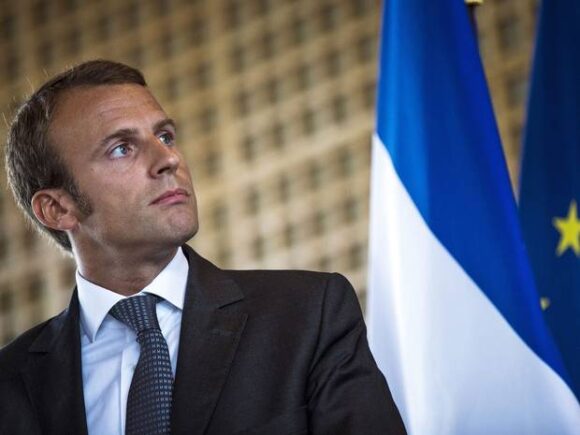
Emmanuel Macron

Emmanuel Macron

Expecting that the law would not pass, the government decided to use a joker – the article 49.3.  It was a gamble since, in the event that the motion de censure (vote of no confidence) of the opposition succeeded, the government of Manuel Valls would be disavowed and fall.  But the motion de censure received only 234 votes when it needed the absolute majority of 289.  The law passed.

The article 49.3 is included in the constitution of the Fifth Republic.  It allows the government to act in force to push a text through the Parliament without the need of a vote. It is a powerful but dangerous device.  It has been used 82 times since 1958.

The last time was in 2006 when Dominique de Villepin, under the presidency of Jacques Chirac, tried to promote the Contrat Premiere Embauche, or CPE (first hiring contract). The students demonstrated in the streets.  Shortly thereafter the CPE received national funerals.  The champion of article 49.3 was Michel Rocard who in the late 1980s used it 28 times.

After 200 hours of consultations and 1,500 amendments granted by the government, it looked as though each article had been accepted separately.  And yet, by the time of the final vote on Feb. 17, the far right (Front National), the far left (Front de Gauche), most of the right (UMP), and the 40 Frondeurs, or splinter group from within the Socialist party, joined in an alliance to put road blocks to stop the government’s proposal. Manuel Valls and Emmanuel Macron made their concluding speeches among jeers and interruptions.  On the face of many deputies could be seen a rather despicable sarcasm.

In fact, the manoeuvre of the government deserves to be applauded since, to push a text in force, was the only way for the Executive to succeed.  The Loi Macron reperesents an enormous task attempting to reform the fabric of French society.  It meant dismantling the century-old system of privileges and protected niches enjoyed by whole segments of the population, including the five million civil servants, known as notaires — in France, notaires are a specific type of French attorneys overseeing all legal transaction while collecting taxes on behalf of the government, doctors, veterinarians, taxi drivers, auction houses officials, etc.

All the professions are regulated and benefit from a a special satus.  The right to work on Sundays, and allowing intercities busses were hard-won victories.  Only indirectly, the Loi Macron dealt with unemployment and ways to jump-start the economy.

The law is insufficient and has its defects, but is a step in the right direction. It represents a real effort to bring changes and to satisfy Brussels. Angela Merkel, in Paris for more discussions about the Ukraine, expressed her satisfaction.

Nicole Prévost Logan

Nicole Prévost Logan

About the author: Nicole Prévost Logan divides her time between Essex and Paris, spending summers in the former and winters in the latter.  She writes a regular column for us from her Paris home where her topics will include politics, economy, social unrest — mostly in France — but also in other European countries.  She also covers a variety of art exhibits and the performing arts in Europe.  Logan is the author of ‘Forever on the Road: A Franco-American Family’s Thirty Years in the Foreign Service,’ an autobiography of her life as the wife of an overseas diplomat, who lived in 10 foreign countries on three continents.  Her experiences during her foreign service life included being in Lebanon when civil war erupted, excavating a medieval city in Moscow and spending a week under house arrest in Guinea.
Letter from Paris: Minsk 2 – Another Truce for Ukraine … Maybe

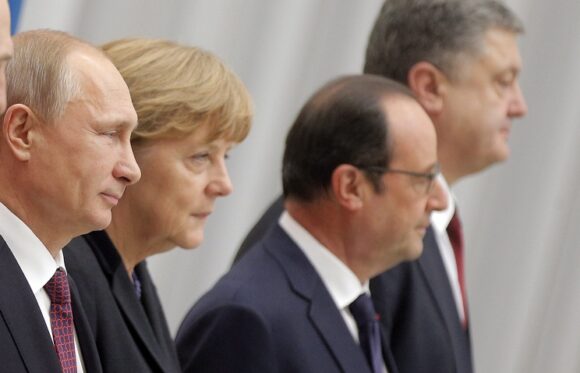
From left to right, Vladimir Putin, Angela Merkel, François Hollande and Petroshenko.

From left to right, Vladimir Putin, Angela Merkel, François Hollande and Petro Porosnhenko. Photo credit EPA/Maxim Shipenkov.

After a 16-hour long marathon of negotiations on Feb. 11, and a great deal of suspense, Angela Merkel and François Hollande wrenched out a hard-won agreement for a cease-fire in Ukraine from Petro Porosnhenko and Vladimir Putin starting on Saturday, Feb. 14 at midnight.  All parties to the agreement were extremely cautious and hoped that “Minsk 2” would last longer than “Minsk 1” signed in September 2014.

More than 5,500 people have died in the conflict during the past 10 months, which makes it the deadliest in Europe since World War II.  There was a sense of relief that the agreement went through and thus a disaster had been avoided.  In the morning, Putin joked that he had had better nights but felt satisfied.

To continue the negotiations rather than slamming more sanctions on Putin, as some Washington pundits advocate, was the objective of Minsk 2.  Sanctions have a cost for Europe (for example, the Russian government retaliated to earlier sanctions by blocking the import of produce from Western Europe.)  More dangerously, they exacerbate the nationalism of Putin and enhance his popularity in Russia.

In the face of a threatening strategy of Daesh* making well planned inroads to destabilise Europe by recent acts of terrorism, Russia and the European Union (EU) have a common enemy.  For decades, the extremist Moslem opposition in Chechnya and Central Asia has been a great fear for the Russian government..

The talks in Minsk started in a polar atmosphere.  Throughout the night, Petro Poroshenko’s and Vladimir Putin’s teams moved like a choreographed ballet.  Early in the morning, Putin left the room, slamming the door, only to reappear a few minutes later. The Franco-German duo is to be credited with an unflappable tenacity to reach an agreement.  The two worked perfectly together.  Merkel needed Hollande since she wants to avoid making foreign policy decisions alone and prefers,“Leading from the center,” to use a formula coined by the German Minister of Defence Ursula von der Leyen.

Screen Shot 2015-02-18 at 12.37.33 AM

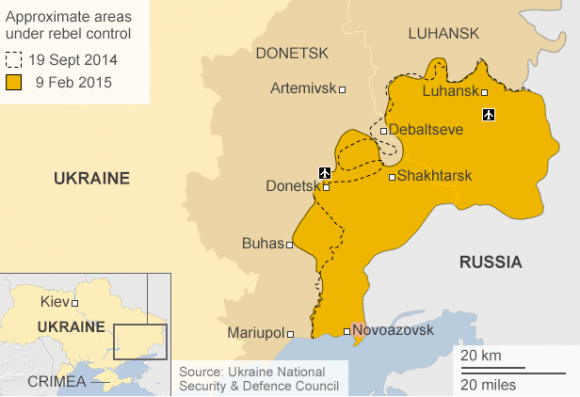
Minsk 2 includes modified provisions to make the process move forward.  The buffer zone – cleared from all heavy armaments – has been widened from 30 km to 70 kms.  The European Council for Stability and Security will be monitoring the application of the agreement.  Putin expressed his demands for the autonomy of the Luhansk and Donestk regions..

The EU widely considers that Ukraine is both a corrupt and failed state.  It cannot afford to help it financially nor envisages its adhesion to the EU any time soon.  Kiev does not want to lose the industrial and mining Donbas region, but its action is disorganized.  For many months, Putin has claimed that he never intervened in the conflict taking place in Eastern Ukraine.

One wonders whether he really controls the Russian separatists, so different from the sophisticated Maidan crowd.  The Donbass miners and blue collar workers are products of massive transfers of population forced by the Soviets at the time of the German offensive to compensate for the relocation of highly skilled workers to the Ural Mountains.  Another headache for Putin is the presence among the Russian separatists of clans whose leaders have political ambitions .

It is hard to understand Putin’s strategy.  Obviously he does not want NATO to choke him nor nuclear misssiles to be installed in the area.  He does not have the means to support the Donbas.  His priority should most likely be to allow a corridor from Rostov on Don, through Mariopol on the Sea of Azov and then leading to the Crimea.  At present his only access to the Crimea is through the Straits of Kerch, which is some distance away.

*The new nickname for ISIS widely used in France, Australia and some other countries because ISIS supposedly dislikes it intensely — it is a loose acronym of the Arabic description of ISIS, which does not acknowledge any statehood for the organization but rather can be roughly translated as, “One who crushes something underfoot,” or, “One who sows discord.”

Nicole Prévost Logan

Nicole Prévost Logan

About the author: Nicole Prévost Logan divides her time between Essex and Paris, spending summers in the former and winters in the latter.  She writes a regular column for us from her Paris home where her topics will include politics, economy, social unrest — mostly in France — but also in other European countries.  She also covers a variety of art exhibits and the performing arts in Europe.  Logan is the author of ‘Forever on the Road: A Franco-American Family’s Thirty Years in the Foreign Service,’ an autobiography of her life as the wife of an overseas diplomat, who lived in 10 foreign countries on three continents.  Her experiences during her foreign service life included being in Lebanon when civil war erupted, excavating a medieval city in Moscow and spending a week under house arrest in Guinea.
Letter from Paris: Patrick Modiano receives 2014 Nobel Prize for Literature

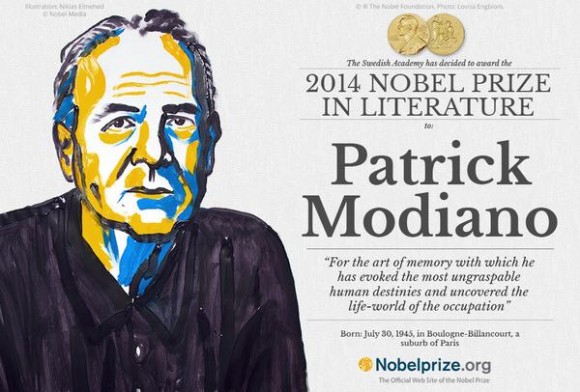
Nobel_prize_for_Literature_2014

…”all those wasted years during which one did not pay enough attention to trees, to flowers”…) says the main character  in Modiano’s latest novel ‘Pour que tu ne te perdes pas dans le quartier’ (which translates roughly as, “To avoid getting yourself lost in the neighborhood”)

France had the distinctive honor of receiving two Nobel prizes in 2014:   Jean Tirole was the recipient of the Prize for Economics for his work on the financial crisis and the banking system while Patrick Modiano received the Prize for Literature.  He will join an illustrious pantheon of writers from Gunter Grass (Germany) ), Toni Morrison and Nadine Gordimer (South Africa), Wole Soyinka (Nigeria), Gabriel Garcia Marques (Columbia) and Alexander Solzhenitsyn (Soviet Union)  to Albert Camus (France) or Ernest Hemingway (USA).  Modiano is the 16th laureate from France, giving that country the largest number since beginning of the Nobel awards in 1900.

The press release issued by the Swedish Academy of Sciences selected the French writer, “For the art of memory with which he has evoked the most ungraspable human destinies and uncovered the life-world of the Occupation.” The prize was a recognition of his abundant literary production (30 novels)  centered on the protagonists’ search of their own past, in the urban setting of Paris, going back to World War II.

He writes like a sleep walker, plodding through a mysterious, sometimes disjointed sequence of events looking for his lost childhood when he was tossed around from one home to another.  Since his first novel, ‘La Place de l’Etoile,’ published in 1968, he has created a world where autobiographic notes are interwoven with the “bad dream” of the Occupation.

Modiano is a tall (6′ 6” ) man of 69 with a kind face and fluttering hands as he speaks.  During a 45-minute acceptance speech in Stockholm, his modest personality must have made him endearing to the distinguished audience, particularly when he dedicated his award to his Swedish grandson.

A writer, he said, is usually a poor speaker, who leaves his sentences unfinished, because he is used to editing his text over and over again.

He explained that he belonged to a generation when children were not allowed to speak up and, if they were given a chance to speak, they expected to be interrupted at any time.

During an interview he gave in his study, surrounded by thousands of books, he asked, “Why would I write another book when so many have been already written?”  Then he added,  “It is probably at the sight of his own bookcases that a discouraged Scott Fitzgerald took up drinking.”

He claims, with incredible modesty, that “It is with bad poets that one obtains prose writers.”

According to Alice Kaplan, head of the French department at Yale University, Modiano can be labelled as the Marcel Proust of modern times.

Claire Duvarrieux, head of the ‘Books’ department of the daily newspaper, Liberation, describes the works of Modiano as a collective memory of France during the war, the German Occupation, collaboration, the persecution of the Jews and finally, the war in Algeria.

With Louis Malle, he co-wrote the scenario of Lacombe Lucien in 1974, one of the best French “New Wave” films.

Nicole Prévost Logan

Nicole Prévost Logan

About the author: Nicole Prévost Logan divides her time between Essex and Paris, spending summers in the former and winters in the latter. She writes a regular column for us from her Paris home where her topics will include politics, economy, social unrest — mostly in France — but also in other European countries. She also covers a variety of art exhibits and the performing arts in Europe. Logan is the author of ‘Forever on the Road: A Franco-American Family’s Thirty Years in the Foreign Service,’ an autobiography of her life as the wife of an overseas diplomat, who lived in 10 foreign countries on three continents. Her experiences during her foreign service life included being in Lebanon when civil war erupted, excavating a medieval city in Moscow and spending a week under house arrest in Guinea.
Letter From Paris: Marcel Duchamp at the Pompidou Center

Marcel Duchamp i(1887-1965) is well known in America. Most people have heard of his readymades like the famous (or infamous) Fontaine, which is, in fact, a public urinal. Stiglitz immortilized the original in a 1917 photograph before it disappeared for ever. The bicycle wheel set on a kitchen stool is a familiar sight for MOMA vistors.

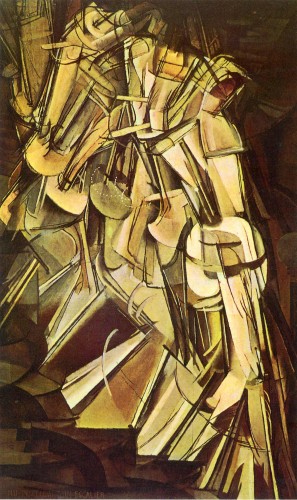
Nude descending a staircase No. 2

Nude going down a staircase No. 2

Since his first trip to the US in 1915, the artist made multiple visits to that country, avoiding the two World Wars. He acquired American nationality in 1955. It was at the 1913 Armory Show that his cubist painting ‘Nu Descendant un escalier No. 2′ (Nude going down a staircase No. 2) became a huge success.

Some critics have labelled Marcel Duchamp as the creator of modern art while others say he destroyed it when he advocated “non-retinal” painting. Volumes have been written about him. In an amazingly short time – since he abandoned art for chess at age 36 – he was able not only to produce art, but also to integrate into it the latest discoveries of science and modern technology.

The Marcel Duchamp exhibit at the Pompidou Center just closed its doors after several successful months. It was a monographic approach consisting of about 100 paintings and drawings little known in France (most of them are part of the Louise and Walter Arensberg collection at the Philadelphia Museum of Art) covering the 1912 to 1923 period and leading to his main creation, ‘Le Grand Verre.’

Born in Normandy, Duchamp belonged to a talented family of six children. The mother was a distant figure, which may explain his alienation from women. ‘Sonate,’ 1911, represents the three sisters playing musical instruments. The mother stands stern and erect . Strangely enough she seems to be enjoying the concert, although she is deaf.

He had a deadpan sort of humor and provocation was his tool. He enjoyed playing tricks on the Regardeurs (viewers), giving wrong titles to his works. He relished plays on words, for example, he called himself Rose Selavy (Eros – that’s life) in the photograph Man Ray took of him. To put a moustache and a goatie on Mona Lisa was a virtual iconoclastic gesture and he made it even more outrageous by giving it the title of LHOOQ (if the letters are pronounced in French the meaning is shockingly vulgar) .

Duchamp joined his two brothers Jacques Villon and Raymond-Duchamp in the Puteaux group of Cubists. ‘Dulcinea’ and the ‘Joueurs d’échecs’ are among his superb cubist paintings. Borrowing the technique of chronophotography and cinema, he introduced time and movement in ‘Jeune Homme Triste dans Un Train 1911-12,’ where the real accomplishment was to show a person in a train in motion while also suggesting his sad mood.

La Mariée mise a nu par ses célibataires,’ meme (also called Le Grand Verre) was his major work. It consists of two free-standing glass panels. In the lower register, nine Moules Maliques* (an officer, a gendarme, a priest, etc) stand beside a chocolate-crushing machine, which rotates non-stop. By means of sexually-related devices, gas travels up toward the mariée, who is hanging limply at the top, having gone from the virgin to the bride stage. The work alludes to the universal themes of erotic love and the inaccessible woman.

* I am not even attempting to translate these nonsensical words!

Nicole Prévost Logan

Nicole Prévost Logan


About the author: Nicole Prévost Logan divides her time between Essex and Paris, spending summers in the former and winters in the latter. She writes a regular column for us from her Paris home where her topics will include politics, economy, social unrest — mostly in France — but also in other European countries. She also covers a variety of art exhibits and the performing arts in Europe. Logan is the author of ‘Forever on the Road: A Franco-American Family’s Thirty Years in the Foreign Service,’ an autobiography of her life as the wife of an overseas diplomat, who lived in 10 foreign countries on three continents. Her experiences during her foreign service life included being in Lebanon when civil war erupted, excavating a medieval city in Moscow and spending a week under house arrest in Guinea.
Letter from Paris: Ten Days Later

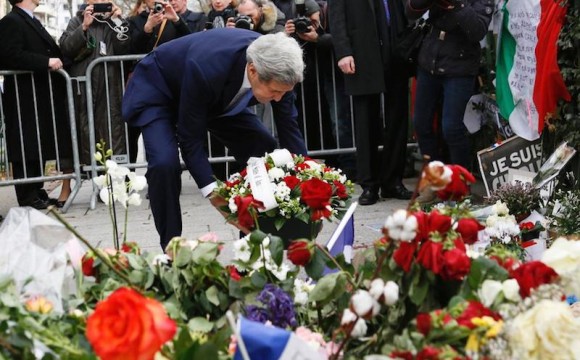
US Foreign Secretary John Kerry pays his respects at the memorial to the Charlie Hebdo victims.

US Secretary of State John Kerry pays his respects at the makeshift memorial in Paris to the Charlie Hebdo victims.

Ten days after the assassination at the Charlie Hebdo office including the magazine’s editor and leading cartoonists, France is on high alert. Threats against persons and acts of vandalism are multiplying. The Jewish community is scared, the Muslims feel stigmatized, the Catholics are worried. It would be exaggerated however to describe – the way a Fox News journalist claimed – that certain areas of Paris, such as the 11th arrondissement, are dangerous and should be avoided. Incidentally, the journalist quickly withdrew his remark.

Prime minister Manuel Valls and minister of the Interior Bernard Caseneuve have launched maximum security measures: the Vigipirate alert system (at first created by president Giscard d’Estaing in 1978) now includes 10,000 troops from the Foreign Legion, the army and the police. They are positioned throughout France to protect monuments, schools and places of worship, as well as strategic points like airports or railroad stations. On Thursday, Francois Hollande was on the air force carrier Charles de Gaulle in Toulon to review the 2,000 troops before their departure for manoeuvers in the Indian Ocean. France has currently nine Rafales in Jordan and two Mirages in Saudi Arabia.

The criminal investigation has been fast and efficient. In lightning speed, they uncovered more ramifications of the jihadists’ organization, extended to their families, friends and acquaintances, with the “Buttes-Chaumont connection” at the center. The Belhoucine brothers are on the list of suspects. A large number of individuals have been taken for questioning and nine are currently in police custody . In the Paris region, five caches of weapons have been located and searched.

Reinforcement of the legal system to control the jihadists’ travels and activities is being studied by the government. Measures such as the creation of special files on terrorists similar to the ones kept on sexual offenders and withdrawing the French nationality of returning jihadists are being considered. Voting on a new law should take place as early as the beginning of February. Control of internet has become a priority. The social networks constitute a counter culture expressed in simple manichean terms to be accessible to the largest possible numbers. Calls for violence and hatred never stop.

The recent events have marked the French. On Wednesday, January 14, after a powerful speech by the prime minister at the National Assembly, all the deputies stood up to observe a minute of silence. Then one voice started singing the Marseillaise and soon everybody followed in unison. The last time this happened was on November 11, 1918! At the Institut du Monde Arabe and during all the official ceremonies, the president and the prime minister reiterated their basic point: the French government is not against Islam nor the Muslim population. Around the world, French diplomatic representations and economic interests are under attack. The TV news shows the fury of violent mobs shouting their hatred in the streets of Niger — quite a contrast from the calm of the people in the streets of Paris on January 11.

Laicite (secularism) is a specificity of France, and the outcome of a tumultuous history, starting with the 16th century wars of religions, opposing monarch and church. It took a whole century for the Catholic Church to accept the separation of church and state in 1904. That principle was enshrined in the first article of the 1958 constitution at the outset of the fifth Republic. It is alien to most of the other countries and should be “formatted” (to use a computer science term) in order to be understood beyond our borders.

US Secretary of State John Kerry paid a visit to Paris, saw the places where the violent attacks took place on January 7 and used warm words (in French) to express his support of France.

Nicole Prévost Logan

Nicole Prévost Logan

About the author: Nicole Prévost Logan divides her time between Essex and Paris, spending summers in the former and winters in the latter. She writes a regular column for us from her Paris home where her topics will include politics, economy, social unrest — mostly in France — but also in other European countries. She also covers a variety of art exhibits and the performing arts in Europe. Logan is the author of ‘Forever on the Road: A Franco-American Family’s Thirty Years in the Foreign Service,’ an autobiography of her life as the wife of an overseas diplomat, who lived in 10 foreign countries on three continents. Her experiences during her foreign service life included being in Lebanon when civil war erupted, excavating a medieval city in Moscow and spending a week under house arrest in Guinea.