Saturday’s Centennial Celebrations at Lyme Art Association Include Traditional ‘Tea Day’ … But What’s Its History?

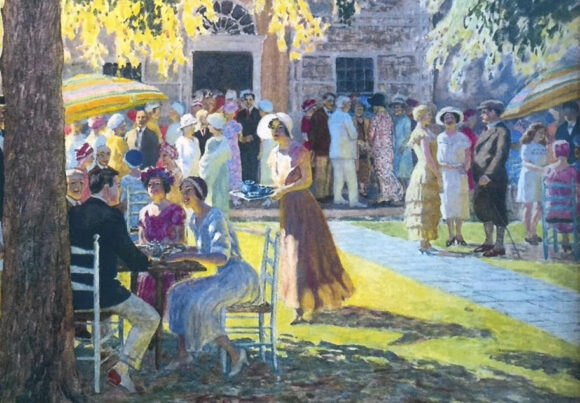
‘Tea Day 1930’ by Edward Volkerts paints a beautiful picture of the teas held on the lawn in front of the Lyme Art Association in yesteryear. A ‘Tea Day’ forms part of the LAA’s Centennial celebrations this Saturday. Image published courtesy of the Volkerts family.

OLD LYME — On Saturday, Aug. 7, the Lyme Art Association (LAA) is celebrating the 100th anniversary of the opening of its gallery.  Several special events are planned, one of which is a tea party on the LAA lawn.  

Though the gallery itself opened in August of 1921, the history of the LAA goes even further back and is interwoven with our town library and the Florence Griswold Museum. 

To start at the very beginning—in 1899, Henry Ward Ranger, already an established painter, arrived in Old Lyme and bunked down at the boardinghouse of Florence Griswold. So smitten was Ranger with the beauty of the area and the quality of the light that he began to envision the village as an American art colony.

He wrote to his agent in New York that Lyme was a landscape waiting to be painted and told Miss Florence he would be back the next summer and bring more painters with him.  And so the artists came. 
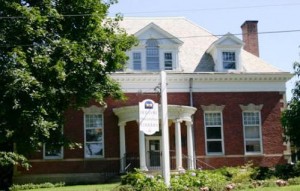
The Phoebe Griffin Noyes Library was the original home of the Lyme Art Colony’s summer exhibition from 1902 through 1920 before the Lyme Art Association had a building of its own.

And in 1902, the artists began a summertime tradition when they held an exhibition in the Phoebe Griffin Noyes Library.  An article in the Hartford Courant explained that “the library and the artists have formed a sort of close corporation.” The library (which opened in 1898, the year before Ranger arrived) needed funds to buy books; the artists needed an exhibition space.

“One scheme after another was tried until it occurred to someone to ask the artists who spend their summers in town to exhibit some of their paintings” the Courant reporter wrote. Admission to the show was 50 cents and proceeds were for the benefit of the library.  Additionally, the library received a percentage of all paintings sold.  

It was the beginning of a beautiful friendship and the shows were a success from the start.  As the fame of the Lyme Art Colony grew, the artists started making plans to build their own gallery. Many of them settled permanently in town and, in 1914, incorporated as the Lyme Art Association. But the shows continued at the library until 1920.

It took years both to raise money and decide on the best location for the new building.  One of the options was a parcel of Miss Florence’s property which fronted on Lyme Street.  World War I also intervened — not to mention what American Art News described as a “merry war” among the artists about the design of the gallery.  

Finally, on Aug. 6, 1921, the LAA gallery was ready for its close-up and opened its doors at 90 Lyme Street next door to Miss Florence’s boardinghouse.  In its review of the opening, the New York Times praised the gallery “as an embodiment of art in harmony with its natural surroundings.” 

Miss Florence became the first gallery manager and remained so until her death in 1937.
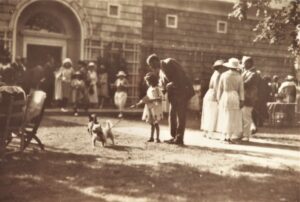
Tea on the lawn of the LAA.

During the years of the early exhibitions at the library, the Ladies’ Library Association served tea on the lawn.  And the artists continued this tea time tradition at the new gallery.  Tea was served en plein air at the LAA on Wednesday and Saturday afternoons.  The Edward Volkert painting above, which is on the poster for the centennial show, depicts one such “Tea Day.” 

A 1928 article in American Motorist also gives a vivid description—“For every July when Lyme Art Association opens the doors to its annual exhibition, the whole village and surrounding countryside awakes to a regular orgy of art and delightful social festivities.  The yellow pennants streaming from tall flagpoles at either end of the terrace, dainty tea tables gay with attractive china and lovely flowers, to say nothing of the pretty girls who serve tea and punch to visitors on Wednesday and Saturday afternoons . . . ” 

Several women, who as teenagers helped serve tea at LAA, were interviewed for an article published in The Pictorial Gazette in 1988.  They remembered the lace tablecloths and that the ladies wore “long, filmy dresses that were every pastel color imaginable.” They also recalled big, floppy hats; white gloves; and ginger and cream cheese sandwiches.

All was not perfect in this pastel paradise, however.  One of the women noted that as a 12-year-old, she was shocked at her first sight of a lady smoking which was “unheard of in this town.” 

And this coming Saturday afternoon, on the 100th anniversary of the gallery opening, the LAA will once again host a tea party.  There will be refreshments and family-friendly activities on the front lawn from 1 to 4 p.m.

Inside the gallery, the current exhibition is “A Century of Inspiration,” for which today’s artists have created works painted at many of the sites that the Old Lyme “old masters” immortalized a century ago.  And throughout the day, you can observe LAA artists up close and personal as they paint in various locations along Lyme Street.  

So much has changed in the world in the last century and we no longer live in a genteel era of outdoor tea parties. Right now, we are even living in the midst of a global pandemic. 

But some things have not changed. 

Old Lyme is still the beautiful village that Ranger first saw in 1899.  Each May and June, the mountain laurel still blooms. And 100 years after the LAA first opened, painters continue to find inspiration in the natural beauty of our town and to exhibit fine art in the gallery.

Editor’s Note: Visit this link for full details of all the events planned for the LAA’s Centennial Day.


Guest Column: Pandemic Surprise—Drive-Ins are Making a Comeback

Editor’s Note: We are delighted to welcome back Linda Ahnert as a guest columnist today. A resident of Old Lyme, she is the former Arts Editor at the popular but now-shuttered weekly, print newspaper, the ‘Main Street News.’ She is also a long-time docent at the Florence Griswold Museum and has volunteered for numerous local art organizations.

One of the unpredictable responses to the COVID-19 pandemic is that the drive-in movie theaters of yesteryear are making a come-back. Photo by Charlie Deets on Unsplash.

Linda Ahnert

When I was young, one of the pleasures of summertime was going to a drive-in movie.  The school year ended in June and a fun-filled expanse of summer vacation stretched before us. 

Those were the days, my friends, when we spent hours at the beach or pool.  In the late afternoon, the Good Humor man jangled his bells and all the kids in the neighborhood came running.  In the evenings, we collected lightning bugs in jars and then released them all at once.  And on weekend nights, families would pile into their Chevrolets and head to the drive-in for a double feature.  

Over the years, these outdoor theaters had been going the way of the dinosaur and practically vanishing from the scene. But with the onset of the pandemic in 2020 when people were searching for safe entertainment, drive-ins are becoming popular once again. 

If you were a kid or a parent in the 1950s and 60s, you certainly remember the “good old days” of drive-in movies.  A neighbor of mine, who grew up in Old Lyme, recalls going to the Waterford Drive-In.  Several women “of a certain age,” who grew up in the Hartford burbs but still spend each summer at the Connecticut shore, remembered the Clinton Drive-In as well as the Blue Hills (in Bloomfield) and a few that were on the Berlin Turnpike in Newington. 

Whether you watched outdoor movies parked in a car along the Boston Post Rd. or on the Berlin Turnpike, it was still the same experience.  After supper, Dad would drive his nuclear family to the drive-in.  (I remember that in families with very young children, the kids were often in their PJ’s, the easier to put them to bed after the show.) 

Dad pulled alongside a pole with an attached speaker and then hooked the speaker over the car window.  Voilà, you had a sound system.  Then everyone waited in anticipation as dusk settled and, yes, there were always a few impatient jokesters who started to honk their horns to get the show going.  Finally, it would be dark enough, the screen would light up … and it was magic time.  

Growing up in Fairfield and Hartford Counties, I have fond memories of the Candlelight Drive-In in Bridgeport where we saw “The King and I” and the Farmington Drive-In where our family watched “Gigi.” A number of people I talked to also recalled specific movies that they saw. 

One woman remembered other recreational activities at the drive-in.  By the time she was dating, drive-ins had become known as “passion pits” where teenagers indulged in their own steamy love scenes.  So when she and her boyfriend went to the local drive-in, they would lie to her mother about where they were going.   

An important part of the drive-in experience was intermission.  After the first feature ended, “It’s Intermission Time, Folks!” or “Time Out for a Delicious Snack in our Sparkling Refreshment Building” would flash before our eyes.  Then, as we walked through the rows of cars to the flat-topped concession stand, images of talking hot dogs and tasty beverages flitted across the screen.  Who could resist those silly ads? 

There was also a ticking clock on the screen counting down the number of minutes before the next movie began.  Ten minutes till showtime!  

Drive-ins were at their peak during the 1950s and 60s because it was the perfect time and the perfect place.  In post-World War II America, the drive-in theater brought together a few of our favorite things—cars and movies.  What better way to be entertained than sitting in the comfort of the family car?  There was also the practical consideration that, in those baby boom years, parents didn’t have to worry about a sitter.  The drive-in was a family entertainment center.

By the 1950s, of course, small black and white screens in living rooms were also becoming the rage.  Before you knew it, there was color TV, then cable TV, premium movie channels, VCRs, and DVDs.  Today many homes are equipped with wide-screen televisions and the 21st century family doesn’t even have to leave the living room to watch a movie.  

 Yes, movie technology has come a long way and today’s kids have grown up with digitally-sharp images and stereo surround-sound. Now living in the age of the coronavirus, a new generation can experience that old-fashioned thrill of watching a flick on a starry summer night.  Drive-ins offer an evening’s entertainment (and getting out of the house) while remaining socially distant. 

Here in Connecticut, there are three al fresco cinemas dating from the 1950s era that are still open—the Mansfield Drive-In, the Southington Drive-In, and the Pleasant Valley Drive-In located in Barkhamsted. And it was recently announced that a brand-new drive-in, which will operate year-round, will open in Wethersfield this September.    

Most drive-ins today have converted to FM radio to broadcast the audio. But some of us will never forget that memorable message on the screen at the end of a Saturday night at the movies—“Please remember to replace the speaker on the post when you leave the theater.” 

Editor’s Note:

Giving Thanks During a Pandemic

Come ye thankful people, come,
Raise the song of harvest home . . .

Well, maybe not this year.

It’s 2020 and starting back in March, our lives changed as the pandemic started spreading across the land. We sheltered in place, incessantly spritzed with hand sanitizers, and began wearing masks every time we dared to venture out in public.

Now it seems that 2020 will be a demarcation date on our timelines. Do you remember what it was like PC (Pre-COVID) when you could hug your friends and meet them for dinner at a favorite restaurant?

More importantly, who could have imagined that nine months later the COVID crisis would have worsened with a death toll of more than a quarter of a million Americans and still spiking? And now it’s Thanksgiving—a time to gather round the table with family and chow down on favorite foods. But many of us will not be celebrating the traditional way in this “annus horribilis” — as Queen Elizabeth would say.

Yet I have plenty to be thankful for (a song by Irving Berlin, by the way.)

I am grateful for my health and that of my family, that I have a roof over my head, and that I go to sleep with a full tummy at night. Especially now when I know so many are suffering, grieving for loved ones, or wondering how to put food on the table.

And I am thankful for all those working on the front lines—from health care workers to those stocking grocery shelves—who have helped us to keep the home fires burning. The heart I placed on my kitchen door last spring is still hanging there and there are many heart signs still in place around our town.

The thoughtfulness of family and friends have also been blessings in my life this year.

Sure, there are days when I’ve been depressed and it was difficult to keep my sunny side up. But how heartwarming it has been to have neighbors text, “Do you need anything at the store?” To receive phone calls from old friends asking, “How are you doing?” Or to have my niece stop by with a “care package” from Sift Bake Shop (my favorite chocolate croissants!)

Since I am a senior citizen and have feasted at many turkey dinners, I will add “Thanks For The Memories” of Thanksgivings Past.

In days of yore, my family would receive a package of pecans from Louisiana at the beginning of each November. They were from the trees in my aunt’s yard and it was a sign that it was time to start baking pies. As I child, I remember rising early with my mom to start cutting up the celery and onion for the stuffing and the periodic basting of the bird. And, oh, that tantalizing aroma of a turkey roasting for hours!

Though I am sad that I can’t be with my family for Thanksgiving 2020, I am counting my blessings and thinking of the song lyrics:

Someday soon, we all will be together
If the fates allow
Until then, we’ll have to muddle through somehow . . .

Editor’s Note: Linda Ahnert is a resident of Old Lyme and former Arts Editor at the now-departed ‘Main Street News.’

She is a long-time docent at the Florence Griswold Museum and has volunteered for numerous local art organizations.

It’s Thanksgiving … So Let’s Talk Turkey

As you busy yourself making plans for Thursday’s feast, we are delighted to take the opportunity to republish a topical article about the evolution of this quintessential American meal that our dear friend — and wonderful writer — Linda Ahnert of Old Lyme wrote for us all the way back in 2007.  Enjoy!

Who Doesn’t Love Thanksgiving?

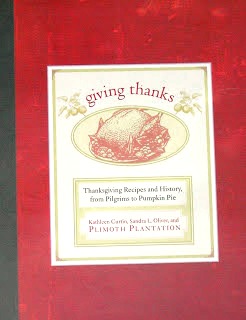
Giving thanks_bookA few years ago, a book entitled “Giving Thanks: Thanksgiving Recipes and History, from Pilgrims to Pumpkin Pie” was published.  The co-authors are Kathleen Curtin, food historian at the Plimoth Plantation, Mass., and Sandra L. Oliver, food historian and publisher of the newsletter “Food History News.”

The book is a fascinating look at how an autumnal feast evolved into a “quintessential American holiday.”

Most Americans, introduced to the story of the Pilgrims and Indians during childhood, assume there is a direct link between the traditional holiday menu and the first Thanksgiving.  But we learn from the book that many of those food items—such as mashed potatoes and apple pie—were simply impossible in Plymouth, Mass., in 1621.  Potatoes were not introduced to New England until much later and those first settlers did not yet have ovens to bake pies.

What we do know about the bill of fare at the first celebration in 1621 comes from a letter written by colonist Edward Winslow to a friend in England:  “Our harvest being gotten in, our governor sent four men on fowling, that so we might after a special manner rejoice together after we had gathered the fruit of our labors.”

Later 90 Indians joined the party with “their great king Massasoit whom for three days we entertained and feasted.”  Then the Indians “went out and killed five deer which they brought to the plantation.”

So venison was a principal food on the menu.  It also seems safe to assume that mussels, clams, and lobsters (all in plentiful supply) were served as well.   According to other journals of the colonists, the “fowl” that Winslow described were probably ducks and geese.  But wild turkeys were also bountiful in 1621, and so it is very likely that they were on the Pilgrims’ table.  Thank goodness for that.

Throughout the New England colonies, it became common to proclaim a day of thanksgiving sometime in the autumn.  In period diaries, there are many descriptions of food preparation—such as butchering and pie baking—followed by the notation that “today was the general thanksgiving.”

By the 19th century, Americans were taking the idea of a “thanksgiving” to a whole new level.  The religious connotations were dropping away in favor of a holiday celebrating family and food.  Roast turkey had become the centerpiece of these fall celebrations.

Turkeys, of course, were native to North America.  (Benjamin Franklin, in a letter, had even proposed the turkey as the official U.S. bird!)  And turkey was considered to be a fashionable food back in the mother country.  Just think of the significance of turkey in Charles’ Dickens’ “A Christmas Carol.”  When Scrooge wakes up in a joyful mood on Christmas morning, he calls to a boy in the street to deliver the prize turkey in the poulterer’s shop to the Cratchit family.  (Earlier in the story, the poor Cratchits were dining on goose.)

It is thanks to a New England woman that Thanksgiving became an American holiday.  Sarah Hale was a native of New Hampshire and the editor of “Godey’s Lady’s  Book,”  a popular women’s magazine.  She lobbied for years for a national observance of Thanksgiving.  She wrote editorials and sent letters to the president, all state governors, and members of Congress.

Finally, in 1863, she convinced Abraham Lincoln that a national Thanksgiving Day might help to unite the Civil War-stricken country.   The fourth Thursday in November was now officially on the American calendar.

“… that endless variety of vegetables …”

Connecticut’s own Harriet Beecher Stowe wrote this description of a New England Thanksgiving in one of her novels—“But who shall . . .describe the turkey, and chickens, and chicken pies, with all that endless variety of vegetables which the American soil and climate have contributed to the table . . . After the meat came the plum-puddings, and then the endless array of pies. . .”

The autumnal feast became a national holiday, but each region of the country put its own spin on the menu.   Not to mention that immigrants have also added diversity.  The result is a true “melting pot” of America.  The second half of “Giving Thanks” contains recipes that reflect what Americans eat for Thanksgiving in the 21st century.

In the South, for instance, the turkey might be stuffed with cornbread and there would be pecan and sweet potato pies on the table.  In New Mexico, chiles and Southwestern flavors may be added to the stuffing.

There’s the “time-honored traditional bread stuffing” recipe.  There’s also one for a Chinese American rice dressing and directions for a Cuban turkey stuffed with black beans and rice.  Desserts run the gamut from an (authentic) Indian pudding to an (exotic) coconut rice pudding.  Old-fashioned pumpkin pie is included as well as the newfangled pumpkin cheesecake.

But no matter what food items grace our Thanksgiving tables, it seems that we all end up stuffing ourselves silly.  Perhaps overeating started at that very first harvest celebration in 1621.  In Edward Winslow’s letter describing the feast with the Indians, he noted that food was not always this plentiful. But he wrote his friend in England “ … yet by the goodness of God, we are so far from want that we often wish you partakers of our plenty.”

Hooray for Halloween! Almost Against All Odds, It Did Happen on Lyme Street Last Night …

It wasn’t only the children having fun on Lyme Street last night – Julie O’Brien (left) and Martha Quaratella were fully invested in the spirit of the evening!

OLD LYME — Despite the weather, a cancelled parade, a fallen tree, and power outages galore, Halloween happened anyway in Old Lyme! 

We’re delighted to share a few photos from the notorious night when trick or treating ghosts and ghouls; witches and wizards; and swashbucklers and superheroes take over Lyme Street in search of candy … along with a reflection on Halloween by our journalist friend Linda Ahnert.

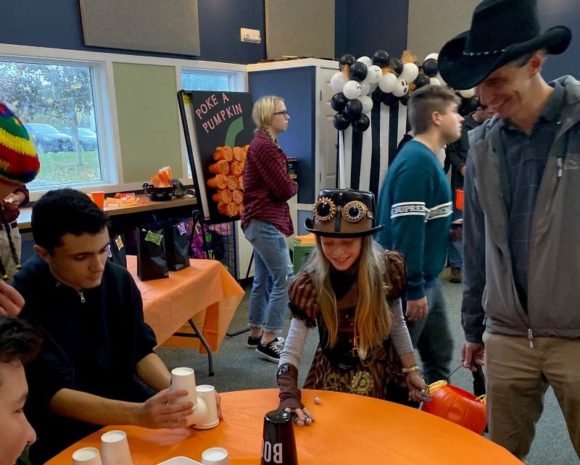
The Halloween Party at LYSB drew lions, Little Red Riding Hoods, Dorothy’s and everything in between! We’re pretty sure that’s Max Garvin inside the lion costume on the left! Photo by Missy Colburn Garvin.

Hooray for Halloween!
By Linda Ahnert

For those of us who grew up in the 1950s, Halloween was a big blast. We decked the school halls with jack-o’-lanterns and black cats. We sang holiday hymns about creepy moonlit nights, sleeping shadows, and ghostly shapes without heads. But most of all, we dreamed about what we were going “to be” for Halloween. What kid doesn’t like to play “make believe” and become a queen for a night or perhaps the bride of Dracula?

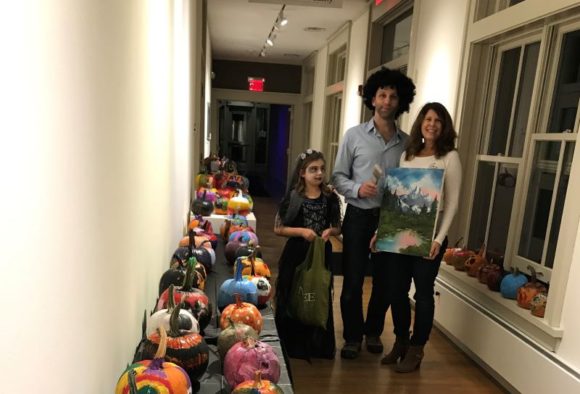
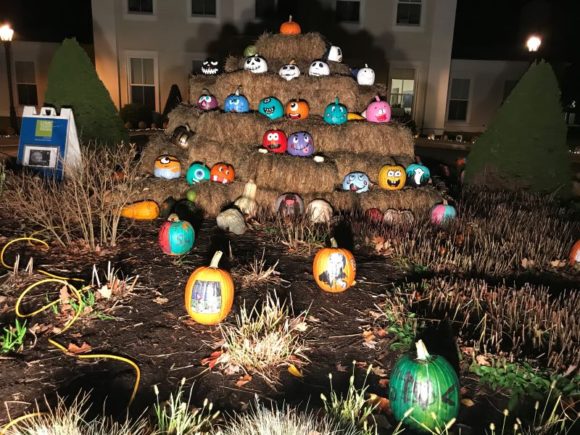
Lyme Academy of Fine Arts opened its doors to display a sea of pumpkins decorated by students from Lyme-Old Lyme Schools. Photo by Suzanne Thompson.

Then there was the trick or treating itself. After donning the nifty costumes our moms had made for us, we headed out to ring doorbells and collect candy. Furtive little groups of us would pass each other in the night as we crisscrossed our Ozzie and Harriet neighborhood. And we would pass along snippets of information—when we learned that the new family on our street was handing out candy apples, we would make a beeline there.

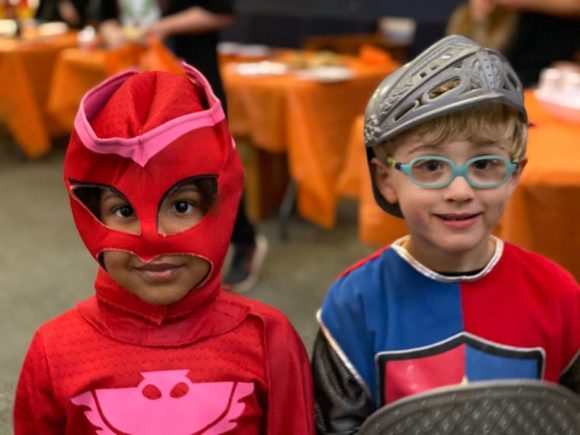
Also attending the LYSB Halloween Party were this Superhero and friend. Photo by Missy Colburn Garvin.

But not too many years after we baby boomers had retired from ringing doorbells, the holiday itself entered a twilight zone. Those were the days when you heard true horror stories of kids finding razor blades in their candy. Real life had become a lot scarier and parents would accompany children as they went from house to house. And certainly no one would dare to knock on the door of a stranger.

Student-decorated pumpkins were also on display outside Lyme Academy. Photo by Suzanne Thompson.

Which is why it’s great to see that in recent years Halloween has once again become big-time fun. People are festooning their houses with orange lights and decorating their lawns with goblins and other gruesome creatures. Pages in mail order catalogs are devoted to all the latest trends in Halloween décor and costuming. Turn on the TV at this time of year and you will see ads for “Halloween Headquarters” at Kmart or “Spooky Central” at Wal-Mart.

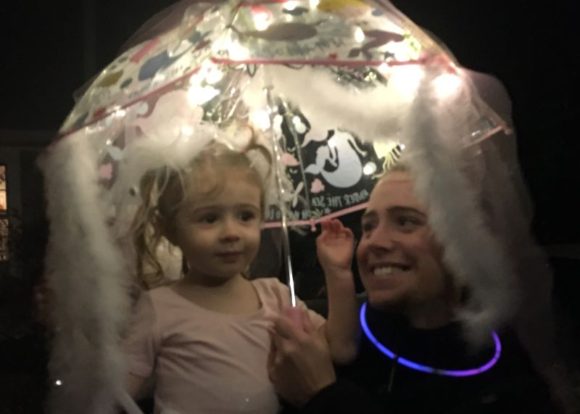
Millie Cameron — dressed as a jelly fish, who is the daughter of Lyme-Old Lyme High School varsity boys’ soccer coach Ally Gleason — was out on the town with Mom (right) last night. Photo by Martha Quaratella.

Today you can purchase all kinds of items to get in touch with your inner ghoul. Everything from Hitchcockian crows to cauldrons equipped with foggers to create a bubbling witch’s brew. And, if you’re hosting a “monster” Halloween party, don’t forget the ice cubes that glow bright orange. Or the CD’s of haunted house music to create an eerie ambience.

Sorry, but we just couldn’t resist publishing another photo of little Millie Cameron — the absolutely cutest jellyfish in town! Photo by Martha Quaratella.

Yes, there’s no doubt that Halloween has gone to a whole new level. So why should kids have all the fun? Nowadays, adults are also donning costumes and getting in on the act. One year I had a dental appointment on Oct. 31. I arrived at the dentist’s office to find the women employees all decked out in costumes. My favorite was the 30-something receptionist outfitted as a teenager from the 1950s complete with poodle skirt and pony tail.

Plenty of fun for the adults too at the LYSB Halloween Party! Photo by Missy Colburn Garvin.

In our neck of the woods, we don’t have to go far to get into the spirit of the season. Take a stroll through the Pumpkin Patch at Scotts Yankee Farmer in East Lyme.  Or drive to Mystic Seaport for “Nautical Nightmares” and listen to maritime ghost stories as you walk through the darkened village. Not to mention that our own village of Old Lyme is transformed into a magical place on Allhallows Eve. Children trick or treat their way along Lyme Street in costumes that range from the scary to the sublime.

It’s Halloween—just like the ones I used to know.