An Easter Tradition: What About Those Deviled Eggs?

Editor’s Note: We are delighted to welcome back Linda Ahnert of Old Lyme, who writes an occasional column for LymeLine. She is a friend and colleague from the former ‘Main Street News,’  (do you remember that fine publication?) and today shares this topical, mouth-watering piece with readers.

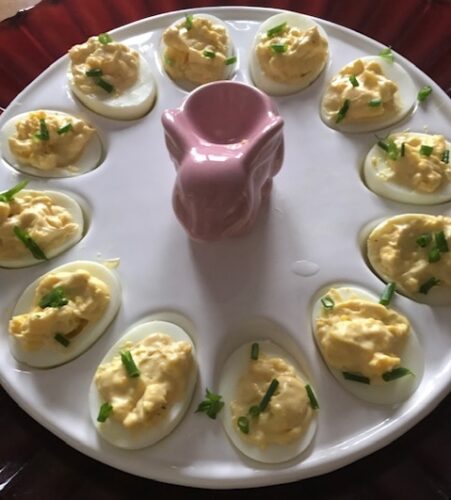
A platter of delicious deviled eggs is always a welcome addition to an Easter—or any other!— celebration. Photo by L. Ahnert.

Do you remember Easter 2020?  Perhaps it was one you might like to forget  We were in the early stages of the pandemic and everyone was “sheltering in place.”  Easter was the first holiday that was affected by the onset of COVID-19, and we were learning how to Zoom since families couldn’t physically be all together.  

My niece had to explain to Stella (my grand-niece, who was then eight years old) that the family would not be gathering at Aunt Linda’s house for the usual Easter festivities. Stella’s response was, “What about the deviled eggs?”  Nothing about missing the egg hunt, which we always have in the yard, or the chocolate bunnies in the candy dish! What really concerned Stella were the deviled eggs I always serve as one of the Easter hors d’oeuvres.  

I emailed my recipe to my niece and she soon sent me a photo of a lovely platter of deviled eggs that she and Stella had made. And over the ensuing weeks, I received recipe requests from other family members—for blueberry coffee cake, German potato salad … Even Stella’s dad asked me to send the recipe for the cheesecake that I often bake for holiday meals. 

Of course, I was delighted that the younger family members were in the kitchen and learning about the joy of cooking. I am not a fancy-schmancy gourmet cook. But I do love to cook and so enjoy putting a good meal on the table for family and friends. 

As Laurie Colwin, one of my favorite food writers, expressed it: “The table is a meeting place, a gathering ground, the source of maintenance and nourishment, festivity, safety, and satisfaction. A person cooking is a person giving. Even the simplest food is a gift.” 

Here is the very simple recipe for deviled eggs, which are simply delicious.  It is from a Williams Sonoma catalog: 

DEVILED EGGS 
8 hard-boiled eggs 
6 tablespoons mayonnaise 
2 teaspoons Dijon mustard 
Salt 
Freshly ground pepper 
2 tablespoons fresh parsley (or other fresh herbs) 

Shell the eggs and slice them in half lengthwise. Remove the yolks and mash them with mayonnaise, mustard, salt and pepper to taste until smoothly blended.  Spoon in (or pipe) equal amounts into the hollow of each egg white.  Sprinkle with fresh herbs. Serves 8. 

Note: I sprinkle the eggs with fresh chives. Some people like to dust the eggs with paprika. The original recipe suggests that, instead of fresh herbs, you could top the eggs with caviar, capers, olives, or watercress … but I think simple is best!   

G. Fox & Co.—A Trip Down Memory Lane

Editor’s Note: We are delighted to welcome back Linda Ahnert of Old Lyme, who writes an occasional column for LymeLine. She says in the covering note she sent with the article, “It’s that time of year when we start dreaming of Christmases like the ones we used to know. For those of us who grew up in the greater Hartford area, our memories include visions of G. Fox & Co.” We are sure quite a number of readers fall into that category, but regardless we hope you all enjoy this wonderful trip down Memory Lane!

This photo shows a postcard of Main Street, with view of the G. Fox & Co. building in downtown Hartford. The postcard is dated prior to 11 August 1905 — the date on which the postcard was mailed. The image is in the public domain.

London has Harrods, Paris has Galeries Lafayette and, once upon a time, Hartford had G. Fox & Co. Although this grand old store shuttered its doors many years ago, for those of us who grew up in the Hartford burbs, G. Fox & Co. was the “center of Connecticut living.”

Today stores like G. Fox are a vanishing breed—people first moved on to malls and now shop online. But if you are of a certain age, you remember the multi-storied, city-block long buildings that were retail paradises. Those were the days, my friends, when residents from surrounding towns would head to Hartford for the latest movie or an afternoon of shopping. Before the sterile cineplexes and the soulless malls, you went “downtown” where there were movie theatres and department stores. 

And what a store G. Fox was! It was elegant and the fabulous main floor featured Art Deco décor. Then there was floor after floor, department after department, filled with the best of everything. You could find the latest fashions, cosmetics, jewelry, furniture, china, toys, linens, luggage, housewares, and appliances. You could buy anything from a mink coat to a dishrag. 

There was a stamp and coin department on the mezzanine where my brother bought stamps to fill his albums. Also on the mezzanine was one of my favorite spots—the book department. It was here that I made the transition from Nancy Drew to Agatha Christie. Many of my favorite books (still on my bookshelves today) came from G. Fox—“The Great Gatsby,” “The Good Earth” “David Copperfield,” and “To Kill A Mockingbird.”

The mezzanine was also home to the jewelry repair shop, the camera department, and American Express Travel Service. On the main floor there was even a pharmacy. You could drop off your prescription when you arrived at the store and pick it up on your way home. For a chic new coiffure, you headed to the G. Fox beauty salon. And if you needed to refuel after hours of shopping, there was a luncheonette where you could eat at the counter.  

For more formal dining, there was the Connecticut Room. On the walls of this circular-shaped room were murals depicting scenes from Connecticut’s history. During the lunch hours, models would parade through the room showing off the latest in women’s fashions.  And who could forget the date nut bread that was served there? 

A newspaper advertisement from the iconic store.

G. Fox was a world of escalators, elevators, and smartly dressed mannequins. It was also a world where you were “waited on” by a thoroughly trained sales staff. These employees were professionals; many of them worked at the store for years and were crackerjacks at their jobs. Not merely cashiers who took your charge card, they were knowledgeable about the stock in their departments. And, in those pre-computer days, they wrote up the transactions in a thick sales book (with carbon paper.) They would refer to a chart to see what the applicable sales tax was and then place your purchase into one of the deep blue G. Fox paper bags. 

As a true-blue, first-rate department store, G. Fox also offered an important amenity to its shoppers—delivery service.  The pampered G. Fox customer never had to schlep around the store laden down with parcels and shopping bags. Even after a spending spree, you could leave the store hands-free. After you made your purchase, those courteous salespeople would always ask, “Would you like that sent?”

G. Fox owned a fleet of delivery trucks and each town in the Hartford vicinity had its assigned delivery days. The next best thing to finding the perfect dress in the store was when you saw the G. Fox delivery van coming down your driveway. The store also offered a telephone order service. Clients could pick up the phone, place an order, and the G. Fox deliveryman would have it on your doorstep on, say, the next Tuesday. 

G. Fox was the “It” store; the G. Fox label had cachet. As a young girl, it seemed to me that all G. Fox clothes were cool and classy. Growing up when Jackie Kennedy and Audrey Hepburn were the fashion paragons, G. Fox was a ‘de rigueur’ destination to achieve The Look. 

One reason department stores have been disappearing over the years, of course, is changing lifestyles. People today simply don’t “dress up” like they used to do. In fact, we live in an age of “dressing down.” The days are long gone when a woman wore a hat to complete her ensemble. Or when her shoes and purse had to match! But back in the ‘50s and ‘60s, a young woman still needed a complete wardrobe. When we were packed off to college, our trunks were filled with matching sweaters and skirts, suits for homecoming, and dressier togs for more formal occasions. 

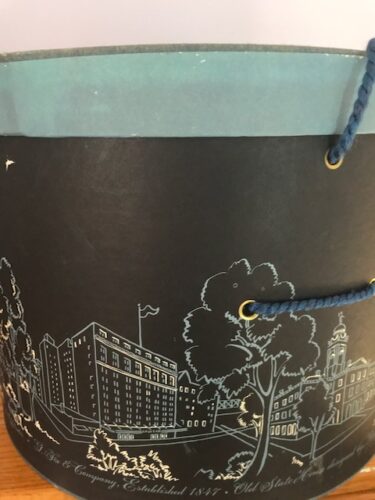
That famous hatbox!

G. Fox opened in 1847 and was part of the Connecticut scene almost to the end of the twentieth century, closing its doors in 1993. Generation after generation of Nutmeggers shopped there. The Christmas season began for us when the New England village went atop the G. Fox marquee. And each December kids would make the pilgrimage to the legendary 11th floor Toy Department and a visit with Santa. 

If you shopped at G. Fox, you probably remember a prized purchase that you made there. For me, it was the place where I bought my first tube of lipstick (Honeysparkle Peach at the Estée Lauder counter,) It was where I bought a pink pillbox hat for Easter and white high heels for high school graduation.

I still have a G. Fox hatbox. On the lid, underneath the store’s name, it says “Serving Connecticut since 1847.” Around the sides of the box are drawings of Hartford landmarks – the Old State House, the Travelers Tower, Bushnell Memorial Hall, and the G. Fox & Co. building at 960 Main Street.

Tidings of Comfort (Food) and Joy

Editor’s Note: We are delighted to re-publish this mouth-watering piece by our friend and former colleague at ‘Main Street News,’ Linda Ahnert of Old Lyme. She wrote it back in 2005 but has recently updated it for us.

In England, ‘Figgy pudding’ has morphed into the traditional Christmas pudding pictured above, which is served in all parts of that country on Christmas Day. Photo by Hello-I’m-Nick on Unsplash.

“There’s a happy feeling nothing in the world can buy, when they pass around the coffee and the pumpkin pie” . . . and, of course, “Everybody knows a turkey and some mistletoe help to make the season bright.”

Have you ever thought how many food references there are in Christmas songs? It runs the gamut from figgy pudding to popcorn! And food plays a starring role in many Christmas stories and in our own memories.  

​I was about 10-years-old when I received “Little Women” as a Christmas present. It is the beloved book about the four March sisters growing up in New England. As the story opens, it is a Christmas during the Civil War and the March family is living in straightened circumstances. But when the girls hear of a needy family in the neighborhood, they gladly give up their Christmas breakfast to feed the hungry children. Even self-centered Amy sacrifices her favorite things—“the cream and the muffins.”

Jo March laments, “Christmas won’t be Christmas without any presents.” And for most of us, Christmas wouldn’t be the same if we didn’t have some particular food in the house during the season.

Holiday cookies are a signature Yuletide food … both to give and receive! Photo by Joshua Doherty on Unsplash.

​For instance, one of my early food memories of Christmas is tangerines and walnuts.  My paternal grandparents came to this country from Germany.  On Christmas Eve, everyone would gather at their home.  I remember my grandfather playing the mandolin and singing “Stille Nacht” and other German carols.  My grandmother decorated the buffet in the dining room with evergreen boughs.  Interspersed in the greens were tangerines and all varieties of nuts in the shell.  Before we left, my grandmother would stuff our mittens with the fruit and nuts.  

​Another family that I spent many hours with as a child were the Ingalls in the “Little House” books.  How I loved reading about the adventures of Laura, Mary, Carrie, Ma, and Pa as they crossed the prairie.  The author, Laura Ingalls Wilder, describes the delight of the children one Christmas morning.  The girls have reached into their stockings to find shiny tin cups and each has a “long, long stick” of peppermint candy, striped red and white.   

​But their stockings weren’t empty yet.  The girls pull out small packages and unwrap them to discover heart-shaped cakes.  “Over their delicate brown tops was sprinkled white sugar.  The sparkling grains lay like tiny drifts of snow.”  It might be a simple Christmas on the frontier, but the girls can’t imagine being any happier.  

​Across the pond in Merrie Olde England, Charles Dickens included numerous descriptions of food in “A Christmas Carol.”  You may not look forward to your weekly trips to the Big Y but, trust me, your mouth will water reading Dickens’ descriptions of the produce in the London grocery shops at Christmas.  

​And who could forget the account of the Cratchit Christmas dinner? (“There never was such a goose.”)  To complement this “feathered phenomenon,” Mrs. Cratchit “made the gravy (ready beforehand in a little saucepan) hissing hot, Master Peter mashed the potatoes with incredible vigor, Miss Belinda sweetened up the apple sauce  . . .  ”

“Some hot mixture” … or cold … Who can ever refuse a holiday-themed cocktail? Photo by Brooke Lark on Unsplash.

​Bob Cratchit rolled up his threadbare sleeves and “compounded some hot mixture in a jug with gin and lemons, and stirred it round and round, and put it on the hob to simmer.”  In 21st century parlance . . . I’ll have what they’re having.

​Truman Capote’s “A Christmas Memory” is an autobiographical story set in rural Alabama in the 1930s.  It opens on a November morning when the elderly cousin who is raising seven-year-old Buddy announces that “It’s fruitcake weather!”  For Buddy this means the official start of the Christmas season.  They begin the yearly ritual of gathering pecans in an old buggy and scrimping together their meager funds to buy the ingredients to bake 30 fruitcakes.  

For days “eggbeaters whirl, spoons spin round in bowls of butter and sugar, vanilla sweetens the air, ginger spices it; melting, nose-tingling odors saturate the kitchen, suffuse the house, drift out to the world on puffs of chimney smoke.”  When the work is done, the “cakes, dampened with whiskey, bask on windowsills and shelves.”

​In our family, too, the holiday season always began on a November day.  A week or two before Thanksgiving, we would receive a package of pecans from Louisiana. They were from the trees in my aunt’s yard, and she sent them each year in time to bake our holiday desserts.  My mother was born and raised in Louisiana, and it wouldn’t have been Christmas in our house without cornbread and pecan pies.  

​And so, gentle readers, whether your Christmas traditions include roasting chestnuts on an open fire or whipping up a batch of wassail, may God bless us, everyone. 

Editor’s Note: This is another offering from our friend and Linda Ahnert of Old Lyme.

St. Patrick’s Day in the City, Where Every Heart Beats … Green!

Editor’s Note: Linda Ahnert lives in Old Lyme now, but for more than 30 years she lived and worked on Manhattan. She wrote this column for LymeLine.com in 2008, but we think think it resonates now as much as it did back then … especially with the full return of the NYC St. Patrick’s Day Parade this year after two years of pandemic-related disruptions.

green_shamrockI was a New Yorker for 30 years and, although I love living in a quiet Connecticut town today, there are still aspects of city life that I miss.  There are the small things like being able to walk everywhere – to the supermarket, to the dry cleaner, to the movies.  And then there are the big things …

One of those is a grand old New York tradition – the celebration of Saint Patrick’s Day.  I’ll bet there are not many ex-New Yorkers (and there are a number of us in the area) who don’t get a little farklempt when calling to mind March 17th’s spent in the city.

After all, is there any better place to toast the Emerald Isle than on the island of Manhattan?

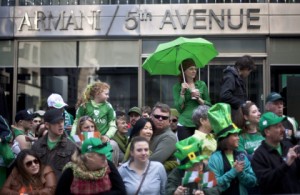
In the lyrics of the Irish-American showman, George M. Cohan, “Every heart beats true for the red, white, and blue.”  But in New York, on Saint Paddy’s Day, the city goes all out for the wearing of the green, starting with the green stripe painted on Fifth Avenue.

As nice as it is to wake up in a New England village on March 17, it could just as easily be February 17 or April 17.  In New York, as soon as you walk out the door on St. Patrick’s Day, there is absolutely no mistaking which day of the year it is.

There’s always electricity in the city air, but on March 17, there is a festival mood along Manhattan’s avenues and streets.  There are vendors selling green and white carnations, businessmen on their way to work sporting green ties, and teenagers with shamrocks painted on their cheeks or with shocks of hair dyed green for the day.  In short, it’s easy being green.

And the great thing about New York is that whether you’re full-blooded Irish, a little bit Irish, or nowhere near being Irish … it makes absolutely no difference.

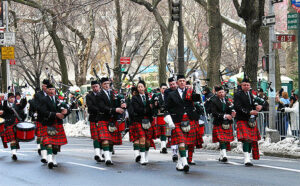
Everyone loves a parade.  And as you get close to Fifth Avenue, you see families on their way to the parade and you start seeing parade participants.Oh, those kilts and tartans and tam-o’-shanters!

It might be a long way to Tipperary but on the streets of New York, I learned the names of many of Ireland’s counties.  These names are emblazoned on banners carried at the head of each county society.  Counties Cork, Clare, and Kilkenny were already familiar to me.  But I soon discovered that there are other counties with the names like Armagh, Donegal, Mayo, and Sligo.

New York City Holds Annual St. Patrick's Day ParadeUnlike New York’s other great processional, the Macy’s Thanksgiving Day Parade, there are no floats and balloons, no vehicles or commercial aspects to the Saint Patrick’s Day Parade.  It is truly a “people parade” with about 150,000 participants marching up Fifth Avenue.

The parade steps off at 11 a.m. from Fifth Avenue and 44th Street and, generally, the last of the groups pass by Rockefeller Center and Saint Patrick’s Cathedral around 5 p.m.  The marchers include military units, top high school bands, drum and bugle corps, members of Eire-based societies, New York’s finest and New York’s bravest … and, of course, any politician who is running for office in the tri-state area.

A fun thing to do is to walk along the side streets off Fifth Avenue where the various groups are whiling away time as they wait their turns to fall into the parade route.  Many of them are practicing and drilling and it’s like attending a giant muster on the city sidewalks.

Pipers_St_Patricks_Day_Fun_in_NYC_3-8-13

And, when those units step out on Fifth Avenue and begin the march uptown, there is nothing like the sound that they make.  The skirling of the bagpipes and the percussion of the drums echoing off the buildings thrills and stirs the soul.  Spectators give appreciative cheers as a band plays a rousing version of “McNamara’s Band” or break into spontaneous song when they hear “When Irish Eyes Are Smiling.”

There were years when I spent hours at the parade and other years when I could only spend a few minutes, but it was always a special time.

If many New Yorkers are tucking into dinners of corned beef and cabbage or lamb stew on Saint Patrick’s night, I’ll always associate the holiday with another Irish specialty.  In my early years in the city, a woman I worked with always brought Irish soda bread to the office on Saint Paddy’s Day.

Kay was from an Irish family in Brooklyn and when she served the bread, she always put out a crock of butter with it.  I can still remember my first taste of that bread.  And today, even though I bake a mean loaf of Irish soda bread myself, nothing can ever quite compare with Kay’s.

StPattysDayBeerThe Irish pubs and saloons in the city are, of course, packed to the gills on the holiday.  And that is another great thing about New York – each neighborhood has its own Irish watering hole.  On my block of East 34th Street, the pub was Brew’s and it was where we ate at least twice a week.  It was the kind of place where you didn’t have to order your drinks because the wait staff already knew what you drank and automatically brought a round to the table when you came in the door.  Richie Brew, the pub’s owner, was warm-hearted and gregarious and called most of his customers by their first names.

We spent many memorable Saint Patrick’s nights at Brew’s.  One time, as we were arriving, a contingent of bagpipers, who had marched in the parade, were getting into formation and tuning up on the sidewalk.  Then, kilts swirling and bagpipes wailing, they marched themselves into Brew’s to the cheers of all the patrons.

The coda to the day’s festivities was watching “The Quiet Man” on TV.  One of the local New York stations (Channel 9 or 11) always screened this movie on Saint Patrick’s night.  (It was akin to airing “It’s a Wonderful Life” at Christmas.)

The movie, which stars John Wayne, Maureen O’Hara and Barry Fitzgerald, is a valentine to Ireland.  With its stunning scenery and depiction of life in the village of Inisfree, the movie always had me longing to jump on the next Aer Lingus flight back to the old countryThis Saint Patrick’s Day, I won’t be in New York.But I’ll still bake Irish soda bread and put on a CD of “The Irish Tenors.”  I’ll listen to songs about sweet Molly Malone, Dublin in the rare old times, and the last rose of summer.

And I’ll drink a toast to the green isle of Erin … and to the great island of Manhattan.

Talking Turkey—How the Quintessential American Feast Evolved

What is better than people sharing a good meal?  Photo by krakenimages on Unsplash.

Editor’s Note: We are delighted to take the opportunity today to republish a topical article about the evolution of that most quintessential of American meals—the Thanksgiving feast—which our former colleague at the ‘Main Street News,’ Linda Ahnert of Old Lyme, wrote for us originally all the way back in 2007. She has kindly updated it this year with a new opening paragraph. Enjoy!

This is a special year for the celebration of our autumnal feast because it is the 400th anniversary of the very first Thanksgiving!

And since this article was first published, Plimoth Plantation has changed its name to Plimoth Patuxet Museums.  Its mission is to tell the story of the English colonists in Plymouth, Mass. and the native peoples who lived there.  So in 2020 the new name was adopted because it better reflects the multicultural history that is the essence of the museum’s mission.

After all, wasn’t this what we first learned about Thanksgiving in grade school? It was the story of the Pilgrims and Indians breaking bread together.  And what is better than people sharing a good meal?

Read on to find out what was really on the menu that first Thanksgiving in 1621 and to learn how this fall feast evolved into a national holiday.

Who Doesn’t Love Thanksgiving?
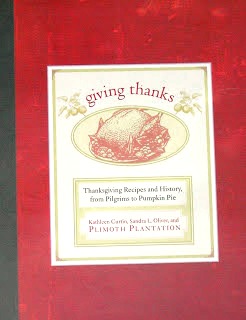
Giving thanks_bookA few years ago, a book entitled “Giving Thanks: Thanksgiving Recipes and History, from Pilgrims to Pumpkin Pie” was published.  The co-authors are Kathleen Curtin, food historian at the Plimoth Plantation, Mass., and Sandra L. Oliver, food historian and publisher of the newsletter “Food History News.”

The book is a fascinating look at how an autumnal feast evolved into a “quintessential American holiday.”

Most Americans, introduced to the story of the Pilgrims and Indians during childhood, assume there is a direct link between the traditional holiday menu and the first Thanksgiving.  But we learn from the book that many of those food items—such as mashed potatoes and apple pie—were simply impossible in Plymouth, Mass., in 1621.  Potatoes were not introduced to New England until much later and those first settlers did not yet have ovens to bake pies.

What we do know about the bill of fare at the first celebration in 1621 comes from a letter written by colonist Edward Winslow to a friend in England:  “Our harvest being gotten in, our governor sent four men on fowling, that so we might after a special manner rejoice together after we had gathered the fruit of our labors.”

Later 90 Indians joined the party with “their great king Massasoit whom for three days we entertained and feasted.”  Then the Indians “went out and killed five deer which they brought to the plantation.”

So venison was a principal food on the menu.  It also seems safe to assume that mussels, clams, and lobsters (all in plentiful supply) were served as well.  According to other journals of the colonists, the “fowl” that Winslow described were probably ducks and geese.  But wild turkeys were also bountiful in 1621, and so it is very likely that they were on the Pilgrims’ table.  Thank goodness for that.

Throughout the New England colonies, it became common to proclaim a day of thanksgiving sometime in the autumn.  In period diaries, there are many descriptions of food preparation—such as butchering and pie baking—followed by the notation that “today was the general thanksgiving.”

By the 19th century, Americans were taking the idea of a “thanksgiving” to a whole new level.  The religious connotations were dropping away in favor of a holiday celebrating family and food.  Roast turkey had become the centerpiece of these fall celebrations.

Turkeys, of course, were native to North America.  (Benjamin Franklin, in a letter, had even proposed the turkey as the official U.S. bird!)

And turkey was considered to be a fashionable food back in the Mother Country.  Just think of the significance of turkey in Charles’ Dickens’ “A Christmas Carol.”  When Scrooge wakes up in a joyful mood on Christmas morning, he calls to a boy in the street to deliver the prize turkey in the poulterer’s shop to the Cratchit family.  (Earlier in the story, the poor Cratchits were dining on goose.)

It is thanks to a New England woman that Thanksgiving became an American holiday.  Sarah Hale was a native of New Hampshire and the editor of “Godey’s Lady’s  Book,”  a popular women’s magazine.  She lobbied for years for a national observance of Thanksgiving.  She wrote editorials and sent letters to the president, all state governors, and members of Congress.

Finally, in 1863, she convinced Abraham Lincoln that a national Thanksgiving Day might help to unite the Civil War-stricken country.   The fourth Thursday in November was now officially on the American calendar.

“… that endless variety of vegetables …”

Connecticut’s own Harriet Beecher Stowe wrote this description of a New England Thanksgiving in one of her novels—“But who shall . . .describe the turkey, and chickens, and chicken pies, with all that endless variety of vegetables which the American soil and climate have contributed to the table . . . After the meat came the plum-puddings, and then the endless array of pies. . .”

The autumnal feast became a national holiday, but each region of the country put its own spin on the menu.   Not to mention that immigrants have also added diversity.  The result is a true “melting pot” of America.  The second half of “Giving Thanks” contains recipes that reflect what Americans eat for Thanksgiving in the 21st century.

In the South, for instance, the turkey might be stuffed with cornbread and there would be pecan and sweet potato pies on the table.  In New Mexico, chiles and Southwestern flavors may be added to the stuffing.

There’s the “time-honored traditional bread stuffing” recipe.  There’s also one for a Chinese American rice dressing and directions for a Cuban turkey stuffed with black beans and rice.  Desserts run the gamut from an (authentic) Indian pudding to an (exotic) coconut rice pudding.  Old-fashioned pumpkin pie is included as well as the newfangled pumpkin cheesecake.

But no matter what food items grace our Thanksgiving tables, it seems that we all end up stuffing ourselves silly.

Perhaps overeating started at that very first harvest celebration in 1621.  In Edward Winslow’s letter describing the feast with the Indians, he noted that food was not always this plentiful. But he wrote his friend in England “ … yet by the goodness of God, we are so far from want that we often wish you partakers of our plenty.”