
Talking Transportation: The ‘Lock Box’ is Log-Jammed in Hartford

locked_chestI hope you’ve been following CT-N to watch our dysfunctional legislature in recent weeks as they struggle to fill a $900 million budget gap. Not only could they not get a new budget together before adjourning (only to be summoned back mid-May for a special session), but the legislative logjam left several important measures in limbo. Among them, the long debated “lock box” for special transportation funding.

As I wrote weeks ago, none of Governor Malloy’s plans to spend $100 billion to rebuild and expand our transportation systems over the next 30 years can go anywhere without an agreement to safeguard those funds from misappropriation by putting them in an untouchable “lock box”.

Because the legislature couldn’t pass such a bill or even put it on the ballot as a potential constitutional amendment referendum, that puts the entire Malloy plan on hold. Without a lock box, nobody trusts Hartford with money raised by tolling or taxes, nor should they.

The lock box idea is not new. In fact, it was Republicans who suggested it years ago. But when Malloy appropriated the idea as his own, GOP lawmakers saw the Governor’s version as more sieve than safe, and they held up a vote.

Folks, if lawmakers can’t agree on an annual budget, let alone a way to keep transportation funding secure, how can we trust them with $100 billion in new money?

The Connecticut Department of Transportation’s (CDOT) track-record on private-public partnerships for transit-oriented development also gives one pause. For example, consider the Fairfield Metro train station where a private developer went belly-up, leaving CDOT to finish the job, sort of: the beautiful new station they built still has no waiting room.

Or consider the ongoing saga of the Stamford rail station garage. It’s been almost three years since CDOT tapped a private developer to demolish the old garage, replace it with a high-rise office / condo / hotel and build new commuter parking lots within a quarter mile from the station. In three years, nothing has been done because there is still no signed contract.

Yet, that project is wrapped in such secrecy that nobody understands the delay. Or why the CDOT is even still negotiating with this laggard “developer of choice.” It couldn’t be because the developer contributed $165,000 to the Malloy campaign that he’s being given so much time, could it? Nah, that would never happen.

So here we are, fellow Nutmeggers. Lawmakers deadlocked. A $900 million budget deficit to fill this year and another $2 billion hole in years ahead. State workers are being laid-off. State funding to towns for education is being cut (meaning local taxes rise). Billionaires are bailing (a third of our taxes are paid by the top 1 percent). And no prospects for a lock box … let alone more funding for transportation. Yup, just the same old stuff as ever.

No wonder they call us “the land of steady habits.”

Jim Cameron

About the author: Jim Cameron is founder of The Commuter Action Group, and a member of the Darien RTM. The opinions expressed in this column are only his own. You can reach him at CommuterActionGroup@gmail.com

For a full collection of “Talking Transportation” columns, visit www.talkingtransportation.blogspot.com

Talking Transportation: Is Uber Really a Bargain?

In the almost two years since Uber rolled into Connecticut, the state’s car/taxi service business has been rocked to its core. But is Uber competing on the same level as taxis and car service companies? Of course not, which is why it’s so successful.

I spoke with Uber’s Connecticut Manager Matt Powers and Drivers Unlimited (a Darien car & limo company) owner Randy Klein to try to get an objective comparison of the services. (Full disclosure: I have been a customer of both firms.)

While Uber does offer a “black car” (premium) service, my comparisons are with their more popular Uber X service … private cars driven by non-chauffeurs, 7,000 of whom have signed up as drivers in CT, according to Powers.

VEHICLES: Car services opt for Lincoln Town Cars and SUV’s. Uber X just requires drivers have a 4-door car, less than 10 years old with a trunk big enough to carry a wheelchair.

MAINTENANCE: Klein owns and maintains his own fleet, inspecting all cars weekly. Uber relies on its X drivers to do upkeep.

DRIVER SCREENING: Klein does his own background checks on top of the DMV screening required for a CDL (commercial drivers license). Uber says it does “rigorous” screening of drivers, including terrorist watch lists, but requires only a regular driver’s license. Klein’s firm also does random drug testing of his drivers.

INSURANCE: Klein has coverage of up to $1.5 million for every driver. Uber relies on the individual driver’s personal insurance but layers a $1 million policy on top when they are driving Uber customers.

RATINGS: Uber asks drivers and passengers to rate each other after every trip. Klein asks passengers to rate drivers but says it’s unfair to allow drivers to rate customers. “We’re in a service business,” he says.

BOOKING: Klein says most of his reservations are made two to three weeks in advance. Uber doesn’t do advance bookings, though, in personal experience, I’ve never had to wait more than 10 minutes for a car.

FARES: Though not an apples-to-apples comparison, an average car service ride from Darien to LaGuardia Airport is anywhere from $130 – $180, one-way. Uber’s quote for an X car is about $75.

SURGE PRICING: When demand is highest, Uber adds a surcharge to fare quotes, sometimes doubling the fare. Klein says his rates are the same 24 x 7.

IF YOU HAVE PROBLEMS: Klein says his office can be reached anytime by phone, toll-free. Uber’s website offers a template to file complaints online.

So, is Uber really a bargain? Let me answer with a hotel analogy. Sometimes I love staying at the Ritz Carlton with its plush rooms and fabulous service. Other times, a Motel 6 or LaQuinta is fine, though there’s always the risk of a “surprise”.

I see car services the same way. With a plush Lincoln SUV and chauffeur you get what you pay for. But sometimes all you want is to get from home to the airport and an Uber X is just fine … and a lot cheaper!

Jim Cameron

Jim Cameron

Editor’s Note: Jim Cameron is founder of The Commuter Action Group, and a member of the Darien RTM. The opinions expressed in this column are only his own.

You can reach him at CommuterActionGroup@gmail.com

For a full collection of “Talking Transportation” columns, see www.talkingtransportation.blogspot.com
Talking Transportation: Cross Country by Amtrak

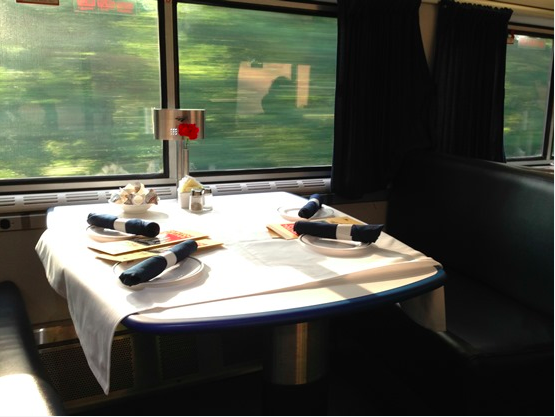
An Amtrak dining car, from the Amtrak blog.

An Amtrak dining car, from the Amtrak blog.

A recent business trip took me to Dallas on a crowded, turbulent 3 ½ hour flight from LaGuardia. But the return trip was a real treat: two days and nights on Amtrak, for free.

Riding a lot of Acela trains in the Northeast Corridor, I’ve built up a ton of Amtrak Guest Rewards points, augmented by their co-branded credit card. So when I checked my calendar and the Amtrak website, I saw an opportunity to enjoy a leisurely ride home in a full bedroom, meals included, gratis.

The long distance trains I rode from Dallas to Chicago (The Texas Eagle) and Chicago to Washington, D.C. (The Capitol Ltd) were all “Superliners”, i.e., double-deck cars with a variety of accommodations, including coaches and sleeping cars.

Each train also had a diner and an observation car, though the sightseeing through Texas, Arkansas, Missouri and Illinois wasn’t exactly memorable. But the second leg of the trip through the hills and river valleys of Pennsylvania and Maryland was gorgeous. “Fly over” country sure looks different from an elevation of about 20 feet.

My bedroom was equipped with a big couch that folded down into an almost queen-sized bed, surprisingly comfortable for sleeping. The private commode doubled as a shower.

Firing up my radio scanner, pre-set to the railroads’ frequencies, I followed the action as the conductor and engineer received instructions from a dispatcher hundreds of miles away.

The food was good, all cooked to order, and included in my first class fare. Dining was communal, one of the fun parts of train travel: getting to meet real folks from across the U.S., chatting about their travels, their work – everything except politics.

In Chicago and Washington D.C., where I had time between train connections, I enjoyed Amtrak’s “Metropolitan Lounge” for first class passengers, complete with free Wifi, snacks and priority boarding. I also had time to explore those cities’ beautifully restored train stations jammed with commuters, Amtrak passengers, shops and restaurants.

To their credit, Amtrak does a great job with their money-losing long distance trains. The service is truly First Class, the ride smooth and, for the most part, on time (thanks to a heavily padded timetable). We had only two small delays… one caused by another Amtrak train colliding with a truck at a grade crossing (no injuries), the other by a boulder on the tracks that needed to be removed.

Because demand is high and the supply of sleepers is low, fares for long distance Amtrak trains are pricey and booked many weeks in advance. Roundtrip airfare from New York to Dallas is as low as $230. But one-way on Amtrak is $299 in coach and $700+ in a roomette. Of course with Amtrak it’s like getting two nights of hotel plus meals, but to me it’s well worth it.

So next time you’re planning a long distance trip, turn it into a journey. Take the train!

Jim Cameron

Jim Cameron

Editor’s Note: Jim Cameron is founder of The Commuter Action Group, and a member of the Darien RTM. The opinions expressed in this column are only his own.

You can reach him at CommuterActionGroup@gmail.com

For a full collection of “Talking Transportation” columns, see www.talkingtransportation.blogspot.com

Talking Transportation: The Secrets of Riding Metro-North

Screen Shot 2016-03-04 at 2.19.18 AMEach week, dozens of people ride Metro-North for the first time. This week’s column is to let both new and veteran commuters in on the secrets of a successful rail commute.

PARKING:
You can’t take the train if you can’t get to the station, so invest in your commuting future by getting your name on your town’s (and neighboring towns’) waiting lists for annual parking permits. In four or five years, when your name rises to the top of the list, you’ll thank yourself. Meantime, opt for legal day-parking, find a friend to ride to the station with or try biking. There are free bike racks at most stations.

PLATFORM POSITIONING:
There’s a science to deciding where on the platform to wait for your train. Many commuters position themselves at the front or rear of the train for a quick get-away when they arrive in Grand Central. Contrarian that I am, I tend toward the center of the train because that’s where there’s a better chance of getting a seat.

FINDING A SEAT:
Believe me, your commute will be a lot better seated than standing. Seats are in short supply, so here’s the strategy. As your train pulls in, scan the cars that pass you and see how the passenger load looks. As the doors open, move quickly inside, eye-ball your target seat and get there fast. Put your carry-ons in the overhead rack and sit down. If you hesitate, you’re toast and will be a standee.
On trains leaving Grand Central, you may be able to get onboard up to 20 minutes before departure. Take a window or aisle seat on the three seat side. The middle seat next to you will be the last to be filled.

STANDEE STRATEGY:
If you didn’t get a seat on boarding, don’t give up. A few people on most trains get off in Stamford, so look for them and position yourself to get their seat before it gets cold. Here’s the secret: intermediate passengers have seat checks with a tear down the middle or a torn corner. Look for them and just before Stamford, position yourself near their row and, bingo, you’ve got a seat!

TICKETS:
Do not make the mistake of boarding a train without a ticket, or you’ll get hit with up to $6.50 penalty for buying a ticket on the train with cash. But if you’re thrifty, don’t buy a ticket from a ticket window or ticket machine. No, the cheapest tickets are only available online at www.mta.info. Go for the ten-trip tickets for an additional discount.

ON-BOARD ETIQUETTE:
Train time is not “your own time,” but shared time. So be considerate of your fellow commuters. Don’t hog empty seats, use the overhead racks. Keep your feet off the seats. If you must use your cellphone, go to the vestibule. Be like the Boy Scouts: anything you carry onto the train (including newspapers, coffee cups, etc.) carry off the train and dispose of properly.

If you’ve got your own “secrets” for a successful commute, send them along and I’ll include them in upcoming columns. Just e-mail me at CommuterActionGroup@gmail.com

Jim Cameron

Jim Cameron

Editor’s Note: Jim Cameron is founder of The Commuter Action Group, and a member of the Darien RTM. The opinions expressed in this column are only his own.

You can reach him at CommuterActionGroup@gmail.com

For a full collection of “Talking Transportation” columns, see www.talkingtransportation.blogspot.com

Talking Transportation: ‘Don’t Blame The Trucks’

Driving to Hartford the other day (no, you cannot really get there by train) I saw a beautiful sight:  hundreds of trucks!  Yet, motorists hate trucks and mistakenly blame them for traffic congestion and accidents that cause hours of delays.

Readers of this column know I’m a “rail guy” and would love to see freight trains replace trucks, but that ain’t gonna happen anytime soon.  But as motorists we should not blame truckers for traffic woes of our own creation.

Check the facts and you’ll find most highway accidents are caused by motor cars, not the trucks.

Do trucks drive too fast?  Sure, but don’t we all?  Next time you’re on I-95, check who’s in the high-speed left lane and you’ll see cars, not trucks.

Should there be better safety inspections of trucks?  Absolutely!  But for every over-weight truck or over-worked truck driver, there are doubtless hundreds of unsafe cars and equally road-weary warriors behind the wheel whose reckless disregard endangers us all.

Truckers drive for a living.  They are tested and licensed to far more rigorous standards than anyone else.  And because they drive hundreds of miles each day, overall I think they are far better drivers.  When’s the last time you saw a trucker juggling a cellphone and a latte like some soccer moms?

And remember … they’re not out there driving their big-rigs up and down the highway just to annoy us.  We put those trucks on the road by our voracious consumption patterns.  Every product we buy at stores large and small, including the very newspaper or iPad you hold in your hand, was delivered by trucks.  Want fewer trucks on the road?  Just stop buying stuff.

By definition, trucks are high-occupancy vehicles.  Compare the energy efficiency of a loaded truck delivering its cargo to you in your “SOV” (single occupancy vehicle), even if it is a hybrid.  Only rail offers better fuel efficiency.

Why are trucks jamming our highways at rush hour?  Because merchants require them to drive at those times to meet the stores’ delivery timetable.  If big-box stores and supermarkets only took truck deliveries in the overnight hours, our highways would flow much better at rush hour. 

Truckers must use the interstates while passenger cars can chose among many alternate routes.  Why is the average distance driven on I-95 in Connecticut just 11 miles?  Because most of us drive the ‘pike for local, not interstate trips.

If we were smart enough to “value price” our highways (i.e., return tolling), we’d see fewer vehicles of all kinds on I-95, and those that were willing to pay for the privilege of motoring there would get real value in a faster ride.

I’m hardly an apologist for the trucking lobby.  But neither is it fair for us to blame anyone but ourselves for highway safety and congestion.  It’s the SOV crowd, not the truckers, who are to blame. 

Let’s be honest about this mess of our own making and stop trying to blame truckers as our scapegoat.  As the great philosopher Pogo once put it, “We have met the enemy and he is us!

Jim Cameron

Jim Cameron

About the author: Jim Cameron is founder of The Commuter Action Group, and a member of the Darien RTM.  The opinions expressed in this column are only his own.  You can reach him at CommuterActionGroup@gmail.com  

For a full collection of “Talking Transportation” columns, see www.talkingtransportation.blogspot.com