Talking Transportation: Speed Limits, Safety and Fuel Efficiency

65-mph-speed-limit-sign

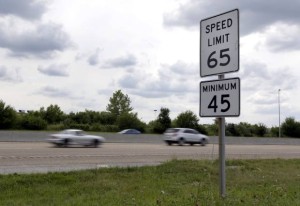
Crawling along I-95 the other day in the usual bumper-to-bumper traffic, I snickered when I noticed the “Speed Limit 55” sign alongside the highway. I wish …

Of course, when the highway is not jammed, speeds are more like 70 mph with the legal limit, unfortunately, rarely being enforced. Which got me thinking: who sets speed limits on our highways and by what criteria?

Why is the speed limit on I-95 in Fairfield County only 55 mph but 65 mph east of New Haven? And why is the speed limit on I-84 just 55 mph from the New York border to Hartford, but 65 mph farther east in “the Quiet Corner”? Why does the eastern half of the state get a break?

Blame the Office of the State Traffic Administration (OSTA) in the CDOT. This body regulates everything from speed limits to traffic signals, working with local traffic authorities (usually local Police Departments, mayors or Boards of Selectmen).

OSTA is also responsible for traffic rules for trucks (usually lower speed limits) including the ban on their use of the left hand lane on I-95 in most places.

It was the Federal government (Congress) that dropped the Interstate speed limit to 55 mph in 1973 during the oil crisis, only to raise it to 65 mph in 1987 and repeal the ban altogether in 1995 (followed by a 21% increase in fatal crashes), leaving it to each state to decide what’s best.

In Arizona and Texas that means 75 mph while in Utah some roads support 80 mph. Trust me … having recently driven 1000+ miles in remote stretches of Utah, things happen very fast when you’re doing 80 – 85 mph!

About half of Germany’s famed Autobahns have speed limits of 100 km/hr (62 mph), but outside of the cities the top speed is discretionary. A minimum of 130 km/hr (81 mph) is generally the rule, but top speed can often be 200 km/hr (120 mph).

Mind you, the Autobahn is a superbly maintained road system without the bone-rattling potholes and divots we enjoy on our highways. And the German-built Mercedes and Audis on these roads are certainly engineered for such speed.

American cars are designed for maximum fuel efficiency in the 55 – 60 mph range. Speed up to 65 mph and your engine runs 8 percent less efficiently. At 70 mph, the loss is 17 percent. That adds up to more money spent on gasoline and more environmental pollution, all to save a few minutes of driving time.

But even bigger than the loss of fuel efficiency is aerodynamic drag, which can eat up to 40 percent of total fuel consumption. Lugging bulky roof-top cargo boxes worsens fuel economy by 25 percent at interstate speeds. So does carrying junk in your trunk (or passengers!): a 1 percent penalty for every 100 pounds.

Even with cheaper gasoline, it all adds up!

Jim Cameron

Jim Cameron

Editor’s Note: Jim Cameron is founder of The Commuter Action Group, and a member of the Darien RTM. The opinions expressed in this column are only his own.

You can reach him at CommuterActionGroup@gmail.com

For a full collection of “Talking Transportation” columns, see www.talkingtransportation.blogspot.com

Talking Transportation: Predictions for 2016

Everybody writes “Year in Review” stories.  But rather than dwell on the past, I’ve got the guts to predict the future!  Here’s what will happen in 2016 in the transportation world.

METRO-NORTH: Slowly but surely, the railroad will drag itself out of the quagmire it’s been in since the Bridgeport, Spuyten Duyvil and Valhalla crashes.  On time performance will hold strong even through the winter, thanks to the dependable new M8 cars and mild weather.  Ridership will continue to climb, causing further crowding and standing room only conditions on some trains.

STAMFORD GARAGE: After waiting for its chosen developer (and Malloy campaign contributor) JHN Group to sign a contract two and a half years after being tapped for the massive transit oriented development project, Connecticut Department of  Transport will plug the plug on its deal and replace the old garage on its own (taxpayers’) dime.

TOLLS & TAXES: Governor Malloy’s quest for $100 billion to pay for his 20-year transportation plan will prove universally unpopular when his Transportation Funding Task Force finally issues its recommendations (originally due after Labor Day) in January. The panel will call for higher gasoline and sales taxes, tolls, motor vehicle fees and a slew of other unpopular ideas.  The legislature will react by slashing the Governor’s unrealistic plans, reluctant to have its fingerprints on anything the Task Force suggests.

EMINENT DOMAIN: Governor Malloy will try again to impose state control over transit oriented development, reintroducing his stealth bill to create a Transit Corridor Development Agency (all of whose members he would appoint) with the power to seize any land within a quarter mile of a rail station. 

FLYING: Returning to profitability, airlines will continue to squeeze more seats onto fewer flights, making flying an ordeal.  Frequent flyer rewards will be harder to get as desperate passengers will pay to ride in business or first class, leaving fewer seats for upgrades.

AMTRAK: Acela will become increasingly popular, allowing the railroad to raise business fares.  Last minute seats will be harder to get, but the railroad will still refuse to expand service by buying new railcars.  Traditional “Northeast Corridor” trains will still be jammed as the railroad tries to compete with discount bus carriers.

HIGHWAYS: With an improving economy and inadequate rail station parking, people will jam I-95 and the Merritt Parkway in even larger numbers, increasing commuting times further.  Gasoline prices will continue to decline thanks to cheap oil, sending even more people to the roads.

UBER WAFFLES:   State and city authorities will come down hard on car services like Uber and Lyft, imposing on them the same regulations and taxes now born by taxis and limos.  After “leveling the playing ground”, Uber-type services will raise fares, passing those costs on to passengers.

Will all of my predictions come true?  Check back in a year and we’ll see … meantime, happy traveling in 2016!

Jim Cameron

Jim Cameron

About the author: Jim Cameron is founder of The Commuter Action Group, and a member of the Darien RTM.  The opinions expressed in this column are only his own.  You can reach him at CommuterActionGroup@gmail.com  

For a full collection of “Talking Transportation” columns, visit www.talkingtransportation.blogspot.com

Talking Transportation: Saving Money on Metro North

MTA logoWith the holidays upon us, let’s review some money-saving tips for riding Metro-North into the city for commuters and day-trippers alike:

TRANSITCHEK: See if your employer subscribes to this great service, which allows workers to buy up to $130 per month in transit using pre-tax dollars.  If you’re in the upper tax brackets, that’s a huge savings on commutation.  A recent survey shows that 45 percent of all New York City companies offer TransitChek, which can be used on trains, subways and even ferries. 

GO OFF-PEAK: If you can arrive at Grand Central weekdays after 10 a.m. and can avoid the 4 to 8 p.m. peak return hours, you can save 25 percent.  Off-peak’s also in effect on weekends and holidays.  These tickets are good for 60 days after purchase.

BUY TICKETS IN ADVANCE: If you buy your ticket on the train you’ll pay the conductor a $5.75 – $6.50 “service charge”… a mistake you’ll make only once !  (Seniors: don’t worry, you’re exempt and can buy on-board anytime without penalty.) There are ticket machines at most stations, but the cheapest tickets are those bought online.  And go for the ten-trip tickets (Peak or Off-Peak) to save an additional 15 percent.  They can be shared among passengers and are good for six months.

KIDS, FAMILY & SENIOR FARES:   Buy tickets for your kids (ages 5 – 11) in advance and save 50 percent over adult fares.  Or pay $1 per kid on board (up to four kids traveling with an adult, but not in morning peak hours).  Seniors, the disabled and those on Medicare get 50 percent off the one-way peak fare.  But you must have proper ID and you can’t go in the morning rush hours.

FREE STATION PARKING: Even stations that require weekday parking permits usually offer free parking after 5 pm, on nights and weekends.  Check with your local town. 

METROCARDS: Forget about the old subway tokens.  These nifty cards can be bought at most stations (even combined with your Metro-North ticket) and offer some good deals:  put $5.50 on a card (bought with cash, credit or debit card) and you get a 5% bonus.  Swipe your card to ride the subway and you’ll get a free transfer to a connecting bus, or vice versa.  You can buy unlimited ride MetroCards for a week ($31) or a month ($116.50). 

BUT IS IT CHEAPER TO DRIVE?: Despite being a mass transit advocate, I’m the first to admit that there may be times when it’s truly cheaper to drive to Manhattan than to take the train, especially with three or more passengers.  You can avoid bridge tolls by taking the Major Deegan to the Willis / Third Ave. bridge, but I can’t help you with the traffic you’ll have to endure.  Check out www.bestparking.com to find a great list of parking lots and their rates close to your destination.   Or drive to Shea Stadium and take the # 7 subway from there.

The bottom line is that it isn’t cheap going into “the city”.  But with a little planning and some insider tips, you can still save money.  Happy Holidays!

Jim Cameron

Jim Cameron

Jim Cameron is founder of The Commuter Action Group, and a member of the Darien RTM.  The opinions expressed in this column are only his own.  You can reach him at CommuterActionGroup@gmail.com   For a full collection of “Talking Transportation” columns, see www.talkingtransportation.blogspot.com

Talking Transportation: Traveling by Tube

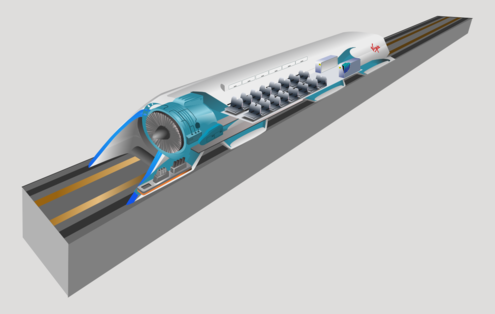
Cutaway graphic of "The Loop."

Cutaway graphic of “The Loop.”

Will the train of the future be a high-speed tube, not a railroad?  That’s inventor and entrepreneur Elon Musk’s and others’ vision.  And Musk, the man who brought us the Tesla (all-electric car) and SpaceX (for-profit space rocket company) is putting his own money behind a proof-of-concept project for what he calls Hyperloop.

The concept sound simple:  move passengers in a sealed tube through a series of giant pipes propelled by air pressure at speeds up to 700+ mph.  That would mean a trip from New York to DC would take 20 minutes.

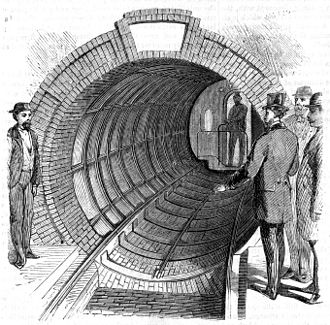
Diagram of the "Beach" pneumatic transit system.

Alfred Beach’s “Pneumatic Transit” system.

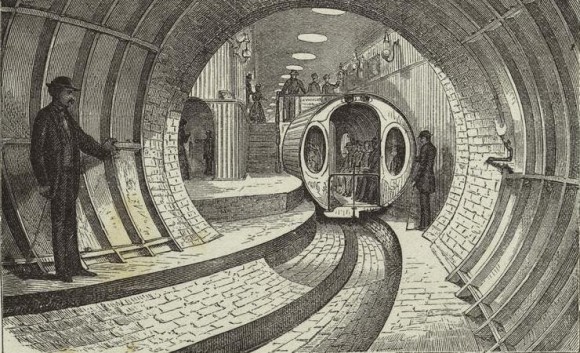
But this is not a new concept.  In fact, the first experimental “subway” in New York City, Alfred Beach’s “Pneumatic Transit” proved back in 1870 that it would work.  Despite political opposition, Beach secretly built a 300-foot-long subway under Broadway near City Hall, offering daring passengers a round-trip ride in the system’s only railcar, pushed and pulled by air.  The system ran for almost three years and carried over 400,000 riders, 11,000 alone in the first two weeks.  The fare was 25 cents (equivalent to $18 today). Competing elevated railroad owners eventually won the City’s franchise and Beach’s system was abandoned.

Even Beach’s idea wasn’t new, as vast underground pneumatic tube systems in Paris and London were already delivering telegrams and mail by the 1850’s.  As recently as the 1960s, office buildings in major cities were designed with pneumatic tube systems for inter-office mail.  Some older department stores still use the tubes to record sales and make change from a centralized money room.

Hurtling through a tube may be fine for mail, but what about humans?  As a recent article in Smithsonian Magazine points out, the psychological factor of being enclosed in a sealed tube, traveling 700+ mph, is not that much different than flying in a jet … maybe just a bit more claustrophobic.

Whether by train or plane, I always like to look out the window.  Seeing where we’re going is half the fun, even on a familiar route.  But wrapped in a metal tube inside a giant pipe affords no views at all.  Riding 31 miles in the Chunnel under the English Channel takes 20 minutes at today’s speeds, and that’s more than enough time for me, thank you very much.

Of greater concern are the propulsion methods and the sheer physics of accelerating and braking from near-supersonic speeds.  But the biggest challenge of all would be where to locate the “pipes” and how to acquire necessary land.

A station inside the"Pneumatic Transit" system.

A station inside the “Pneumatic Transit” system.

Like high-speed rail, it would make no sense to follow the median on Interstate 95 or the Metro-North / Amtrak rights of way with all their twists and turns.  And anyone crazy enough to invest in any project along the coastline with the inevitability of rising sea levels should probably think pontoons, not pipes.

It will be interesting to see if Musk’s and others’ Hyperloop concepts get off the ground (pun intended) … but I don’t expect to ride such a system any distance in my lifetime.

Jim Cameron

Jim Cameron

Jim Cameron is founder of The Commuter Action Group, and a member of the Darien RTM.  The opinions expressed in this column are only his own.  You can reach him at CommuterActionGroup@gmail.com  

For a full collection of “Talking Transportation” columns, see www.talkingtransportation.blogspot.com

Talking Transportation: The Fairest (and Least Popular) Way To Pay for Roads

Back in April, I wrote about the challenge we face to pay for Gov. Malloy’s $100 billion transportation plan.  And I expressed sympathy for his bipartisan, blue-ribbon panel tasked with coming up with funding alternatives, the Transportation Finance Panel.

To be honest, I think that panel may be on a fool’s errand.  They’re trying to pay for a wish list of projects not of their making and many of which may not be necessary let alone affordable.  Maybe we only need $50 billion.  But it’s not their mandate to question our “transportation Governor.”  Someone else will have to do the “vetting.”

But even as the Finance Panel does its work, exploring all manner of funding options, they are being second-guessed by politicians and public alike.

How about tolls?  Too expensive … they’ll slow traffic … and don’t forget those flaming truck crashes at toll barriers!  (Not true … no they won’t … and there won’t be toll barriers).

Gas tax?  Unfair … out-of-state motorists won’t pay … improved gas mileage means dwindling revenue.  (Totally fair … maybe so … and absolutely correct).

Which brings us to what would seem to be the fairest, most equitable fundraising mechanism for paying for our roads, but which brought a bipartisan crap-storm of response when suggested:  a mileage tax, or VMT (vehicle miles traveled) tax.

The concept is simple:  have each motorist pay a tax for the number of miles he/she drives each year.  The data could be collected electronically by a GPS or with an odometer check when you get your annual emissions inspection.  You drive more, you pay more … whether you drive on I-95 or back-country roads.  Take mass transit, you’d drive less and pay less.

The VMT idea was discussed at the Finance Panel’s July 29 meeting, and the public and political reaction was immediate and universally negative.

Senate Majority Leader Bob Duff (D-Norwalk) called it “unproven,” despite successful trials in the Netherlands and Oregon and VMT’s endorsement by the US Government Accountability Office.

Republican State Senator Toni Boucher calls VMT nonsensical and an invasion of privacy, though testimony proved both claims wrong.

Face it:  nobody likes a tax that they have to pay.  Tax the other guy … the trucker, the out-of-state driver, the real estate transferor … but don’t tax me!

Driving a car is not free.  Paying for gasoline is only part of the cost and even Connecticut’s relatively high gas tax comes nowhere near to paying for upkeep of our roads.  Our deteriorating roads are a hidden toll as we pay for car repairs.

The Transportation Finance Panel will find there is no easy or popular solution to paying for the Governor’s $100 billion untested and unattainable wish list of projects.  Whatever they recommend, citizens will scream bloody murder and their lawmakers will vote it down.

But shame on reactionaries in Hartford for calling the VMT, or any funding alternative, “dead on arrival.”  Let’s at least let the Finance Panel do its due diligence before saying they have wasted their time.

Jim Cameron

Jim Cameron

Jim Cameron is founder of The Commuter Action Group, and a member of the Darien RTM.  The opinions expressed in this column are his own.  You can reach him at CommuterActionGroup@gmail.com   For a full collection of “Talking Transportation” columns, see www.talkingtransportation.blogspot.com