Talking Transportation: Summer Daytrips To Ride Connecticut’s Rail History

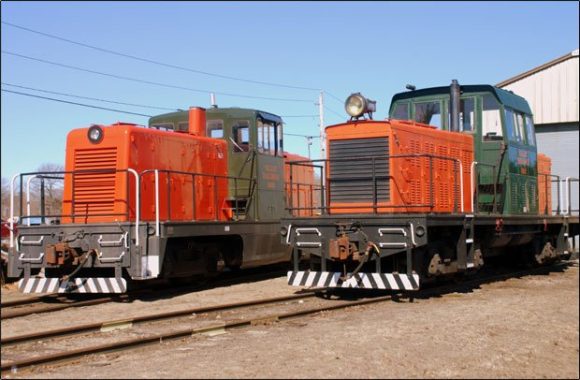
Either of these Valley Railroad diesel locomotives pictured above, “0900” or “0901”, is used to power the Essex Clipper Dinner Train.

Either of these Valley Railroad diesel locomotives pictured above, “0900” or “0901”, is used to power the Essex Clipper Dinner Train.

If you’re looking for family fun this summer, consider visiting one of Connecticut’s many living museums celebrating our rail heritage.

The Shore Line Trolley Museum in East Haven (www.shorelinetrolley.com) was founded in 1945 and now boasts more than 100 trolley cars in its collection.  It still runs excursion trolleys for a short run on tracks once used by The Connecticut Company for its “F Line” from New Haven to Branford.  You can walk through the car barns and watch volunteers painstakingly restoring the old cars.  There’s also a small museum exhibit and gift shop.

The Connecticut Trolley Museum in East Windsor (www.ceraonline.org) began in 1940, making it the oldest trolley museum in the US.  It too was started on an existing right-of-way, the Rockville branch of the Hartford & Springfield Street Railway Company.  You can ride a couple of different trolleys a few miles into the woods and back, perhaps disembarking to tour their collection of streetcars, elevated and inter-urbans in the museum’s sheds and barns.

If you’re looking for a day-trip, especially for kids, I can highly recommend either museum.  But if you’re looking for trains, you’re also in luck.

The Danbury Railroad Museum (www.danbury.org/drm) is walking distance from the Metro-North station, making this a potentially full-day, all-rail adventure.  On weekends they offer train rides and for a premium you can even ride in the caboose or the engine.  They have a great collection of old rail cars and a well stocked gift shop.

For nostalgia fans, The Essex Steam Train (www.essexsteamtrain.com) offers not only daily rides on a classic steam train, but connecting riverboat rides up to the vicinity of Gillette Castle and back.  In addition to coach seating you can ride on an open-air car or in a plush First Class Coach.  There’s also a great dinner train, “The Essex Clipper” which offers a two and a half hour, four-course meal and a cash bar.

In downtown South Norwalk, you can visit what once was a busy switch tower, now the SoNo Switch Tower Museum (www.westctnrhs.org/towerinfo.htm).  Admission is free (donations welcome) weekends 12 noon to 5 p.m.

Also open only on weekends is the Connecticut Eastern Railroad Museum in Willimantic (www.cteastrrmuseum.org).  In addition to guided tours, visitors can operate a replica 1850’s-style pump car along a section of rail that once was part of the New Haven Railroad’s “Air Line”.

The Railroad Museum of New England in Thomaston (www.rmne.org) offers rail trips on Sundays and Tuesdays along the scenic Naugatuck River in addition to a large collection of restored engines and passenger cars including a last of its kind 1929 New Haven RR first class “smoker” complete with leather bucket seats.

All of these museums are run by volunteers who will appreciate your patronage and support.  They love working on the railroad and will tell you why if you express even the slightest interest in their passion.  Try ‘em.

Jim Cameron

Jim Cameron

About the author: Jim Cameron has been a Darien resident for 25 years.  He is the founder of the Commuter Action Group and also serves on the Darien RTM. 

The opinions expressed in this column are only his own. 

You can reach him at CommuterActionGroup@gmail.com 
Talking Transportation: America’s Mass Transit Mecca

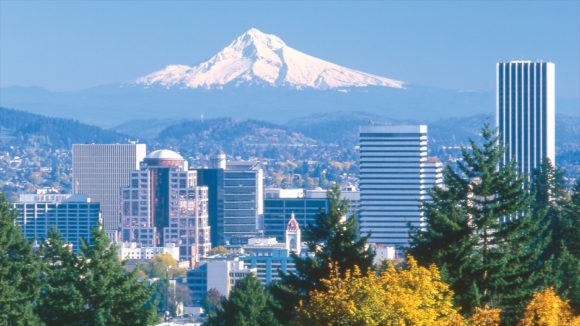
Portland, Oregon, with Mount Rainier providing a stunning backdrop.

Jim Cameron names Portland, Ore., (with Mount Rainier providing a stunning backdrop) the most mass-transit intensive city in the US.

What’s the most mass-transit intensive city in the US?  By the numbers, New York City.  But for a glimpse of the real future of mass-transit,  the winner is clearly Portland, Oregon.

Portland has only 632,000 residents but 2.3 million in its metro area.  Yet it has, per capita, what I think is the largest, most extensive and best integrated systems of light rail, streetcars and bike lanes in the nation.

LIGHT RAIL: It was 1986 when Portland opened its first light-rail line.  Today the system covers 60 miles (including the airport, 12 miles from downtown).  In 2001 a downtown streetcar system was added.  It proved so successful that Portland now manufactures streetcars for other American cities.

Like the city’s extensive bike-rack equipped bus network, all of Portland’s mass transit operates on the honor system:  you buy tickets before boarding and only show them if a inspector boards, looking for proof of payment.

To encourage ridership, fares are ridiculously cheap.  For $2.50 you can roam the system for 2 ½ hours.  An unlimited day pass is $5 or $26 a month (about the cost of a round-trip to NYC on Metro-North).  “Honored Citizens” (seniors, Medicare or disabled) get a monthly pass for $7.50!

DON’T EVEN THINK ABOUT DRIVING: To further encourage use of the ubiquitous mass transit, driving in downtown is difficult and expensive.  The main transit corridors have one lane for streetcars, one lane for bikes and just one lane for cars.  Parking is really expensive, both by meter on the streets and in lots.  And yes, the freeways crawl just like in LA.

TECHNOLOGY: The bus and rail system offers free apps for trip-planning which use GPS to tell you exactly how long you’ll wait for the next trolley, directions by line to your destination and expected travel time.  And yes, you can buy and show your ticket using your smartphone.

BIKES ARE KING:     The city’s unofficial motto is “Keep Portland Weird”, and the residents work hard to do so.  Outside of Europe or Asia I have never seen so many people on two-wheels traversing a community.

There are so many dedicated bike lanes that when a new bridge was built crossing the Willamette River, the bridge was built for everything except cars and trucks:  a mass transit-only bridge!

When a new Medical Center was planned on a downtown hill, designers realized it would be foolish to waste land on parking, so they built an aerial tram from unused industrial land on the waterfront.  Hospital employees and patients alike take light rail or bike to the base station (where a free 400-space bike-lot is usually full) and are skyward in minutes.

So if you are ever disillusioned by the sorry state of mass-transit in our area, take heart.  The future is now in Portland!

Jim Cameron

Jim Cameron

About the author: Jim Cameron has been a Darien resident for 25 years.  He is the founder of the Commuter Action Group and also serves on the Darien RTM.  The opinions expressed in this column are only his own. 

You can reach him at CommuterActionGroup@gmail.com
Talking Transportation: Why Ferries Aren’t the Answer for Commuting in Connecticut

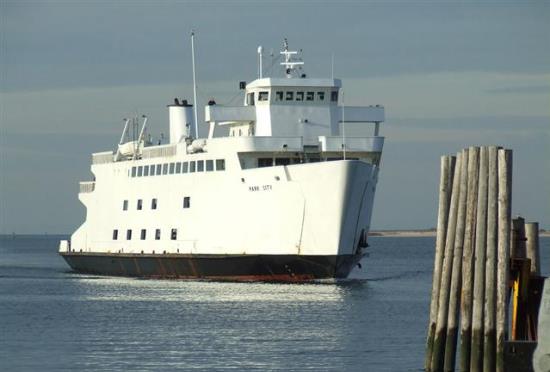
Bridgeport to Port Jefferson Ferry

Bridgeport to Port Jefferson Ferry

Recently, NYC Mayor DeBlasio announced a $325 million plan to reintroduce ferry boat service to the five boroughs charging the same fare as subways.  The mayor says these boats could carry 4.5 million passengers a year.

So why don’t we have ferries in Connecticut?  There are several reasons:

SPEED:  In open water, fast ferries on the Sound could make 30 knots (35 mph).  But if they must sail up inlets to the downtown areas of Bridgeport, Norwalk or Stamford, that speed is cut to 5 knots, extending travel time.

DOCKING: To keep to their competitive speeds, docks would have to be located close to the Sound.  That’s expensive real estate. And what about parking at those docks… and drive-time on local roads to reach them? Again, more travel time.

FREQUENCY: Metro-North offers trains to midtown New York every 20 minutes in rush hour carrying 800 – 1000 passengers per train. No ferry service anywhere in the country can compete with that frequency of service. Will travelers really be willing to wait an hour or two for the next boat?

COMFORT: In nice weather, a boat ride to work sounds idyllic. But what about in a Nor’easter?  The bumpiest ride on the train pales by comparison.

FARES:  The most optimistic of would-be ferry operators in CT estimate their fares will be at least double those charged on the train.  And people say Metro-North is too expensive?

OPERATING COSTS: Fast ferries are gas guzzlers, the aquatic equivalent to the Concorde.  When the Pequot tribe built high-speed catamarans to ferry gamblers to their casino in Connecticut to lose money, the service proved so expensive to run that the Pequots dry-docked the ferries in New London.

ECONOMICS: The final reason I don’t think ferries make economic sense is that nobody else does either!  Ferry operators (like the near-bankrupt NY Waterways) aren’t stupid. They’ve looked at possible service from coastal Connecticut, crunched the numbers and backed off. In a free market economy, if a buck could be made running ferries, they’d be operating by now. They aren’t operating, and there are lots of reasons why, many of which I’ve listed.

The only place ferries are run successfully is where they’re heavily subsidized (everywhere), have a monopoly (for example, getting to downtown Seattle from an island suburb), don’t duplicate existing transportation routes (like from Bridgeport to Port Jefferson), or offer advantages of speed because they operate on extremely short runs (from Hoboken to midtown).  Our situation here in Connecticut passes none of those tests.

You already know I’m a train nut. (The bumper sticker on my car reads “I’d Rather Be on the Train.”)  And I do love an occasional recreational sail on the Sound.  But it’s unrealistic to think that commutation by ferries is in our future.

Jim Cameron - Chairman of the CT Metro-North / Shore Line East Rail Commuter Council

Jim Cameron

About the author: Jim Cameron is founder of The Commuter Action Group, and a member of the Darien RTM.  The opinions expressed in this column are only his own.  You can reach him at CommuterActionGroup@gmail.com

For a full collection of “Talking Transportation” columns, visit www.talkingtransportation.blogspot.com

Talking Transportation: Big Brother Comes Along for the Ride

Big_BrotherHere in my car, I feel safest of all.  I can lock all my doors.  It’s the only way to live, in cars.*
* Quote from Gary Numan, “Cars”, 1979

You may feel that your car is your last private refuge in this busy world.  But there’s someone along for the ride:  Big Brother.  And you’d be surprised what he knows about you, thanks to modern technology.

Cell Phones:
Your cell phone is constantly transmitting its location, and services like Google Dashboard’s location history can show exactly where you were at any date in time.  Don’t want to be tracked?  Turn off your cellphone.

E-Z Pass:
Even when you are nowhere near a toll booth, E-ZPass detectors can monitor your location.   Want to stay anonymous? Keep your E-ZPass wrapped in aluminum foil in your glove box.

Highway Cameras: 
The extensive network of traffic cameras on our interstates and parkways is used mostly to monitor accidents.  But State Police can also watch individual vehicles. The cameras are even available to the public online.  But state law specifically forbids using these cameras to write speeding tickets.

License Plate Readers (LPRs): 
This is the newest and most powerful tracking tech, as I saw in a ride-along a few years ago with my local PD.  These cameras mounted on police cars can scan up to 1,800 license plates a minute as cars drive by at speed.

As the plate number is recognized, it is transmitted to a national crime computer and compared against a list of wanted vehicles and scofflaws.  If it gets a “hit,” a dashboard screen in the cop car flashes a red signal and beeps, detailing the plate number and infraction.  In just one hour driving through my town, we made stops for outstanding warrants, lack of insurance and stolen plates.  (Some towns also use LPR’s for parking enforcement in train station parking lots, forgoing the need for hang-tags or stickers.)

While this may lead to very efficient law enforcement, LPRs also have a potentially darker side: the data about plate number, location and time can be stored forever.

Faced with a string of unsolved burglaries, Darien police used their LPR to track every car entering the targeted neighborhood and looked for patterns of out-of-town cars driving through at the time of the burglaries and made an arrest.

But the American Civil Liberties Union (ACLU) is concerned about how long cops can store this data and how it should be used.  They laud the Connecticut State Police policy of only storing data for 90 days.

In the early days of LPRs in 2012, an ACLU staffer filed an FOI request for his car’s plate number and found it had been tracked four times by 10 police departments in a database that had 3 million scan records.

So enjoy your car.  But realize that none of us have any privacy.

Jim Cameron

Jim Cameron

About the author: Jim Cameron is founder of The Commuter Action Group, and a member of the Darien RTM.  The opinions expressed in this column are only his own.  You can reach him at CommuterActionGroup@gmail.com  

For a full collection of “Talking Transportation” columns, see www.talkingtransportation.blogspot.com

Talking Transportation: Infrastructure – Dangling by a Thread

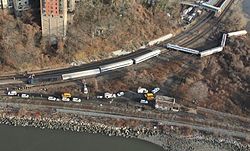
The Spuyten Duyvil derailment in 2012 caused massive disruption.

The Spuyten Duyvil derailment in 2013 caused massive disruption on Metro North..

The recent fire under the Park Avenue viaduct in Harlem, which disrupted commutes of a quarter million Metro-North riders got me thinking:  our aging, crumbling and vulnerable transportation infrastructure is close to collapse, and the effects of such failure could be catastrophic.  Consider this track-record:

June 1983:  Inadequate inspections and repairs cause the collapse of the Mianus River Bridge on I-95 in Greenwich. Three people were killed and three others injured.  For almost five months, 80,000 daily vehicles had to detour through city streets.

March 2004:  An oil tanker crashes on I-95 in Bridgeport and the ensuing fire is hot enough to melt steel supports on the Howard Avenue overpass.  Traffic was disrupted for a week.

September 2013:  Con-Ed plans to replace a crucial electric feeder cable for Metro-North in the Bronx.  The railroad decides to forgo the $1 million cost of a temporary back-up cable and the main cable fails, disrupting train service for weeks, both on Metro-North and Amtrak.

June 2014:  Twice in one week the Walk Bridge in South Norwalk (built in 1896) won’t close, cutting all rail service between New York and Boston.  Cost of replacement will be more than $450 million.

May 2016:  Illegally stored chemicals and propane tanks at a gardening center under the Park Ave. viaduct catch fire.  The flames’ heat melts steel girders, cutting all train service out of Grand Central Terminal and stranding thousands.  Limited train service in the following days leads to subway-like crowding and lengthy delays.

Mind you, this list does not include fatal accidents and disruptions caused by human error, like the Metro-North crash at Spuyten Duyvil that killed four.

Our lives, our jobs and our economy rely on safe, dependable transportation.  But when the roads we drive and the rails we ride are museum pieces or go uninspected and unrepaired, we are dangling by a thread.

A single fire, whether caused by accident or act of terrorism, can bring down our infrastructure in an instant, cutting us off from work for days and costing our economy billions.

What can be done?  Safety inspections by engineers and fire departments looking to prevent disaster are obvious.  Better enforcement of speed limits and safety are as well.  But prevention of accidents cannot make up for decades of neglect in reinvestment in our roads, rails and bridges.

The American Society of Civil Engineers’ annual infrastructure report card gives the US a D+.  They estimate we will need to spend $3.6 trillion to get things back into good shape … less than the cost of the last 15 years of US fighting in the Middle East and Afghanistan.

As the old auto-repair ad used to say, “You can pay me now or you can pay me later”.  But sooner or later, we will have to pay.

Jim Cameron

About the author: Jim Cameron is founder of The Commuter Action Group, and a member of the Darien RTM. The opinions expressed in this column are only his own. You can reach him at CommuterActionGroup@gmail.com

For a full collection of “Talking Transportation” columns, visit www.talkingtransportation.blogspot.com