
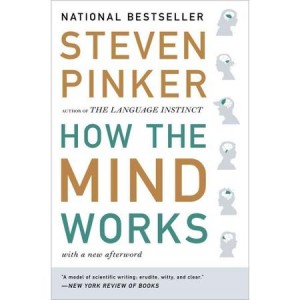
Reading Uncertainly? ‘How The Mind Works’ by Steven Pinker

How_the+Mind+WorksWhy is reading, at least for me, so soothing, stimulating and confusing, all at the same time? Why does my mind react so strangely at times to what I am reading?

Four years ago, I tried Steven Pinker’s monumental (some 800 pages of small type!) suggestion that we humans are actually becoming less violent, in The Better Angels of Our Nature. So it was only natural that I stepped back in time to read How The Mind Works, his equally long tome of 1997, updated to 2009, describing the innumerable quirks and ramblings that emanate from inside our heads.

A noted professor of psychology at Harvard University, Dr. Pinker attempts, and succeeds, I think, in synthesizing, “An emerging view of human nature,” one replete with frequent humor, quotations from numerous other sages (ranging from Plato and Pascal, to Bierce and Mencken, including Monty Python, Peanuts and Woody Allen!), and solid scientific evidence.

But he begins on a “note of humility,” saying, “We don’t understand how the mind works and I have not discovered what we do know about how the mind works.”

He cautions, “… our minds are not animated by some godly vapor or single wonder principle.” We do know, “the mind is a product of the brain and the brain is a product of evolution.” That leads him to “the central idea … that the mind is a system or naturally selected organs of computation.” He notes, “We increasingly understand ourselves in terms of the inner workings of our minds, their origins in the natural world, and their interplay with the contents of culture and civilization.”

Pinker explains further: “The mind is a system of organs of computation, designed by natural selection to solve the kinds of problems our ancestors faced in their foraging way of life; in particular, understanding and outmaneuvering objects, animals, plants and other people.”

Many of his succinct “definitions” made me come to a complete halt, frequently with a laugh, followed by serious reflection:

The tongue: “a boneless water balloon, controlled by squeezing.”

The computer: “the most legalistic, persnickety, hard-nosed, unforgiving demander of precision and explicitness in the universe.” (Could a computer actually become a “thinking machine?”)

Life: “a series of deadlines”

Winter: “the best insecticide”

Our brains: “… take up only two percent of our body weight but consume 20 percent of our energy and nutrients.”

Information: “…  the one commodity that can be given away and kept at the same time.”

Mathematics: “… ruthlessly cumulative.”

The stock market: “a large industry of self-appointed seers hallucinating trends in the random walk of the stock market.”

Jewish dietary laws: “Talmudic sophistry and bafflegab”

Status: “the public knowledge that you possess assets that would allow you to help others if you wished to.” (But Pinker notes that these “assets” must be conspicuous to be of any use …)

Music: “an enigma – a cocktail of recreational drugs that we ingest through the ear to stimulate a mass of pleasure circuits at once.”

And humor: “an anti-dominance poison, a dignicide.”

But “problems continue to baffle the modern mind: consciousness in the sense of sentience, the self, free will, knowledge, and morality.” Pinker suggests that you “step outside your own mind for a moment and see your thoughts and feelings as magnificent contrivances of the natural world rather than as the only way that things could be.”

And comments in conclusion, “Our bafflement at the mysteries of the ages may have been the price we paid for a combinatorial mind that opened up a world of words and sentences, of theories and equations, of poems and melodies, of jokes and stories, the very things that make a mind worth having.”

We human beings, surmounting by our minds, are extraordinary, complex and yet strange adaptations.

What a read!

Editor’s Note: ‘How The Mind Works,’ by Steven Pinker is published by W. W. Norton, New York 2009.
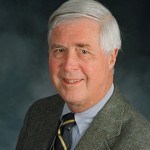
Felix Kloman_headshot_2005_284x331-150x150About the author: Felix Kloman is a sailor, rower, husband, father, grandfather, retired management consultant and, above all, a curious reader and writer. He’s explored how we as human beings and organizations respond to ever-present uncertainty in two books, ‘Mumpsimus Revisited’ (2005) and ‘The Fantods of Risk’ (2008). A 20-year resident of Lyme, he now writes book reviews, mostly of non-fiction that explores our minds, our behavior, our politics and our history. But he does throw in a novel here and there. For more than 50 years, he’s put together the 17 syllables that comprise haiku, the traditional Japanese poetry, and now serves as the self-appointed “poet laureate” of Ashlawn Farms Coffee, where he may be seen on Friday mornings. His wife, Ann, is also a writer, but of mystery novels, all of which begin in a bubbling village in midcoast Maine, strangely reminiscent of the town she and her husband visit every summer.
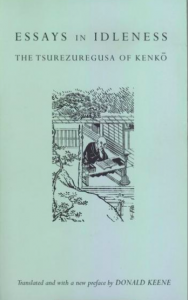
Reading Uncertainly? Kenko, “Essays in Idleness,” from The Tsurezuregusa of Kenko, (1332?)

KenkoOccasionally, I find myself compelled to drift into the past, seeking older words of wisdom. I was therefore drawn to Kenko, a Japanese Buddhist priest who wrote these words some 700 years ago: “The pleasantest of all diversions is to sit alone under the lamp, a book spread out before you . . . “ How true!
In these Essays, he leads with repeated cautionary admonitions: “The most promising thing in life is its uncertainty,” following that later with “A man is more likely to seem a true master of his art if he says, ‘I cannot tell for certain.’ “  And he concludes: “The one thing you can be certain of is the truth that all is uncertainty.” Yet today how often do we hear politicians, commentators, and ourselves state “absolutely,” “exactly,” “emphatically,” “certainly,” and unequivocally.” So much for uncertainty …

Here are a few more delicious Buddhist quotations:

  • “People tend to exaggerate even when relating things they have actually witnessed, but when months or years have intervened, and the place is remote, they are all the more prone to invent whatever tales suit their fancies, and, when these have been written down, fictions are accepted as fact.”
  • “What a foolish thing it is to be governed by a desire for fame and profit and to fret away one’s whole life without a moment of peace. Great wealth is no guarantee of security. Wealth, in fact, tends to attract calamities and disaster. Even if, after you leave enough gold to prop up the North Star, it will only prove a nuisance to your heirs . . . . The intelligent man, when he dies, leaves no possessions.”
  • “If you trust neither in yourself nor in others, you will rejoice when things go well, but bear no resentment when they go badly. You will then have room on either side to expand, and not be constrained.”
  • “In everything, no matter what it may be, uniformity is undesirable. Leaving something incomplete makes it interesting, and gives one the feeling that there is room for growth.”

So this brief comment is deliberately left incomplete, to encourage you to try Kenko!

Editor’s Note: Kenko, “Essays in Idleness,” from The Tsurezuregusa of Kenko, (1332?), as edited and translated by Donald Keene, is published by Columbia University Press, New York, 2nd edition, 1998.

Felix Kloman_headshot_2005_284x331-150x150About the author: Felix Kloman is a sailor, rower, husband, father, grandfather, retired management consultant and, above all, a curious reader and writer. He’s explored how we as human beings and organizations respond to ever-present uncertainty in two books, ‘Mumpsimus Revisited’ (2005) and ‘The Fantods of Risk’ (2008). A 20-year resident of Lyme, he now writes book reviews, mostly of non-fiction that explores our minds, our behavior, our politics and our history. But he does throw in a novel here and there. For more than 50 years, he’s put together the 17 syllables that comprise haiku, the traditional Japanese poetry, and now serves as the self-appointed “poet laureate” of Ashlawn Farms Coffee, where he may be seen on Friday mornings. His wife, Ann, is also a writer, but of mystery novels, all of which begin in a bubbling village in midcoast Maine, strangely reminiscent of the town she and her husband visit every summer.

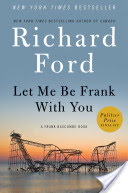
Reading Uncertainly? ‘Let Me Be Frank With You’ by Richard Ford

let me be frankLet me be frank with you, Frank: you are a bystander, a passive yet sensitive observer of the daily stream, but frustratingly disconnected!
“Frank,” of course, is Frank Bascombe, Richard Ford’s complex and compelling character who has now reached the age of 68. Ford first introduced him to us in The Sportswriter in 1986, when he, his wife and son moved from New York to “Haddam,” New Jersey (in reality Princeton, without the university) as he tried a new career as a novelist. That failed, his wife divorced him and he lost his son.

Frank resurfaced in Independence Day in 1995, when he took his second son for a quick tour of the Halls of Fame in Springfield and Cooperstown, just before the Fourth of July. This one included a delicious put-down of the town of Deep River! He had then become a real estate agent in Haddam.

And in our Millennium Year of 2000, in The Lay of the Land (published in 2007), Frank found a new wife, only to see her depart, had prostate surgery and, in this three-day story, tried to celebrate Thanksgiving as a 55-year-old in his new home on the Jersey Shore, still working in real estate.

Let Me Be Frank With You is the fourth in the series (doesn’t this remind you of John Updike’s Rabbit Angstrom?) and we find Frank back in Haddam, his second wife returned, as he interacts, still passively, with four unusual characters.

The first is Arnie Urquhart, a college classmate whose Jersey Shore house (it used to be Frank’s) has been demolished by Hurricane Sandy (Sandy, it seems, is a major character in this set of novellas). The second is Charlotte Pines, a woman he finds knocking on his Haddam door, an ex-resident of that house in which her family was killed. Then we reconnect with Ann Dykstra, his former wife, who has returned to Haddam to an “extended care facility” to cope with her onset of Parkinson’s. And finally we share Frank’s visit with Eddie Medley, an old friend who is in the final stages of dying.

Throughout these sessions Frank remains the foil, yet a remarkable observer of every facial tic, bodily motion and surrounding sights, smells and sounds: crows jousting in a tree, a trash truck grinding debris, auto horns, laughter next door. He just never seems connected. He’s open to everything …

But his stock answers in conversation are: “I don’t know. Maybe.” “It makes me realize how remote I am.” “All is frankly enigma.” He is an aloof reporter experiencing a syncopation of senses and sounds, in the middle of brief conversations.

Frank acknowledges his advancing age: “ . . .  the ‘gramps shuffle’ being the unmaskable, final-journey approaches signal.” And “as you get older things slide away, like molasses off a table top.” And “ . . . life’s a matter of gradual subtraction.” And someone asking of you “Are you okay?” He thinks: “No more grievous words can be spoken in the modern world.”

His self-description: “I am: a man who doesn’t lie (or rarely), who presumes nothing from the past, who takes the high, optimistic road (when available), who doesn’t envision the future, who streamlines his utterances (no embellishments) and in all instances acts nice.”

But Frank winds into all this a marvelous sense of humor, often acidic: An “extended care facility: Nothing’s bleaker than the stingy, unforgiving one-dimensionality of most of these places; their soul-less vestibules and unbreathable antiseptic fragrances, the dead-eyed attendants and willowy end-of-the-line pre-clusiveness to whatever’s made life be life but that now can be forgotten.”

Hurricane Sandy seems to be the primary stimulant of Frank’s aging recollections. As he notes, “There’s something to be said for a good, no-nonsense hurricane, to bully life back into perspective.”

But Ford’s Frank Bascombe lives on! Will we see a fifth view of him one day soon … perhaps at 80?

Editor’s Note: Let Me Be Frank With You by Richard Ford is published by Harper Collins, New York 2014.

Felix Kloman_headshot_2005_284x331-150x150

About the author: Felix Kloman is a sailor, rower, husband, father, grandfather, retired management consultant and, above all, a curious reader and writer. He’s explored how we as human beings and organizations respond to ever-present uncertainty in two books, ‘Mumpsimus Revisited’ (2005) and ‘The Fantods of Risk’ (2008). A 20-year resident of Lyme, he now writes book reviews, mostly of non-fiction that explores our minds, our behavior, our politics and our history. But he does throw in a novel here and there. For more than 50 years, he’s put together the 17 syllables that comprise haiku, the traditional Japanese poetry, and now serves as the self-appointed “poet laureate” of Ashlawn Farms Coffee, where he may be seen on Friday mornings. His wife, Ann, is also a writer, but of mystery novels, all of which begin in a bubbling village in midcoast Maine, strangely reminiscent of the town she and her husband visit every summer.

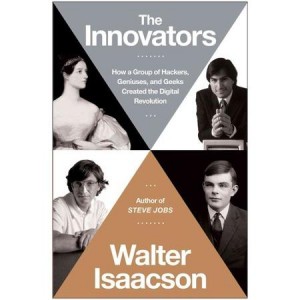
Reading Uncertainly? ‘The Innovators’ by Walter Isaacson

The_InnovatorsThis is the remarkable and intricate story of the computer, the Internet and the World Wide Web, all of which transformed and continue to alter this globe. It is a story of human collaboration, conflict, creativity and timing, from Ada, Countess of Lovelace in 1843 to the more familiar names of Vannevar Bush, Alan Turing, John Mauchly, John von Neumann, Grace Hopper, Robert Moore, Bill Gates, Paul Allen, Tim Berners-Lee, Larry Page, Sergey Brin, and, of course, “Watson,” the almost-human Jeopardy contestant of IBM.
Isaacson stresses the importance of the intersection of individual thinking combined, inevitably, with collaborative efforts.  Ideas start with non-conformists, in many of whom initiative is often confused with disobedience. But it is in collaboration that we have found the effectiveness of the Web, a “networked commons.”

These changes have come about through conception and execution, plus “peer-to-peer sharing.” Isaacson cites three co-existing approaches: (1) Apple with its bundled hardware and software, (2) Microsoft with unbundled software, and (3) the Wikipedia example of free and open software, for any hardware. No one approach, he argues, could have created this new world: all three, fighting for space, are required. Similarly, he believes that a combination of investment works best: Government funding and coordination, plus private enterprise, plus “peers freely sharing ideas and making contributions as a part of a voluntary common endeavor.”

In his concluding chapter, Isaacson raises the question of the future for AI, artificial intelligence. Stephen Hawking has warned, yet again, that we may create mechanisms that will not only think but also re-create themselves, effectively displacing homo sapiens as a species. But Isaacson is more optimistic: he sees and favors a symbiotic approach, in which the human brain and computers create an information-handling partnership. Recent advances in neuroscience suggest that the human brain is, in many ways, a limited automaton (see System One of Kahneman). But our brain, with its ability to “leap and create,” coupled with the computer’s growing ability to recall, remember, and assess billions of bits of information, may lead us, together, to better decisions.

His final “five lessons” are worth inscribing:

  1. “Creativity is a collaborative process.”
  2. “The digital age was based on expanding ideas handed down from previous generations.”
  3. “The most productive teams were those that brought together people with a wide array of specialties.”
  4. “Physical proximity is beneficial.”
  5. To succeed, “pair visionaries, who can generate ideas, with operating managers, who can execute them.”

Isaacson’s final lesson:  humans bring to our “symbiosis with machines . . . one crucial element: creativity.” It is “the interaction of humanities and sciences.”

And we wouldn’t have LymeLine without the Innovators!

Editor’s Note: “The Innovators” is published by Simon & Schuster, New York 2014.

Felix Kloman_headshot_2005_284x331-150x150

About the author: Felix Kloman is a sailor, rower, husband, father, grandfather, retired management consultant and, above all, a curious reader and writer. He’s explored how we as human beings and organizations respond to ever-present uncertainty in two books, ‘Mumpsimus Revisited’ (2005) and ‘The Fantods of Risk’ (2008). A 20-year resident of Lyme, he now writes book reviews, mostly of non-fiction that explores our minds, our behavior, our politics and our history. But he does throw in a novel here and there. For more than 50 years, he’s put together the 17 syllables that comprise haiku, the traditional Japanese poetry, and now serves as the self-appointed “poet laureate” of Ashlawn Farms Coffee, where he may be seen on Friday mornings. His wife, Ann, is also a writer, but of mystery novels, all of which begin in a bubbling village in midcoast Maine, strangely reminiscent of the town she and her husband visit every summer.


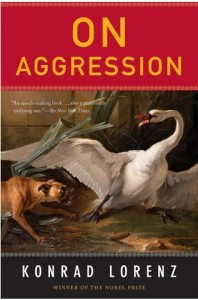
Reading Uncertainly? ‘On Aggression’ by Konrad Lorenz

On_Aggression_book_coverAre we naturally “aggressive?”  What a way to greet the spring!  Today’s headlines seem to indicate that we simply cannot avoid creating friction among human beings.  This sent me backwards in time to re-read Konrad Lorenz’s monumental On Aggression, first published in German in 1963 and in English in 1966.
Lorenz defines aggression as, “the fighting instinct in beast and man, directed against members of the same species.”  The forms, objectives and examples of aggression include:

  • behavior
  • preservation of the species
  • physiology of instinctual motivation
  • the process of ritualization
  • how instinctive impulses function
  • mechanisms evolution has “invented” to channel aggression to harmless paths
  • social organization (“anonymous crowds”)
  • bonds of “love and friendship”
  • the “virtue of humility”
  • counter-measures against the malfunctions of aggression (including examples among fish, birds and four-legged mammals).

He concludes: “aggression . . . is really an essential part of the life-preserving organization of instincts.”  And our own-species aggression is “essential for its preservation.”

The “principle of the bond” seems to require some degree of aggressive behavior: we apparently need something in common to be defended against outsiders, such as territory, brood, opinion and, most dangerously, ideology. Aggression thus becomes “necessary to enhance the bond.”

And “ the danger to modern man arises not so much from his power of mastering natural phenomena as from his powerlessness to control sensibly what is happening today in his own society.”

Is there a ray of hope?  Lorenz thinks it is possible.

First, our, “insatiable curiosity is the root of exploration and experimentation …  a linking of cause and effect … the conscious foreseeing of the consequences of one’s action.”  This “unrelenting demand for causal understanding” may well lead to a “scientific enlightenment [that] tends to engender doubt in the value of transitory beliefs long before it furnishes the causal insight necessary to decide whether some accepted custom is an obsolete superstition or still an indispensible part of a system of sacred norms.”  Our inquiring minds may often be too far ahead of how we react!

And why are our young so often at the center of disruptive behavior?

Lorenz suggests an answer.  “During and shortly after puberty, human beings have an indubitable tendency to loosen their allegiance to all traditional rites and social norms of their culture, allowing conceptual thought to cast doubt on their value and to look around for new and perhaps more worthy ideals … At the postpuberal age some human beings seem to be driven by an overpowering urge to espouse a cause and, failing to find a worthy one, may become fixated on astonishingly inferior substitutes.”  Shades of the Middle East today, one might venture …

But he is, nevertheless, optimistic  — Lorenz suggests some preventive steps to counter our natural aggressive instincts.  First, he reiterates the famous Chilton/Socrates admonition to “Know thyself,” acknowledging some obstacles:

  1. unawareness of our evolutionary origin
  2. reluctance to admit that our “behavior obeys the laws of natural causation” (there is no “free will!”)
  3. a heritage of “idealistic philosophy”

His conclusion: “Truth, in science, can be defined as the working hypothesis best fitted to open the way to the next better one.”  Nothing is “absolute!”  And, finally, allow humor to play a major role: do not take ourselves too seriously.

There is nothing quite like stepping back in time to re-read some earlier thoughts …

HFK_headshot_2005_284x331About the author: Felix Kloman is a sailor, rower, husband, father, grandfather, retired management consultant and, above all, a curious reader and writer. He’s explored how we as human beings and organizations respond to ever-present uncertainty in two books, ‘Mumpsimus Revisited’ (2005) and ‘The Fantods of Risk’ (2008). A 20-year resident of Lyme, he now writes book reviews, mostly of non-fiction that explores our minds, our behavior, our politics and our history. But he does throw in a novel here and there. For more than 50 years, he’s put together the 17 syllables that comprise haiku, the traditional Japanese poetry, and now serves as the self-appointed “poet laureate” of Ashlawn Farms Coffee, where he may be seen on Friday mornings. His wife, Ann, is also a writer, but of mystery novels, all of which begin in a bubbling village in midcoast Maine, strangely reminiscent of the town she and her husband visit every summer.