
Reading Uncertainly? ‘The Court and the World’ by Stephen Breyer

The_Court&the_WorldShould our Supreme Court be a pragmatic, flexible, problem-solving institution or should it continue to rely on the distant past to address today’s challenges?

Stephen Breyer, perhaps our most articulate and thoughtful Supreme Court Justice, discusses in his latest study “the new challenges imposed by an ever more interdependent world,” asking how we should “interpret” our 18h century Constitution in the 21st century. He is both concise and compelling on the general themes of the rule of law and “the need for courts to listen to ‘many voices ‘. “

The judge suggests we discontinue our perpetual deification of the Declaration of Independence, Constitution, and its Bill of Rights, which may well have led to numerous serious mistakes: the ethnic cleansing of native Americans and war-mongering (citing the Mexican-American War, the Spanish-American War, the Vietnam War, and the Iraq War II, among others). Is, for example, our foreign policy, including going to war and security, solely the responsibility of the executive and legislative branches of government, and not the judiciary? Is this an outmoded 18th century idea?

Breyer goes on to dissect the “worst Court decisions in U. S. history:” Dred Scott (confirmation of slavery), Plessy vs. Ferguson(confirmation of state racial segregation), and Korematsu (approving the interning of Japanese-Americans).  These show we require some external ideas to modify our domestic prejudices.

Since 1787 we’ve entered into many international agreements, such as the Geneva Convention, the United Nations, NATO, and the World Trade Organization.  “In an intensely interdependent world facing global threats that are likely to last a generation or more (particularly terrorism), special security needs are no longer as intermittent or short-lived as they once were.” Our Afghanistan War is the longest in our history …

Add to this the growing complexity of international commerce: “ … the reality of modern-day commerce: national markets are now so interconnected and integrated that the most ordinary commercial transactions can involve a host of different activities and entities across the globe.” This leads to a “judicial need for information about foreign practices, rules, laws, and procedures.” We should try to stimulate the “laws of different nations” to “work together in harmony.” Better to argue than shoot each other.

Judge Breyer concludes, “Today’s Court should not base its answer to the kinds of questions illustrated here by reference solely (my italics) to the facts and conclusions of eighteenth century society.” The goal of the “rule of law” is to acknowledge that it is always in flux: “ … the rule of law prevents the opposite – namely the arbitrary, the autocratic, the despotic, the unreasonable, the dictatorial, the illegal, the unjust, and the tyrannical.” The reviewer in The New York Times had a succinct observation — “Democracy has never been a nativist straitjacket.”

History is the “sustained struggle against arbitrariness.”  So the good judge gives us no conclusion. “There are no easy answers to this question.” We must continue “our conversations,” as our Court does.

A most thoughtful and stimulating read.

Editor’s Note: ‘The Court and the World’ by Stephen Breyer is published by Alfred A. Knopf, New York, 2015

Felix Kloman_headshot_2005_284x331-150x150About the Author: Felix Kloman is a sailor, rower, husband, father, grandfather, retired management consultant and, above all, a curious reader and writer. He’s explored how we as human beings and organizations respond to ever-present uncertainty in two books, ‘Mumpsimus Revisited’ (2005) and ‘The Fantods of Risk’ (2008). A 20-year resident of Lyme, he now writes book reviews, mostly of non-fiction that explores our minds, our behavior, our politics and our history. But he does throw in a novel here and there. For more than 50 years, he’s put together the 17 syllables that comprise haiku, the traditional Japanese poetry, and now serves as the self-appointed “poet laureate” of Ashlawn Farms Coffee, where he may be seen on Friday mornings. His wife, Ann, is also a writer, but of mystery novels, all of which begin in a bubbling village in midcoast Maine, strangely reminiscent of the town she and her husband visit every summer.
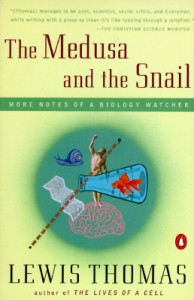
Reading Uncertainly? ‘The Medusa and the Snail’ by Lewis Thomas

medusa&SnailStep back, once again, to read the questions posed by a thoughtful physician. Dr. Thomas presents us with some 29 brief, challenging, curious, skeptical, and often humorous essays on the human condition. They inevitably raise more questions than answers:
  • Why do we feel euphoria when watching small animals going about their work? (I ask this after sitting on our deck, wondering why our squirrels and chipmunks are forever so industrious.)
  • Do ants as a group “think?’ (Edward O. Wilson may answer than one)
  • Where do we fit in this “inter-collaborative system” called earth?
  • Why are mistakes the essential elements of life?
  • Should we play Bach before all committee meetings?
  • Why do we meddle so much?
  • Why are commas useful?

Those questions along should encourage a re-reading of the good Dr. Thomas, who died in 1993 after serving many years as head of Memorial Sloan-Kettering Cancer Center in New York.

Some further jewels:

  • “All the forms of life are connected.” The earth is a “system of interacting, intercommunicating components that, as a group, act or operate individually and jointly to achieve a common goal through the concerted activity of the individual parts.”
  • “We are components in a dense, fantastically complicated system of life; we are enmeshed in the inter-living, and we really don’t know what we’re up to.”
  • “We are … worrying animal. We worry away our lives, fearing the future, discontent with the present, unable to take in the idea of dying, unable to sit still.”(Doesn’t this describe our responses to world events in 2015?)
  • “Man has always been a specifically anxious creature with an almost untapped capacity for worry; it is a gift that distinguishes him from other forms of life.”
  • On human surprise: “ … we have a whole eternity of astonishment stretching out ahead of us.” “It seems to me the safest and most prudent of bets [is] to lay money on surprise.”

If these brief quotes intrigue you, read this book, plus some of his other works: The Lives of a Cell: Notes of a Biology Watcher (1974) and Late Night Thoughts on Listening to Mahler’s Ninth Symphony (1983).

Editor’s Note: ‘The Medusa and the Snail’ by Lewis Thomas is published by Viking, New York 1979.

Felix Kloman_headshot_2005_284x331-150x150About the Author: Felix Kloman is a sailor, rower, husband, father, grandfather, retired management consultant and, above all, a curious reader and writer. He’s explored how we as human beings and organizations respond to ever-present uncertainty in two books, ‘Mumpsimus Revisited’ (2005) and ‘The Fantods of Risk’ (2008). A 20-year resident of Lyme, he now writes book reviews, mostly of non-fiction that explores our minds, our behavior, our politics and our history. But he does throw in a novel here and there. For more than 50 years, he’s put together the 17 syllables that comprise haiku, the traditional Japanese poetry, and now serves as the self-appointed “poet laureate” of Ashlawn Farms Coffee, where he may be seen on Friday mornings. His wife, Ann, is also a writer, but of mystery novels, all of which begin in a bubbling village in midcoast Maine, strangely reminiscent of the town she and her husband visit every summer.

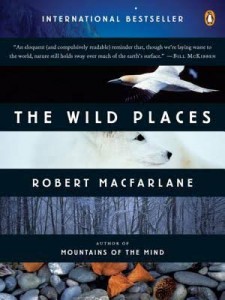
Reading Uncertainly? ‘The Wild Places’ by Robert Macfarlane

The_Wild_Places_by_Robert_MacFarlaneLast year, at our son’s suggestion, I read and reviewed with enthusiasm Robert Macfarlane’s The Old Ways (2012), his recounting of extensive walks in Great Britain, Spain, Palestine, and Tibet (see LymeLine.com review of Oct. 12, 2014.) That led me to his Landmarks (2015) and now to an earlier work, The Wild Places.
What begins as a eulogy for our disappearing wilderness becomes an elegy, even a celebration of remoteness, privacy and “the wild.” But the reply of the wild, wherever he finds it, at the remote corners of the British Isles or in his own Cambridge backyard, is “reports of my demise are premature!”

Macfarlane, a don at Emmanuel College, Cambridge, mixes remarkable research, reading and language, to explore both geographic and intellectual wildness. On his perambulations, he is always picking up small rocks, leaves, stems, feeling them, admiring them, and saving them for his library. He links every trek with apt, far-ranging quotations from a global entourage of writers. And his words, what words …

Consider:

  • “ideas like waves have fetches.”
  • The sky a “slurless blue”
  • The “grain of the mind”
  • “a row of hawthorns quaffed eastwards by the onshore winds”
  •  the “krekking of a raven”
  • “small waders – knots, plovers, turnstones – form their palping jellyfish-like shoals”
  • “a gang of rooks chakked over the corn stubble”
  • “I had a heptic memory, too.”
  • A rock that was “knapped out.”

Do you recognize any of the places he visited: Ynys Enlli (Scotland), Coruisk (Isle of Skye), Rannoch Moor (near Glencoe), Black Wood (east of Rannoch Moor), Cape Wrath (Scotland north coast), the Holloways (Dorset), Orford Ness (Suffolk), and Burren (north of County Clare, Ireland)? Macfarlane comes to acknowledge that wildness is often found close to home. How many of us know Hog Pond (the old name), Cedar Pond, Brown Hill, Joshua Rocks, Whalebone Creek, Nickerson Hill, Moulson’s Pond, Oliver’s Hole or Rat Island?

Wildness, to this professor, is “a quality to be vanquished and to be cherished.” It has “implications of disorder and irregularity” but it is also “an expression of independence from human direction … containing an energy both exemplary and exquisite.” Wild places remind us “of the narrow limits of human perception, of the provisionality of (our) assumptions about the world.”  Our response: “a brief blazing perception of the world’s disinterest” in what we humans have created — they give us “this sense of the human presence as being something temporary.”

Fellow wanderers appear.  Macfarlane asks a “Helen” to join a walk seeking birds: falcons, tiercels, ospreys, goshawks, and peregrines. None other than Helen Macdonald, also a professor at Cambridge, whose H Is For Hawk I enjoyed earlier this year.

The Wild Places reminded me of my own traipsing along the public footpaths of West Sussex and the South Downs, in the fall of 1978, and along the wanderwegs of St. Gallen and the Appenzell in Switzerland in the 1980s and 1990s. Plus the trails of Nehantic State Forest in the 1990s …

Macfarlane suggests wildness is an attribute to be carefully enjoyed, with both sight and sound: “rooks haggled in the air above the trees … the noise of the wood in the wind; a soft marine road. It was the immense compound noise of friction – of leaf fretting on leaf, and branch rubbing on branch.”

His admonitions: listen and look. Wildness may be close at hand.

Editor’s Note: The Wild Places by Robert Macfarlane was published by Penguin, New York, 2007.

Felix Kloman_headshot_2005_284x331-150x150About the Author: Felix Kloman is a sailor, rower, husband, father, grandfather, retired management consultant and, above all, a curious reader and writer. He’s explored how we as human beings and organizations respond to ever-present uncertainty in two books, ‘Mumpsimus Revisited’ (2005) and ‘The Fantods of Risk’ (2008). A 20-year resident of Lyme, he now writes book reviews, mostly of non-fiction that explores our minds, our behavior, our politics and our history. But he does throw in a novel here and there. For more than 50 years, he’s put together the 17 syllables that comprise haiku, the traditional Japanese poetry, and now serves as the self-appointed “poet laureate” of Ashlawn Farms Coffee, where he may be seen on Friday mornings. His wife, Ann, is also a writer, but of mystery novels, all of which begin in a bubbling village in midcoast Maine, strangely reminiscent of the town she and her husband visit every summer.

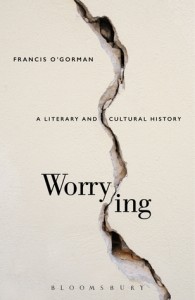
Reading Uncertainly? ‘Worrying: A Literary and Cultural History’ by Francis O’Gorman

Worrying_“What if … ?” This is the key question that confronts all worriers, their dominant question about an ever-uncertain future. Professor O’Gorman, who teaches at the University of Leeds (U.K.) readily admits he is a worrier, and, in this slim volume (163 pages) he deftly probes, with humility plus good humor, the various definitions, strategies, relevant observations, advantages, and consolations, concluding with some fatalism that there may be little he can do about his condition. He actually begins with his end, “If we can’t ‘cure’ worry, we can venture to understand it – for better or worse.”

Here is his definition: “Worry is a form of fretfulness, of mental uncertainty and persistently tremulous bother,” the “fretful evaluations of the options in our life.” English has many synonyms: fretting, anxiety, bother, concern, fidgeting, doubt, nervousness, apprehension, and perplexity. Rodgers and Hart expressed them well in their hit song from Pal Joey (1940), “Bewitched, Bothered, and Bewildered.”

The dictionary’s verb is defined as “to feel uneasy or concerned about something,” but it also has an alternative “to pull or tear at something, as with the teeth.” It is when normal worry disintegrates into the dog’s work that we become concerned.

So is worry abnormal? For many of us it is a compulsive habit, “part of the fabric of life,” as O’Gorman argues, but too often seen as anti-social. He suggests: “Life is overflowing with opportunities to fret!”

For some of us who are trying to manage organizations facing numerous “risks,” “worry’s primary concern is about an uncertain future or, more exactly, about a future that has some element of the uncertain in it.” Our problem is that one “worry leads to another, and consequential worries.”  And that is unhealthy as too many of us have a “fixed belief that there is, today, something risky about tomorrow.” We end up fearing, not relishing, the future.

Indeed, “daring to be happy is a risk” in itself to a worrier.

Dr. O’Gorman suggests that “worry” also breeds ritual: routines, religions, compulsive habits, not all pleasant.  “The fundamental tenets of the major world religions will look delusional to the skeptic atheist, while seeming the brightest of reality to the believer.” So who is right? What is sanity? The author suggests a re-statement of Descartes’ mantra: “I worry; therefore I am.”

His arguments are ripe with the pertinent and often amusing citations of an enormous range of writers: Bronte, T.S. Eliot, George Eliot, the Bible, Shakespeare, Trollope, Kipling, Auden, Woolf, Joyce, Hardy, Darwin, Gladstone, Descartes, Homer, Mill, Sebald, Boswell, Frost, and, above all, Bach. Plus, of course, numerous academics.

Is reason an antidote for worry? “Reason can gather information. It can enumerate the issues. It can search out matters pertinent to the problem in hand. But the worrier’s reason is notoriously bad at suggesting a way forward.” “Worry’s a kind of mental risk assessment that regularly fails to result in an action plan …”

O’Gorman elaborates, “Our reasoning mind has come, in the contemporary world, to be bogged down in debilitating conditions of fretful decision-making and persistent blame, the grim and politicizing consequences of the apparently innocent and cheering pleasures of choosing.” And, “We run through options, assimilating and listening for the give-away signs of ideas we haven’t listened to. We’re always alert to the snuffling in the undergrowth of bristly problems we’ve not already imagined. We’re analysts who are genuinely good at analyzing even if we take little pleasure in our gifts and frequently fail to adjudicate on the most likely outcomes.”

What is the alternative? Should we all become Doctor Panglosses who exist in this, the most perfect, world? O’Gorman does offer the idea that the “arts” (painting, poetry, and especially music) can divert the worrier, but not permanently. They are, to him, a temporary distraction.

His book was a temporary but thoroughly engaging distraction for me, a non-worrier. I think like Alfred E. Neuman, the cover cartoon character for MAD Magazine, who persistently stated, “What? Me worry?”

I’m also reminded of the classic folk song of the Carter Family, first sung in 1930, “It takes a worried man to sing a worried song.” The last line is the best: “I’m worried now but I won’t be worried long!”

Editor’s Note: Francis O’Gorman, Worrying: A Literary and Cultural History, Bloomsbury, London 2015.

Felix Kloman_headshot_2005_284x331-150x150About the Author: Felix Kloman is a sailor, rower, husband, father, grandfather, retired management consultant and, above all, a curious reader and writer. He’s explored how we as human beings and organizations respond to ever-present uncertainty in two books, ‘Mumpsimus Revisited’ (2005) and ‘The Fantods of Risk’ (2008). A 20-year resident of Lyme, he now writes book reviews, mostly of non-fiction that explores our minds, our behavior, our politics and our history. But he does throw in a novel here and there. For more than 50 years, he’s put together the 17 syllables that comprise haiku, the traditional Japanese poetry, and now serves as the self-appointed “poet laureate” of Ashlawn Farms Coffee, where he may be seen on Friday mornings. His wife, Ann, is also a writer, but of mystery novels, all of which begin in a bubbling village in midcoast Maine, strangely reminiscent of the town she and her husband visit every summer.

Reading Uncertainly? Ruminations on Henry David Thoreau’s Walden, 1854

With the advent of a new year, this seemed the perfect time to publish this wonderful review by our resident book reviewer and aspiring poet Felix Kloman. Felix looks back at a book published 161 years ago and yet finds contemporary wisdom among its pages, some of which is especially pertinent as we enter 2016.

Walden_by_Henry_David_ThoreauAs my stack of reading dwindled recently to nothingness, by chance I was drawn to my ancient copy of Thoreau’s story of his two-year-long self-proclaimed “exile” to the shores of Massachusetts’ Walden Pond. My re-read was well worth the time.

Some stimulating thoughts from the Massachusetts monk, who sought solitude but could not refrain from talking and writing about it:

  • On a Lyme summer evening’s solitude: “This is a delicious evening, when the whole body is one sense, and imbibes delight through every pore.” I considered this observation as I, too, sat quietly on our Lyme porch, overlooking meadows, our Ely’s Ferry Road, and, closer to hand, our orange-embossed cyphea (pronounced like “goofier,” I am advised by my resident horticulturist), whose juices were being avidly sucked away by several hummingbirds. They actually seemed to squeak after each tongue-licking. As Thoreau concluded “… my serenity is rippled but not ruffled.”
  • On the delights of quiet conversation with a few intelligent friends, reminding me of my regular Friday morning “communions” at Ashlawn Farm Coffee: “Having each some shingles of thought well dried, we sat and whittled them, trying our knives, and admiring the clear yellowish grain of the pumpkin pine. We waded so gently and reverently, or we pulled together so smoothly, that the fishes of thought were not scared from the stream, nor feared by any angler on the bank, but came and went grandly, like the clouds which float through the western sky, and the mother-o’-pearl flocks which sometimes form and dissolve there. There we worked, revising mythology, rounding a fable here and there, and building castles in the air for which earth offered no worthy foundation … To converse with whom was a New England Night’s Entertainment. Ah! Such discourse we had …”
  • On spending too much time worrying: “A man sits as many risks as he runs.” Thoreau went on to explain: “The old and the infirm and the timid, of whatever age or sex, thought most of sickness, and sudden accident and death; to them life seemed full of danger – what danger is there if you don’t think of any? – and they thought that a prudent man would carefully select the safest position.” Has anything changed in the past 161 years? Doesn’t seem like it …
  • As I am an aspiring yet amateur poet, contributing occasional haiku to the Ashlawn Farm cognoscenti, I found reassurance in this from Henry David: “… but nothing can deter a poet  … Who can predict his comings and going?”
  • And, finally, Thoreau’s concluding advice: “ … explore your own higher latitudes … Open new channels, not of trade, but of thought … There are continents and seas in the moral world, to which every man is an isthmus or an inlet, yet unexplored by him …“

Surprises can be enthralling and energizing, if only we anticipate them with pleasure. This is just how I found my re-reading of Walden.

Do try your own re-read.

Felix Kloman_headshot_2005_284x331-150x150About the Author: Felix Kloman is a sailor, rower, husband, father, grandfather, retired management consultant and, above all, a curious reader and writer. He’s explored how we as human beings and organizations respond to ever-present uncertainty in two books, ‘Mumpsimus Revisited’ (2005) and ‘The Fantods of Risk’ (2008). A 20-year resident of Lyme, he now writes book reviews, mostly of non-fiction that explores our minds, our behavior, our politics and our history. But he does throw in a novel here and there. For more than 50 years, he’s put together the 17 syllables that comprise haiku, the traditional Japanese poetry, and now serves as the self-appointed “poet laureate” of Ashlawn Farms Coffee, where he may be seen on Friday mornings. His wife, Ann, is also a writer, but of mystery novels, all of which begin in a bubbling village in midcoast Maine, strangely reminiscent of the town she and her husband visit every summer.