
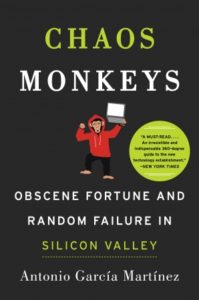
Reading Uncertainly: Chaos Monkeys: ‘Obscene Fortune and Random Failure in Silicon Valley, by Antonio Garcia Martinez

Let’s face it, we are all, every one of us, irrevocably married to this new and all-pervasive technology. We are computers and they are us. So isn’t it time that we learn something more about its source?

Antonio Garcia Martinez takes us on a four-year, inside-tour of Silicon Valley and San Francisco, an autobiography of life in the Valley: long-winded, discursive, sarcastic, cynical, opinionated, and always hilarious.

Martinez, an admitted “gleeful contrarian,” presents fascinating characters with enormous egos, from Zuck (Mark Zuckerberg), Sheryl (Sandberg), and Gokul (Gokul Rajaram); from start-ups to abrupt shutdowns; along with the organizations that shaped his life: University of California-Berkeley, Goldman Sachs, AdCharm, AdGrok, Facebook, Twitter, and, at last, Ayala, a cutter at anchor at Orcas Island in Puget Sound, prior to her escape into the Pacific Ocean. And people as well — since he is also a human being — including several female partners and two young children.

So exactly what is this “Valley?”

“It’s a society,” the author explains, “in which all men and women live in their own self-contained bubble, unattached to traditional anchors like family or religion, and largely unperturbed by outside social forces like income inequality or the Syrian Civil War.

‘Take it light, man’ elevated to life philosophy. Ultimately, the Valley attitude is an empowered anomie turbo-charged by selfishness, respecting some nominal ‘feel-good’ principals of progress or collective technological striving, but in truth pursuing a continual self-development refracted through the capitalist prism: hippies with a capitalization table and a vesting schedule.”

Wow!

His characters display both greed and credibility: they “ … spend their lives in a blizzard of meetings interspersed with email breaks.”

And what are the “chaos monkeys” of his title? They are the “software tools to test a product or a website’s resilience against random serve failures.” Beware the system!

Yet Martinez sees this mélange as being composed of human beings after all, noting, “The tech start-up scene for all its pretensions of transparency, principled innovation, and a counter-culture renouncement of pressed shirts and staid social convention, is actually a surprisingly reactionary crowd.” It is one “wired on caffeine, fear, and greed at all times.” And Facebook, Twitter, and Google have become “all-consuming new” religions. Technology is the Soma of our time.

Despite this cynicism, Martinez cannot help but admire Mark Zuckerberg: “I submit he was an old-school genius, the fiery force of nature possessed by a tutelary spirit of seemingly supernatural provenance that fuels and guides him, intoxicates his circle, and compels his retinue to be great as well …  The keeper of a messianic vision that, though mercurial and stinting on specifics, presents an overwhelming and all-consuming picture of a new and different world … the church of a new religion.”

The author suggests we consider similar leaders in history: Jefferson, Napoleon, Alexander, Joseph Smith, Jim Jones, and L. Ron Hubbard. The leaders and followers in the Valley are simply part of that natural human urge to believe and to be part of something bigger than oneself.

But the Martinez story doesn’t fade into a glowing future. Following Robert Frost’s admonition, the author in early 2016 concludes “a man occasionally reaches a fork in life’s road.”

His last sentence predicts a completely different future: “Thus do I bow off this stumbled-upon stage, hopefully forever, and disappear into the heaving swells of the Pacific Ocean, the only such sanctuary from social mediation we’ll soon have left.”

Sail on, skipper! I give you joy of your decision.

Editor’s Note: ‘Chaos Monkeys: Obscene Fortune and Random Failure in Silicon Valley’ by Antonio Garcia Martinez, is published by HarperCollins, New York 2016.

Felix Kloman

About the Author: Felix Kloman is a sailor, rower, husband, father, grandfather, retired management consultant and, above all, a curious reader and writer. He’s explored how we as human beings and organizations respond to ever-present uncertainty in two books, ‘Mumpsimus Revisited’ (2005) and ‘The Fantods of Risk’ (2008). A 20-year resident of Lyme, he now writes book reviews, mostly of non-fiction that explores our minds, our behavior, our politics and our history. But he does throw in a novel here and there. For more than 50 years, he’s put together the 17 syllables that comprise haiku, the traditional Japanese poetry, and now serves as the self-appointed “poet laureate” of Ashlawn Farms Coffee, where he may be seen on Friday mornings. His wife, Ann, is also a writer, but of mystery novels, all of which begin in a bubbling village in midcoast Maine, strangely reminiscent of the town she and her husband visit every summer.

Reading Uncertainly? ‘Notes From Old Lyme: Life on the Marsh and Other Essays’ by Sydney M. Williams

Another neighbor turns to words, to look at where and how we live.

Sydney Williams, formerly of Smith’s Neck in Old Lyme and now of Essex, gives us an engaging and thoughtful autobiography and personal peregrination, in fits and starts (brief essays), leading us from Madison, CT and Peterborough, NH, to Massachusetts, New Hampshire again, the U.S. Army, Greenwich, CT, New York City and on to Old Lyme, with side excursions to California, Colorado and Austria.

It is, as he calls it, “a memory of mindfulness” stimulated by “time to think,” a great asset of old age!

Williams is ever humorous and self-effacing as he draws us into his history using “The Great Outdoors,” “The World at Large,” “Books” (he is a voracious reader and quoter), and “Family and Friends.”

His analogies pop up on almost every page. A marsh is a “cacophony” of sight and sound, creatures and vegetation. The sea “as calm as a toad in the sun.” That one reminds me of a recent haiku of my own:

October Reverie
Glistening green toad,
Snoozing on the hot tarmac:
Sound of tires ahead?

Often a subtle jab: “On occasion we have caught sight of weasels, which, while common in Washington, are rarely seen in our marsh.”

He apologizes for his longest essay (11 pages) of political musings in which he bemoans the excessive partisanship and incivility in today’s governmental climate, the “fiction” of representative government (he suggests term limits on all elected offices, especially those in Washington), and stresses “the importance of  confronting differing opinions” with reason, candor, and civility. We live, he suggests, in “a world marked with uncertainty.”

Sydney Williams’s essays also stimulate personal reflections: I too have experienced education in New Hampshire (Concord vs. Durham), working the the bowels of New York City (I lasted but three years!), skiing at Vail, climbing Marin County’s Mt. Tamalpais, summers on the Jersey Shore (Mantoloking vs. Rumson), and residences in western and eastern Connecticut (Rowayton vs. Greenwich). But the most remarkable coincidence is that of rowing: Williams describes his paddling a single scull on the Lieutenant River, while I have rowed Hamburg Cove, the Connecticut River, Selden Creek, and Rogers Lake. He describes his rowing as being “almost Zen-like.” My car’s bumper sticker describes it as “kinetic meditation.”

He also refers to Yale’s Peabody Museum of Natural History, the subject of another Old Lyme writer, Richard Conniff, a review of whose House of Lost Worlds appeared on LymeLine.com on Aug. 22, 2016.

Read on, neighbors, and do check out Sydney Williams’s blog: www.swtotd@blogspot.om for his weekly observations.

Editor’s Note: ‘Notes, From Old Lyme: Life on the Marsh and Other Essays’ by Sydney M. Williams is published by Bauhan Publishing, Peterborough, NH 2016.

Felix Kloman

About the Author: Felix Kloman is a sailor, rower, husband, father, grandfather, retired management consultant and, above all, a curious reader and writer. He’s explored how we as human beings and organizations respond to ever-present uncertainty in two books, ‘Mumpsimus Revisited’ (2005) and ‘The Fantods of Risk’ (2008). A 20-year resident of Lyme, he now writes book reviews, mostly of non-fiction that explores our minds, our behavior, our politics and our history. But he does throw in a novel here and there. For more than 50 years, he’s put together the 17 syllables that comprise haiku, the traditional Japanese poetry, and now serves as the self-appointed “poet laureate” of Ashlawn Farms Coffee, where he may be seen on Friday mornings. His wife, Ann, is also a writer, but of mystery novels, all of which begin in a bubbling village in midcoast Maine, strangely reminiscent of the town she and her husband visit every summer.

Reading Uncertainly? ‘Divergent Paths – The Academy and the Judiciary’ by Richard A. Posner

Judge and Professor Posner explores the apparent diverging paths of our judiciary, especially the Federal, from the academies that teach our would-be lawyers, some of them advancing to become judges. This is a sobering view. Forgive me for an extensive quote, but it summarizes in one page the 400 pages of his thesis:

“ . . . at this writing the United States exhibits an unprecedented array of failed social systems. The political system is in disarray – Congress is a mess, the executive branch poorly managed. The Supreme Court bears some of the responsibility for congressional malfunction because of its refusal to allow reasonable limitations on campaign expenditures and its refusal to outlaw, as a denial of equal protection of the laws, political gerrymandering.

Likewise in disarray is the medical industry (as in matters of cost and coverage, preventive medicine, and the care of the elderly and the poor); also education (other than in the elite private and public high schools and the elite colleges and universities), public pensions, immigration, federal taxation, and the nation’s transportation infrastructure.

Our prison systems and our criminal laws (especially sentencing) are an international disgrace, and the judges, including federal judges, are complicit. A number of state and local governments are seriously underfinanced. Our foreign and national security policies are pervaded by a degree of indecision unseen since the 1930s. Although admired by most Americans, our armed forces are plagued by serious cost, competence, and leadership problems.

Economic inequality has reached a dangerous level. There are too many guns in private hands. Conflict between religious and secular views on issues of public policy such as abortion, contraception, same-sex marriage, and the teaching of evolution is increasingly bitter. The government cannot get a handle on global warming or environmental regulation generally.

There are sectional tensions, racial and ethnic tensions along with sexual and religious ones, regulatory failures everywhere, bureaucratic incompetence, widespread corruption and fraud both public and private, and a weakening of family structure as reflected in the greatly increased prevalence of single-parent households. One can hardly expect the federal judiciary to be completely immune from so pervasive a national malaise, and it isn’t.

And this analysis was written before the death of Justice Scalia and the election of the loud-mouthed, newly elected president.

Is there any hope for us?

But there is!

From what he calls this gallimaufry (a confused jumble of things), Judge Posner extracts, first, notable deficiencies in our judicial system, followed later by his numerous suggestions for change. He is not an “originalist,” one who puts his faith entirely in earlier mandates such as our Constitution. “As society changes, so must the law,” is his thesis. He also acknowledges his own missteps: “Very wrong was I!” and “I don’t have a solution to this problem.”

At the end of Chapter 6, he summarizes his 55 “problems” and 48 reasonable and doable “solutions.” Best yet is his quote from Oliver Wendell Holmes: “certitude is not the test of certainty. We have been cocksure of many things that were not so  …  And this again means skepticism.” With this admonition in mind, Posner gives us a note of optimism.

Posner attributes much of our judicial problem to the “adversarial” nature of our system, in which lawyers tee off against one another in the courtroom, with judges as observers. He prefers the European “inquisitorial” approach, not in the sense of the Spanish Inquisition, but rather in the sense of judges acting as questioners and researchers, a third voice in the hearings.

He optimistically sees “the law” as a fluid, evolving instrument that “does not have a solid foundation. It is ultimately a collection of rules and procedures, highly malleable, often antiquated, often contestable, often internally conflicted, for managing social conflict – a set of aging, blunt tools.” Both we and the law can and should evolve. That is why we have judges, to help in interpretation.

But I do have a minor qualm with his writing. About halfway through his argument, he suggests a “good judicial opinion requires:

  1. No jargon.
  2. No footnotes.
  3. Forget citation form.
  4. Delete every superfluous word.
  5. Use adverbs and adjectives sparingly.
  6. Avoid section headings.
  7. Be grammatical.
  8. Brevity.
  9. Be candid as well as truthful.”

These are excellent admonitions, straight from Strunk and White’s Elements of Style. But Posner often fails to follow his own advice! Take footnotes, for example. In the 403 pages of his exegesis, he gives us 453 (!) footnotes, one of which is more than a page long. They are useful, perhaps, to legal minds, but to the uninitiated?

He frequently utilizes the word “utilization” instead of the simpler “use.” And he is the archbishop of parenthetical phrases, often inserting two or three within a single sentence (I confess to doing this myself – this one being an example.) His very last and very first sentences include those diverting asides. Am I being too pedantic? No. I fully agree with Posner’s recommendations.

Despite my minor reservations, Judge Posner’s analysis of our aging judicial system should be required reading.

Editor’s Note: ‘Divergent Paths’ by Richard A. Posner, is published by Harvard U. Press, Cambridge 2016.

Felix Kloman

About the Author: Felix Kloman is a sailor, rower, husband, father, grandfather, retired management consultant and, above all, a curious reader and writer. He’s explored how we as human beings and organizations respond to ever-present uncertainty in two books, ‘Mumpsimus Revisited’ (2005) and ‘The Fantods of Risk’ (2008). A 20-year-resident of Lyme, he now writes book reviews, mostly of non-fiction that explores our minds, our behavior, our politics and our history. But he does throw in a novel here and there. For more than 50 years, he’s put together the 17 syllables that comprise haiku, the traditional Japanese poetry, and now serves as the self-appointed “poet laureate” of Ashlawn Farms Coffee. His wife, Ann, is also a writer, but of mystery novels, all of which begin in a bubbling village in midcoast Maine, strangely reminiscent of the town she and her husband visit every summer.

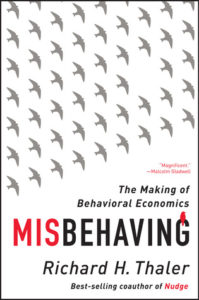
Reading Uncertainly? ‘Misbehaving: The Making of Behavioral Economics’ by Richard Thaler

This is the engaging story of the development and rise to practical significance of “behavioral economics,” the recognition that we “Humans” (as Professor Thaler calls us) are inevitably flawed in our dealing with finance and the market. It is also the personal biography of the author, along with many of the most important thinkers of the past 50 years.

The idea that our financial markets are “efficient,” as suggested by the “Econs,” the gurus we followed for many years, is destroyed by the realities of the human brain. First came Daniel Kahneman and Amos Tversky, who discovered our innate aversion to loss. Thaler notes that “ … losses hurt about twice as much as gains make you feel good,” noting, “Loss aversion has become the single-most powerful tool in the behavioral economist’s arsenal.”

But, Thaler also warns that, “… people who are threatened with big losses and have a chance to break even will be unusually willing to take risks, even if they are normally risk averse. Watch out!”

We need to be far more aware of the vagaries of the human mind when trying to guide ourselves and others toward the best balance of risk and reward: “The bottom line is that in many situations in which agents are making poor choices, the person who is misbehaving is often the principal, not the agent. The misbehavior is in failing to create an environment in which employees feel that they can take good risks and not be punished if the risks do not pay off.”

Unfortunately, we all tend to follow the herd: “It is better for reputation to fail conventionally than to succeed unconventionally.” Many years ago, IBM tried a better idea: it created a “Skunk Works” (from Al Capp’s L’il Abner cartoon) where employees with new and uncommon ideas could use corporate funds and help to work them out. If they succeeded, glory. If not, they could return, without blame, to their former employment.

Thaler’s sense of humor is always evident. Instead of watching our investment portfolios too closely, a uniformly bad habit, he suggests doing a crossword puzzle instead. He made a correct prediction about the collapse of the market in 2008: “Having made that one correct prediction, I am resolving not to make any more.”

And in American football, he urges teams to do the unexpected, such as “going for it” on fourth down. It changes the psychology on both sides echoing the, “And now for something completely different,” from Monty Python.

Thaler’s language is distinctly non-academic, a pleasure to read. He quotes Douglas Bernheim (2002): “As an economist, one cannot review the voluminous literature on taxation and saving without being somewhat humbled by the enormous difficulty of learning anything useful about even the most basic empirical questions.”

The last third of the book details the writing and reception of Nudge, the 2008 book he co-authored with Cass Sunstein. Their original title was “libertarian paternalism,” abbreviated, thank goodness, to “nudge,” the idea that we can encourage someone to do something that is in their best interests, by making it slightly easier.

At the end, Thaler asks “What Is Next?” He answers: “the only sensible prediction is to say what happens will surely surprise us.” Behavioral economics, the role of humans in what we do and how we live, is critical to both strategic and tactical planning.

And I did find a word I’ve never seen before: “corybantic.” It means frenzied, agitated, unrestrained: exactly how some human respond when their traditional beliefs and ideals are challenged.

Editor’s Note: ‘Misbehaving: The Making of Behavioral Economics’ by Richard Thaler is published by W. W. Norton & Co., New York 2015

Felix Kloman

About the Author: Felix Kloman is a sailor, rower, husband, father, grandfather, retired management consultant and, above all, a curious reader and writer. He’s explored how we as human beings and organizations respond to ever-present uncertainty in two books, ‘Mumpsimus Revisited’ (2005) and ‘The Fantods of Risk’ (2008). A 20-year-resident of Lyme, he now writes book reviews, mostly of non-fiction that explores our minds, our behavior, our politics and our history. But he does throw in a novel here and there. For more than 50 years, he’s put together the 17 syllables that comprise haiku, the traditional Japanese poetry, and now serves as the self-appointed “poet laureate” of Ashlawn Farms Coffee. His wife, Ann, is also a writer, but of mystery novels, all of which begin in a bubbling village in midcoast Maine, strangely reminiscent of the town she and her husband visit every summer.

Reading Uncertainly? ‘The Invention of Nature’ by Andrea Wulf

the_invention_of_natureFor those who attended this year’s Florence Griswold Museum-sponsored Samuel Thorne Memorial Lecture, which took place on Nov. 12, this month’s book review will ring significant bells. Not entirely by coincidence, we venture, our esteemed reviewer, Felix Kloman of Lyme, selected ‘The Invention of Nature’ as his book of choice this month and its author — Andrea Wulf — was the speaker at this year’s lecture .

Who was Alexander von Humboldt, the subject of this engrossing new biography? I must admit I had only a fleeting memory of his name, but for many in the 1900s, he was acknowledged as a major icon of the previous century in science and philosophy. Humboldt was a well-born Prussian, and Wulf’s story of his life is one of an intensely curious man whose travels, meetings and writings influenced many of the key thinkers of those years.

Consider these names: Johan von Goethe, Friedrich Schiller, Simon Bolivar, Thomas Jefferson, Charles Darwin, John Muir, Henry David Thoreau, Ernest Haeckel, Joseph Banks, and George Perkins Marsh. This biography is an exultation of interconnections!

And connectivity was the theme of Humboldt’s life: “Everything seemed somehow connected – an (early) idea that would come to shape his thinking about the natural world for the rest of his life.” Nature, to him, was a “web of life and a global force … with plants and animals dependent on each other.” This “urge to understand nature, globally, as a network of forces and interrelationships” generated “ferocious activity” for his entire life.

It began with his remarkable initial expedition to South America, including a climb to the top of Chimborazo, an inactive volcano in what is now Ecuador, a search for a link to the Amazon River, then walking in Mexico and Cuba, and, finally, a visit to President Thomas Jefferson in Washington. As a note on those times, it took Humboldt and his fellow traveler three and a half days to move from Philadelphia to the capital city.

While he yearned to travel again to South America, and then to Asia, and Africa, his shortage of funds allowed him only one other extensive tour, from Prussia to Russia and its border with China. But he never lost his curiosity, even while writing his journals, publishing a later masterpiece of his thinking, Cosmos, and forever trading correspondence and ideas with everyone he had met.

Wulf writes “comparison not discovery was his guiding theme,” and Humboldt issued an early warning of three ways in which the human species adversely affected the climate, based on his travels: deforestation, “ruthless irrigation,” and the “great masses of steam and gas produced in the industrial countries.” Almost two centuries later, we still have not learned …

Charles Darwin and Humboldt had frequent communication, in person and through letters. They shared, according to the author, a “flexibility perspective … telescopic and microscopic, sweepingly panoramic and down to the cellular levels, and moving in times from the distant geological past to the future economy of native populations.”

Humboldt was an outspoken critic of colonialism and slavery, but he had to be cautious as he remained under the financial support of Prussian royalty. Those years featured the turmoil of revolutions, as Europe and the Americas shifted from absolute despotisms to emerging democracies, and often back again.

Wulf’s entrancing biography is reading history through the vision of one extraordinary man who saw “harmony in diversity.” Would that we had listened more closely to his words …

Editor’s Note: ‘The Invention of Nature’ by Andrea Wulf is published by Alfred A. Knopf, New York 2015

Felix Kloman_headshot_2005_284x331-150x150About the Author: Felix Kloman is a sailor, rower, husband, father, grandfather, retired management consultant and, above all, a curious reader and writer. He’s explored how we as human beings and organizations respond to ever-present uncertainty in two books, ‘Mumpsimus Revisited’ (2005) and ‘The Fantods of Risk’ (2008). A 20-year resident of Lyme, he now writes book reviews, mostly of non-fiction that explores our minds, our behavior, our politics and our history. But he does throw in a novel here and there. For more than 50 years, he’s put together the 17 syllables that comprise haiku, the traditional Japanese poetry, and now serves as the self-appointed “poet laureate” of Ashlawn Farms Coffee. His wife, Ann, is also a writer, but of mystery novels, all of which begin in a bubbling village in midcoast Maine, strangely reminiscent of the town she and her husband visit every summer.