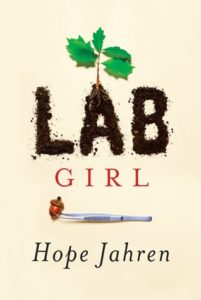
Reading Uncertainly? ‘Lab Girl’ by Hope Jahren

This month, let’s try an intensely introspective autobiography of a botanical scientist, wrapped in a biography of trees, flowers, and plants.

Hope Jahren, a professor at the University of Hawaii at Manoa in Honolulu, writes the clear, coherent, and engaging story of her upbringing in Minnesota, her education, travel and work in California, Georgia, Maryland, and Hawaii, intermixed with her study and analysis of the history and lives of plants and trees. And she apparently has a photographic memory as she recalls detailed conversations with her teachers, students, science mates and husband.

But, early on in my reading, I had a nagging question: does this intense self-analysis and self-reflection indicate something else?

Jahren finally acknowledges being a “manic-depressive woman” four-fifths of the way through her writing. She is consumed with her love of and study of plants: it dominates her life.

Fellow human beings? She acknowledges an early debt to her science-minded father, but never mentions him again after her first pages. Her scientific partner, Bill, is never granted a last name, nor is her husband, Clint. And none of those three is mentioned in her credits. She devotes one of the longest chapters to the birth of her son, but he remains nameless (mentioned only as “my toddler” and “my son.” Note he is not “our” son.)

But her often lyrical phrases continue to delight you as a reader, “a leaf is a platter of pigment strung with vascular lace,” and “vines are hopelessly ambitious,” and “being able to derive happiness from discovery is a recipe for a beautiful life.” Hers is a two-part, parallel story of intense curiosity – her science and her life.

Her self-analysis close to the end reads as follows:

“I’m good at science because I’m not good at listening. I have been told that I’m intelligent, and I have been told that I am simple-minded. I have been told that I am trying to do to much, and I have been told that what I have done amounts to very little. I have been told that I can’t do what I want to do because I am a woman, and I have been told that I have only been allowed to do what I have done because I am a woman. I have been told that I can have eternal life, and I have been told that I will burn myself out into an early death. I have been admonished for being too feminine and I have been distrusted for being too masculine. I have been warned that I am far too sensitive and I have been accused of being heartlessly callous.

But I was told all these things by people who can’t understand the present or see the future any better than I can. Such recurrent pronouncements have forced me to accept that because I am a female scientist, nobody knows what the hell I am, and it has given me the delicious freedom to make it up as I go along. I don’t take advice from my colleagues, and I try not to give it. When I am pressed, I resort to these two sentences: You shouldn’t take this job too seriously. Except for when you should.”

If that doesn’t arouse your curiosity to read this book, I don’t know what will!

Jahren’s conclusion, “Our world is falling apart quietly.” And her more optimistic recommendation: go plant a tree once a year! Which is exactly what my wife and I have done in our 24 years in Lyme, Conn. We’ve planted 13 Evergreens, four Red Maples, three Acacia, two Apples, one Japanese Maple, and one Witch Hazel. Yes, we’ve cut down an apple savaged by a hurricane, plus two small apples, but the latter were promptly replaced with two pears!

Do read Hope Jahren … and plant a tree.

Editor’s Note: ‘Lab Girl’ by Hope Jahren is published by Alfred A. Knopf, New York 2016
Felix Kloman

About the Author: Felix Kloman is a sailor, rower, husband, father, grandfather, retired management consultant and, above all, a curious reader and writer. He’s explored how we as human beings and organizations respond to ever-present uncertainty in two books, ‘Mumpsimus Revisited’ (2005) and ‘The Fantods of Risk’ (2008). A 20-year resident of Lyme, he now writes book reviews, mostly of non-fiction that explores our minds, our behavior, our politics and our history. But he does throw in a novel here and there. For more than 50 years, he’s put together the 17 syllables that comprise haiku, the traditional Japanese poetry, and now serves as the self-appointed “poet laureate” of Ashlawn Farms Coffee, where he may be seen on Friday mornings. His wife, Ann, is also a writer, but of mystery novels, all of which begin in a bubbling village in midcoast Maine, strangely reminiscent of the town she and her husband visit every summer.
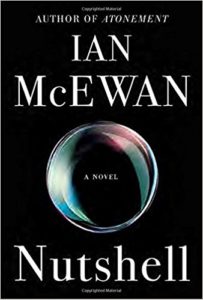
Reading Uncertainly: ‘Nutshell’ by Ian McEwan

Can you imagine an entire novel, spoken through the senses of a foetus, awaiting his entry into this world?
McEwan’s opening sentence sets the stage: “Here I am, upside down in a woman.” From that point, this young man extols first the “condition of the modern foetus. Just think: nothing to do but be and grow, where growing is hardly a conscious act. The joy of pure existence, the tedium of undifferentiated days. Extended bliss is boredom of the existential kind … In here I’m owed the privilege and luxury of solitude,” as his mother listens continuously, with ear-buds, to self-improvement books, biographies and world classics.

But at the same time it is a story of, first, murder, and then the revenge of his mother and of the young man himself. I realized that about halfway through this engrossing and often-hilarious tale, McEwan is embedded in a take-off on Hamlet. This youngster’s mother, Trudy, is drawn from Gertrude. His stepfather, Claude, is Claudius, a “fraud who’s wormed in between my family and my hopes.”

This leads the still-enclosed boy to conclude his “dim view of our species, of which psychopaths are a constant fraction, a human constant. ” His reaction: “Anxiously, I finger my cord.”

His brain, after listening to all that his mother hears, plus her plans with her lover, leads him to a sour conclusion about his life yet to come, “Long ago, someone pronounced a groundless certainty a virtue. Now, the politest people say it is. I’ve heard their Sunday-morning broadcasts from cathedral precincts. Europe’s most virtuous spectres, religion and, when it faltered, godless utopias bursting with scientific proofs, together they scorched the earth from the tenth to the twentieth centuries. Here they come again, risen in the East, pursuing the millennium, teaching toddlers to slit the throats of teddy bears. And here I am with my home-grown faith in the life beyond.”

Towards the end (or the beginning, his birth), he comments: “It’s already clear to me how much of life is forgotten even as it happens. Most of it. The unregarded present spooling away from us, the soft tumble of unremarkable thoughts, the long-neglected miracle of existence.” But the young man does start …

That sums up this mesmerizing story, in a nutshell: a woman’s womb for your world view.

My own coda: “To be or yet to be: that is gestation.”

Editor’s Note: ‘Nutshell’ by Ian McEwan, was published by Doubleday, New York, 2016.

Felix Kloman

About the Author: Felix Kloman is a sailor, rower, husband, father, grandfather, retired management consultant and, above all, a curious reader and writer. He’s explored how we as human beings and organizations respond to ever-present uncertainty in two books, ‘Mumpsimus Revisited’ (2005) and ‘The Fantods of Risk’ (2008). A 20-year resident of Lyme, he now writes book reviews, mostly of non-fiction that explores our minds, our behavior, our politics and our history. But he does throw in a novel here and there. For more than 50 years, he’s put together the 17 syllables that comprise haiku, the traditional Japanese poetry, and now serves as the self-appointed “poet laureate” of Ashlawn Farms Coffee, where he may be seen on Friday mornings. His wife, Ann, is also a writer, but of mystery novels, all of which begin in a bubbling village in midcoast Maine, strangely reminiscent of the town she and her husband visit every summer.

Reading Uncertainly? ‘Payoff’ by Dan Ariely

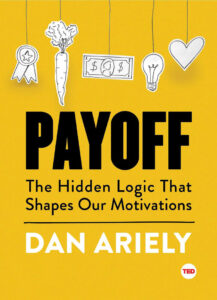
What is “motivation” and how does it affect our daily activity? Is motivation “central to our lives”? Dan Ariely, a professor of behavioral economics at Duke University, explores the human feeling of identification with and empathy for others, suggesting these two feelings help stimulate motivation, while their absence destroys it.
This brief book (103 pages) combine stories from Dr. Ariely’s personal life and his continuing work studying our strange behaviors. It continues his earlier work: Predictably Irrational, The Upside of Irrationality, and The (Honest) Truth About Dishonesty, all of which I’ve read with fascination.

At the very start, the author describes his own teenage accident in Israel, in which he sustained severe burns over some 70 percent of his body, leading to three years of hospitalization and slow and painful recovery. It was then he began to discover the idea of motivation, enlarged later when he helped a friend’s two teenage children, similarly injured.

As he writes, “I also realized how many of our motivations spring from trying to conquer a sense of helplessness and reclaim even a tiny modicum of control over our lives.” Any success in such an effort becomes a “feeling of accomplishment.” This then leads to the need to “look closely at the positive side of motivation,” creating pleasure and affection for your own handiwork.

But does financial reward motivate us? Ariely suggests “money matters far less than we think.” We should avoid “overemphasizing the countable dimension and beware (my italics) treating the uncountable dimension as if it were easily countable.” This skewers the old adage that if you can’t count it, it doesn’t exist!

He continues: “In short, these findings suggest that when we are in the midst of a task, we focus on the inherent joy of the task, but when we think about the same task in advance, we over-focus on the extrinsic motivators, such as payment and bonuses. This is why we are not good predictors of what will motivate us and what will crush our motivation. This inability to intuit what will make us happy at work is sad.” Trust and goodwill seem to be far better inspirations than cash … Is it possible that large bonuses are actually counterproductive?

Dr. Ariely concludes: “We are certainly far from grasping the full complexity of motivation, but the journey to understand  … (its) nuances … (is) exciting, interesting, important and useful.”

As usual, brevity enhances comprehension. A short book motivates continued reading!

Editor’s Note: ‘Payoff ‘ by Dan Ariely is published by TED Books, New York 2016.

Felix Kloman

About the Author: Felix Kloman is a sailor, rower, husband, father, grandfather, retired management consultant and, above all, a curious reader and writer. He’s explored how we as human beings and organizations respond to ever-present uncertainty in two books, ‘Mumpsimus Revisited’ (2005) and ‘The Fantods of Risk’ (2008). A 20-year resident of Lyme, he now writes book reviews, mostly of non-fiction that explores our minds, our behavior, our politics and our history. But he does throw in a novel here and there. For more than 50 years, he’s put together the 17 syllables that comprise haiku, the traditional Japanese poetry, and now serves as the self-appointed “poet laureate” of Ashlawn Farms Coffee, where he may be seen on Friday mornings. His wife, Ann, is also a writer, but of mystery novels, all of which begin in a bubbling village in midcoast Maine, strangely reminiscent of the town she and her husband visit every summer.

Reading Uncertainly? ‘The Tide’ by Hugh Aldersey-Williams

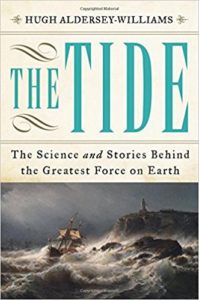
A present from a New Hampshire daughter, The Tide is a delightful, entertaining, and thought-provoking mix of lucid, often poetic, language with numerous literary quotations plus detailed scientific explanations of the tides that embellish our lives on this earth. It is Aldersey-Williams’s thought-experiment.
It is also his history of the oceanic tides, mixed with a bit of mathematics. But not more than you can handle. As he notes, “You may be relieved to know that I will leave the mathematics aside here.” And, given that many tell us the world’s tides are soon to be much higher, this is a most worthwhile book.

It is, as he states, “not a book about the sea” (sailors, ships, and winds), but rather a book “about the seas” and the ever-changing space between land and water. The tide, he explains, “offers an irresistible mathematical tease” as we attempt to understand and predict it. It is both a horizontal and a vertical force. That is a “scientific challenge” and “a physical; and psychological influence on our culture.” The classic story of King Canute’s (or Cnut, as the author spells it) attempt to stem the tide may have altered the English view of nobility.

This is the author’s story of watching tides around the world, from the English Channel to, of all places, Griswold Point on the Connecticut River, with a cousin, David Redfield. Tides are entrancing: they give us slow, relative motion that produces a “hallucinatory feeling.” Water is, after all, “an inelastic fluid (that) cannot be compressed or expanded.” I too have been mesmerized: by the 10-foot tides in Tenants Harbor, Maine; by the rising waters in Bosham, West Sussex, England, that regularly swamp cars in the local bar’s parking lot; and by the rushing tidal currents in the Straits of Shimonoseki, between Honshu and Kyushu, Japan, through which we once sent our Navy ship (at slack water, of course!)

He acknowledges the inevitability of climate change and global warming, and the fact they will lead to rising seas: “The greatest impact of rising sea levels and the changing tides that may accompany them will be on human habitation.” After all, we easily succumb to the human drive to cling to shores. “In the long term, if not the short, ‘managed retreat’ is our only option. The sea always wins in the end.”

Trying to ‘stop the sea? “It is a futility that Sisyphus would understand all too well.” So New York is a potential Venice … and New London too!

But do not be deterred by such pessimism. The Tide is full of rich, poetic language, as in this description of birds above the sea: “Once aloft, the birds first coalesce as an egg-shaped cloud low over the water, before gaining height and taking on ever more extravagant, twisted shapes like a pixelated flamenco dancer.”

It is enough to send me down to the end of Ely’s Ferry Road to watch the Connecticut River slip by the marshes of Essex.

Editor’s Note: ‘The Tide’ by Hugh Aldersey-Williams was published by W. W. Norton, New York 2016.

Felix Kloman

About the Author: Felix Kloman is a sailor, rower, husband, father, grandfather, retired management consultant and, above all, a curious reader and writer. He’s explored how we as human beings and organizations respond to ever-present uncertainty in two books, ‘Mumpsimus Revisited’ (2005) and ‘The Fantods of Risk’ (2008). A 20-year resident of Lyme, he now writes book reviews, mostly of non-fiction that explores our minds, our behavior, our politics and our history. But he does throw in a novel here and there. For more than 50 years, he’s put together the 17 syllables that comprise haiku, the traditional Japanese poetry, and now serves as the self-appointed “poet laureate” of Ashlawn Farms Coffee, where he may be seen on Friday mornings. His wife, Ann, is also a writer, but of mystery novels, all of which begin in a bubbling village in midcoast Maine, strangely reminiscent of the town she and her husband visit every summer.

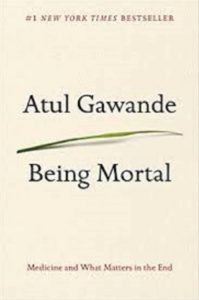
Reading Uncertainly? ‘Being Mortal’ by Atul Gawande

Here is a challenge and a question.

The challenge: “Our decision-making in medicine has failed so spectacularly that we have reached the point of actively inflicting harm on patients rather than confronting the subject of mortality.”

The question: Can the medical profession change from its former “priestly doctor-knows-best” and its current “informative” models to a more jointly-responsible “interpretive” model in which patients and physicians work together to mold priorities and decisions?

Atul Gawande, a professor at Harvard Medical School and one of the most thoughtful and articulate observers of the medical scene today (frequently in The New Yorker), asks us to “ … confront the realities of decline and mortality,” not with fear but with intelligence and realism. Too often “the waning days of our lives are given over to treatments that addle our brains and sap our bodies for a sliver’s chance of benefit.”

It has not always been that way. In the past “elders were cared for in multi-generational systems” when we died much sooner and faster, but now we must endure multiple failures in our bodies during “long retirements. … We are already oddities living well beyond our appointed time.” Institutionalization means loss of privacy and control, too many medications whose combined effects we don’t understand, and too much passive entertainment. Even the advent of the much-heralded “assisted living” mechanism has been watered down and often corrupted.

Gawande proposes a future in which “geriatrics” will be taught to all physicians who, in turn, will discuss options with us realistically. For example, his illustration is the simple use of living plants, birds, dogs, and cats, plus smaller groupings of the aged to reduce “the plagues of nursing home existence: boredom, loneliness, and helplessness,” so that we can “renew the joy of life.”

But the good doctor seems to equivocate when it comes to the idea of “death with dignity,” or the option of physician-assisted suicide, now permissible to some degree in five states in the U. S. and in The Netherlands. “I am leery of the idea that endings are controllable,” he writes. Must we insist, legally, on palliative care for the terminally ill? Don’t we/they have an inherent right to select our own course of action, not only for terminal physical illnesses where courses of painful (and costly) procedures may give us only a few extra months, but also for forecasts of mental deterioration, such as dementia and Alzheimer’s?

An inability or unwillingness to take our own early action when capable may create enormous costs (mental and financial) to all of us. I am an advocate of considering options early enough, working with our physicians, but retaining the right to final decisions, including death.

(Read, for example, Derek Humphry”s Final Exit, Random House, New York 2002)

Doctor Gawande’s goal makes eminent sense, “The battle of being mortal is the battle to maintain the integrity of one’s life – to avoid becoming so diminished or dissipated or subjugated that who you are becomes disconnected from who you were or who you want to be.”

Editor’s Note: ‘Being Mortal’ by Atul Gawande is published by Henry Holt and Co., New York 2014.

Felix Kloman

About the Author: Felix Kloman is a sailor, rower, husband, father, grandfather, retired management consultant and, above all, a curious reader and writer. He’s explored how we as human beings and organizations respond to ever-present uncertainty in two books, ‘Mumpsimus Revisited’ (2005) and ‘The Fantods of Risk’ (2008). A 20-year resident of Lyme, he now writes book reviews, mostly of non-fiction that explores our minds, our behavior, our politics and our history. But he does throw in a novel here and there. For more than 50 years, he’s put together the 17 syllables that comprise haiku, the traditional Japanese poetry, and now serves as the self-appointed “poet laureate” of Ashlawn Farms Coffee, where he may be seen on Friday mornings. His wife, Ann, is also a writer, but of mystery novels, all of which begin in a bubbling village in midcoast Maine, strangely reminiscent of the town she and her husband visit every summer.