Reading Uncertainly? ‘Wicked, Weird & Wily Yankees’ by Stephen Gencarella

Editor’s Note: Stephen Gencarella, the author of ‘Wicked, Weird & Wily Yankees’ will be the guest speaker at the Lyme Public Library’s Annual Meeting on Tuesday, June 26, at 7 p.m.
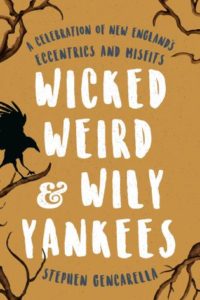
What a pleasure: to read an engaging book by a close neighbor (Steve and his family live just down Tinker Lane from me) and to encourage other Lymies to do the same!

Steve, a professor at the University of Massachusetts in Amherst and the resident folklorist at the Connecticut River Museum, offers us a series of essays about unusual folk from New England, eccentric and out-of-the-ordinary men and women: hermits, healers, poets, mesmerists, fortune-tellers, prophets, reformers, bandits, visionaries, vagabonds, introverts, and misogynists.

In other words, most of us!

But what is eccentricity. The professor explains: “ … eccentricity is not an inherent quality but one always partially imposed from the outside, from the society that demarcates and gazes upon the eccentric … “[it] is always a matter of contested perspectives” and “ … tendencies to the reclusive or to the flamboyant quickly garner the label of eccentricity.”  He continues, “As tends to happen when history yields to folklore, this oddity began to grow in dimensions through the course of a century” of retelling stories of eccentrics.  And “the stories themselves are vagabonds.”

Among the locals described in these essays are a character at the Monkey Farm Café in Old Saybrook, William Gillette of Gillette’s Castle, that “Hadlyme stone heap,” and Elizabeth Tashjian, perhaps better known as “The Nut Lady” of Old Lyme.

Steve concludes with the counsel, “but that is precisely the challenge of eccentrics: to demand respect for the integrity and for the unique and unusual demands of every individual and to refuse to allow authority – however minor – to get away with discouraging people who hear a different drummer.”

We are all story-tellers!

But I was most impressed by the author’s continued use of the word “passing” as his euphemism for death: he uses it 31 times, by my count. It reminded me of that famous “Dead Parrot” skit from Monty Python, in which John Cleese presents an inert parrot nailed to a stick to Michael Palin, the man who had just sold it to him.

“E’s passed on! This parrot is no more! He has ceased to be! ‘E’s expired and gone to meet ‘is maker! ‘E’s a stiff! Bereft of life, ‘e rests in peace! If you hadn’t nailed ‘im to the perch, ‘e’d be pushing up the daisies! ‘Is metabolic processes are now ‘istory! ‘E’s off the twig! ‘E’s kicked the bucket, ‘e’s shuffled off ‘is mortal coil, run down the curtain and joined the bleedin’ choir invisible!! This is an ex-parrot!”

Does this usage “passeth all understanding” (Philippians)?

I pass … but do read these entrancing stories of eccentric Yankees!

About this book: ‘Wicked, Weird & Wily Yankees’ by Stephen Gencarella was published in May 2018 by Globe Pequot, Guilford, CT 2018.
Felix Kloman

About the Author: Felix Kloman is a sailor, rower, husband, father, grandfather, retired management consultant and, above all, a curious reader and writer. He’s explored how we as human beings and organizations respond to ever-present uncertainty in two books, ‘Mumpsimus Revisited’ (2005) and ‘The Fantods of Risk’ (2008). A 20-year resident of Lyme, he now writes book reviews, mostly of non-fiction that explores our minds, our behavior, our politics and our history. But he does throw in a novel here and there. For more than 50 years, he’s put together the 17 syllables that comprise haiku, the traditional Japanese poetry, and now serves as the self-appointed “poet laureate” of Ashlawn Farm Coffee, where he may be seen on Friday mornings. His wife, Ann, is also a writer, but of mystery novels, all of which begin in a village in midcoast Maine, strangely reminiscent of the town she and her husband visit every summer.
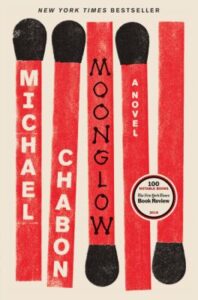
Reading Uncertainly? ‘Moonglow’ by Michael Chabon

This is, at one and the same time, a work of fiction and the author’s actual family history, selectively combined and embellished. It is the story of Michael Chabon’s grandfather and grandmother, recreated as a totally engaging novel, covering more than five decades in Germany, Philadelphia, Baltimore, New York City, Florida and California.  He “recreates” these two antecedents, beginning with his grandfather’s work with the Office of Strategic Services (O.S.S.) in Germany in the waning day of World War II, followed by the meeting with his grandmother in Baltimore two years later, and then their fractured lives thereafter.
The key lies in Chabon’s candid Author’s Note: “In preparing this memoir, I have stuck to the facts except when facts refused to conform with memory, narrative purpose, or the truth as I prefer to understand it.” He went on later: “To claim or represent that I retain an exact or even approximate recollection of what anyone said so long ago would be to commit the memoirist’s great sin.” And so his imagination is unleashed …

This is a history, or really even slightly connected stories about his grandparents and their lives in these United States, as they allowed their interconnected emotions to respond to ever-changing stimuli. As Chabon confesses, perhaps there is nothing such as a defined “self”: “Maybe ‘self’ was a free variable with no bounded value.”

Chabon is rich with descriptive phrases. (1) a priest’s cassock: “White dust patterned the black cassock in big splotches like continents or the spots on a cow.”

(2) “The small room was all cross-hatchings of shadow like a lesson in shading a sphere, an arc of darkness wrapped around a circle of gray with a bright spot a bit off-center.  The bright spot was my grandmother; all the light in the sad little room seemed to be radiating from her.”

And describing his father reminded me of John le Carre’s father: ” … my big-talking, sweet-talking, fast-talking father was in and out of courtrooms, tax dodges, marriages, and my life … ” And as Chabon concludes, “That was only human, the common lot. But once your dream revealed itself, like most dreams, to be nothing but a current of raw compulsion flowing through a circuitry of delusion and lies, then that was the time to give it up.” His grandfather’s was with Wernher von Braun and space exploration.

Finally, a curious note. The chapter heads are safety matches formed into roman numerals. But two matches are lit, one in Chapter XX describing an O.S.S. excursion, and the other heading Chapter XXV, when his grandfather heads off to jail.  The connection: I do not know.

A rich and completely engrossing story!

Editor’s Note: ‘Moonglow’ by Michael Chabon was published by HarperCollins, New York 2016.

Felix Kloman

About the Author: Felix Kloman is a sailor, rower, husband, father, grandfather, retired management consultant and, above all, a curious reader and writer. He’s explored how we as human beings and organizations respond to ever-present uncertainty in two books, ‘Mumpsimus Revisited’ (2005) and ‘The Fantods of Risk’ (2008). A 20-year-resident of Lyme, he now writes book reviews, mostly of non-fiction that explores our minds, our behavior, our politics and our history. But he does throw in a novel here and there. For more than 50 years, he’s put together the 17 syllables that comprise haiku, the traditional Japanese poetry, and now serves as the self-appointed “poet laureate” of Ashlawn Farms Coffee. His wife, Ann, is also a writer, but of mystery novels, all of which begin in a bubbling village in midcoast Maine, strangely reminiscent of the town she and her husband visit every summer.

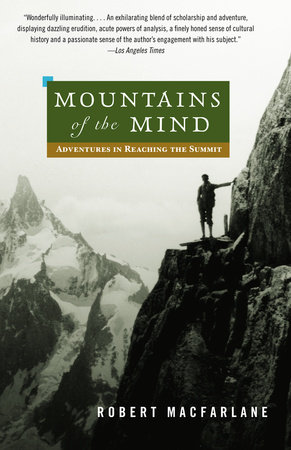
Reading Uncertainly? ‘Mountains of the Mind’ by Robert Macfarlane

Have you ever been mesmerized by a mountain?
I have … Mount Fuji, from the waters of Suruga Wan, Mounts Rainier and Baker from Puget Sound on a cloudless day, and even Mount Kearsarge in central New Hampshire when I actually climbed it with some of our family.

What is it about mountains that seem to entrance our minds?

Robert Macfarlane, a Fellow of Emmanuel College, Cambridge, gives us a meditation on these heights, an enthralling “mental stimulation that explores why “the unknown is so inflammatory to the imagination.”  And why is it that almost every “prophet” of all our religions has ‘habitually been up mountains … to receive divine counsel”?

What is “the mesmerism of high places”?  He explains: “ … the urge to explore space – to go higher – is innate in the human mind” and “ … the visionary amplitudes of altitude felt like the approximations of divine sight  … the spell of altitude.”

He writes “when we look at a landscape, we do not see what is there, but largely what we think is there … We read landscapes” as interpreted “in the light of our own experience and memory, and that of our shared cultural memory.”  In other words, landscapes are “romanticized into being,” mountains most of all.

“Contemplating the immensities of deep time, you face in a way that is both exquisite and horrifying, the total collapse of your present, compacted to nothingness by the pressures of pasts and futures too extensive to envisage … [plus] the appalling transience of the human body.”

Macfarlane’s chapters explore geology, fear, glaciers, heights, maps, theology, and conclude, inevitably, with Mount Everest and the attempt of George Mallory and Andrew Irvine in 1924. The author himself is also a climber as well as a student of mountains.

He cites John Ruskin with the idea that “risk-taking – scaring yourself – was, provided you survived, a potent means of self-improvement.”

“This is the great shift which has taken place in the history of risk.  Risk has always been taken, but for a long time it was taken with some ulterior purpose in mind: scientific advancement, personnel glory, financial gain.  About two and a half centuries ago, however, fear started to become fashionable for its own sake.  Risk, it was realized, brought its own reward: the sense of physical exhilaration and elation which we would now attribute to the effects of adrenaline.  And so risk-taking – the deliberate inducement of fear — became desirable; became a commodity.”

Macfarlane concludes, “mountains return to us the priceless capacity for wonder.”  He continues, “In ways that are for the most part imperceptible to us, we all bend our lives to fit the templates with which myths and archetypes provide us. We all tell ourselves stories, and bring our futures into line with these stories, however much we cherish the sense of newness, or originality, about our lives.”

Finally, “at bottom, mountains, like all wildernesses, challenge our complacent convictions – so easy to lapse into – that the world has been made for humans by humans.”

So, encourage your doubts and go climb a hill!

Editor’s Note:  ‘Mountains of the Mind’ by Robert Macfarlane was published by Vintage Books, New York 2004.

Felix Kloman

About the Author: Felix Kloman is a sailor, rower, husband, father, grandfather, retired management consultant and, above all, a curious reader and writer. He’s explored how we as human beings and organizations respond to ever-present uncertainty in two books, ‘Mumpsimus Revisited’ (2005) and ‘The Fantods of Risk’ (2008). A 20-year-resident of Lyme, he now writes book reviews, mostly of non-fiction that explores our minds, our behavior, our politics and our history. But he does throw in a novel here and there. For more than 50 years, he’s put together the 17 syllables that comprise haiku, the traditional Japanese poetry, and now serves as the self-appointed “poet laureate” of Ashlawn Farms Coffee. His wife, Ann, is also a writer, but of mystery novels, all of which begin in a bubbling village in midcoast Maine, strangely reminiscent of the town she and her husband visit every summer.

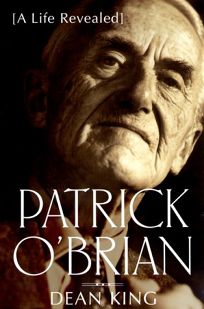
Reading Uncertainly? ‘Patrick O’Brian: A Life Revealed’ by Dean King

This is a confession of an addict.

In early 1993, I was urged by a long-time sailing friend to begin reading a series of novels by Patrick O’Brian about an English skipper and his shipboard surgeon set in the Napoleonic Wars.

I did.

By now I’ve read – three times, no less –all 21 of the famous Jack Aubrey-Stephen Maturin novels, plus six of his other books, plus King’s 2000 biography. And I’ve just finished a second read of this biography, learning even more about a compelling writer, now acknowledged by many as one of the two best 20th Century tellers of sea stories (Joseph Conrad being the other.)

A re-read is often even more enlightening than the first, and so it was this time.  For Patrick O’Brian was a consummate “storyteller” in both senses of the word. First, he was not “Patrick O’Brian”, an Irish novelist. He was Richard Patrick Russ, the grandson of a German who moved to London in 1842 to seek his fortune as a furrier. He served in the ambulance corps during World War II and divorced his first (Welsh) wife immediately thereafter, taking his new wife Mary (English, but divorced from her Russian husband) first to Wales and then to southern France, as his writing career blossomed.

Patrick was indeed a well-read and curious man, whose “ … love of nature, literature, and writing arrived early, whose love of solitude would endure, and whose obsession with privacy would infuse his eventual literary tour de force, the Aubrey-Maturin novels.”

But his worlds were mostly vicarious, experienced through his reading, not through actual sea experience. While his stories give us detailed and factually-correct stories of the sea and many of the battles, skirmishes, and life at sea during the wars between 1800 and 1820, plus the intrigues of life in England at that time, they were a result of his reading and research plus his remarkable memory.As far as we know, O’Brian never went to sea in any sort of vessel!

O’Brian avoided publicity whenever he could: As he had his alter-ego, Stephen Maturin, say in Truelove: “Question and answer is not a civilized form of conversation … It is extremely ill bred, extremely unusual, and extremely difficult to turn aside gracefully or indeed without offense.”

But he was, above all, a writer: “ … he found his most life-affirming moments in this fluid act of creation … For him, the creative process was largely an inexplicable one, some magical combination of conscious, and subconscious, of instinct and intellect, all clicking at once.” In addition to his English, he was fluid, “to some extent, in Italian, French, Spanish, German, Catalan and Irish and had a good background in Latin and Greek.” He also, “possessed extraordinary powers of retention and integrated this information into his lively ken.” King concludes that O’Brian had “ … an ego of iron beneath a surface of humility.”

My connection with O’Brian’s work goes beyond his novels and biographies.  Two of us went to the Princeton Club in New York City in the fall of 1993 to hear O’Brian talk about his novels and read from one of them. Mesmerizing, but the high point was when we asked him to autograph copies of his latest work. With an impish smile he proceeded to do so: one with his right hand and the other with his left!

Most of his novels have beguiling conclusions, somewhat abrupt, if only to lead the reader toward the next “installment.” But he explained his endings in a conversation about writing with Maturin and a friend one evening on the rail of a ship in the Pacific in the Nutmeg of Consolation: “La betise c’est de vouloir conclure (the absurd thing is the desire to come to a conclusion.) The conventional ending, with virtue rewarded and loose ends tied up is often sadly chilling; and its platitude and falsity tend to infect what has gone before, however excellent.”

I noted that passage when I first read it and used it for the end of my own autobiography.  King also cites it.

Mary O’Brian died in France in March 1998. Patrick O’Brian died, incongruously, in Dublin, Ireland, in January 2000. But his stories live on …

Editor’s Note: ‘Patrick O’Brian: A Life Revealed,’ by Dean King is published by Henry Holt & Co., New York 2000.

Felix Kloman

About the Author: Felix Kloman is a sailor, rower, husband, father, grandfather, retired management consultant and, above all, a curious reader and writer. He’s explored how we as human beings and organizations respond to ever-present uncertainty in two books, ‘Mumpsimus Revisited’ (2005) and ‘The Fantods of Risk’ (2008). A 20-year-resident of Lyme, he now writes book reviews, mostly of non-fiction that explores our minds, our behavior, our politics and our history. But he does throw in a novel here and there. For more than 50 years, he’s put together the 17 syllables that comprise haiku, the traditional Japanese poetry, and now serves as the self-appointed “poet laureate” of Ashlawn Farms Coffee. His wife, Ann, is also a writer, but of mystery novels, all of which begin in a bubbling village in midcoast Maine, strangely reminiscent of the town she and her husband visit every summer.

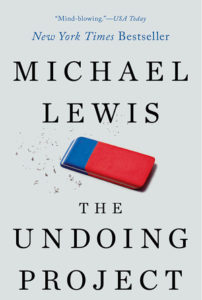
Reading Uncertainly? ‘The Undoing Project’ by Michael Lewis

No, this is not the story of a baseball team savant, who doubted conventional statistics and reused them with extraordinary success (Moneyball). It is not a personal disclosure of the seamy underbelly of financial markets (The Big Short; Flash Boys; Liar’s Poker).
Rather, it is the story of learning how our minds work, of behavioral economics, and of the unusual and highly prolific working relationship of two Israeli academics, who first met in 1960. It is the story of how an extrovert, Amos Tversky, and an introvert, Daniel Kahneman, stimulated and prodded each other over almost 40 years, first in Israel and then teaching  in the United States on the West coast, then in the Midwest, and finally in the East, uncovering and describing the numerous biases that confuse our thinking.

Each challenged the ideas of the other.

As the author describes an early intellectual collision, “Theories for Amos were like mental pockets or briefcases, places to out the ideas you wanted to keep. Until you could replace a theory with a better theory–a theory that better predicted what actually happened—you didn’t chuck a theory out. Theories ordered knowledge, and allowed for better prediction … But (Amos) left Danny’s seminar in a state of mid unusual for him: doubt. After the seminar, he treated theories that he had more or less accepted as sound and plausible as objects of suspicion.”

Kahneman: his “defining emotion is doubt.”

Tversky:  his interest is psychology: “why people behaved as they behaved, and thought as they thought,” never entirely “rational.”

Kahneman:  “He thought of himself as someone who enjoyed, more than most, changing his mind.”

Tversky: “People live under uncertainty whether they like it or not.”

Kahneman:  “It is the anticipation of regret that affects decisions, along with the anticipation of other consequences. This is why we seem to be instinctively ‘risk averse’.”

Tversky: “Reality is a cloud of possibility, not a point.”

Kahneman:  “The basic rules of undoing, however, apply alike to frustration and regret. They require a more or less plausible path leading to an alternative state.”

Together these two thinkers described the numerous biases that both confuse and enlighten our thinking: hindsight, anchoring, availability, small numbers, context, framing, the endowment effect, and many others. As Lewis explains it, “ they would learn to evaluate a decision not by its outcomes—whether it turned out to be right or wrong—but by the process that led to it. He then concludes: “ … the brain is limited. There are gaps in our attention. The mind contrives to make those gaps invisible to us. We think we know things we don’t. We think we are safe when we are not.”

In 1996, Amos Tversky died. In 2002, Daniel Kahneman won a Nobel Prize, one that almost certainly would have been awarded to Amos as well, had he been alive.

Do read this fascinating story of two thinkers, and go further and read Kahneman’s Thinking, Fast and Slow (2011).  And consider my own personal haiku, one that forces me to rethink all the time:

Pause for a moment:
Doubt, then curiosity.
Try another path.

Editor’s Note: ‘The Undoing Project’ by Michael Lewis was published by W. W. Norton, New York, in 2017.

About the Author: Felix Kloman is a sailor, rower, husband, father, grandfather, retired management consultant and, above all, a curious reader and writer. He’s explored how we as human beings and organizations respond to ever-present uncertainty in two books, ‘Mumpsimus Revisited’ (2005) and ‘The Fantods of Risk’ (2008). A 20-year resident of Lyme, he now writes book reviews, mostly of non-fiction that explores our minds, our behavior, our politics and our history. But he does throw in a novel here and there. For more than 50 years, he’s put together the 17 syllables that comprise haiku, the traditional Japanese poetry, and now serves as the self-appointed “poet laureate” of Ashlawn Farms Coffee, where he may be seen on Friday mornings. His wife, Ann, is also a writer, but of mystery novels, all of which begin in a bubbling village in midcoast Maine, strangely reminiscent of the town she and her husband visit every summer.