Selden J. Whitcomb, 92, of Atria Lincoln Place, Lincoln, RI, died Monday, May 8, 2023. He was born on April 8, 1931, and was preceded in death by his parents Frank and Ignacia (Jordan) Whitcomb of Groton, and loving wife Lois (Zimmerman) Whitcomb. Selden had lived in Cumberland and Lincoln, RI for the past 53 years and spent his summer months on Leete’s Island, in Guilford …
Selden is survived by his brother and sister, Robert Whitcomb of Old Lyme; and Nacia Patterson of Waterford …
A Service of Remembrance and Thanksgiving will be held on June 11, 2023, at 1:00PM in Arnold Mills United Methodist Church, 690 Nate Whipple Highway, Cumberland, RI. The burial will be private.
The newly restored terrace with slate paving stones will be highlighted at the official opening of Gillette Castle on Saturday, May 27. Photo submitted.
EAST HADDAM, Conn. – On Saturday, May 27, the interior of Gillette Castle re-opened to visitors after completion of a half-million-dollar project to restore its surrounding terrace.
Most Connecticut state park buildings, museums, nature centers and other enclosed structures are expected to open during the Memorial Day weekend.
Through Sept. 4, the century-old fieldstone mansion may be toured daily from 10 a.m. to 4 p.m. Advance purchase of tickets from park staff is highly recommended, and may be done at ReserveAmerica.com under “Gillette Castle State Park Tours.” Questions about tickets should be directed to park staff at (860) 526-2336.
“The home of the late stage actor William Gillette is the true centerpiece of this wonderful park, and our plans over the past couple of years are coming to fruition — with more to come,” said Lynn Wilkinson, president of the Friends of Gillette Castle State Park.
“What visitors may not notice is the restoration of the upper terrace behind the Castle, which has been in works since last autumn,” she added. “The work allowed an improved drainage system to be installed, preventing possible damage to the Castle.”
The $480,000 project was administered by the Connecticut Department of Energy and Environmental Protection in cooperation with the engineering firm Nathan L. Jacobson & Associates of Chester and Baltic, Conn.-based Mattern Construction Inc.
“Now that the project has been completed, the terrace and a restored retaining wall look just as they did before,” Wilkinson said.
Elsewhere on the Castle grounds, visitors who travel to the ferry dock may note that efforts are continuing to prevent additional deterioration at the former home of Gillette’s longtime assistant and friend, Yukitaka Osaki.
The park’s grounds are open from 8 a.m. until sunset daily, offering visitors a chance to use the park’s varied hiking trails, stroll around Gillette’s unique home and perhaps spot the eagles that frequently nest with their young along the river at many times of the year.
The park is nestled between the towns of East Haddam and Lyme. Many of its trails follow a former railroad bed created for a narrow-gauge track installed by the late Connecticut stage actor, who built his castle-like home atop one of the Seven Sister Hills along the river.
Trail maps and videos of the estate may be found on the Friends website at www.gillettecastlefriends.org. Those interested in becoming a Friends member may sign up online or download a mail-in application form at the website, or direct their questions to info@gillettecastlefriends.org or (860) 222-7850.
The organization’s mission includes the preservation, restoration and conservation of the historic structure and its scenic grounds. The all-volunteer, nonprofit group works in cooperation with the Connecticut Department of Energy and Environmental Protection. Memberships help to finance park and structural improvements while preserving the estate and Gillette’s legacy.
I took this photo (above) of the mixed use development to the Main Street in South Portland, Maine. This could be a blueprint for Halls Road if the Halls Road Improvements Committee (HRIC) zoning changes are adopted.
Halls Road is and will always be a service road not an area for residential development. Any development should be limited to service oriented business, examples being health care facilities, urgent care facility as well as businesses that support the highways.
We all agree that Halls Road in its current configuration is an eyesore but overreacting and approving the HRIC proposed changes to zoning regulations may make a bad situation worse.
OLD LYME — Edie Twining, who serves as Chair of the Halls Road Improvements Committee (HRIC), contacted us to let us know that the committee had prepared a revised list of Frequently Asked Questions along with the committee’s responses. We are pleased to publish it here to reach an expanded audience and increase resident’s understanding of the project. The questions are also posted on the Town of Old Lyme’s website.
Why is the town considering changes to Halls Road? In 2015 community members asked for safer pedestrian passage to and from Halls Road. The Halls Road Improvements Committee (HRIC) was formed to address this issue. After several public meetings the town heard that townspeople wanted more than sidewalks and lighting. They wanted the town’s commercial area to look more like Old Lyme, to have apartments for older and younger citizens, and to be a more attractive town center than the existing strip centers.
What is the Halls Road Master Plan and why was it developed? A formal Master Plan is an important tool in seeking grants for work on Halls Road, for encouraging investment, and for setting broad goals designed to insure the future of Old Lyme’s main shopping district. It covers two main aspects of change:
Public Improvements: Paid for by the town with the help of grants from the state, these include creating sidewalks, lighting, landscaping, cross walks, and a new pedestrian/cycling bridge over the Lieutenant River at the old bridge abutments.
Private Investments: Private investors created the existing Halls Road, and they will create any future Halls Road. The town’s role was and is to guide private investment into the channels the town wants and needs. The Master Plan envisions a walkable, bike-able shopping street in a mixed-use neighborhood. This is the most supportive environment for 21st-century retail. It is also attractive for those who want a convenient, walkable neighborhood with smaller-scale housing. None of this is allowed under current zoning (C-30S). The town needs a new, alternative zoning to allow these changes, and to encourage the private investment that will realize the Master Plan.
How was this plan developed?
Initially, the Yale Urban Design Workshop did valuable Computer-Assisted Design (CAD) drawings of existing conditions and held two public workshops on town planning. At their departure, it became a home-grown process of creating a vision of the best future Halls Road – one prosperous for businesses and amenities that serve the town. Mixed use, retail visibility, and attractiveness were key goals, as was a safe pedestrian connection to Lyme Street. Volunteers further adapted the “vision statement” in wide-ranging conversations around town.
In an Old Lyme Economic Development Commission (EDC) economic development study, Advance CT conducted surveys and workshops to identify community needs across Old Lyme. The future of Halls Road figured prominently in town-wide discussions, which significantly influenced planning.
The Town hired BSC Group to help create a formal master plan based on community input and town studies. The plan was presented in multiple community venues.
What were the main findings that informed the master plan? In order of community preference [the responses were]:
Any new construction should reflect Old Lyme’s small town character.
Create a new pedestrian bridge to make a safe connection between Halls Road and the arts, historic and municipal districts on Lyme Street.
Businesses would rather be up on a walkable street than be tucked away in a strip center.
Older citizens want to stay in Old Lyme. Today, they must leave Old Lyme to find smaller-scale housing options.
How was this master plan presented? HRIC held two open houses at Memorial Town Hall to talk with all-comers about the Master Plan. HRIC published the plan on the town website, publicized it, and took the plan to the community with multiple presentations to Commissions, community organizations, and local businesses.
How would the public improvements be made and who pays for them? The town is responsible for public improvements and their cost. The town has applied for grants that can cover a significant part of the costs, and will seek additional grants.
The work along Halls Road requires approval from the CT Department of Transportation (DOT). In July, 2022 the town applied for a grant under the Local Transportation Capital Improvement Program (LOTCIP) which is overseen by CT DOT. Their review of this application is also DOT’s formal approval of the proposed improvements.
The pedestrian bridge and associated trails are not covered under the LOTCIP grant. The town hired AI Engineers (AIE) to create alternative designs for public review and town approval. AIE will then handle formal design and permitting, create construction documents (CDs), and oversee the construction bid process. The town has received grants to cover AIE’s work, and will seek construction grants.
How will Private Investment be changed from a commercial only district? The town has proposed an alternative to the current (and unchanged) C-30S zoning. The Halls Road Overlay District (HROD) gives owners the option to follow its less restrictive rules: in exchange for building a small amount of first-floor front retail along Halls Road, they can build multi-family residential above that, or elsewhere on their property; significantly increasing return per acre.
Will my taxes increase if the HROD is used? No. Development on Halls Road brings new tax revenue to Old Lyme.
How does the HROD prevent overdevelopment? HROD has explicit size and setback limitations. Parking, surface coverage, and infrastructure requirements each pose additional limitations on building size and density. Design Guidelines based on the varied styles of Lyme Street define what is and is not acceptable in the HROD. The Design Review Board works with developers to help them create successful projects in keeping with the Guidelines.
How will the Private Investment be done and who pays for it? Owners and developers along Halls Road, whether in C-30S or HROD, are wholly responsible for their own properties and projects. That includes the costs of meeting regulatory requirements of all kinds, including those for water and septic. The town has no responsibility for these private expenses.
How does the overlay district affect Old Lyme’s housing needs? There is a pent-up need for smaller-scale housing in the town. Halls Road is a particularly attractive place for this, as it offers easy access to shops and the main town center.
Is affordable Housing required? No, it is not required but can be instituted if the owner choses to do so.
How will changes to Halls Road effect property values? In general, the HROD allows greater returns per acre than C-30S. Being attractive to new investment makes property values rise.
Can Halls Road stay just like it is today? No. The world changes, even if we do nothing. Under current market conditions, C-30S zoning and easy highway access drive new investment on Halls Road into highway services (gas stations, fast food, etc.). HROD offers better returns, and thus competition for truck stop developers. We can guide our own future, but we cannot stop change.
Thank you for taking the time to read this FAQ. If you have further questions or comments, please contact the committee at: hallsroadcommittee@oldlyme-ct.gov
The valuable compost being made by the Lyme-Old Lyme Food Share Garden is shown above after its first turning as it starts heating up again.
OLD LYME — If you were a contestant on “Chopped” or “Iron Chef”, what would you do with a basket of coffee grounds, banana peels, egg shells and other kitchen castoffs?
When the Lyme-Old Lyme Food Share Garden (LOLFSG) threw this daunting challenge to its microbial chefs, they responded by cooking up a dish of sumptuous compost.
In early March 2023, residents of the Library Lane neighborhood were invited to drop their household plant-based food waste at the home of Jim Ward, who is also the LOLFSG president. Since that time, approximately a dozen families have donated more than 350 pounds of cooking scraps. All the delectable tidbits are transported to the LOLFSG for incorporation into the garden’s compost system, where they are mixed with leaf litter and feasted upon by bacteria.
Unlike a TV cooking show, it will take months rather than minutes to create the final product.
Yet, a few short weeks from the inception of the project, the household organic matter has begun its transformation into luscious compost that will serve as a natural fertilizer for LOLFSG garden beds.
All produce from the garden, a fully volunteer organization, is donated to local food pantries.
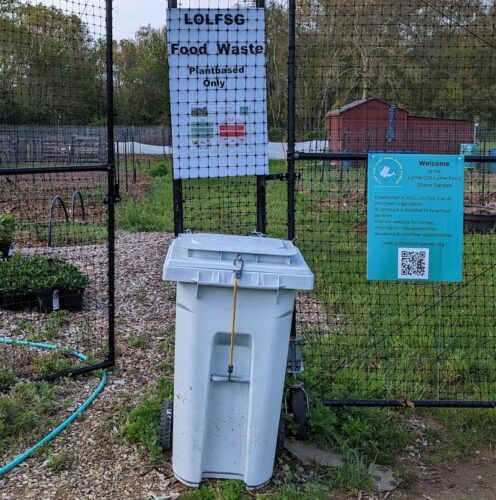
In an effort to expand food waste recycling, the LOLFSG has installed a food waste collection bin onsite. The container is located outside the main gate of the garden, which is situated behind the field house at Town Woods Park. Residents are encouraged to drop any plant-based food waste such as any part of fruits and vegetables, coffee grounds and stale bread. No meat or dairy products please!
The collection bin is one of two repurposed trash containers donated by the Town of Old Lyme.
The second is not yet being utilized for food waste recycling, but is available. If you are interested in spearheading food waste collection in your neighborhood, please contact Jim Ward at jimdub@gmail.com.
The LOLFSG has installed a food waste collection bin onsite at Town Woods Park. Residents are encouraged to drop off any plant-based food waste in it.