Chris Kitchings, owner of ‘The Bowerbird’ (right), is on hand as a Bowerbird staff member presents a check for $3,605.00 to Jim Ward (second from left), founder of the Lyme-Old Lyme Food Share Garden, Inc. The funds donated by ‘The Bowerbird’ were raised through the store’s gift-wrap program.
OLD LYME —The Bowerbird of Old Lyme has selected the recipient of the proceeds from their 2023 gift-wrap program as A Place Called Hope. This organization is a non-profit, volunteer organization with the goal of teaching the public how to protect and respect wildlife, in particular raptors. The Bowerbird donation program runs from Nov. 1, 2022 through Oct. 31, 2023.
The Bowerbird recently wrapped up their 2022 gift-wrapping campaign to raise funds Lyme-Old Lyme Food Share Garden, Inc.(LOLFSG.) A check in the amount of $3,605.00 representing 2,064 packages wrapped was presented to the LOLFSG’s founder Jim Ward. The Bowerbird charges a nominal fee for gift-wrapping purchases and donates 50 percent to local non-profit organizations.
The Bowerbird pioneered ‘cause’ marketing when they created their gift wrap donation program in 1992. In the past 28 years, The Bowerbird has donated over $104,000 to 33 statewide and local non- profits proving that small businesses can make a difference.
SOUTHINGTON — Douglas F. Woitowitz, 59, of Southington, passed away unexpectedly Thursday (May 11, 2023) at the Hospital of Central CT at Bradley Memorial in Southington …
Surviving is his longtime companion of 31 years, Debora (Bokanoski) Olsen; five sons … two brothers, Mark Woitowitz and his wife Sally of Old Lyme; and Christopher Woitowitz and his wife Sherry of Neosho, MO; 5 grandchildren …
Funeral services are Tuesday (May 16, 2023) 10 AM at Carlson Funeral Home, 45 Franklin Square, New Britain …
In lieu of flowers, donations may be made to Klingberg Family Centers, 370 Linwood Street, New Britain, CT 06052 …
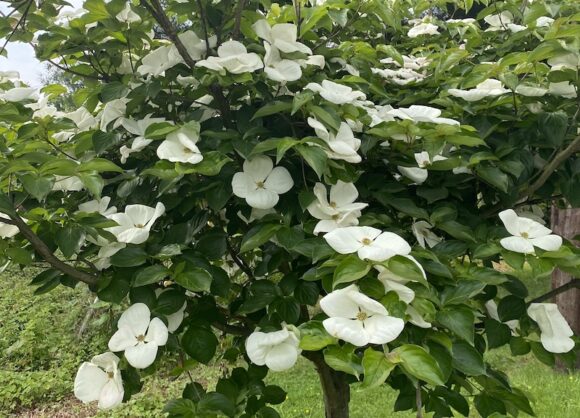
Dogwood is just one of the ‘darling buds of May,’ which comes into full bloom before the month is over.
“The darling buds of May” is such an apt phrase for one of the most enchanting months, which brings bloom on spring bulbs and flowering trees — the Amelanchier, the Dogwood and the Cherry to name a few — and new, awakening foliage on trees winking in the sun.
Maureen Haseley-Jones
By now, you have probably removed most of the winter debris, pruned broken branches and re-edged borders. However, do not apply the composted manure before the soil warms up to 60 degrees. The soil needs to reach that temperature for the soil organisms to work with the bacteria of the manure, which produces nutrients for the roots of the plants. I suggest, when shopping for garden supplies, pick up a soil thermometer to check soil temperature as I am sure the soil temperature will reach 60 degrees in a few weeks.
As I walk around my garden, I notice our old nemesis, weeds, emerging everywhere. Pull these up by hand, without breaking them together with the roots. If you use a tool, it breaks the weed and the broken weed pieces will take root and you will face hundreds more to get rid of soon. Follow on the weeding with an organic corn, gluten- based weed pre-emergent by Bradfield Organics; this product will keep weeds at bay for quite a few weeks.
Compost, Humus, Mulch, Manure & More
When the soil warms to 60 degrees, apply composted manure around daffodils and other spring bulbs so that soil organisms will produce nutrients to feed the bulbs for next year’s bloom. Also, a reminder to not cut down the daffodil foliage as the nutrition from the foliage is absorbed into the bulb for bloom next spring.
Humus brings carbon from the air into the soil.
Also in a few weeks when the soil has warmed up, apply composted manure and a light layer of fine bark mulch to all maintained areas of the garden, again in July and finally in October before putting the garden to bed. The manure and mulch begin to build the humus component.
Regarding types of mulch, only use the natural brown wood mulch — do not use the colored mulches, which contain chemicals, and do not use rubber mulch.
A word of caution on Cocoa Mulch. This product is highly toxic to dogs and cats. This product is manufactured by Hershey and sold in many large garden centers. It is made from the residue of chocolate products and other ingredients and contains a lethal ingredient that has resulted in the reported deaths of cats and dogs that are attracted by the chocolate odor. This mulch contains Theobromine, which is a Xanthine compound with effects similar to those of caffeine and theophylline. The symptoms, which the animals experience, are seizures and death within hours.
I wrote about the carbon component in my April tips but wanted to emphasize its importance by stating it again for you to build or continue to build the humus component in your soil .
All living things, including us, are all carbon-based creatures. Humus brings carbon from the air into the soil.
Humus acts like a sponge and holds 90 percent of its weight in water. Because of its negative charge, plant nutrients stick to humus bringing nitrogen, calcium, phosphorus and other important elements to the plant, preventing these nutrients from washing away, acting like nature’s slow-release fertilizer.
Humus improves soil structure making it loose and friable, which helps plants to root in this environment with better access to nutrients, water and oxygen. Humus also helps to filter toxic chemicals from soil, much like carbon-based water filtration systems filter toxins from your water.
I also recommend that you go online to read this article in Scientific American to check out the dangers of Round-Up. This is the most dangerous herbicide not only because of Glyphosate, which is on the list by the World Health Organization as a chelating agent that causes cancer but also because of its inert ingredients. I ask that you are not swayed by the word ‘inert’ as the ingredients are anything but inert and those ingredients combined with Glyphosate are deadly to human cells.
Flowering Trees& Plants
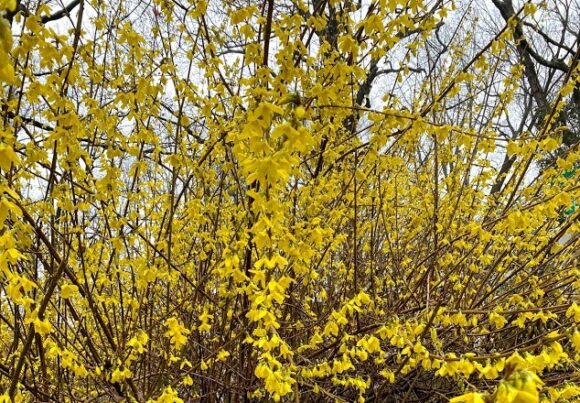
Forsythia is in bloom, lovely fresh yellow blossoms. If the bloom on your shrub is not as prolific now, as it was in previous years, prune out the old sparse wood after bloom ends.
Forsythia offers a yellow burst of color in May.
A favorite native tree of mine is the Amelanchier (common name is Shadblow Serviceberry so named for the Shad that run in the rivers at this time to swim upstream to spawn). This early spring blooming tree has creamy panicle blooms, followed by small green leaves and within weeks, red fruit, which is a delicious treat for our feathered friends. Before the birds eat all the fruit, you may want to pick some of the fruit which makes a delicious jelly for your morning toast.
Here in my town of Old Lyme, the magnolias, cherries and Eastern redbud are vying with one another to show off their finery together with the graceful Dogwoods. Following the recent rains, many of these trees are blooming at the same time or within a few weeks of one another. Their bloom will soon be over, then we can look forward to rhododendrons, azaleas and followed by mountain laurel in early June.
Another favorite of mine is the Carlesii viburnum (also known as Korean Spice) with pink buds, opening to white flowers and their delightful fragrance fills the air outside my kitchen door. This viburnum grows to about five feet and can be tucked into many a border particularly in an area where you often walk by to inhale the fragrance.
Covering the barn wall and scrambling up to the barn roof is my climbing hydrangea – bright green leaves emerging with hundreds of buds indicating that this beautiful climber will be laden with blossoms in summer.
Tulips, creeping phlox, forget-me-nots, primroses and candytuft are bringing much-needed color to borders and rock gardens.
If you have not had the opportunity yet, you can still prune your roses for another couple of weeks. Pull back the old mulch from around the base of the roses and in two to three weeks, apply manure about six inches from the trunk of the plant. Then a week later reapply a layer of the brown natural mulch on top of the composted manure.
As well as building the humus component, these layers keep the roots cool, keep weeds at bay and help retain moisture. Do not mulch right up against the base of any plants as this encourages rodents to nest and gnaw on the plants.
Beware of fungi that look like weird mushrooms in your mulch; this is called Artillery fungus, which can adhere to the walls of your home and cause problems. If you notice this fungus, you will need to remove all the mulch and get it off your property.
Apply a small amount of lime and about three inches of manure around lilacs — they like sweeter alkaline soil, indicating the use of the lime. By now, you may have already applied lime to the grass, which also enjoys sweeter soil and organic grub control, which eliminates the Japanese Beetle larvae and therefore lessens moles as this cuts off their food source.
Vegetable Gardens
A well-maintained 6 ft. x 24 ft. vegetable garden is documented as can feed a family of four for a year.
If you are making an organic vegetable garden this year; a garden measuring 16 ft. x 24 ft. can feed a family of four for a year; but keep the size within your needs and capability. Don’t work the soil if it is too wet or too dry.
Double digging is the best way to go, this takes time and effort but its well worth it – dig down about one foot and remove the topsoil, put the soil to one side, then dig down and loosen the next six inches of soil and add about three inches of composted manure then put back the topsoil and add another three to four inches of manure.
Do not rototill the vegetable garden, as this destroys soil structure. Gently loosening the top few inches of the soil to aerate it, makes it friable and results in an excellent yield of fruits and vegetables.
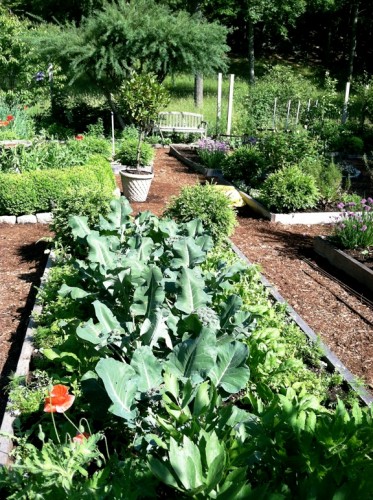
I prefer 6 ft. x 4 ft beds rather than rows; beds produce a larger yield of crops. In addition, beds make for ease of weeding and harvesting by having narrow compacted soil or grass paths (having removed lawn from the area) in-between the beds.
The vegetable garden should be situated on the south or southwest side of the property for maximum sun exposure.
Make sure you remove as many weeds as possible by hand, before you even begin digging.
You need a water source close by as vegetables require lots of water, particularly annual fruiting vegetables like tomatoes, which are hydroponic which means they consist of a large amount of water.
Rotate crops, by that I mean, do not plant the same vegetables in the same place as the previous year. Using this method helps to prevent any soil- born diseases occurring.
In the loosened soil, plant the vegetables plants so that they are touching, this forms a natural canopy, shading out weeds and helps retain moisture.
I prefer to mulch the vegetable garden with composted manure, the reason being that manure, as mulch, does not cap. Capping is when mulch forms a crust, which does not allow water or air to penetrate to the roots of the plants.
Fence in the vegetable garden with a tall fence to keep animals out. At the base of the fence install eight inches of fine mesh chicken wire above ground and eight inches below ground to keep out the digging and burrowing animals.
Organic Insect Control
Insects do not like fragrance so plant fragrant plants like marigolds, nasturtium, lavender, nepeta, honeysuckle and roses to name a few.
Encourage lacewings, which feed on aphids by planting marigolds and sunflowers,
Attract ground beetles by laying a log or a rock on the earth, under which the beetles can hide. These useful insects are nocturnal and eat slug and snail eggs, cabbage maggots, cutworms and even climb trees to feed on armyworms and tent caterpillars.
Mowing Tips
Following all the rain, your grass is hopefully a vibrant shade of green, therefore when mowing keep the blades of grass at about three inches tall; the taller blades attracts sunlight, promoting a healthier lawn. The taller blades also shade out weeds and help to retain moisture in the grass.
Is your lawn “a vibrant shade of green?”
When mowing, leave grass clippings on the lawn, the clippings are a natural source of nitrogen. If you have clover in the grass, clover is an added benefit as clover takes nitrogen from the air and fixes it in the soil, as an additional nutrient for plant growth.
After flowering is over, prune flowering shrubs by 25 percent – do this task immediately before new buds set for next year.
On a rainy day go shopping for any garden supplies that may be needed, then when the weather is dry, you can be outdoors doing what you love and not indoors shopping. Buy good hoses, cheap ones will bend and crack.
Peonies, Hydrangeas, Lilacs & More
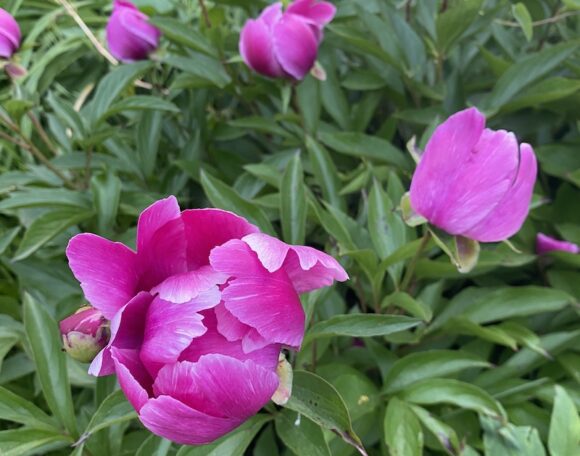
Peonies need plenty of water to produce flower buds. I had a 30 ft. long stand of Peonies in my field. The Peonies have been in the ground for over 50 years and are a sight to behold when in bloom. I gave them lots of loving care with a light dressing of aged manure in early May. In a few weeks, I pinch off the side buds while they are still small, leaving the terminal flower bud on each stalk, which develops into a large main bloom.
Peonies are a perennial favorite.
Hydrangeas are a wetland plant and require plenty of water during the season, with the addition of manure and mulch around the base. If you have blue Hydrangeas and want a deeper color of blue, also add some peat around the base of the plant, the acidity in the peat produces the bright blue color.
If you need to prune a Hydrangea, which has become too large, then prune it immediately after flowering, in EARLY SEPTEMBER, prune about 1/3 of the old wood and the weakest shoots. DO NOT WAIT, as Hydrangeas begin to develop bloom buds for next year later in September. If you wait to prune it is likely that you will not have bloom for next year.
The beloved Lily of the Valley is a delightful, sweet-scented flower,
My maternal grandmother’s favorite plant, the Lily of the Valley (pictured right in photo) will bloom in another couple of weeks. These lovely flowers are tucked on the small hill on the west side of my apartment, and I am so looking forward to gathering a few fragrant blooms to enjoy indoors.
When the lilacs have finished blooming, pinch off the withered flower clusters, and do the same on the mountain laurel and rhododendrons in late June to ensure good blossoms next year.
In mid-May apply composted manure, a light application of peat and fine bark mulch around all evergreens and rhododendrons, mountain laurel and azaleas; these plants are shallow- rooted and the mulch will keep the roots nourished, protected, warm and moist.
Some annual seeds that may be planted outside in mid May are: Calendula, Coreopsis, Marigold, Nasturtium, Nicotiana and Zinnia.
Frost – If you purchase annuals, on Mother’s Day weekend, place them in a sheltered spot on the south side of your home. Plant them no earlier than Memorial weekend as we can still get a late frost.
Tuberous-rooted begonias, caladiums, cannas and elephant ears can be moved from porch or cold frame to a part shade area as the weather becomes warmer and there is no sign of frost in the forecast.
If you staked trees, when they were planted last year, cut the stakes off at ground level, do not pull them out otherwise the roots of the trees could tear and be damaged.
Aphid tip: squish a few in your hand; dead aphids release a chemical that causes other aphids to drop off the plants.
Another ants and aphids tip – if you drink mint tea, any leftover tea sprinkle on the bugs, as they do not like the smell of mint.
A word of caution on mint – plant mint only in containers, mint is tremendously invasive and can take over your garden.
When planting annuals, perennials, vegetables, trees, shrubs or evergreens keep them watered.
Houseplants can be moved outdoors for their summer sojourn at the end of May. However, do not put your African violets outdoors as they will burn, move the violets to a porch that is covered and shaded, or keep them indoors in a window that does not receive direct rays from the sun.
Wait until the soil warms up at the end of May to set out Dahlia tubers.
Rosesare Red… and a Multitude of Other Colors
Roses are a constant delight in the garden. Photo by Lena Albers on Unsplash.
Roses are not the troublesome creatures you have been led to believe. I like to plant David Austin roses; these shrub roses are repeat bloomers with lovely fragrances.
Roses need at least four hours of sun per day, good air circulation, and excellent drainage. During their growing period from the beginning of June to mid August; add a little extra composted manure each month; it may be applied over the mulch. Stop adding the manure in August so that the roses can go into a slow dormancy.
Roses like the same growing conditions as Clematis and can be planted together in a ‘companion planting’, which means they grow well together, with feet in the shade and head in the sun. Before you top up the soil around the roses when planting, add water and check if the soil drains, roses need good drainage. Deep watering is recommended at least once a week.
Plenty of stuff to keep you hopping folks and remember to keep your eye out for any pest trouble and when you spot it get on the ball immediately to avoid further problems. Carefully discard all herbicides and pesticides; these poisons have the same effect on your health as second-hand smoke.
Your garden offers an anchor for peace and quiet enjoyment. Enjoy the warmth, the gentle breeze, the earth’s fragrance and bloom and please remember to breathe and stretch before any garden labor.
Enjoy and I will see you in your garden next month.
If you would like, my son Ian of LandscapesByIan would be happy to talk to you and answer gardening questions or you may request him to visit your home for a consultation. The apple does not fall far from the tree and, in my humble opinion, Ian is more talented and creative than I!
About the author: Maureen Haseley-Jones is a member of a family of renowned horticultural artisans, whose landscaping heritage dates back to the 17th century. She is one of the founders, together with her son Ian, of, The English Lady Landscape and Home Company. Maureen and Ian are landscape designers and garden experts, who believe that everyone deserves to live in an eco-conscious environment and enjoy the pleasure that it brings. Maureen learned her design skills from both her mother and grandmother, and honed her horticultural and construction skills while working in the family nursery and landscape business in the U.K. Her formal horticultural training was undertaken at the Royal Botanic Gardens at Kew in Surrey.
“We are simply a team that loves tennis for the fun it is and how it brought us all together” (Lauren Rahr, Old Lyme Girls’ Tennis Coach)
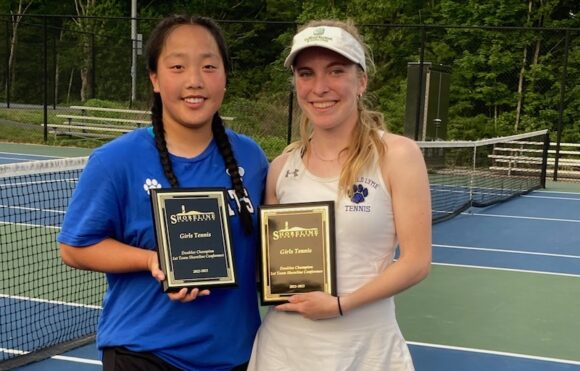
Alexis Fenton (left)and Livie Bass won the Shoreline Doubles Championship. All photos by A. Fenton.
CLINTON — At the start of the second day of the 2023 Shoreline Individual Tennis Tournament, there was an Old Lyme player in every semi-final match.
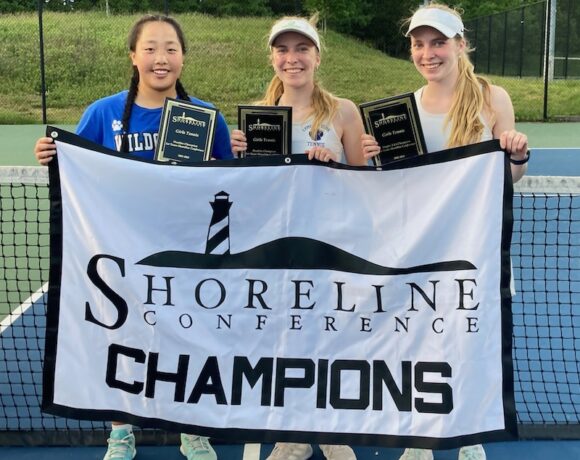
By the end of the day, Alexis Fenton and Livie Bass of Old Lyme were crowned Shoreline Doubles champions and Callie Bass, also of Old Lyme, was the 3/4 Singles Champion.
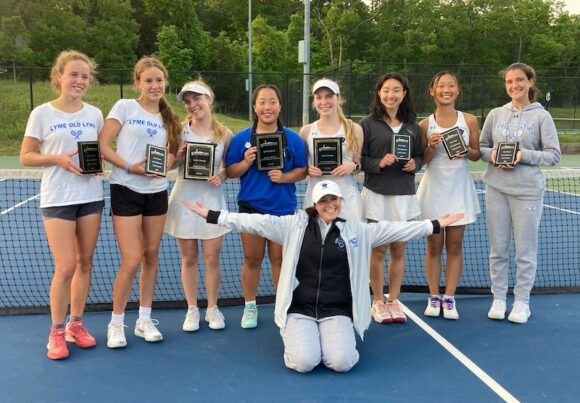
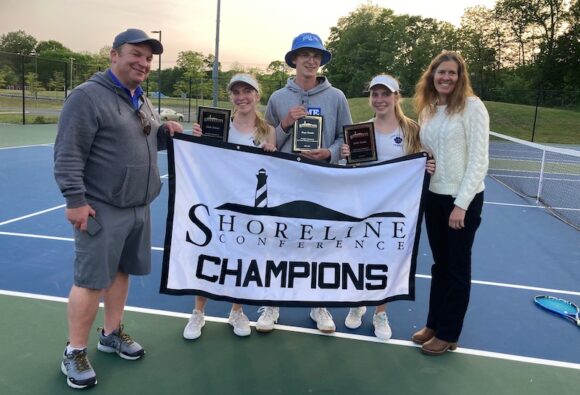
The team celebrates its Shoreline Championship victory with Varsity Coach Lauren Rahr at right and Junior Varsity Coach David Rahr at left.
Piper Remillard of Coginchaug defeated Sam Tan of Old Lyme 6-2, 6-0 to win the 1/2 Singles final — Tan was seeded #2.
Finalists – Aggie and Beatrice hunt 2 doubles vs #1 doubles , Livie bass alexis Fenton, Callie bass 3 winner, Sam tan #1 runner up , Katherine Zhang 4 vs #3 Callie , #2 elaina Morosky
There were two all-Old Lyme finals;– top-seed Callie Bass defeated Katherine Zhang in the 3/4 Singles final 6-3, 6-3, and #1 seeds Alexis Fenton and Livie Bass defeated #4 seeds Aggie Hunt and Beatrice Hunt 4-6, 6-1, 6-2.
From left to right, Elaina Morosky, Sam Tan , Beatrice Hunt , Katherine Zhang and Aggie Hunt
Other Old Lyme students, who qualified for the tournament, were Elaina Morosky, Katherine Zhang, Izzy Reynolds and Natalie Buckley. Elaina Morosky lost in the semi-finals to Piper Remillard 2-6, 2-6.
Asked how she felt about her team’s performance in this tournament, coach Lauren Rahr responded by email to LymeLine, saying, “As always, I am so proud of the girls. Each one of them stepped out on the court and gave it their all, focusing on one point at a time. They adjusted well to their opponents and played smart tennis.”
Coach Lauren Rahr (kneeling) displays her pride in her victorious team.
She continued, “Throughout the season, a lot of them had this goal of meeting in the finals of the tournament and we took steps each match and practice to get them prepared for the level of competition they would have to face during the tournament in order to achieve that goal. They rose to that challenge and embraced it every step of the way.”
In one of the all-Old Lyme finals, top-seed Callie Bass (right) defeated Katherine Zhang in the 3/4 Singles final.
Rahr concluded, “Walking around yesterday and watching each semifinal match filled with our team gave me goosebumps. We are simply a team that loves tennis for the fun it is and how it brought us all together.”
Peter (dad, left) and Michelle) (mom, right) Bass gathered with their children to celebrate the childrens’ Shoreline tennis successes. Livie won the 1/2 doubles with Alexis Fenton and her twin Callie took home the 3/4 singles honors. Meanwhile their brother Micah was a finalist in the boys 1 /2 doubles.
After the tournament, the following Old Lyme players were named to the All-Shoreline Conference first team: Callie Bass, Livie Bass, Aggie Hunt, Beatrice Hunt, Alexis Fenton, Elaina Morosky, Sam Tan and Katherine Zhang.
Izzy Reynolds and Natalie Buckley were awarded Honorable Mention.
James Driscoll Griffin Jan 31, 1926 – May 14, 2023
LYME — James Driscoll Griffin, aged 97, died peacefully around sunrise on Sunday, May 14th, 2023. He had been recovering at home on Grassy Hill Road in Lyme from a severe stroke a year earlier. He was surrounded by family.
Jim was the eldest of seven children, born in 1926 in West Lafayette, Indiana. The family soon moved to Evanston, outside of Chicago, where he attended Evanston High School. He joined the Navy in 1943, did officer training at the University of Notre Dame, and served in the Far East. Discharged in 1945, he returned to Notre Dame as part of the V12 program, completed his degrees, and won an NCAA tennis national championship along the way. After graduating, he continued as a part time member of the Navy Submarine division in Chicago.
He built a successful career in the international food business, and was a firm believer in the importance of good corporate citizenship, especially during the upheaval of the civil rights era. His work took him to many parts of the world where he established what would become lifelong friendships.
Soon after marrying Jane Bingham, New York City became home, and they raised four children in the public schools of Manhattan and Apartment 2M– an address memorized by scores of traveling friends and family across the years. In the late 1960s, through a serendipitous friendship with Francis Rosseau of Lyme, Grassy Hill Road offered Jim and Jane a verdant alternative for the next half-century.
Jim’s Catholic faith was always a source of strength. He worshiped at Saint Vincent Ferrer in Manhattan and at Christ the King church in Old Lyme, and made many friends among his fellow congregants, and the community of priests and sisters. He believed in the important but unfulfilled role of the laity in governance of the church and was particularly committed to increasing and improving the role of women in the church. He served on the board of Union Theological Seminary where he was one of its first Catholic directors, and he was an early and active member of Voices of the Faithful, a global effort to bring the church into the 21st century.
The world of the arts, and especially choral and sacred music, was his passion, and he served on the board of Musica Sacra, one of New York’s premier choral ensembles. He was a jazz aficionado, and it gave him great pleasure when Notre Dame, at his suggestion, conferred its highest honor, the Laetare Medal, to the legendary pianist Dave Brubeck in 2006.
Jim simultaneously eschewed and marveled at cell phones and I-Pads and modern gadgetry. In the end, he was a people person, and always preferred the landline, the mailman, and newsprint. Jim was a tireless optimist who believed deeply in our capacity for Good. His wife and four children, his daughters-in-law, his grandchildren and his siblings and extended family were integral parts of his daily thoughts and actions.
He illuminated the room, and will be missed by many. A memorial gathering will be held at the Grassy Hill Congregational Church on June 24th at 11 a.m. All are welcome. (In lieu of flowers, contributions will be gratefully received by Jim’s favorite choral ensemble, Voices of Ascension.)