Letter From Paris: A New Spire – and Rooster – Set to Rise Above Notre Dame Cathedral

Nicole Prévost Logan

The spire and the rooster of Notre Dame will soon be back in the sky of Paris. 

The 2019 fire destroyed Notre-Dame’s wooden roof and spire but left the outer structure largely intact. This photo was taken on April 15, 2019 from the Quai de Montebello by Wandrille de Préville.This file is licensed under the Creative Commons Attribution-Share Alike 4.0 International license.

On April 15, 2019, the world watched in horror as the spire of Notre Dame was consumed by flames and finally crumbled down. It left a gaping hole in the cathedral at the center of its vault. 

Four years later, the installation of a tabouret — (literally, a stool) — which, in this case, is a huge wood contraption intended to serve as the base of the new flèche  (or spire), marked the beginning of a crucial stage in the restoration of the church. 

The first flèche (spire) was erected in 1220-30 and removed at the end of the18th century. In 1859, architect Eugène-Emmanuel Viollet-le-Duc , carried by the revival of medieval art inspired by Romanticism and the publication in 1831 of “Notre Dame de Paris” by Victor Hugo , brought the dilapidated cathedral back to life and rendered it more medieval than before with new features like chimeras and gargoyles. His main creation was the flèche.

By the spring of 2018, the spire was in a state of disrepair. The 12-ft.-tall copper statues of 12 apostles and four evangelists, including a St. Thomas, which was the architect’s self portrait, were lifted by cranes creating something like a ballet in the sky. Scaffolding was put in place at the base of the spire to start the future restoration. It is believed that it was the exact place where the fire originated in April 2019 and spread to the wood frame or forêt under the roofs.   

After heated debates between the world’s architects, engineers and art historians, it was decided to reconstruct the spire identical to its original appearance , including Viollet-le- Duc’s own vision of medieval art.  

After all these years spent stabilizing the structure, putting robots to work to remove debris and toxic lead dust, recreating the stone sculptures, which had exploded under intense heat; reviving the brilliant colors of the stained glass windows; cleaning up the 15th century organ; and stripping walls, columns and 16th century paintings from the dark, slimy layer of dirt accumulated by tens of millions of visitors tramping through the building for centuries, five-star General Jean Louis Georgelin — appointed to oversee the restoration project by the French government — was able to announce, “Now, for the first time, we are starting to rebuild.”

Reconstruction is well underway in 2023 at the Cathedral of Notre Dame. Photo by Sylvia Logan.

TF1, one of the main French TV channels, aired a series of fascinating videos over several days during the week of April 14. Senior international reporter and historian Michel Izard took the viewers through the step by step restoration process of the new flèche, which will soar again into the sky by the end of 2023.

At 40 meters (131 ft.) from the ground, the installation of the tabouret at the intersection of the transept and nave is an impressive piece of work, weighing 80 tons and measuring 15 by 13 meters (49 x 43 ft.) The two beams of solid oak 10 meters long (33 ft.) are placed in the form of a  cross. At the center a poinçon (a tool used to make holes ) will act as the spinal cord of the structure.. 

The installation of the spire was preceded by months of intense work in workshops outside Paris. For this operation, the best know-how and the best trees were required. France is lucky to have both. One thousand trees were selected in the oak forests of Lorraine. Those trees were out of the ordinary for the length of their trunks uninterrupted by branches.

After being felled, the 250-year-old trees had to be “squared” by hand, using an axe. It is a skill transmitted through generations. The few lumberjacks, who still know how to do this type of work are usually foreign. They live in the forest. The video showed a lumberjack from Croatia squaring the trunks in 1985. The Association of Carpenters Without Borders helps preserve the ancient wood-working methods.  

The trees are worked while still green and soft, then dried for a period of one and half years. For the carpenters, working the wood while still alive, is a challenge. Working manually allows them to respect the grain of the wood and know each knot. 

The logs of unusual length of 20 meters (or 60 ft.) had to be processed in special sawmills since very few mills are equipped to accommodate such operations.  

A trial run of assembling the 110 pieces of the tabouret was carried out while they were lying flat on the ground, then that piece was dismantled to be lifted and put together again on top of the transept, at 30 meters (99 ft.) from ground level. This huge object was to be put in place with the precision of a Swiss watch-maker and fitted with specific measurements calculated in millimeters. As previously mentioned, the wood was still “alive” and allowances had to be made on occasion for a few millimeters resistance, since the wood — not being totally dry — could contract   

Around 30 carpenters were selected from among the best in the world. They seemed enthusiastic and proud to work on Notre Dame. “We are going to go much higher,” one of them said with much excitement. Many of them are Compagnons du Devoir et du Tour de France, an élite school of craftsmen, who are taught methods used by generations of artisans going back to the Middle Ages.

The prestige of this school is comparable to the élite Grandes Ecoles. The school used to function in 49 countries but today, it is particularly active in France. The Compagnons learn a trade under a master as apprentices. They share their knowledge by traveling throughout France and live in hostels. In the Middle Ages, they helped build castles and churches. UNESCO wrote their charter.

This view of Notre Dame Cathedral before the devastating fire clearly shows the spire, which was destroyed in the fire and is now being reconstructed. Photo by Robin Garnier on Unsplash.

Carpenters from four different companies from several countries are taking part in the spire’s reconstruction. The video showed carpenters from The Netherlands and England. Hank Silver and Miles Jenners, respectively from Vermont and Massachusetts, were beaming during an interview. They emanated pride for having being selected. They gave up their jobs to come to Paris. Today 1,000 people are working on the Notre Dame site, half of them inside the cathedral.  

Women were also present on the flèche worksite. They variously draw épures  (working draughts), are architects or site supervisors. Women were not accepted in the Compagnons du Devoir until 2005. 

Like their 13th century medieval ancestors,  the carpenters find the pencil and plumb-line their most dependable tools. But they also use oversized tools fabricated especially for this work. They need to use circular saws, mortaiseuses, to create notches, and laser beam to ensure the lines are straight.

Under the tabouret described above, a temporary floor was installed at 26 meters (85 ft.) from ground level. 

It is at 31 meters (102 ft.) under the tabouret, that we find the complex vaulting system, which makes the gothic architecture so unique. The vault arches and rib vaulting rest on four pillars and on pieds de gerbe (sheaf foot) placed on top of each pillar that will support the whole weight of the spire structure.

The skilled grutier (crane driver) does a perilous job when he lifts and carries each stone of the ronde de pierre which supports the vault. The arches meet at the center at the clé de voûte or keystone. A medallion representing the Virgin Mary will again be painted with an azure background dotted with gold stars. 

Similar to the wood cintres (half hangers), which had been custom-made to reinforce the flying buttresses in the early stage of the Notre Dame restoration, four large, custom-made pieces of wood or cintres each weighing one and a half tons were laid at the bottom of the hole left by the collapse of the spire in 2019 in order to reinforce the vaulting arches, which had also collapsed.  

The 320-tons flèche, carved out of solid oak , will soar again into the sky at a height of 96 meters (315 ft.) The intricate framework will be pulled upward by giant beams.  

The Cathedral of Notre Dame de Paris prior to the fire. This file is licensed under the Creative Commons Attribution-Share Alike 2.0 Generic license.

The viewer of the video is invited to start his or her virtual ascent of the flèche. At 60 meters (197 ft.) one reaches an openwork balcony decorated with floral motives. From there, the view over Paris is breathtaking.

As one continues the virtual ascent, at 89 meters (292 ft.), one reaches a tiny platform big enough to stand with two feet … and free of vertigo. 

The original rooster from the Notre Dame Cathedral s now exhibited at the Cité of Architecture and Patrimoine.
Photo by Nicole Prévost Logan. 

A copper rooster will again be perched on top of a rod and pivot in the wind. This will only be a replica. In 2021, a photo showed chief architect Philippe Villeneuve cradling the damaged rooster rescued from the debris. The original bird is now safe and permanently on display at the Cité de l’Architecture et du Patrimoine, Place du Tocadéro. In 1935, relics of the Holy Cross were placed inside the rooster, as well as relics of St Denis and Ste. Geneviève, patrons of Paris. 

The wood framework of the new spire will be protected from rain by 140 tons of lead. On the video, the workers are shown doing what seems like a very dangerous process when, in a bucket, they mix the lead, which has been melted to a temperature of 320 degrees.

None of the construction of the spire will be shown to the public until completion. Like a rocket about to take off to the moon, the structure will be hidden behind scaffolding.   

The flèche will be completed at the end of 2023.  During that time, work will continue around the cathedral. Light will again pour into the apse choir as the tall windows are reinstalled. The tarp covering the whole structure, like a giant umbrella, will be removed. There will be a last chance to have a close look on the newly-refreshed colors of the rose windows before the scaffolding is dismantled.  

The stone work will return to its original, blonde color. For the first time, one will be able to see a Notre Dame not seen since eight centuries ago.  

The fire at Notre Dame provoked a new awareness of the danger of fires and drastic measures are being taken in 90 French churches to prevent from the danger of fire such as coupe-feu or firewalls, treating charpente or framework under the roofs with fire-resistant products and amplifying the alarm system.  

On April 16, French president Emmanuel Macron climbed up to the tabouret with his wife Brigitte. Two days later, on TV,  he reiterated the  promise made just one day after the fire that the cathedral would be whole again in 2024 .

By comparison, Notre Dame is 96 meters high (315 ft.), much smaller than Cologne cathedral with its 157 meters (515 ft.) spire. The latter’s construction ceased in 1473 and was not finished until 1880. Therefore it remained incomplete during medieval times.

Before the fire, Notre Dame received between 30,000 and 45,000 visitors per day or about 13 million a year – numbers comparable to the Louvre’s. This museum is thinking of capping the numbers of visitors at 30,000 a day.

Food for thought — perhaps it might be a good idea to apply the same rule to the cathedral both to preserve its pristine beauty and also remind the visitors that it is first and foremost a place of prayer and worship.

tor’s Note: This is the opinion of Nicole Prévost Logan.

Nicole Prévost Logan

About the author: Nicole Prévost Logan divides her time between Essex and Paris, spending summers in the former and winters in the latter. She writes an occasional column for us from her Paris home where her topics will include politics, economy, social unrest — mostly in France — but also in other European countries. She also covers a variety of art exhibits and the performing arts in Europe. Logan is the author of ‘Forever on the Road: A Franco-American Family’s Thirty Years in the Foreign Service,’ an autobiography of her life as the wife of an overseas diplomat, who lived in 10 foreign countries on three continents. Her experiences during her foreign service life included being in Lebanon when civil war erupted, excavating a medieval city in Moscow and spending a week under house arrest in Guinea.

A View From My Porch: Finding Fenway — A Feline Interest Story 

Tom Gotowka

Nearly a year ago, Christina and I announced in LymeLine that we were “on the lookout for two adoptable kittens; we hope to find a pair of orange tabby sisters.” Our plan was to name them Fenway and Wrigley.

We had lost Finn, our pet of more than 15 years, as a result of an inoperable and inexplicable carcinoma of the lung, which appeared on a radiograph at an emergency visit. 

Finn was a rescue, and had spent her early months in our daughter’s NYU freshman dormitory; remaining there until expulsion appeared inevitable (i.e., the kitten’s, not the daughter’s). Devan, the freshman, was visited by her older sister, Erin, who convinced her to relocate the kitten to Old Lyme, where she remained with us. 

Those who have also had long-term pets know just how soon they become important members of the household; and how long they are mourned, when lost. 

We never really anticipated what would then lay before us as we set out on our search for kittens. 

We began our quest near the beginning of this year with the municipal animal shelters in southeast Connecticut, and then eventually, with both Finn’s and another veterinary practice, who suggested that we wait until early-summer, when kittens are often more plentiful. 

Although we were persistent with the municipal shelters and on waiting lists at several, we were unsuccessful and decided to investigate the private animal rescue shelters in the same area, where there are several. 

We learned that these shelters tend to be non-profit and/or charitable organizations that are highly reliant on volunteers, although some had a few paid staff. They are “no-kill”, and so, do not terminate healthy or treatable animals, limiting euthanasia for incurably ill animals or those who could pose a danger to public safety. 

Fenway is found, but the Gotowkas are still looking for Wrigley. This image is not Fenway but rather a file photo of another kitty by Michael Sum on Unsplash!

Adoptions at these shelters may require payment of a nominal fee (e.g., $200 to $250 per kitten) to cover expenses for veterinary services incurred by the organization while the animal was in residence. These can include a health examination, neutering, various vaccinations, and treatments for problems like fleas, ticks, ear mites. 

We felt confident that our history and experience with pets, relationships with veterinarians, and sensible and stable lifestyle would make us very suitable candidates for adopting rescued kittens. 

In addition, the “PBS News Hour” reported in February that, “Rescue shelters are feeling the pressure of too many potential pets and not enough people adopting them. Many shelters are at capacity and understaffed; pets adopted during the pandemic were returned, and inflation had made owning and caring for a pet more expensive, leaving some owners struggling to afford rising costs.” While this may have been the situation in many parts of the country, it was apparently not so for kittens in this area, as we were to experience.

The first shelter we explored had stated that their mission was, “To stop the proliferation of homeless cats living hard lives and struggling to find food and shelter on the streets of our local communities.” Their application process seemed daunting, and included the disclaimers that the organization, “Reserves the right to deny an adoption request for any, or no reason, and may choose not to reveal specific reasons;” and that they “Promote age-appropriate adoptions.”

I did some further research on this shelter, and found several unhappy reviews that cited age as a factor. A few examples follow: 

  • “To adopt a kitten from this shelter you must be no older than 60.”
  • “We were told that at 60 and 65, we were too old to adopt any of their cats that aren’t two years of age.” 
  • “When we visited, we witnessed them declining another couple because they were “too old to adopt a young cat.”
  •  (In contrast): “During this process, we walked into a section with a volunteer, June, who immediately exclaimed, “We do not let anyone under the age of 25 adopt!”

Christina and I were shocked and surprised that this organization apparently had such discriminatory age restrictions in place. We were both already “of a certain age”, and so we were discouraged and decided to regroup before exploring other similar shelters.

Frankly, these practices “fly in the face” of conventional wisdom, which is supported by several scientific studies, that pets are important for the health of older adults, especially for those who are single, living alone, and a little isolated. Pets offer socialization and companionship to lonely seniors; and provide a strong sense of purpose that may reduce stress and assist them maintain a regular routine. However, as I describe below, our explorations unexpectedly came to an end.

Celestial Interference?

We were returning home from Chester on a nice February Saturday. On the spur of the moment, we pulled into a local market in Deep River. While I wandered a few aisles on the hunt for dinner ideas, Christina checked out the bakery and bulletin board. Nothing appealed in the bakery, but there was a listing that stated, “Looking for a good home for our cat.” We called on Sunday and learning that we were not the first respondents, arranged a visit on Tuesday.  

This retired couple was moving from Connecticut to care for the wife’s elderly brother in Florida. The brother’s circumstances did not allow them to bring their pet. Faye was not a kitten, but very young; perhaps a toddler, if it was human. Faye was a long-hair with remarkable coloring — pure white with a black saddle, crown, and tail. They said she was a rescue from a litter that was abandoned in a box behind their apartment complex. 

The couple was childless and doted on Faye. They shared her veterinary records with us, which were very complete, and arranged a site visit in Old Lyme; where we passed muster. They delivered Faye about a week later. The cat’s parting from her former owners was smooth, if not a little emotional for them. 

After several weeks transition in her new digs, she now answers to Fenway. She is a nice, playful pet; has very expressive ears, and communicates well when dinner is late. There is a very active fox population in our neighborhood, so Fenway will be exclusively indoors. We are discussing whether we will resume our search for Wrigley.  Cats are social animals and tend to be happier in pairs. 

In closing, Christina is a retired professor of Human Development and Ageing and corroborates the value of pets for older adults, which I touched on above.

Sources:

Cirrillo, Anthony. “The value of pet ownership for older adults” US News and World Report. 10/16/2019
Moeller, Philip. “10 reasons older people need Pets” US News and World Report. 01/07/2010
Norris, Courtney. “Animal shelters struggle as many pets adopted during pandemic are returned” PBS News Hour (transcript). 02/20/2023
Cleveland Clinic. “The Health Benefits of Pets” Health Essentials Newsletter. 02/09/2023

About the author: Tom Gotowka is a resident of Old Lyme, whose entire adult career has been in healthcare. He will sit on the Navy side at the Army/Navy football game. He always sit on the crimson side at any Harvard/Yale contest. He enjoys reading historic speeches and considers himself a scholar of the period from FDR through JFK. A child of AM Radio, he probably knows the lyrics of every rock and roll or folk song published since 1960. He hopes these experiences give readers a sense of what he believes “qualify” him to write this column.

Seeking Critical Support for Afghan Family Living in Old Lyme: Statement From LOL Refugee & Resettlement Committee

Editor’s Note: We are pleased to support the efforts of the Lyme-Old Lyme Refugee and Resettlement  Committee (LOLRRC) by publishing this statement from the LOLRRC seeking critical support in different ways for an Afghan family living in Old Lyme.The family need help in order to be able to stay in our wonderful community.

OLD LYME — If you have been watching the news during the past few weeks, you  may have seen that the Washington blame game over the chaotic US  withdrawal from Afghanistan is grabbing headlines once again. After  more than four decades of conflict and instability in Afghanistan, some Afghan families were able to escape the horrible persecution of the Taliban by escaping to other countries.

One such family is now living in  Old Lyme supported by the Lyme-Old Lyme Refugee and Resettlement  Committee (LOLRRC), an active community organization. The family counts themselves  to be very lucky to have been airlifted out of Afghanistan in August 2021 and transported to the United States.

The father had been working for the US Military and therefore been targeted. This young family of  seven was resettled in Old Lyme through Integrated Refugee and Immigrant Services (IRIS) in New Haven.  

Posting photos of this wonderful family cannot happen right now because they want to stay somewhat private for obvious reasons. The young  parents, four school-age children, and a baby girl have worked very hard to  adjust to life in our country. Being in the friendly and peaceful community  of Old Lyme has been a true blessing for them.

Our committee, the Lyme-Old Lyme Refugee and Resettlement Committee, has been supporting them  tirelessly as they all move toward adjusting and being able to live  independently. They faced unbelievable challenges in Afghanistan and so  appreciate now living in Old Lyme.

The children are thriving in school and learning to speak English. They even help to translate for their parents at  times.

The Lyme-Old Lyme Schools have been largely instrumental in helping these children settle into their new lives here. This is one of the many reasons these parents want to stay in Old Lyme for their children’s  sake. They have also seen up close what it means when women are  deprived of getting an education. 

The father, Hayat Popal is now driving for delivery services to make ends meet; he likes to cook and will be getting a full-time job at a new local  restaurant in the very near future. The mother, Bibi Popal takes in sewing  and stays at home with their baby girl, who was born at a U.S. military base shortly after the family’s arrival in the states.

Now the family faces another daunting move because it is time for them to  find permanent housing.The cost of a rental home that can house their family of seven in our area is beyond the family’s financial reach for now. 

This is why the LOLRRC is hoping for donations to help subsidize the family’s housing costs in the near term.

It would be even more special if they could find a rental property owned by someone that might give a discount so that this wonderful family, The Popals, can stay in our community.

All donations are tax-deductible and can be made online or by check.  Please make a note that your donation is earmarked for the Housing  Fund. 

To make a donation online, visit this link, then select ‘Refugee Resettlement’ on the drop-down menu under ‘Fund.’

To donate by mail, make your check payable to First Congregational  Church of Old Lyme with Refugee Resettlement Committee in the memo  line. Mail the check to P.O. Box 172 Old Lyme Ct. 06371

On behalf of the LOLRRC and the Popal family, thank you in advance for your generosity.

Death Announced of Jil Nelson, Former Board Member of Lyme Land Trust

Jil Nelson passed away at age 70 on Tuesday, March 28, 2023 …

Many will remember her as an early adopter and regular contributor on social media, where she applied her passion for politics and her visual and linguistic creativity …

Jil was born on February 17, 1953 in New Haven to Joan and Stanley Nelson …

She … later moved to Chester after marrying Howard Kaplan … She … continued to support land conservation when she moved to Lyme and joined the Lyme Land Trust’s Board of Directors. Throughout the years, she has been a supporter of the Lyme Academy of Fine Arts, the Democratic Party, the Florence Griswold Museum …

She will be deeply missed and celebrated by her daughter Xander, son-in-law Matt, granddaughter Una, …

Memorial contributions may be made in Jil’s name to The Lyme Land Trust, Everytown for Gun Safety and Connecticut Public Radio ..

Visit this link to read the full obituary published by Hartford Courant on Apr. 23, 2023.

Old Lyme Girls’ Varsity Tennis Team Celebrates 50 Successive Wins!

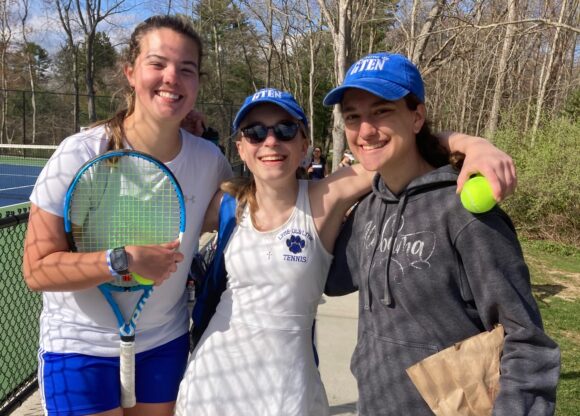
On Thursday, after their 7-0 victory over Portland, the Lyme-Old Lyme High School Girls Varsity Tennis Team celebrated 50 consecutive wins with cupcakes. All photos by Andrea Fenton.

OLD LYME — The Old Lyme Girls’ Varsity Tennis team celebrated their 50th consecutive win yesterday with a 7-0 victory over Portland … and cupcakes!

The results were as follows:

1st Singles:
Sam Tan vs Morganne Diheda 6-0, 6-0

2nd Singles:
Elaina Morosky vs Maddy Varano 6-0, 6-0

3rd Singles:
Callie Bass vs Cassidy Maruschock 6-0, 6-0

4th Singles:
Katherine Zhang vs forfeit OL Win on Forfeit

The #3 doubles pair of Izzy Reynolds and Natalie Buckley stand with #2 singles player Elaina Morosky. All three girls won their games against Morgan.

1st Doubles:
Livie Bass / Alexis Fenton 6-0, 6-1
Isabelle McClelland / Amella Hair

2nd Doubles:
Aggie Hunt/ Beatrice Hunt 6-0, 6-0
Emella Eckert / Logan Kenoe

3rd Doubles:
Izzy Reynolds/Natalie Buckley OL Win on Forfeit

After their game against Morgan, Aggie and Beatrice Hunt stand with JV coach Mr. Rahr to celebrate their #2 doubles win.

On Wednesday, April 19, the girls defeated Morgan, also 7-0.