Gardening Tips by ‘The English Lady’ for April, the ‘Month of Activity’

Those April showers that come our way
They bring the flowers that bloom in May.
And when it’s raining, let’s not forget,
It isn’t raining rain at all, it’s raining violets.

Al Jolsen

Maureen Haseley-Jones

April is the month of activity in the garden, and our old nemesis, weeds are beginning to rear their heads, so we need to extract the little devils before they take hold and are difficult to remove.  

Having said that, I must point out the benefits of many weeds. Nettles are food for butterflies, clover extracts nitrogen from the air and fixes it in the soil, and oil from jewel weed soothes poison ivy rash. The young foliage of Dandelions is great in salads, it is healthy and contains many nutrients and when the foliage is cooked, it tastes like spinach. I also do not want to forget our songbirds and other wildlife, who depend on weed seeds as a food source. 

Weeds must be pulled gently so the weed and roots do not break apart for if this happens thousands of weed seeds will reseed and you will find yourself with an endless cycle of unnecessary weeding. When careful weeding has been accomplished, apply an organic weed pre-emergent, with a corn gluten base by Bradfield Organics; this natural product will keep weeds at bay for about six weeks. 
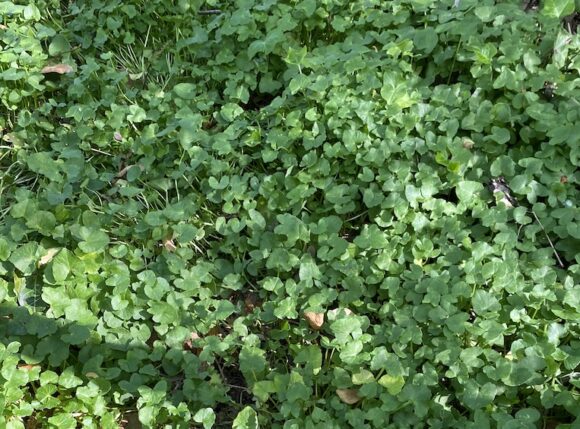
Surprisingly, weeds, like the clover in the photo above, can have many benefits.

Plant bare root roses at the end of April and plant container roses in mid- May.  In the middle of May when the soil temperature has reached 55 degrees, add manure and on top of manure, add a fine bark mulch about one foot from the base of the roses. Check my March tips to remind yourself on pruning roses. 

Be careful clearing winter debris from around rhododendrons, mountain laurel and azaleas; these evergreens have shallow roots and do not grow well when the roots are exposed. If the winter weather did erode soil around some roots, add some soil to cover the exposed roots, at the same time resettle the plant in place, then in the middle of May apply manure and fine bark mulch as well as some peat, which adds much needed acidity for evergreens.

Plant Gladioli corms at two-week intervals in late April. Planting in two-week intervals ensure you will get a succession of bloom. Plant the corms eight inches below the surface; this extra depth helps to keep the heavy blooms erect.

The Red Lily Beetle will soon begin to appear, so I suggest applying organic Neem oil on the Lilies when they are about four inches above ground, which helps prevent and deal with this beetle problem.

Soil Solarization is an effective way to control many soil-borne problems, specifically the tomato blight that causes fruit rot. Covering the soil with clear plastic at the end of April for one to two months can generate high enough temperatures in the top six to 12 inches of soil to kill pests, nematodes, weed seeds and many disease organisms like the tomato blight. This process has proved invaluable for home gardeners and the beneficial effects last for several seasons.  

To solarize, dig a trench several inches deep around the bed, and spread a thin, clear plastic film (1-4mils) over the bed.  Press the plastic into close contact with the soil and seal the edges by filling the trench with soil.  Leave the plastic on the soil until you are ready to plant tomatoes or other vegetables in about six weeks.  

When the soil temperature reaches 55 degrees, manure all the borders with composted manure in bags from the garden center or aged manure from the bottom of the farmer’s pile, then mulch with a fine, brown, hardwood mulch. 
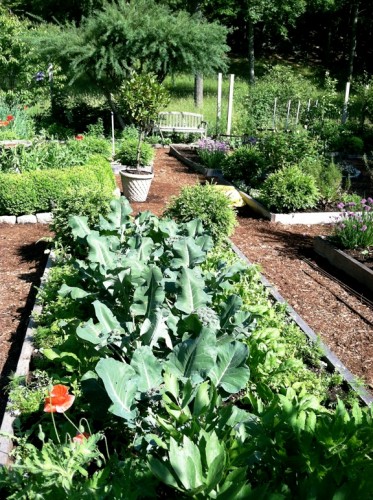
Follow Maureen’s tips as to what to do now to achieve a vegetable garden like this come the summer.

In the vegetable garden after preparation and planting, then it is time to mulch. Mulch with the composted manure, which will not ‘cap’ — this means that it does not form a crust like other mulches so that air and water can get through to the roots of the plants where it is needed.      

If you did not apply an organic grub control on the grass in March, apply now to keep the grubs down, which will cut down on the mole population.    

The soil is the most important component of the growing business; compost, organic manure and peat alter the soil to rebuild its structure. The ratio to use is one part compost to three parts manure and apply peat to the planting mix in the ratio of one part peat to three parts manure when planting evergreens. And as mentioned above, peat adds the acidity, which evergreens need.

Good soil structure assists with drainage and prevents compaction. Meanwhile, the rich nutrients, which are the result of these changes, break down and encourage the soil animals beneath the surface to work at full capacity. In a light soil such as sand, humus — which is the combination of manure, mulch and carbon from the atmosphere — binds the sand particles together and in heavy soil, such as clay, it keeps the clay particles separate to make room for air and drainage.  

Growing conditions in April are very favorable for new plant-root development and it is the ideal time to transplant evergreen shrubs and new evergreens. Apply composted manure and peat together with the topsoil in the planting hole. Then give the roots a workout with your hands before planting which releases. Opening up the roots in this way enables the roots to reach into the surrounding soil for nutrients and water and not dry out in the heat of summer.    

Many years ago, when I moved into my farmhouse on the shoreline, I discovered that my soil was sandy, which is good for drainage but sadly lacking in nutrients. I began adding a few inches of manure to all planted borders in April, July and October. The result today is when I put a spade in the ground to check the color of the soil in spring, it is, ‘black gold’.  

Gloves should be worn when handling manure, which contains bacteria; the bacteria is great for the plants and the soil but not good for your health. These natural soil amendments tend to be slow acting; gradually making the nutrients available to the plants and the rewards are infinite. Composted manure is applied in spring around mid May when the soil temperature has reached 55 degrees and when the plant shows about six inches of growth. This method allows for the nutrients and soil animals to become active at the time when plant growth is occurring at a rapid pace. 

Daffodils are blooming; what a lovely sight to see! Photo by Sarah Mitchell-Baker on Unsplash.

When the Daffodil bloom has past, do not cut the leaves from Daffodils or any of your spring flowering bulbs, the leaves send down energy into the bulbs to store for next season’s bloom. 

April is the time to tackle a new lawn or patch seed, use only good quality seed and organic fertilizers.   

Do not be lulled into complacency with a few back-to-back warm days; we can still get frost, so I caution that you not to plant annuals until Memorial weekend.  Do not cultivate around the perennials in the borders until mid-May. Do not panic if you were not able to get the April tasks done until May, your garden will wait for you and the constancy that is Mother Nature will continue to keep your patch of earth flourishing. 

Enjoy the pleasure of being outdoors in warmer temperatures, inhaling the pungency of awakening soil and your connection with Mother Nature. Do not overdo it; warm up the body before the garden labor and stay well hydrated with lots of water. We are inexorably entwined with the earth and know that even the smallest gesture of a garden has positive rewards; the effects are not only on you but on our planet. 

I will return with more gardening tips in May when you will be out in the garden in full force.

About the author: Maureen Haseley-Jones is a member of a family of renowned horticultural artisans, whose landscaping heritage dates back to the 17th century. She is one of the founders, together with her son Ian, of, The English Lady Landscape and Home Company. Maureen and Ian are landscape designers and garden experts, who believe that everyone deserves to live in an eco-conscious environment and enjoy the pleasure that it brings. Maureen learned her design skills from both her mother and grandmother, and honed her horticultural and construction skills while working in the family nursery and landscape business in the U.K. Her formal horticultural training was undertaken at the Royal Botanic Gardens at Kew in Surrey. 
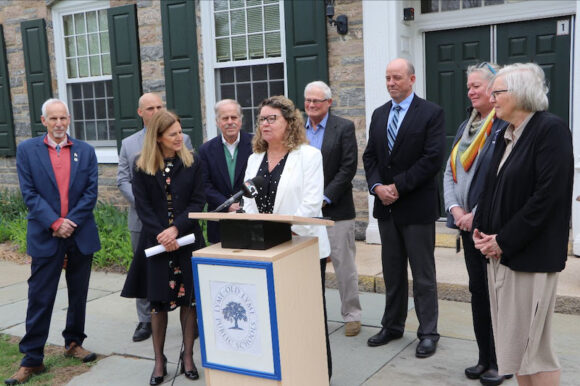
State Senators Join Lt. Gov. Bysiewicz in Old Lyme to Celebrate Receipt of Over $12 Million in Grants to Improve School Air Quality

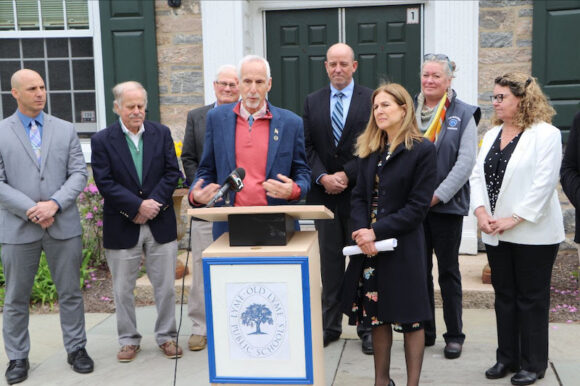
State Senator Martha Marx speaks during the press conference held Tuesday in front of Center School in Old Lyme to celebrate release of over $12 million in grants from the state of Connecticut to support improved air quality. Standing alongside Sen. Marx is Lt. Gov. Susan Bysiewicz. Also in attendance are, from left to right, State Sen Norm Needleman, LOL Middle School Principal Mark Ambruso, Old Lyme First Selectman Timothy Griswold, Lyme First Selectman David Lahm, Region 18 Schools Superintendent Ian Neviaser, Lyme School teacher (and sister of Martha Marx) Mary Dargie, and Old Lyme Selectwoman Martha Shoemaker.

OLD LYME — On Tuesday morning, April 18, State Senator Martha Marx (D-New London), whose district includes Old Lyme, and State Senator Norm Needleman (D-Essex), whose district includes Lyme, joined Lt. Gov. Susan Bysiewicz, Region 18 Schools Superintendent Ian Neviaser, and Lyme and Old Lyme local leaders at Center School in Old Lyme to celebrate the state’s approved release of $12.009 million in grant funding to support improved air quality in Lyme-Old Lyme (LOL) schools.

Region 18 Schools, located in Lyme and Old Lyme, will receive three grants, each supporting air quality improvements and upgrades in local schools, through the HVAC Indoor Air Quality Grant Program for Public Schools. Lyme Consolidated School will receive $3.051 million, Center School $2.719 million and LOL Middle School $6.24 million.

These funds can be used to replace, upgrade, or repair boilers and other heating and ventilation components; replacing controls and technology systems related to HVAC operations; installing or upgrading air conditioning or ventilation systems; and other similar work approved by the Department of Administrative Services.

“It is very exciting that Region 18 is one of the first districts to get this grant funding,” said Sen. Marx. “I still remember the stories of the challenges educators and parents faced and fought through during COVID, and that hard work cannot be forgotten. So let’s try and do this for a lot of schools and bring positive change to our classrooms. The kids, educators and staff deserve this; everyone deserves a safe working and learning environment,”

“We learned firsthand through the school of hard knocks the importance of air quality,” said Sen. Needleman. “It was a hard way to learn, but I’m glad we’re on track, and I think we need to upgrade all of our schools throughout the state to make sure our kids and our teachers have a safe environment to work and learn.”

“This is a major investment in school infrastructure, in the health of our children and students and in the health of our teachers and staff who work there,” said Lt. Gov. Bysiewicz. “This is a really big and important investment. It’s also an investment in job creation; Our friends in the building trades such as plumbers and pipefitters will be on site working at schools across our state. There will be a lot of folks in Lyme and Old Lyme doing this important work.”

“We hope to begin construction on this project in the next several months and complete it within the next year or two,” said Superintendent Neviaser. “It is not just for one school but for four schools, and we’re really appreciative of all the hard work already put into it. We look forward to completing this project on time and under budget.”

State Senator Norm Needleman addresses those gathered to celebrate the release of grants from the state to improve air quality in LOL Schools.

In 2022, the General Assembly voted to create the Indoor Air Quality Grant Program, as part of an effort to improve ventilation and air conditions in schools statewide. Local and regional boards of education and regional education service centers can use those funds to make valuable improvements. Municipalities are responsible to provide matching grants to fund work not covered by grants.

Eligible schools and districts are those found to have the greatest need for indoor air quality improvements; factors considered include school HVAC system age, air quality issues at the school and overall school building age and condition.

Along with creating that program, the state additionally invested in a pipeline training system for HVAC work and strict standards for inspection and evaluation of HVAC on an accelerated schedule compared to previous state law.

In November 2022, Old Lyme voters approved $57.5 million in bonding for renovations and updates to local schools, with projects including updates to HVAC, air conditioning and ventilation at four Lyme regional schools that had last been renovated roughly two decades prior.

In past interviews, Neviaser said these projects included applying for the state grant program for air quality improvements as a significant issue was their age; some Region 18 schools have systems dating back to the 1960s, he said.

Editor’s Note: This article is based on a press release issued by the Press Office of Senators Marx and Needleman.

Death Announced of Edward Coe Hemmann, Former VP, Manager of Old Lyme Office of Essex Savings Bank

Edward Coe Hemmann of Deep River, beloved husband of the late Roberta Kittredge Hemmann passed away on Saturday, April 8, 2023 at Middlesex Hospital. Born in Hartford on September 24, 1923 he was the son of the late Carl Edward Hemmann and Clara Coe Hemmann …

He also worked for … Essex Savings Bank where he retired in 1985 as vice president and manager of the Old Lyme office …

Edward is survived by his beloved daughter Joyce Louise Bugbee …

A memorial service will be held on Saturday April 22nd at 10 a.m. at the Deep River Congregational Church …

Visit this link to view the full obituary published by the ‘Hartford Courant’ on Apr. 16, 2023.

Old Lyme Girl’s Tennis Continue Unbeaten Run, Trounce Westbrook 7-0

L-R Coach Lauren Rahr talking between sets with #1 doubles Alexis Fenton and Livie Bass and No 1 singles Katherine Zhang. All photos by Andrea Fenton.

WESTBROOK — Playing away on Friday, April 14, the Old Lyme girls varsity tennis team soundly defeated Westbrook 7-0. The team is currently unbeaten with five wins and no losses.

In this photo, Coach Rahr speaks between sets to three of the girls who play singles for the team, from left to right, #3 Callie Bass, #2 Elaina Morosky and #1 Sam Tan.

The results were as follows:

1st Singles:
Sam Tan vs Megan Bache 6-3, 6-1

2nd Singles: 
Elaina Morosky vs Delany Belcourt 6-1, 6-0

3rd Singles: 
Callie Bass vs Ava Ciarcic 6-1, 6-1

4th Singles: 
Katherine Zhang vs Caroline Dias 6-1, 6-3

Coach Lauren Rahr (left) congratulates #2 doubles teammates Beatrice and Aggie Hunt ( at rear) and #3 doubles teammates Izzy Reynolds and Natalie Buckley on their respective victories.

1st Doubles: 
Livie Bass / Alexis Fenton vs. Olivia Palumbo / Adriana Stanier 6-3, 6-1

2nd Doubles:  
Aggie Hunt/ Beatrice Hunt vs. Natalie Palumbo / Giovanna Silva 6-0, 6-1

Junior Varsity players (from left to right) Ada LaConti, Elsie Arafeh-Hudson and Charlotte Tinniswood maintained records for the teams.

3rd Doubles:
Izzy Reynolds/Natalie Buckley vs. Gabby Spash / Norah Hayden 6-0, 6-0

Miami Beach Fence in Old Lyme Comes Down After Court Ruling

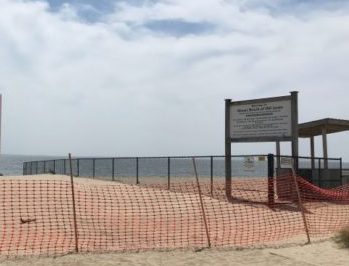
File photo showing the fence that for six years prior to Thursday sectioned off Miami Beach from Sound View Beach. The fence has now been removed.

OLD LYME — A Miami Beach fence that divided beach-goers and homeowners, both literally and figuratively, came down Thursday morning, a week after the state Supreme Court refused to review a lower court decision ordering a private beach association to stop impeding access to public property.

“Break out the champagne, baby,” said Kathleen Tracy, lead plaintiff in the case against the Miami Beach Association and a summer resident of nearby Sound View Beach. “It’s been six years of a battle that from the very beginning …

Editor’s Note: Visit this link to read the full story, Miami Beach fence comes down after court ruling, by Lee Howard and published April 14, in ‘The Day.