A View from My Porch: A Primer on Vaccines, Part 2.5: Where Are We With Vaccines? CT’s Distribution Plan, Immunity Questions & More

Editor’s Note: This is a previously unplanned third of three parts of a highly topical essay titled, “A Primer on Vaccines,” by Thomas D. Gotowka. Part 2.5 reviews Connecticut’s readiness to distribute the vaccine, identifies some of the side effects that may be experienced, and considers the acquisition of individual immunity. Read the previous parts of the essay at these links:
A View from My Porch: A Primer on Vaccines: Part 1; “Still Running to Daylight”

A View from My Porch — A Primer on Vaccines: Part 2; “Approaching Daylight”

When Part 2 of this series was published in mid-December, only the Pfizer vaccine had received emergency use authorization (EUA); the FDA then granted Moderna’s EUA on Dec. 18. As a result, we are now in the earliest stages of a massive vaccination campaign that will span the United States; and millions of Americans will reach the vaccination on-deck circle in 2021. 

The COVID “playbook” is still evolving; and guidance will change as the scientific and medical communities discover more about this virus and its reaction to the vaccines. That’s a good thing. 

The COVID Data Remain Troubling:

The first autopsy-confirmed COVID-related death in the United States occurred on Feb. 6, 2020 in Santa Clara County, Calif. Just 10 months later, i.e., by year’s end, over 345,000 Americans had been killed by the virus; and, incredibly, we surpassed 20 million cases, with an increase of more than a million cases in the last week of the year.

Unfortunately, this trend will continue through this dark winter; and, by this morning, Jan. 7, we’ve reached nearly 364,000 American fatalities. Finally, COVID hospitalizations are increasing in Connecticut, and may be evidence of another post-holiday spike.

New Vaccines:

Photo by Daniel Schludi on Unsplash.

Last week, Great Britain became the first country to authorize the use of Astra Zeneca’s COVID-19 vaccine. In addition, a promising vaccine candidate from Johnson & Johnson is proceeding through clinical trials. However, for the foreseeable future, Americans will receive the Pfizer or the Moderna vaccines, both of which require two doses, three or four weeks apart, respectively.

Poorly Executed Federal Vaccine Rollout:

The Centers for Disease Control and Prevention (CDC) has reported that Operation Warp Speed’s promise to vaccinate 20 million Americans by the end of December fell remarkably short of goal; and only about 2.8 million people were provided the vaccine — primarily front-line health care workers, and nursing home residents.

Earlier in December, General Gustave Perna, COO of Operation Warp Speed, apologized for a “planning error” that caused dozens of states to receive substantially fewer vaccine doses than were originally promised.

Predictably, the outgoing Administration then announced that, like testing, vaccine distribution will now be the responsibility of the individual states. Transition to the states occurred rapidly, and with only limited assistance and oversight.  There is no plan for logistical support.

They essentially told the states that “this is now your responsibility, figure it out.” Many states will have significant difficulty in meeting this challenge. However, the Coronovirus Relief Bill, which was reluctantly signed into law by the outgoing president at the end of December, includes some financial assistance for the states’ vaccination rollout.  

Vaccine Distribution in CT:

Connecticut began preparing for vaccine distribution well before the candidate vaccines were on the threshold of the United States Food and Drug Administration (FDA) emergency use authorization. 

Governor Lamont had appointed a broad-based Vaccine Advisory Group, who worked with the state’s Department of Health (CT DPH), the local health departments, CDC, and a group of providers and healthcare institutions to develop a phase-based program, which the Governor presented last October. The Governor also stated, at that time, that the state’s goal was to have everyone in the state “who wants a dose” to be vaccinated by early fall of 2021.

You can review the details of CT’s vaccination plan at Phases (ct.gov)

At present, Connecticut is vaccinating people who meet Phase 1a eligibility, which includes front-line healthcare workers, and residents and staff of long-term care facilities. CVS Pharmacy teams began to administer the first dose of the Pfizer vaccine in Connecticut skilled nursing facilities on Dec. 21. 

By the end of that month, they had administered more than 50,000 vaccine doses. The role of CVS in Connecticut’s vaccination program is reviewed in: A View from My Porch — A Primer on Vaccines: Part 2; “Approaching Daylight” (LymeLine.com)

By the end of December 2021, more than 50,000 vaccine doses of Coronavirus vaccine had been administered. Photo by Kristine Wook on Unsplash.

Phase 1b:

The Governor has confirmed that Connecticut remains on track to complete Phase 1a by the end of January; and the CDC recently reported that Connecticut is ahead of most states in vaccine distribution. Phase 1b is expected to begin immediately after completing Phase 1a objectives, and will probably extend into June. 

The Governor’s Vaccine Advisory Group has just recommended that Phase 1b target frontline essential workers, residents of congregate settings and those aged 75 and older. This will include teachers, grocery store workers, police officers, food service workers and sanitation workers. 

Congregate settings include homeless shelters, prisons, psychiatric facilities and group homes. The Advisory Group has not yet decided whether this next phase will also include residents, who are under the age of 75, but have underlying health conditions that place them at high-risk of serious illness from COVID-19. It appears that heathy people, ages 65 to 74 years old, may, otherwise, be deferred to Phase 1c.

Side Effects:

The most common side effects for both vaccines include pain and swelling in the arm where you received the injection; fever, chills, fatigue, and headaches, and muscle and joint pain. There was some early concern regarding a few claims of “Bell’s Palsy” following receipt of the Pfizer or Moderna vaccine in the clinical trials. (“Bells” is a condition that causes temporary and mild weakness or paralysis of the facial muscles).

This was not considered significant, however, because the incidence rate of the condition in the clinical trial was very comparable to the incidence of Bell’s Palsy in the general population.

Note that the CDC and FDA are monitoring adverse reactions, using a national data collection system. Healthcare professionals are required to report certain adverse events; and vaccine manufacturers are required to report all adverse events that come to their attention. Vaccine Adverse Event Reporting System (VAERS) (hhs.gov)

Even you have received the first shot of vaccine, keep wearing your mask until one to two weeks after your second dose.  Photo by engin akyurt on Unsplash.

Immunity ETA:

As noted above, the Pfizer and Moderna vaccines both require two doses, three or four weeks apart, respectively. Based on the current literature, you will have some protection about 12 days after the first dose. 

However, you will not receive the strongest immunity until after the second dose — at least seven days after the second for the Pfizer vaccine; but at least 14 days after the second for the Moderna vaccine. Therefore, it is important that you continue wearing a face mask, practice social distancing until one to two weeks after your second dose.

Questions (Always) Remain:

There is still a need for continuing study. We do not yet know how long vaccines will confer immunity. Although the vaccine may be more than 90 percent effective in blocking the symptoms of COVID-19 at the individual level; it is still unclear whether it will reduce transmission and stop the symptomless spread that accounts for a large portion of cases

Some Final Thoughts:

Vaccinations for the general public are not expected to begin until late-summer but, by then, vaccines will be available in a wide range of healthcare sites: physician’s offices, hospitals, pharmacies, community health centers, and other locations that would normally administer influenza vaccines. Note that Connecticut is not mandating vaccination.  So, it’s an extremely important public health program that requires we “rely on the kindness of strangers.”

As I write this, I am distracted by the televised play-by-play of a violent attack on the Capitol by a group of domestic terrorists, which was apparently instigated and applauded by the outgoing Executive Branch. 

All that said, I believe that Connecticut is well-prepared to carry out this massive vaccination program. Other states are woefully unprepared. For example, Florida has what appears to be a poorly organized, “first come, first served” program.

We must make certain, however — and especially as other states reach readiness — that the vaccine supply line is continually sufficient to meet immediate requirements. 

I’ll close by paraphrasing Queen Elizabeth II: 2020 was without question an “annus horribilis.” Let’s not allow its ‘horrible-ness‘ to spill over any further into 2021.

This is the opinion of Thomas D. Gotowka.

Tom Gotowka

About the author: Tom Gotowka’s entire adult career has been in healthcare. He’ will sit on the Navy side at the Army/Navy football game. He always sit on the crimson side at any Harvard/Yale contest. He enjoys reading historic speeches and considers himself a scholar of the period from FDR through JFK.

A child of AM Radio, he probably knows the lyrics of every rock and roll or folk song published since 1960. He hopes these experiences give readers a sense of what he believes “qualify” him to write this column.

A la Carte: Lee Shares a New, Fun, Easy and ‘Craggy’ Recipe for Scones

Lee White

It was a bit of a sad holiday season. I shared Thanksgiving with my neighbors. They are the only people who have been invited into my condo during the pandemic, other than my daughter, the physical therapist, visiting nurses or a few minutes from friends. I lit the candles on my menorah each of the holiday’s eight days and Sue and Bob and I decided not to spend Christmas dinner together. 

I didn’t do a lot of cookie baking either. In the early part of December, I did stews and pasta sauces (marinara, pink vodka and a marathon of Bolognese). I actually do the last in a cauldron the size of a pot cannibals might choose. But the Bolognese is now down to one 3-quart plastic container in the freezer (I share it) and I am planning to drive to see my daughter-in-law and three of my granddaughters tomorrow. (They get rapid results with their covid tests and I have been negative every week or so since April.)

So right now another batch of Bolognese is cooking downstairs: onions, garlic and carrots along with the pork and beef are in a bottle of pinot gris. In 30 minutes, it will have somewhat evaporated, the milk will be added, then about 200 ounces of tomatoes and the tomato paste will simmer for two or so hours.  

I have, however, been doing some baking. I found a new recipe for scones which was a bit more fun than the recipe I had been using for decades. With this new one, I use my hands to work the butter into the flour mixture, drill a well into the dough and add heavy cream. I mix this batter with my hands, too.

The author says she likes the “cragging” of the scones instead of rolling the dough and using a biscuit cutter to make them all look neat. I like that look. I have made this recipe three times: once with chopped pecans, once with marzipan and once with tiny cinnamon chips.  This is fun and easy, and scones can be frozen, too.

You can’t beat a warm scone with butter and/or jam at any time of the day! Photo by Craig Bradford on Unsplash.

 Any-Fruit or –Nut Scones

Adapted from The Fearless Baker by Erin Jeanne McDowell (Houghton Mifflin Harcourt, Boston New York, 2017)

Yield: makes about 18 scones

3 cups all-purpose flour
2/3 cup granulated sugar
1 tablespoon baking powder
½ teaspoons fine sea salt
10 tablespoons cold unsalted butter cut into ½ inch cubes
2 to 2 ½ cups fruit and/or nuts
1 cup heavy cream
Egg wash (1 egg beaten with 1 tablespoon water and small pinch of salt
Sugar for sprinkling

Preheat oven to 400 degree with racks in the upper and lower two thirds. Line two half-sheet pans with parchment or Silpat.

In a large bowl, whisk dry ingredients together. Add butter and toss to cubes with flour; cut butter into flour mixture by rubbing them between forefingers and thumbs until the size of peas or walnut halves. Add fruit and/or nuts and toss gently to combine.

Make a well in the middle and pour in cream. Toss mixture with fingers to combine; then knead gently to ensure everything is evenly moistened.

Scoop ¼-inches of dough onto prepared sheet pans. I used my hands to do this, leaving 1 1/2 –inches apart. Brush top with egg wash and sprinkle with sugar.

Bake scones, switching the sheets from front to back and top to bottom at the halfway mark, for 20 to 22 minutes, until tops and edges are golden brown. Scones can be served warm or at room temperature. They may also be microwaved for 10 to 15 seconds.

About the author: Lee White has been writing about restaurants and cooking since 1976 and has been extensively published in the Worcester (Mass.) Magazine, The Day, Norwich Bulletin, and Hartford Courant. She currently writes Nibbles and a cooking column called A La Carte for LymeLine.com and the Shore Publishing and the Times newspapers, both of which are owned by The Day. She was a resident of Old Lyme for many years but now lives in Groton, Conn.

Jan. 6 COVID-19 Update: Old Lyme Cumulative Cases Rise by One to 163, Lyme’s Increase by Two to 50

Photo by CDC on Unsplash

LYME/OLD LYME — In light of the serious rise in Coronavirus cases, we have started a new weekday update reporting confirmed and probable COVID-19 cases in Lyme and Old Lyme.

The state is now issuing a COVID-19 metric report daily around 4 p.m. Monday through Friday, which includes current data up to the previous evening. The Monday reports include data for the weekend as well as the previous Friday.

The Daily Data Report for Connecticut issued Wednesday, Jan. 6, 2021 by the Connecticut Department of Public Health (CT DPH) for data as at 8:30 p.m., Jan. 5, 2021 shows the following:

Both Lyme and Old Lyme are still in the state-identified ‘Red Zone;’ where they have been for the past two weeks.

As of today’s report (see map above), five towns in the state — Canaan, Colebrook, Cornwall, Union and Warren — remain in the ‘Gray Zone.’ Salisbury is the only town in the ‘Cream Zone,’ while Wilton is the only town in the ‘Orange Zone.’

  • The red category is defined as when the Average Daily Rate of COVID-19 Cases Among Persons Living in Community Settings per 100,000 Population By Town exceeds 15.
  • The orange category is defined as when the Average Daily Rate of COVID-19 Cases Among Persons Living in Community Settings per 100,000 Population By Town is between 10-14.
  • The cream category is defined as when the Average Daily Rate of COVID-19 Cases Among Persons Living in Community Settings per 100,000 Population By Town is between 5-9.
  • The gray category is defined as when the Average Daily Rate of COVID-19 Cases Among Persons Living in Community Settings per 100,000 Population By Town is less than five or less than five reported cases.

In all four cases, this rate does not include cases or tests among residents of nursing home, assisted living, or correctional facilities.

Old Lyme

Old Lyme now has a cumulative total (since the outbreak began) of 160 confirmed COVID-19 cases and THREE probable cases, making a TOTAL of 163 cases.

This represents NO CHANGE in the number of confirmed cases reported Tuesday, Jan. 5, and an INCREASE of ONE in the number of probable cases reported the same day

The total number of Old Lyme residents tested is 3,881.

There have been two fatalities in Old Lyme.

CT DPH Two-Weekly Report

The Dec. 31 report issued by CT DPH shows that during the two-week reporting period from 12/13 through 12/26, Old Lyme had 11 cases in Week 1 and 11 in Week 2. This data was updated Dec. 31.

The case rate in Old Lyme for 100,000 population is 21.3, reflecting a decrease from the previously reported two-week rate of 26.2. A case rate of 15 or more cases per 100,000 population places a town in the state’s ‘Red Zone.’

Lyme

Lyme has a cumulative total (since the outbreak began) of 45 confirmed cases and five probable cases, making a total of 50 cases.

This represents an INCREASE of TWO in the number of confirmed cases from the numbers reported Tuesday, Jan. 5 and NO CHANGE in the number of probable cases reported the same day.

There have been no fatalities in Lyme.

The total number of Lyme residents tested is 997.

CT DPH Two-Weekly Report

The Dec. 31 report issued by CT DPH shows that during the two-week reporting period from 12/13 through 12/26, Lyme had five cases in Week 1 and one in Week 2. This data was updated Dec. 31.

The case rate in Lyme for 100,000 population is 18.3 reflecting a decrease from the previously reported two-week-rate of 30.6. A case rate of 15 or more cases per 100,000 population places a town in the state’s ‘Red Zone.’

***

The next CT DPH Daily Data Report for Connecticut will be issued Thursday, Jan. 7, 2021.

POSTPONED: SECWAC Presents “Prospects for a Russia-China Alliance: Moscow’s Calculus” with David Abramson, Jan. 12

LYME/OLD LYME – Jan. 7 UPDATE: This program as been postponed until later this year, “due to circumstances beyond our control,” according to a press release issued yesterday by SECWAC. the group’s next presentation will be held Wednesday, Jan. 27, when New York Times and New Yorker journalists, Peter Baker & Susan Glasser will discuss their new book, The Man Who Ran Washington: The Life and Times of James A. Baker III.

The Southeast Connecticut World Affairs Council (SECWAC) presents David Abramson speaking on the Russia-China relationship at 6 p.m., Tuesday, Jan. 12, 2021, via Zoom. The virtual presentation is free for members; $20 for non-members. Registration is required.

Presidents Vladimir Putin and Xi Jinping have flirted with and talked around the prospect of a Sino-Russian alliance, but the truth is both sides are reluctant to commit to alliances in general because of the various restraints they impose on members. Uncertainties about future U.S. foreign policy and shifts in the world order heighten those uncertainties.

Dr. David Abramson will discuss these issues from Moscow’s perspective and assess the chances that its increasingly warm and reciprocated public rhetoric about their “comprehensive strategic partnership of coordination” is leading towards a formal alliance.

Dr. Abramson is senior analyst covering Russia’s relations with Asia for the U.S. Department of State’s Bureau of Intelligence and Research. He previously worked for many years as a Central Asia analyst, focusing primarily on domestic and regional politics and Islamic trends in Eurasia.

During 2001-2005, Dr. Abramson spent four years in the Department’s Office of International Religious Freedom, monitoring and promoting religious freedom as an element of U.S. foreign policy, advising on outreach to the Muslim world, and engaging with Muslim-American communities.

Dr. Abramson has taught at Georgetown and George Washington Universities and published on Islam, foreign assistance in Central Asia, and anthropologists working in national security. His most recent publication is a chapter on Islam and state policies in Uzbekistan in “Islam, Society, and Politics in Central Asia.”

Raised in Storrs, CT, he later earned his B.A. in Russian language and literature at Wesleyan University and his Ph.D. in cultural anthropology at Indiana University.

Abramson’s presentation is part of the SECWAC 2021 monthly Speaker Series.

Register in advance at https://scwac.wildapricot.org/event-4089066.

Editor’s Note: SECWAC is a regional, nonprofit, membership organization affiliated with the World Affairs Councils of America (WACA). The organization dates back to 1999, and has continued to arrange at least 8-10 meetings annually, between September and June. The meetings present a range of topics in international affairs, foreign policy and diplomatic history, and are hosted at venues along the I-95 corridor, welcoming members and guests from Stonington to Old Saybrook, and beyond. 

SECWAC’s mission is “to foster an understanding of issues of foreign policy and international affairs through study, debate, and educational programming.” It provides a forum for nonpartisan, non-advocacy dialogue between members and speakers, who can be U.S. policymakers, educators, authors, and other experts on foreign relations. Learn more at http://secwac.org.

CALENDAR LISTING: Southeast Connecticut World Affairs Council (SECWAC) presents David Abramson on Tuesday, January 12, 2021, 6:00 p.m. via Zoom. Free for members; $20 for non-members. Registration is required in advance. Annual membership of SECWAC is $85; $25 for young professionals under 35, and free for students and educators; corporate membership available for $1,000 (contact SECWAC for details).


Lyme-Old Lyme Schools Schedule Vote on Artificial Turf Field at Tonight’s Meeting, Playing Surface Recommendation Changed

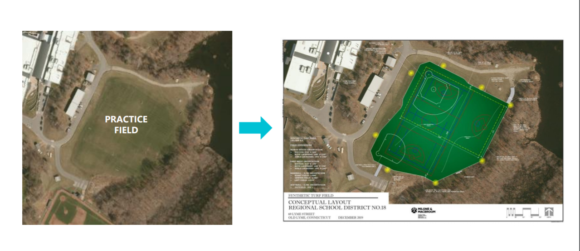
This image, courtesy of Millone & McBroom, shows the current field behind Lyme-Old Lyme High School and the proposed synthetic turf field.

LYME-OLD LYME — The Region 18 Board of Education (BOE) meets this evening, Wednesday, Jan. 6, for its regular monthly meeting at 6:30 p.m. in the BOE Conference Room in Center School.

The BOE agenda includes under New Business: Approval of Multipurpose Artificial Playing Surface.

The following comment is published in the General Overview  of the project on the Region 18 website under, Playing Surface Options: The original presentations focused on a crumb-rubber infill, a recycled product that can also be repurposed at the time of replacement. We are also looking at alternative infill options. Some options such as cork/coconut blends, walnut shells, etc. are no longer being considered based on the high cost of installation and yearly maintenance or irrigation needs that can’t be met. That still leaves a handful of other infill options currently being explored.

In view of that comment, LymeLine asked Ian Neviaser, Superintendent of Lyme-Old Lyme Schools, whether the proposal had changed from that discussed in a number of presentations with both Lyme-Old Lyme Schools audiences and various Old Lyme commissions. He responded by email, “The proposal from [the Facilities ] committee has been adjusted to include Brockfill instead of crumb rubber.”

Adding that the final decision on the playing surface will be made this evening, he also noted that if a change to Brockfill were to be made, it does not require the proposal to be resubmitted to any commissions in Old Lyme.

A live stream of the meeting will be available at this link:
http://region18.devosvideo.com/show?video=bf6143e600f1&apg=db58a112

In-person attendance is also possible at the meeting, but masks must be worn and social distancing respected.

Anyone wishing to make public comment virtually may use the following Zoom link: https://region18.zoom.us/j/83527766795; Meeting ID: 835 2776 6795;
+16465588656,,83527766795# US (New York).

Those choosing this option will be required to follow the same expectations for those making public comment in person. After being recognized by the chairperson, participants must state their name and place of residence before making their comments to the board.

Related articles published by LymeLine.com:

Old Lyme Zoning Approves Lyme-Old Lyme Schools Proposal for Turf Field — With Conditions Dec. 21, 2020

Old Lyme Zoning Delays Decision on LOL Schools’ Proposed Artificial Athletic Field Pending Drainage Review, ‘It’s All About Drainage’ (Cable)  Sept. 17, 2020

Old Lyme Zoning to Discuss Lyme-Old Lyme Schools’ Proposal for Synthetic Turf Field Tonight Sept. 14, 2020

Lyme-Old Lyme $2.28 Million School Turf Field Moves Forward (from The Day) May 26, 2020

Lyme-Old Lyme Schools Move Forward with Plans for $2.3 Million Artificial Turf Field Dec. 11, 2019

Engineering Firm to Present Work to Date on Turf Field Project at Tonight’s BOE Meeting, Public Welcome Dec. 4, 2019