
Jan. 5 COVID-19 Update: Old Lyme Cumulative Cases Climb by Four to 162, Lyme’s Hold at 48

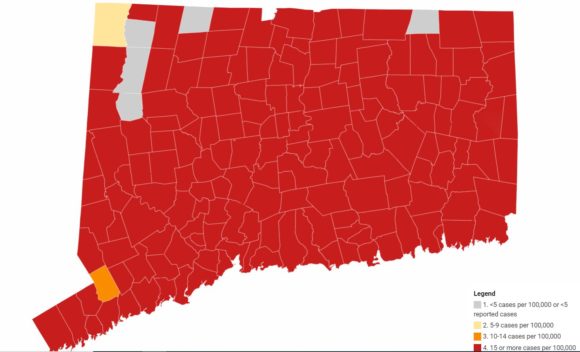
Map of Connecticut dated Jan. 5 showing both Lyme and Old Lyme in the CT DPH-identified ‘Red Zone.’ This is defined as when the Average Daily Rate of COVID-19 Cases Among Persons Living in Community Settings per 100,000 Population by Town is over 15.

LYME/OLD LYME — In light of the serious rise in Coronavirus cases, we have started a new weekday update reporting confirmed and probable COVID-19 cases in Lyme and Old Lyme.

The state is now issuing a COVID-19 metric report daily around 4 p.m. Monday through Friday, which includes current data up to the previous evening. The Monday reports include data for the weekend as well as the previous Friday.

The Daily Data Report for Connecticut issued Tuesday, Jan. 5, 2021 by the Connecticut Department of Public Health (CT DPH) for data as at 8:30 p.m., Jan. 4, 2021 shows the following:

Both Lyme and Old Lyme are still in the state-identified ‘Red Zone;’ where they have been for the past two weeks.

As of today’s report (see map above), five towns in the state — Canaan, Colebrook, Cornwall, Union and Warren — remain in the ‘Gray Zone.’ Salisbury is the only town in the ‘Cream Zone,’ while Wilton is the only town in the ‘Orange Zone.’

  • The red category is defined as when the Average Daily Rate of COVID-19 Cases Among Persons Living in Community Settings per 100,000 Population By Town exceeds 15.
  • The orange category is defined as when the Average Daily Rate of COVID-19 Cases Among Persons Living in Community Settings per 100,000 Population By Town is between 10-14.
  • The cream category is defined as when the Average Daily Rate of COVID-19 Cases Among Persons Living in Community Settings per 100,000 Population By Town is between 5-9.
  • The gray category is defined as when the Average Daily Rate of COVID-19 Cases Among Persons Living in Community Settings per 100,000 Population By Town is less than five or less than five reported cases.

In all four cases, this rate does not include cases or tests among residents of nursing home, assisted living, or correctional facilities.

Old Lyme

Old Lyme now has a cumulative total (since the outbreak began) of 160 confirmed COVID-19 cases and two probable cases, making a TOTAL of 162 cases.

This represents an INCREASE of FOUR over the 156 confirmed cases reported Monday, Jan. 4, and NO CHANGE in the number of probable cases reported the same day

The total number of Old Lyme residents tested is 3,863.

There have been two fatalities in Old Lyme.

CT DPH Two-Weekly Report

The Dec. 31 report issued by CT DPH shows that during the two-week reporting period from 12/13 through 12/26, Old Lyme had 11 cases in Week 1 and 11 in Week 2. This data was updated Dec. 31.

The case rate in Old Lyme for 100,000 population is 21.3, reflecting a decrease from the previously reported two-week rate of 26.2. A case rate of 15 or more cases per 100,000 population places a town in the state’s ‘Red Zone.’

Lyme

Lyme has a cumulative total (since the outbreak began) of 43 confirmed cases and five probable cases, making a total of 48 cases.

This represents NO CHANGE in the number of confirmed or probable cases from the numbers reported Monday, Jan. 4.

There have been no fatalities in Lyme.

The total number of Lyme residents tested is 987.

CT DPH Two-Weekly Report

The Dec. 31 report issued by CT DPH shows that during the two-week reporting period from 12/13 through 12/26, Lyme had five cases in Week 1 and one in Week 2. This data was updated Dec. 31.

The case rate in Lyme for 100,000 population is 18.3 reflecting a decrease from the previously reported two-week-rate of 30.6. A case rate of 15 or more cases per 100,000 population places a town in the state’s ‘Red Zone.’

***

The next CT DPH Daily Data Report for Connecticut will be issued Wednesday, Jan. 6, 2021.

SECWAC Hosts NYT, New Yorker Journalists Speaking on Their New Book About James A. Baker III, Jan. 27

LYME/OLD LYME — Join SECWAC virtually on Wednesday, January 27, 2021 at 6:00 p.m. for a presentation by Peter Baker and Susan Glasser, New York Times and The New Yorker journalists, to speak on their book, ‘The Man Who Ran Washington: The Life and Times of James A. Baker III.’ Register in advance. More information at http://secwac.org.

Death Announced of Michael J. Picano, 60, Brother of Karen Kerwin of Old Lyme

Michael J. Picano, 60 of Sacramento, California passed away at home on Saturday, December 19, 2020 surrounded by his loving family after a courageous battle with cancer. He was born on May 2, 1960 in Hartford, CT …

… He is survived by his wife, Maura and his son Nathan Picano of Sacramento CA; brother Stephen Picano and his wife Debra of Enfield, CT, sister Karen Kerwin of Old Lyme, CT; nieces and nephews Marissa Carignan of Waterford, CT and James Kerwin of Old Lyme, CT.

Visit this link to read the full obituary published jan. 3, 2021 in the Hartford Courant.

Jan. 4 COVID-19 Update: Old Lyme Cumulative Cases Climb by Three to 158, Lyme’s Rise by Four to 48

Photo by CDC on Unsplash

LYME/OLD LYME — In light of the serious rise in Coronavirus cases, we have started a new weekday update reporting confirmed and probable COVID-19 cases in Lyme and Old Lyme.

The state is now issuing a COVID-19 metric report daily around 4 p.m. Monday through Friday, which includes current data up to the previous evening. The Monday reports include data for the weekend as well as the previous Friday.

The Daily Data Report for Connecticut issued Monday, Jan. 4, 2021 by the Connecticut Department of Public Health (CT DPH) for data as at 8:30 p.m., Jan. 1, 2021 shows the following:

Both Lyme and Old Lyme are still in the state-identified ‘Red Zone;’ where they have been for the past two weeks.

As of today’s report (see map above), five towns in the state — Canaan, Colebrook, Cornwall, Union and Warren — remain in the ‘Gray Zone.’ Salisbury is the only town in the ‘Cream Zone,’ while Wilton is the only town in the ‘Orange Zone.’

  • The red category is defined as when the Average Daily Rate of COVID-19 Cases Among Persons Living in Community Settings per 100,000 Population By Town exceeds 15.
  • The orange category is defined as when the Average Daily Rate of COVID-19 Cases Among Persons Living in Community Settings per 100,000 Population By Town is between 10-14.
  • The cream category is defined as when the Average Daily Rate of COVID-19 Cases Among Persons Living in Community Settings per 100,000 Population By Town is between 5-9.
  • The gray category is defined as when the Average Daily Rate of COVID-19 Cases Among Persons Living in Community Settings per 100,000 Population By Town is less than five or less than five reported cases.

In all four cases, this rate does not include cases or tests among residents of nursing home, assisted living, or correctional facilities.

Old Lyme

Old Lyme now has a cumulative total (since the outbreak began) of 156 confirmed COVID-19 cases and two probable cases, making a TOTAL of 158 cases.

This represents an INCREASE of TWO over the 154 confirmed cases reported Saturday, Jan. 2, and an INCREASE of ONE in the number of probable cases reported the same day

The total number of Old Lyme residents tested is 3,839.

There have been two fatalities in Old Lyme.

CT DPH Two-Weekly Report

The Dec. 31 report issued by CT DPH shows that during the two-week reporting period from 12/13 through 12/26, Old Lyme had 11 cases in Week 1 and 11 in Week 2. This data was updated Dec. 31.

The case rate in Old Lyme for 100,000 population is 21.3, reflecting a decrease from the previously reported two-week rate of 26.2. A case rate of 15 or more cases per 100,000 population places a town in the state’s ‘Red Zone.’

Lyme

Lyme has a cumulative total (since the outbreak began) of 43 confirmed cases and five probable cases, making a total of 48 cases.

This represents an INCREASE of THREE in the number of confirmed cases and an INCREASE of ONE in the number of probable cases reported Saturday, Jan. 2.

There have been no fatalities in Lyme.

The total number of Lyme residents tested is 973.

CT DPH Two-Weekly Report

The Dec. 31 report issued by CT DPH shows that during the two-week reporting period from 12/13 through 12/26, Lyme had five cases in Week 1 and one in Week 2. This data was updated Dec. 31.

The case rate in Lyme for 100,000 population is 18.3 reflecting a decrease from the previously reported two-week-rate of 30.6. A case rate of 15 or more cases per 100,000 population places a town in the state’s ‘Red Zone.’

***

The next CT DPH Daily Data Report for Connecticut will be issued Tuesday, Jan. 5, 2021.

Legal News You Can Use: Understanding CT’s New Paid Family & Medical Leave Act

Happy New Year!  Welcome 2021! 

As Connecticut employers bid farewell to the year of “unprecedented times,” not so fast, I say.  This New Year ushers in a significant change in employment law for Connecticut employers of all sizes.  Connecticut has joined a handful of other states in creating a Paid Family and Medical Leave Act (PFMLA) that drastically changes the landscape of family and medical leave in this state.

Prior to the enactment of the PFMLA, Connecticut state law (CT FMLA) required only employers with 75 or more employees to provide 16 weeks of family and medical leave, and the leave could be unpaid.  Similarly, under the Federal FMLA, employers with 50 or more employees were required to provide 12 weeks of leave, paid or unpaid.

For Connecticut employers, however, the PFMLA changes family and medical leave by:

  • eliminating the threshold of a minimum number of employees (75 down to 1);
  • mandating 12 weeks of leave (instead of 16);
  • expanding the range of circumstances for which an employee may take a leave; and
  • providing wage replacement for all employees who take leave.

The PFMLA essentially provides most Connecticut workers with access to paid leave life events previously covered under the current federal and state FMLAs, as well as the Connecticut Family Violence Leave Act (CT FVLA), such as to:

  • To address the worker’s own serious health concern;
  • To care for a child after birth, adoption or foster placement;
  • To provide care to a seriously ill or injured family member;
  • To address qualifying exigencies arising from the foreign deployment of related service-member;
  • To serve as an organ or bone marrow donor; or
  • To address certain matters relating to family violence.

Under the new PFMLA, not only larger employers, but now even small Connecticut employers (with at least one employee), are required to comply with the mandates of the PFMLA.  Of note, the PFMLA generally excludes federal employees, Connecticut and municipal employees who are members of unions, employees of local and regional boards of education, and non-public elementary and secondary school employees.

Aside from employees of excluded employers, all other employees in the State of Connecticut will entitled to paid leave under the PFMLA starting on Jan. 1, 2022. In fact, even those who are self-employed or sole proprietors are eligible to opt-in to the program in certain circumstances where they contribute a portion of their income to the state fund.

How Does the Paid Family Leave Program Work?

The PFMLA authorized and established a quasi-state agency, the Connecticut Paid Leave Authority (“CPLA”), to administer the PFMLA program and trust fund.  The PFMLA program will be funded by employees and voluntary self-enrolled participants through the collection of wage deductions, capped at 0.5% of wages, beginning on Jan. 1, 2021. Payment of benefits to eligible employees will begin on Jan. 1, 2022.

The CPLA is the state-agency that will accepts applications for paid leave benefits, reviews those applications and if approved, administer benefits to eligible employees, those who are self-employed and sole proprietors. The CPLA is also responsible for collecting employee contributions and working with the Office of the Treasurer to properly invest and manage the contributions so that funds are available to pay benefits.

Employers must comply with the PFMLA by either using the state-run program administered by the CPLA or, the PFLMA provides employers with the option to apply to the CPLA for an exemption because the employer opts to provide the PFMLA benefit to their employees through an approved private program that provides all of the same rights, protections and benefits as the PFMLA (e.g. private insurance carriers such as long-term/short-term disability insurance carriers are providing private programs).

Note that an employer’s private plan must also comply with specific application requirements, including the requirement that a majority of the employer’s employees working in Connecticut vote in favor of the private plan. In the event that an employer receives an exemption and provides a private plan, the withholdings from employee paychecks are held by the employer, instead of the CPLA.

The first step for employers is to register their business with the CPLA (registration opened on November 1, 2020) and, if necessary, to apply for an exemption if providing the benefit through a private program.  Please note that third parties, such as payroll providers, may handle the application procedures with the CPLA and there are separate processes for these third parties when registering with the CPLA.

 Why is Jan. 1, 2021 Important to the PFMLA for Connecticut Employers?

When the law was enacted in June, 2019, the Connecticut legislature selected Jan. 1, 2021 as the commencement of the first “phase” of the program. Commencing with the first pay-period following Jan. 1, 2021, the mandatory payroll deductions from employee wages to fund the state program commence and employers not otherwise exempt must begin withholding the required amounts from employee wages and submitting the same to the CPLA.

During this first phase, the program is being seeded through these payroll deductions for one year; however, employees may not apply for benefits under the program until January 1, 2022.

 How Much Will Employees be Paid During PFMLA leave?

Under the PFMLA, an employee will receive a weekly benefit for the full 12 weeks of leave. An additional two weeks may be available for pregnancy-related issues.

If an employee’s weekly wages are less than or equal to the then-current Connecticut minimum wage multiplied by 40, the weekly benefit rate under the PFMLA will be 95 percent of the employee’s average weekly wage.  If an employee’s weekly wages exceed the Connecticut minimum wage multiplied by 40, the weekly benefit rate will be 95 percent of the Connecticut minimum wage multiplied by 40, plus 60 percent of the amount by which the employee’s average weekly wage exceeds the Connecticut minimum wage multiplied by 40. The benefit rate is capped at 60 times the Connecticut minimum wage.

Employers may supplement the paid leave benefits provided by the PFMLA, as long as the total amount received by an employee does not exceed 100 percent of their usual weekly wages.

What Should Employers Be Communicating to Employees Now?

At this time, employers should communicate with employees regarding the payroll deductions that begin Jan. 1, 2021, and regarding the benefits that will be available to them via the PFMLA as of January 1, 2022.  The CPLA provides a poster that may be displayed in your workplace and/or distributed to employees.

Employers and employees alike may refer to the CT Paid Leave Employee Factsheet or may contact Attorney Kristi Kelly at Suisman Shapiro Attorneys-at-Law at kkelly@sswbgg.com or 800-499-0145 to obtain legal advice on this and other employment-related topics.