
Editor’s Note: This the fifth part of Thomas Gotowka’s series titled “Great Leaders and Great Speeches.’ The previous four parts can be found at these links:
A View from My Porch: Great Leaders and Great Speeches, Part 3: The Cold War
A View from My Porch: Great Leaders and Great Speeches, Part 4: The Cold War Heats Up
The last essay concluded with President Kennedy’s humiliation of the Soviets and the resultant dismantling and removal of their offensive weapons from Cuba. The United States had stepped back from the brink of nuclear war.
In this essay, I explore the “Visuals” of the Cold War. What were anxious Americans reading and watching during that tense era? I will then wrap up my treatise on the Cold War with a review of the gradual “wind-down” of hostilities, and the collapse of the Soviet Union.
As always, my goal is that the reader gets a solid foundation in the fundamentals of the subject, which may even pique their curiosity enough to seek additional information.
COLD WAR VISUALS & EVENTS:
Images played an important role in waging the Cold War and communicating its possible impacts to Americans. The importance of television, posters, cinema, and political cartoons in representing our Cold War enemy was recognized early. Public Service Announcements and posters often featured mushroom clouds and some reference to “We will bury you”.
I have strong memories of a large portion of the Cold War era, and, being familiar with the demographics of SE CT, I know that I am not unique.
Americans feared that the Soviet Union would launch an unprovoked attack on the United States with nuclear weapons. I am only providing a small sample of what Americans were reading, watching, or hearing from their leaders during that tense era; and just a few of the events that also affected our collective angst.
Much of the following was created or supported by a series of independent government agencies involved in civil defense.
In the early 1950s, schools performed emergency “Duck and Cover” drills to prepare children to react in a manner that provided some protection in a nuclear attack. The animated character, “Bert the Turtle”, engaged the youngest Americans in preparing for these drills. Students were trained to dive under their desks and cover their heads. Desks were incredibly sturdy back then.
“I Led Three Lives” was a series that aired from 1953 through 1956 on American television, and covered the activities of Herbert Philbrick, a young professional in 1939 Boston, who infiltrated a Communist Party Cell in Cambridge, Mass.; and worked covertly with the FBI for nine years. His cover was so convincing that he was asked by Cell leaders to follow other comrades to assess their loyalty. Hence, his three lives: white-collar worker, Communist agent, and FBI operative thwarting Communist plots.
On Oct. 4, 1957, the Soviet Union successfully launched Sputnik1, the world’s first artificial satellite, and one of three in the Soviet “Sputnik” program that achieved orbit. Sputnik1 remained in orbit until Jan. 4, 1958, when it dropped and burned in the Earth’s atmosphere. Many Americans feared the potential “sinister” uses that the Soviets could bring to bear on us with this expertise in rocket and satellite technology.
However, more serious was the perception of American weakness and loss of scientific leadership, which then contributed to Kennedy’s election win, as he had emphasized the “space gap” and the role of the Eisenhower-Nixon administration in creating it.
Our government, the military, and the scientific community were caught off guard by the Soviet technological achievement; and, as a result, combined their efforts to catch and surpass the Soviets, marking the beginning of the “space race”. Our first satellite, Explorer1, was launched on Jan. 31, 1958; and, with more advanced communications technology than Sputnik, provided the first data transmitted from space, revealing the presence of radiation belts encircling the Earth, now known as the Van Allen Radiation Belt.
In 1958, NBC presented “Ten for Survival”, a 10-episode television series on how to survive a nuclear attack. There were also several pamphlets accompanying the series, published by the Department of Defense Office of Civil Defense.
“AXIOM FOR SURVIVAL: If this country is attacked with nuclear weapons, you can protect yourself. But first, you must know what to do and how to do it.” The associated pamphlets covered subjects ranging from “dealing with the three main effects of a nuclear explosion (i.e., “Heat, Blast, Fallout, Heat”) to “preparing to live in a fallout shelter”.
During the Plenary Meeting of the United Nations General Assembly on Oct. 12,1960, Nikita Khrushchev, Soviet First Secretary of the Communist Party, removed his shoe, and raised it above his head as if to strike the desk, in protest at a speech by another delegate, who stated that Eastern Europe had been “deprived of political and civil rights due to the dominant influence in the region by the Soviet Union”.
Note that it was reported widely that he did strike the desk, but I could only locate photographs of a “threat to pound”, with shoe held above his head.
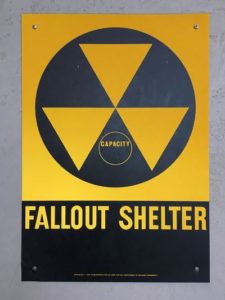
A fallout shelter sign in the United States of America. Photo by Geraldshields11. Published under the Creative Commons license.
Fallout shelters became that generation’s wine cellars and whirlpool tubs in essential home features and improvements. In a speech on “Urgent National Needs” delivered to a joint session of Congress on May, 25, 1961, President Kennedy stated that, “his Administration has been looking hard at exactly what civil defense can and cannot do. It cannot be obtained cheaply. It cannot give an assurance of blast protection that will be proof against surprise attack or guarantee against obsolescence or destruction. And it cannot deter a nuclear attack.” (Holy Cow!)
Then, in July, after the Soviets imposed a blockade on West Berlin, Kennedy said in a televised speech, that “in the event of an attack, the lives of those families which are not hit in a nuclear blast and fire can still be saved if they can be warned to take shelter, and if that shelter is available.”
Finally, on Oct. 6, he advised families to build shelters to protect themselves from atomic fallout in the event of a nuclear exchange with the Soviet Union. In another speech on civil defense issues, Kennedy assured the public that the government would soon begin providing such protection for every American.
The President went on say: “We owe that kind of insurance to our families and to our country. The time to start is now. In the coming months, I hope to let every citizen know what steps he can take without delay to protect his family in case of attack. I know you would not want to do less.”
Congress approved $169 million to locate, mark and stock fallout shelters in existing public and private buildings. Note that this all occurred about a year before the Cuban Missile Crisis.
Periodicals like “Better Homes and Gardens”, “Life Magazine”, and “Popular Science” all included articles on fallout shelters, aimed at readers who were preparing to build the best possible shelter. How-to booklets were widely available, with instructions and diagrams in the finer points of building and equipping your family fallout shelter.
Even earlier, Eisenhower’s Federal Civil Defense Administration (FCDA) had urged American families to maintain a seven-day supply of food and water in case of an atomic emergency. The FCDA launched an initiative called “Grandma’s Pantry”, with slogans like “Grandma was always ready for an emergency.” They produced thousands of “Grandma’s Pantry” exhibits for use in stores, with advice on what should be in every American’s disaster pantry.
The “Mother of All Fallout Shelters”:
In 1955, President Eisenhower instructed the Department of Defense to develop emergency plans to relocate Congress and ensure continuity of government in the event of a nuclear strike. The Army Corps of Engineers selected the Greenbrier Resort property in White Sulphur Springs, W.Va., which was relatively close and accessible to Washington, D.C., but distant enough to be safe from an atomic bomb dropped on the Capital.
The Greenbrier had served as a confinement facility for Japanese, Italian, and German diplomats; and then as a military hospital during the second world war.
Construction on the “super-bunker” Relocation Center began in 1957; and was completed in October, 1962, just as the Cuban Missile Crisis loomed. The Greenbrier bunker was buried 720 ft. underground. It would not survive a direct nuclear strike, but was capable of withstanding a blast 15 to 30 miles away and protecting its occupants from fallout.
The facility‘s two levels totaled about 115,000 square ft., “roughly the size of two football fields on top of one another”. Although the presence of the bunker was a closely-guarded secret, its largest halls, which were intended for sessions of Congress, were actually depicted as part of the Greenbrier Hotel complex, and would have been sealed off in the event of an attack.
All walls were concrete, three feet thick, and reinforced with steel. The entire structure was covered with a concrete roof and buried beneath 20 ft. of soil. It had a highly sophisticated ventilation system that was designed to circulate air and remove radiation.
The Bunker included a decontamination room, 18 rooms of dormitory space, each housing 60 people in metal bunk beds; a kitchen, and a 400-seat cafeteria, which was decorated with fake windows featuring scenic views. The upper level contained storage space and offices for Congressional leaders.
The bunker also had a hospital, operating room, pharmacy, crematorium, and a vast television, radio, and communications facility. The Relocation Center was maintained in a constant state of “readiness” by Forsythe Associates, which was later described by the Washington Post as an “obscure company ostensibly based in Arlington, Va.” These on-site employees claimed that their purpose was to maintain the hotel’s 1100 televisions.
The bunker remained a closely-guarded secret until 1992, when the Post published “The Ultimate Congressional Hideaway.” Given that its secure location was one of the primary guarantees for its defense, the bunker was quickly decommissioned and became the Greenbrier Cold War theme park. (To schedule a tour, call 844-690-4141. Adults: $39 per person Youth (10-18): $20 per person.)
The “Miracle on Ice” — some Cold War good news:

In 2005, the Olympic Center ice arena in Lake Placid where the Miracle on Ice took place was renamed the Herb Brooks Arena in the US ice hockey coach’s honor.
“Miracle” was a medal-round game between the United States and the heavily-favored Soviet Union that occurred during the men’s ice hockey tournament at the 1980 Lake Placid Winter Olympics. Our team of college players, the youngest team at that tournament, held on to beat the four-time defending gold medalists Soviet Union team of “amateurs” by a score of 4 to 3.
Two days later, the United States secured the gold medal by beating Finland in their final game. The Soviet Union beat Sweden for the silver. (USA! USA!)
The United States’ victory over the Soviets became one of the most iconic moments in sports; and, in 1999, was named by Sports Illustrated as the top sports moment of the 20th century. Perhaps as well-known as the final score was the call in the final seconds of the game by Al Michaels for ABC Sports, when he declared: “Do you believe in miracles? YES!”
Some Final Scary Thoughts:
Most historians doubt that the Greenbrier bunker could have been used effectively. Missile technology had so decreased the time between a “decision to strike” and the appearance of a bomb crater that a safe relocation of Congress in anticipation of an imminent attack was virtually impossible. An early relocation would have been provocative to the Soviets.
In his May, 25, 1961 speech, Kennedy also stated that “we will deter an enemy from making a nuclear attack only if our retaliatory power is so strong and so invulnerable that he knows he would be destroyed by our response. If we have that strength, civil defense is not needed to deter an attack. If we should ever lack it, civil defense would not be an adequate substitute.”
Thus, it was widely believed by Cold War strategists that war with the Soviet Union was largely prevented by the fear of mutually-assured destruction (i.e., the MAD Doctrine). In simple terms, the theory of deterrence assumes that, because a full-scale use of nuclear weapons by two or more opposing sides would cause the complete annihilation of both the attacker and the defender; the threat of using such weapons against the enemy prevents the enemy’s use of those same weapons.
This deterrent concept assumes rational calculations by rational people; which I am not convinced that we still possess at the highest levels of Government.
Is “person, woman, man, camera, TV” ever really enough?
This is the opinion of Thomas D. Gotowka.

Tom Gotowka
About the author: Tom Gotowka’s entire adult career has been in healthcare. He’ will sit on the Navy side at the Army/Navy football game. He always sit on the crimson side at any Harvard/Yale contest. He enjoys reading historic speeches and considers himself a scholar of the period from FDR through JFK.
A child of AM Radio, he probably knows the lyrics of every rock and roll or folk song published since 1960. He hopes these experiences give readers a sense of what he believes “qualify” him to write this column.