Chester Reopens ‘First Friday’ Tonight, First Time for Event Since March

Chester’s Main Street will be bustling during ‘First Friday’ tonight, Friday, Sept. 4.

CHESTER, CT — The downtown Merchants of Chester are thrilled to host their first First Friday since March this evening, Friday, Sept 4, from 5 to 8 p.m.

The organizers of this family friendly event are aiming to keep everyone extra-safe so … masks must be worn at all times while in town for ‘First Friday’ and all attendees are requested to stay socially distant, especially if they are enjoying one of the four music performances taking place throughout town.

Also, attendees are requested to respect the stated capacity of each space as noted at the entrance. Shops will all be open late and many will offer special sales or featured artists.

  • Chester Gallery is hosting and exhibition titled ‘Chester Artists: Past, Present and Up & Coming,’ along with sculptures by Connecticut-based artists throughout the grounds.
  • Dina Varano is having an ‘Arm Party’, showcasing her newest bracelets.
  • Little House Brewery is celebrating its second birthday with a special birthday brew.
  • Lori Warner Gallery + Swoon Boutique are having a sale of the current Ann Lightfoot jewelry collection and all Clare V bags through Tuesday.
  • Leif Nilsson of Spring Street Studio invites the public to listen to Arrowhead and Friends six feet apart on the porch while enjoying some of his oldest and the newest paintings of his home and travels.
  • There will be four acoustic musicians stationed around town, filling the streets with their
    acoustic sounds. As already mentioned,
    >Guitarist Leif Nilsson will play from the front of his Spring Street Gallery above the Chester Wall
    >Local guitarist, Mark Fornwald will play from the porch of Chester Gallery
    >Cellist Julie Ribchinsky from Ivoryton will be on the porch of the Hive
    >CT natives guitarist Pat Brennan and bassist Wallace Stelzer will perform a mix of the Great American Song Book, Jazz Classics, and Bossa Nova from the stoop of 1 Main Street

Downtown restaurants are booking up fast, so prompt reservations are recommended.

All visitors to Chester are required to wear masks over their nose and mouth and stay socially distant from one another.

Visitors that feel unwell are asked to stay home.

In addition to on-street parking in Chester, there is free parking available in the town’s public lots on Main Street by the cemetery, at 20 Water Street and on Maple Street.

More information about First Friday is available on Facebook.com/VisitChesterCT or by emailing chestermerchants@gmail.com.

Old Lyme Land Use Official Confirms Diebolt Has Discussed 200+ Apartment Proposal Off Hatchetts Hill

OLD LYME — Old Lyme Land Use Coordinator Dan Bourret confirmed to LymeLine.com by phone Thursday that he has had a, “Very preliminary discussion,” with Mark C. Diebolt about the proposal Diebolt is planning to submit for a development of apartments on a substantial piece of land off Hatchetts Hill Rd. towards the eastern perimeter of the Town of Old Lyme.

Asked how many units were being proposed, Bourret said he believed it was, “A low 200’s number of apartments.”

Bourret stressed, “I don’t know much. I only have a little bit of an overview. There are no plans submitted at this point.” He emphasized he would know much more about the project, ” … when we get an application.”

Responding to a question regarding whether Zoning would be the first Commission to receive the application if it is ultimately submitted, Bourret explained it would have to be reviewed by the Old Lyme Wetlands Commission initially if the proposed development were within 100 ft. of an Upland Review Area. Without an application, Bourret said he did not know at this point whether that would be the case, though he was aware, “There is a stream to the west of the property.”

Bourret noted that Diebolt had indicated the proposal would be submitted under Connecticut’s 830-g Affordable Housing Statute, which can, “circumvent the zoning process” and therefore how the application would move forward is “a little bit of an unknown.”

Stating that Diebolt is the contact for the proposal, Bourret said he did not know the names of any other investors in the project. Asked when he anticipated receiving the application, Bourret replied that he had, “No indication of when plans are coming.”

The next meeting of the Old Lyme Affordable Housing Committee is scheduled for Monday, Sept. 21, at 5:30 p.m. in Old Lyme Town Hall.  The agenda for that meeting has not yet been published, but a member of the committee has confirmed to LymeLine.com that Diebolt plans to discuss his proposal at that meeting.

Editor’s Note: Mark C. Diebolt is the President/CEO of Diebolt & Company, manufacturers and designers of Specialty Hose Products since 1991. The Connecticut Corporate Headquarters are located at 18 Riverview Drive, Old Lyme, CT 06371. For more information, visit this link.


The Movie Man: Positive Thoughts on Dealing With the “Ambiguous Loss” of a Night at the Movies

Kevin Ganey is ‘The Movie Man.’

Around the start of 2019, I published a piece lamenting the rise of A-list movies being released through direct-streaming services such as Netflix. I figuratively begged the cinematic geniuses to never go down this path and always stick to theatrical releases.

I was frustrated to learn that my favorite filmmaker, Martin Scorsese, was releasing his highly anticipated crime-epic, The Irishman, via Netflix, (but he revealed the main reason for choosing the source of lazy date ideas was because Netflix was the only studio that would fund the picture for its de-aging effects.)

But nobody would have anticipated this “new normal” that we would come to experience due to the Coronavirus pandemic. Studios that planned for new releases suddenly needed to get creative in order to assure they did not suffer financial losses, so many of these flicks were released via streaming services.

The first one that I watched through this ‘New Normal’ was Pixar’s Onward and it did not feel the same. It was as if I stumbled upon a movie that had been released in the last few years but had slipped my mind when it came to catching (this accounted for the fact that I watched it mid-afternoon while the sun shone through the windows.)

The new Bond movie No Time to Die was scheduled for a theatrical release in April but was postponed to this coming November. I fear that it is highly likely that the 25th installment of Ian Fleming’s iconic spy (and Daniel Craig’s last run as the character) will be released via Amazon or Apple TV via purchase, something Albert R. Broccoli and Harry Saltzman (the original creators of the James Bond films) never could have imagined.

My biggest lament when I wrote my original piece was that we would be deprived of the movie-going experience, from purchasing your ticket at the box office (or scanning your previously paid ticket on your phone), picking out your snacks, finding your seats, and chatting with your friends as the commercials and movie trivia games were displayed before you. Then the lights went down for the previews and you shared your desire to see it or skip it, after that the lights went down even further for the feature presentation, and finally — after the credits — you walked out, letting it all soak in.

Now it’s just turning on the TV, finding the app, starting it (and pausing it in case you need to take a phone call or go to the bathroom, which can lead to distractions and never finishing the movie.) Assuming you do finish it, you look over to whomever you were sitting with (assuming this is someone you can invite into your home without fear of infection) and critiquing it amongst yourselves.

But guess what?

Life happens, and pandemics are part of life, even if they only occur once every century, and we need to adjust. We need to make sacrifices. The main sacrifice that we have had to make is to forfeit our ability to socialize, which is truly a burden on us as social creatures.

This has led to athletes competing in “bubbles” as fans are no longer allowed to spectate, concerts have been called off, and, as we have recently seen, political conventions could only be screened on TV (though some participants still deliver their speeches as if there is a crowd before them, leading to an awkward scene [you know which person I’m talking about …]) Of course, this also includes going to the movies.

We’ve seen so many industries that have been delayed because of this and need to take a break in order to safely get back to work. This also includes the production of highly anticipated films and TV series that probably will not be able to be completed until it is deemed safe for the cast and crew to assemble together, and will perhaps require creativity to present our heroes always standing six feet apart.

Imagine how romance scenes will be filmed as they keep their distance while confessing their undying love for each other?

My mother recently shared the term, “Ambiguous loss,” with me, which she teaches in her therapeutic horseback riding work. Basically it’s a loss like any other, but there is no tangible or concrete end, such as losing somebody during wartime and having no answer to where they are.

It is quite clear that we are in the middle of an “ambiguous loss” at the moment, as we wonder what will transpire in the coming months (or even years) as we anticipate the arrival of a vaccine to defeat COVID-19.

She also shared a phrase that is often thrown around as a way to console others, “Everything happens for a reason.” I had to balk at that because there are clearly some things that happen, which have no rhyme nor reason whatsoever. She agreed, having observed in recent years that words matter and can have negative consequences.

After much discussion, we ultimately decided that a better way to justify these losses is to consider them not as the end, but rather that they could lead to something better if we put the appropriate effort into them.

While we must make sacrifices in the meantime, they will lead us to appreciate everything that we cherished or even took for granted. I hope that from a cinematic perspective, we can appreciate movies in the way in which they have been historically presented to us: as an extension of the theater — accessible to all throughout the world for all time. While the theater is no longer a top venue of entertainment, I hope that we can eventually appreciate our movie-going experiences and treat them like a night out at the theater.

As we long for an unimpeded return to restaurants, concerts, and sports events, so too we should anticipate and celebrate the return of a night at the local cinema.

About the Author: Though no longer a resident of Lyme, Kevin knows he can never sever his roots to the tree of his identity. When not attending to his job in Boston, he is committed to ensuring a better grasp of current (and past) releases of cinema to his home community as he strives to leave his own mark in the same field that has always been his guide to understanding life. If you enjoy his published reviews here on LymeLine.com, follow him on his new website at ‘The City of Cinema and read more of his unique insights into entertainment.

Lyme, Old Lyme Schools Celebrate a Successful (Masked) Start to School

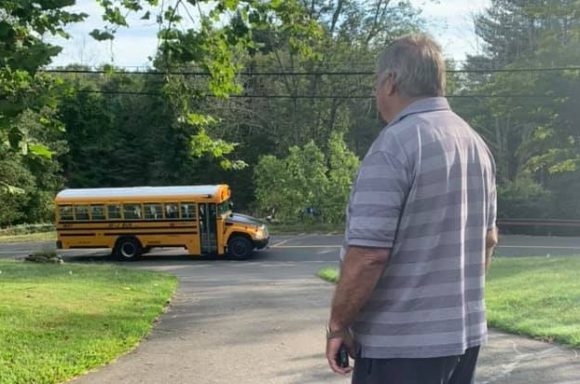
Don Gerber of Lyme looks wistfully at the bus heading off to Lyme-Old Lyme Schools with his grandson and daughter aboard. Photo by Emily Gerber Bjornberg.

LYME-OLD LYME — It was the first day of the new school year for Lyme-Old Lyme (LOL) Schools yesterday although, due to the COVID-19 situation, parents had the option to keep their children home and have them follow a virtual program of learning. “We are excited to welcome our students back both in our classrooms or from their homes,” said Ian Neviaser, Superintendent of Lyme-Old Lyme Schools in a press release.

There was a definite air of anticipation for all the students as they entered their respective schools again for the first time since March 13, and in the end, only 10 percent of the 1,300-strong Pre-K through Grade 12 student body opted to stay home for their schooling. That percentage was achieved despite enrollment increasing this year, which had necessitated the addition of an additional Pre-K class; new students had also joined LOL Schools at every grade level.

Frequent cleaning, physical distancing and additional protocols are in place throughout all the schools. Meanwhile, social and emotional health is being emphasized, particularly in the first weeks of school as students adjust to a new normal.

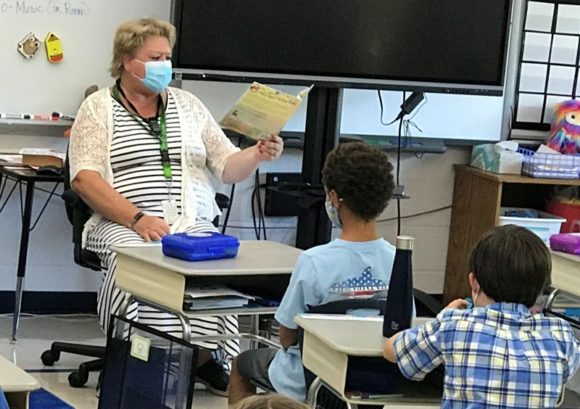
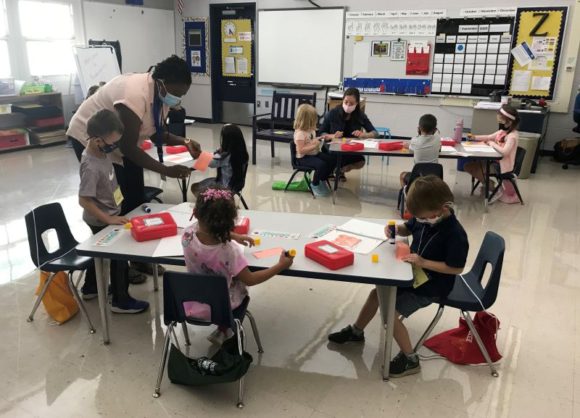
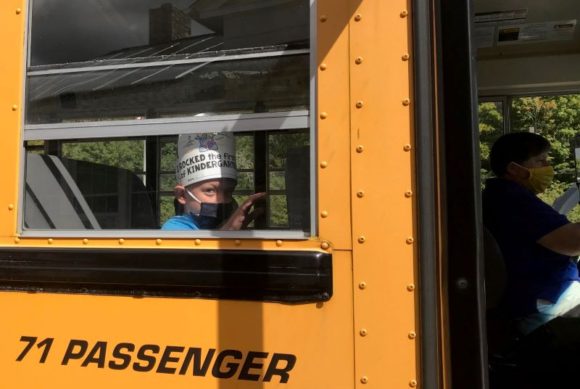
“This year may look different, but what hasn’t changed is the dedication and commitment of our teachers, students and staff,” said Neviaser in the press release. Perhaps the most visible difference is that all administrators, staff, faculty members, and students must wear masks throughout the day … including when reading to students at Mile Creek School (see photo above) …

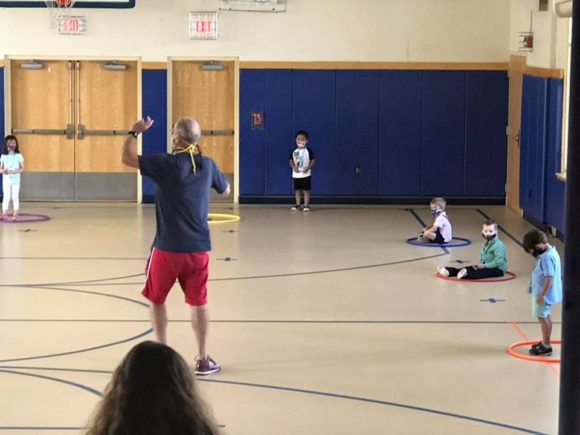
… or in the Center School gym (see photo above), where Tim Gavin is instructing Pre-Kindergartners during a physical education class.

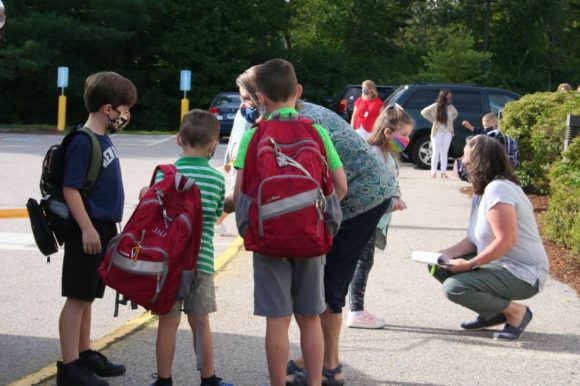
Masks are now worn throughout the school day in elementary school (see photo above) …

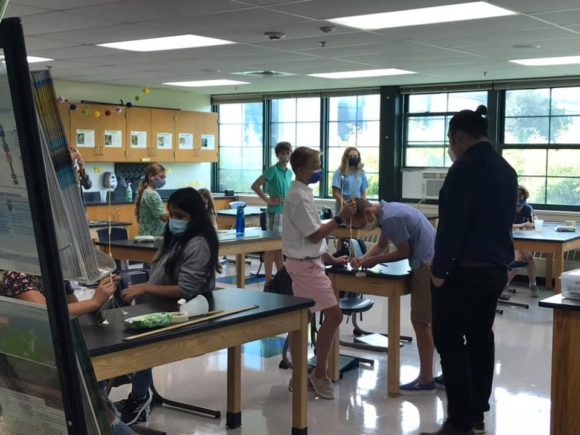
… in middle school (see photo above) …

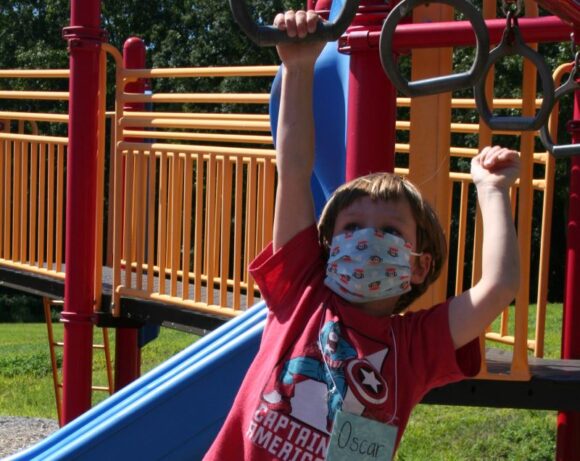
… and even at recess!

Photo by Michelle Tappett.

And then it was time to board the bus home, in this case (see photo above) from Lyme School.

Asked how the first day went, Neviaser told LymeLine.com exclusively, “We had a great first day and feedback from staff has been incredibly positive. Students did a great job of wearing masks and following new rules.”

Photo by Emily Gerber Bjornberg.

He added, “Dismissal was a little bumpy with some traffic issues, but we are looking at ways to improve the process.”

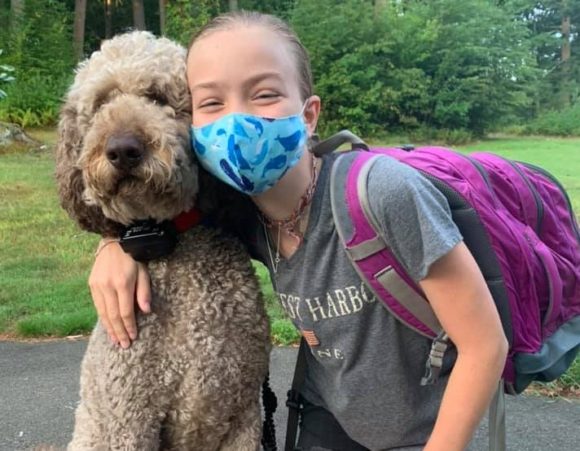
These two photos (above and below) are Elliot (age 14) and his sister Anna (age 10) of Lyme, grandchildren of Don Gerber (see first photo), and children of Emily Gerber Bjornberg and Jason Bjornberg.

Photo by Emily Gerber Bjornberg.

Op-Ed: A Gardener, “The Gardener’s Tale,” and Structural Racism in Our Towns

Editor’s Note: The author of this op-ed, Joseph CL Merola,  MD, MPH, is an active member of the Old Saybrook March for Justice.  He lives in Old Saybrook and is a semiretired Obstetrician and Gynecologist, having most recently practiced, taught and served as Chairman of the Department at the St. Luke’s University Health Network in Eastern PA and Western NJ. Dr. Merola also has been a Clinical Associate Professor at the University of Pennsylvania School of Medicine, and Clinical Professor at the Temple University School of Medicine. He has an abiding interest in the public’s health, particularly for women and children, and for distributive justice in health care.           

Photo by Vince Fleming on Unsplash.

At this time of year, I’m in my glory as an avid gardener in Coastal Connecticut.

So grateful to my Italian father and grandfather for sharing and showing, by example, a gardener’s passion  (and frankly requiring  me to participate by helping to sow, nurture, weed and pick!) Arising from that hands-on education comes a now more natural understanding of the elements of the growing environment for seeds and plants … temperature, soil quality, water, sun and organic principles. 

So here we are again, in early September, with an abundant harvest of herbs, greens, root vegetables, peppers and array of tomato varieties, sizes and colors. And we can still look ahead to corn, squashes and pumpkins for the fall.  How wonderful! But, giving credit where credit is due, these “fruits of one’s labor”, and their quality, begin and depend on the all-important environment.

So, let’s consider for a moment “The Gardener’s Tale,” an allegory, first appearing within an article in the American Journal of Public Health in 2000, authored by Camara Phyllis Jones, MD, PhD, MPH, the former President of the American Public Health Association and a Professor at the Harvard School of Public Health. (An Abstract, and access to the full text is available at https://www.ncbi.nlm.nih.gov/pmc/articles/PMC1446334/ for further reference.) 

She develops a context for understanding racism on three levels. First is Personally Mediated Racism, i.e. intentional or unintentional prejudice and discrimination, including acts of omission and/or commission, structural boundaries, and societal condonation.

The second is Internalized Racism, wherein the members of the race in question accept notions of their own lesser intrinsic worth and ability.

The last is the so evident Institutionalized Racism, shown by sub-optimal material conditions (access to quality housing, education, employment, a clean environment and particularly health care). Also included in this category is similarly differential access to power, resources, information, and a “voice.”

As a demonstration, Jones presents the referenced allegory of a Gardener with two flower boxes, one with fresh, rich soil (and beautiful red flowers) and the other, unknowingly at first, with old, poor quality soil (and similarly poor quality pink flowers.) 

Personally Mediated Racism is reflected in the Gardener’s discard of the scraggly pink blossoms before going to seed, or removing pink scattered seeds that might be blowing into the more fertile soil. 

Internalized Racism here relates to the pink flowers telling the bees not to pollinate them with pink pollen, as they prefer red pollen, and thus red flowers.

The allegorical equivalent of Institutionalize Racism is most poignant … with the two flower boxes historically keeping the soils, seeds and flowers separate by color, the oversight of the gardener in not addressing the soil differences in the first place, and the belief that red flowers were intrinsically better!

This summer a light has dramatically been shone on our own “gardens”, in our own shoreline towns. The marches for social justice, arising from the Black Lives Matter movement, have grown in size and number. Privileged people, not directly impacted by racism, have materialized and raised their voices against racism. This has been a powerful maker! 

Towns across Connecticut, including New London, have adopted resolutions claiming that “racism is a public health crisis,” and used the opportunity for town hall conversations to bring about change. Why is all quiet in the Old Saybrook, Essex and Old Lyme Town Halls, despite their own residents’ protests and affirmation?    

Clearly, “the Gardener” here is our local government. They have the power to consider, act, and openly declare racism as a reality, a grave concern, and a public health crisis. They have the power to allocate more resources to mitigate this dilemma. Among other outcomes, these could take the shape of education, public culture, affordable housing and accessible healthcare. 

But, why are they so quiet? 

We need open recognition, and declaration: our various garden environments for growth must be optimized, and not different. Our racial soil quality, particularly new and fertile soil, is needed to permit pink flowers to flourish, as well as red. Then, flowers of all colors can be recognized equally, and have the same opportunity for contributing to a brighter and more meaningful life.