Superintendent/Student Recognition Award Presented to LOLHS Seniors McGlinchey, Fava

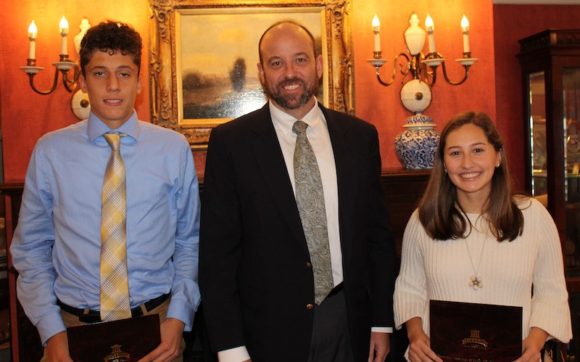
Lyme-Old Lyme Schools Superintendent Ian Neviaser stands between Brynn McGlinchey and Nick Fava after they had received CAPSS Student Recognition Awards

Brynn McGlinchey and Nicholas Fava, students at Lyme-Old Lyme High School, have been awarded the Connecticut Association of Public School Superintendents’ (CAPSS) Superintendent/Student Recognition Award for leadership service to the school, academic prowess relative to ability, and service to others in the community at a ceremony held Nov. 26, at Saybrook Point Inn.

Ian Neviaser, Superintendent of Schools of Regional School District 18, made the presentation as part of a program designed by school administrators to recognize students who have served their schools and communities while maintaining good scholastic progress.

The Superintendent/Student Recognition Program awards a Certificate of Excellence at the discretion of the local superintendent of schools according to a distribution formula set for all state school districts. Awards are generally given during American Education Week in November in order to provide a meaningful focus for each school district and to enhance the quality of the certificate. 

Brynn McGlinchey is a bright young woman in every sense of the word. She is an intelligent, high-level student while taking an extremely competitive course load. She is a spirited member of the school community and involved in many activities at school. She gets others to be interested, enthusiastic and involved.

McGlinchey’s style of leadership is calm and deeply thoughtful; she steps to the forefront representing her peers while serving on the Lymes’ Youth Service Bureau Board of Directors and as the student representative of the Board of Education. She is proof that leadership is not about volume but rather the quality of one’s actions and the ability to foster compromise and moving forward effectively.

McGlinchey’s vision of the world values our community but reaches much, much wider and it will take her far. 

Nicholas Fava has been involved in leadership and service at the high school since his earliest days of his freshman year. He is vice-president of his class and can be counted on to show up and get the job done, whatever the task may be.

A three-season athlete, Fava is a key member of Techno-Ticks Robotics Team and the Community Service Club.

Fava can seem quiet by nature, but is an excellent listener, assessing the situation and feedback around him to know how the group needs to proceed. He is academically talented, conquering everything from honors math to college-level Spanish. We have yet to see anything slow Nick down, and we are proud he has come so far so fast.

CAPSS, the statewide school superintendents’ professional organization, is based in West Hartford and provides professional development, personal support, statewide conferences, legislative information and educational services to its membership.

For more information about CAPSS, contact Ian Neviaser at neviaseri@region18.org or 860-434-7238.

LYSB Hosts Gingerbread House Family Workshop This Afternoon

Lymes’ Youth Service Bureau (LYSB) hosts a Gingerbread House Family Workshop this afternoon from 12:30 to 2:30 p.m. 

In keeping with all the years this annual tradition has been followed, LYSB will supply all the ingredients for the houses, while you simply bring your camera, create a masterpiece … and leave the mess behind!

The fee is $10 per participant.  Space is limited. 

For more information, call 860-434-7208 or visit the LYSB website.

Talking Transportation: Trucker Shortage Takes Its Toll

What does the future hold for the trucks on our highways? Photo by Rhys Moult on Unsplash

As if crumbling bridges and pot-holed highways weren’t enough to worry about, now America’s transportation network is facing a new crisis:  a shortage of truck drivers.

According to the American Trucking Association (ATA), trucks carry more than 70 percent of all domestic freight, bringing in $719 billion in revenue.  It’s trucks, not trains, that deliver our Amazon purchases and fill the shelves of our favorite big box stores for the holidays. So while we hate to drive behind them on our highways, we love what trucks deliver.

But now, of the existing half-million truck drivers in the US, demographics are taking their toll as more and more retire each year, leaving those jobs unfilled. The ATA estimates the industry needs 51,000 new truck drivers.  And new candidates are not stepping forward.

Why?  Well, the ATA says Gen Z’ers don’t like the lifestyle.  They don’t want to spend long, lonely days or weeks doing long-hauls, eating bad food and sleeping in their rigs.  Even money, like $50,000 signing bonuses, isn’t attracting them.

The average trucker makes $59,000 and drivers for private fleets can make $86,000. But lengthy, expensive training courses present a roadblock to immediate recruitment.  And newly-mandated technology tracking drivers’ time on the road is exacerbating the problem.

Drivers are only supposed to drive 11 hours of every 14 hours a day, but many used to fudge their paper log-book records because they got paid by the mile.  Since last December, electronic logging has been the law, so the safety rules are impossible to circumvent.  Of course, nobody wants tired drivers on the road, but in the cause of safety, truckers are losing efficiency.

Where will the industry find new drivers?  Well, women still only represent about 6 percent of all drivers.  And minorities have seen their numbers increase 12 percent in the past year.  And the industry is also seeking a reduction in the minimum driving age from 21 to 18.

What’s this all mean to us as consumers?  Higher costs.

Amazon saw a 38 percent increase in shipping costs in the first quarter, forcing it to raise its (unlimited free-shipping) Amazon Prime membership fee from $99 to $119 a year.  Across the industry spectrum, shipping rates are rising.

But the real solution will probably be self-driving trucks.

That’s why big companies like Waymo (owned by Google), Tesla and Uber, as well as truck-builders like Freightliner and Volvo are investing heavily in the autonomous technology.

Not that we’ll be seeing driverless trucks on Connecticut interstates anytime soon.  There’s probably too much congestion to make them practical.  But there are vast stretches of interstates in “fly over country” out west where self-driving trucks make perfect sense, delivering truckloads of products to automated warehouses where robots will unload them.

Automating trucking may be good for the industry but it certainly doesn’t help with recruitment.  Who wants to sign on for a career knowing full well they may be replaced by a robot?

Sociologist and 13-year trucker Steve Viscelli says the solution is in changing the system:  paying truckers for actual hours on the road (not just mileage), including those times when truckers must waste hours or days waiting for a new load.

Whatever the solution, it’s clear who’ll end up paying:  consumers.

Posted with permission of Hearst CT Media.

Jim Cameron

About the author: Jim Cameron is founder of The Commuter Action Group, and a member of the Darien RTM.  The opinions expressed in this column are only his own.  You can reach him at CommuterActionGroup@gmail.com

For a full collection of  “Talking Transportation” columns, visit www.talkingtransportation.blogspot.com

Con Brio Presents Second Holiday Concert in Old Lyme, This Afternoon

How do you get into the holiday spirit? Why not ease into the season by experiencing the joy of uplifting seasonal music at a Con Brio Choral Society December concert this afternoon, Sun., Dec. 9, at 3 p.m. at Christ the King Church in Old Lyme. You’ll hear glorious choral music, trumpet fanfares, and even get the chance to sing your favorite carols along with the singers at the concert’s end.

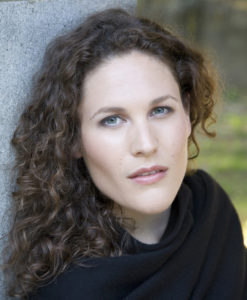
Danielle Munsell Howard, soprano.

Three professional soloists – Danielle Munsell Howard, soprano; Louise Fauteux, soprano; and Allison Messier, mezzo-soprano – will join the 66 voices of Con Brio and the Con Brio Festival Orchestra under the baton of Dr. Stephen Bruce. To open the concert – and herald the holiday season – four trumpets will perform Jan Zelenka’s Fanfares for four trumpets and timpani.

The choral program that follows will feature two baroque pieces performed with soloists and orchestra. The first piece, one new to most, is Czech composer Jan Zelenka’s Te Deum for double chorus. A new edition of this long-lost Baroque masterwork prompted Con Brio to program it. Zelenka knew J.S. Bach and at least once, stayed at Bach’s house in Leipzig, and also knew Telemann and other famous musicians of the time.

The other baroque piece is likely more familiar, the first movement of J.S. Bach’s Cantata 63, Christen ätzet diesen Tag, composed for the First Day of Christmas, 1713.

Soloist Danielle Munsell Howard, soprano, has been praised by Opera News Online for her “bright, pretty timbre and remarkable facility.” She has performed as soloist with the American Bach Soloists, Amherst Early Music Festival, Boulder Bach Festival, the Yale Collegium Soloists, Princeton Pro Musica and a number of contemporary choral and chamber ensembles. Her New York debut singing Melagro in Gluck’s La Corona at Merkin Hall was enthusiastically received, critically acclaimed in the New York Times and recorded live for Albany Records.

Louise Fauteux, soprano

Soloist Louise Fauteux enjoys a diverse career in the arts devoted to education and performance. Her versatility as a soprano includes a performance of Peer Gynt with the New York Philharmonic and actor John De Lancie and a tour of Venice with DiCapo Opera and the Fairfield Chorale. She has also performed as soloist with New Haven Chorale, Concora, the Farmington Valley Chorale, the Connecticut Master Chorale and the Connecticut Chamber Chorus.

Soloist Allison Messier, mezzo-soprano, has performed as an oratorio soloist in numerous major works including the Mozart Requiem with the Clearlakes Chorale in the New Hampshire Lakes Region, the Rachmaninov Vespers with the Boston Russian Choir; Dvorak’s Mass in D and Mass in Time of War with the Bermuda Chamber Choir. Her opera credits include Dido in Dido and Aeneas and La Zia Principessa in Suor Angelica with Piccola Opera NH, as well as other works.

As in past years, Con Brio will sing two pieces in the round while the singers are arrayed around the Sanctuary. The first piece is Quem Vidistis Pastores by Richard Dering and the second, Hodie Christus Natus Est by Giovanni Gabrieli. For many regulars, the eight-part early music pieces sung in the round are a highlight of each Con Brio concert.

Allison Messier, mezzo-soprano

Also on the program is Ola Gjeilo’s Serenity (O Magnum Mysterium) and Franz Biebl’s Ave Maria, both written for eight parts, Mary Had a Baby, arranged by Craig Courtney, I Saw Three Ships arranged by Mack Wilberg, and Sir Christémas, arranged by William Mathias.

The concerts are on Friday evening, Dec. 7, at 8 p.m. and on Sunday afternoon, at 3 p.m. at Christ the King Church at 1 McCurdy Lane, Old Lyme, CT. Tickets are $30 and can be purchased in advance at www.conbrio.org or by calling 860-526-5399.

Con Brio Choral Society is a classical, all-auditioned chorus drawing its 66 singers from 15 towns extending along the Connecticut River from Old Saybrook to Deep River and East Haddam and along the shoreline from Guilford to Mystic.

The group performs with the Con Brio Festival Orchestra and professional soloists under conductor Dr. Stephen Bruce.

Letter to the Editor: Thoughts, Concerns, Suggestions on Halls Rd. Improvement Plan

To the Editor:

Christina and I attended both public meetings hosted by Old Lyme’s Halls Road Improvements Committee, and conducted by members of the Yale Urban Design Workshop. Yale presented the Committee’s vision statement and several conceptual renderings of what fully realizing that vision might yield. The article in the New London Day accurately summarized the vision.

The audience was skeptical of the immense breadth and scope of that vision; – requiring twenty- five or more years to complete.  Several concerns were raised about cost and the impact on taxes.

We left with a few thoughts and concerns. It was not apparent to us that current Halls Road business owners and the professionals occupying office space had participated to any extent in developing that vision. It is absolutely important to get their buy-in. Essex Bank did state that any of their future development would take Old Lyme’s plan into consideration.

We found Alan Plattus’ presentation to be a bit glib. This is important stuff, and some of the vision could be lost in presenter style. Also, know the names of our local landmarks, especially if they factor into the plan. (i.e. it’s the “Bow Bridge” that used to cross the Lieutenant River). But, after all; they’re Yale, not Harvard.

Our suggestion: parse the plan into achievable shorter- range projects that will yield some early successes. Start with the hiking/biking paths along the Lieutenant River, rebuild the foot bridge, and create the new Halls Road village green.

Sincerely, 

Thomas D. Gotowka,
Old Lyme.