Editor’s Note: We are watching events in Paris today with deep dismay. Nicole Logan’s topical column gives her opinion on the background to the tense situation unfolding there.
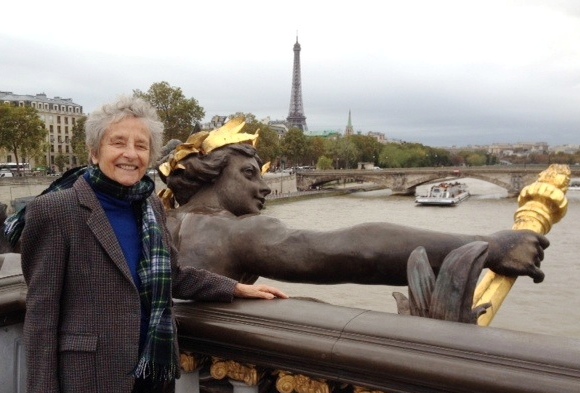
Nicole Prévost Logan
France is in a tailspin.
The crisis started with the fury against the seven-cent tax hike on diesel fuel. The movement of the gilets jaunes (yellow vests) spread like wildfire through the social networks as they blocked the roads all over France. For three weeks in November, the demonstrators congregated in Paris each Saturday. Their confrontation with the police culminated in scenes of violence, which shocked the world: Place de l’Etoile obliterated by the smoke of tear gas, graffiti desecrating the Arc de Triomphe, and a policeman being attacked near the monument.

Riots have been occurring in cities all over France but are centered on Paris. File photo by Randy Colas on Unsplash
Since the Champs Elysées and the Place de la Concorde were cordoned off by the police, the casseurs (hooligans) spilled over Avenue Kleber and Avenue de la Grande Armee, where they looted shops and set fire to six buildings. Hundreds were wounded and 412 demonstrators arrested. By the day’s end, a picture of desolation remained with the smoldering remains of 35 cars and streets littered with whatever was used as a projectile by the radicalized mob.
The tension is mounting. The government seems unable to contain it. The gilets jaunes are widening their demands to lower all taxes, raise salaries and retirements as well as the dissolution of the National Assembly. At this point they will not stop short of the resignation of Macron.
It is an unprecedented, unstructured popular anger directly aimed at the president. The opposition parties – with much glee – are surfing on this tsunami.
The government is making concessions to meet people’s demands. Unfortunately these concessions always arrive too late. The more the government concedes, the more the gilets jaunes demand, apparently comforted by their success. On Dec. 4th, Prime Minister Edward Philippe announced a six-month freeze on fuel and utility taxes followed by their cancellation the same evening. And the price tag of this measure? Four billion euros. This was the first admission of defeat by the Macron team – a measure very hard to swallow since it went against its own environmental principles.
What are the causes of this crisis? Mistakes made by a president attempting to reform the country from the bottom up? Ungovernable French people? Perhaps a combination of both.
During the first 16 months of his mandate, Macron undertook structural reforms to turn France into a modern and competitive country. These reforms dealt with political institutions, the labor code, the impressive — but somewhat antiquated — railroad system or SNCF (Societé Nationale des Chemins de Fer), crowded universities by abolishing a chaotic and ridiculous entrance selection by lottery.
But French people do not like changes and are attached to their privileges, tax niches and social benefits acquired over decades. An attempt at reforming the system was bound to face an uphill battle .
All these reforms were part of a general plan — a vision — which the president had placed at the core of his electoral campaign and on the basis of which he had been elected. in 2017. He gave himself five years to achieve his goals.
Unfortunately for him the people wanted immediate results. He wanted to raise the French economy and society from the bottom up and encourage the active population. This was different from a “trickle down” process, but was not perceived as such by the French. Soon the label,”President of the Rich,” was firmly attached to him.
Macron’s strategy was to consult with trade unions, elected local officials or business people at the Elysée Palace before making any decisions.
Apparently tetanized by the fast pace of the president’s method, the population seemed at first to accept the reforms. But gradually, overwhelmed by the sheer number of new regulations, taxes, or reforms facing them them every morning, its discontent started as an underground rumble until it finally exploded. The last drop was the additional tax on diesel.
Overall, the French population is justified in its revolt against an unbearable tax burden. France is the world number one champion of taxes with 48 percent of its Gross Domestic Product coming from tax revenues versus 40 percent in the other European countries and less than 30 percent in the US. One of the buzz expressions among the gilets jaunes is “ras le bol” (meaning “we are totally fed up.”) There are hundreds of hidden taxes in France. For example, did you know that here, one has to pay a tax on “oiseaux de companie” (pet birds)?
The French have a special craving for social justice as shown in their attitude toward the Impot de Solidarite sur la Fortune (ISF) or wealth tax. Macron had split that tax between property wealth — which he retained — and financial holdings such as stocks. In order to encourage investments — particularly on green energy — he created a “flat tax” of only 30 percent. What he did was misunderstood by the public opinion and may be scrapped soon.
Today Macron’s room to maneuver is very small. Since the opposition has no leader to replace him, where is the country going? Cohn Bendit, the hero of May 1968, the largest French uprising in the past 50 years, gave a frightening prognosis, “I see the present movement in France as a possibly the first step toward totalitarianism, headed by an illiberal despot.”
The situation is evolving by the hour. More demonstrations of force are already planned …
Editor’s Note: This is the opinion of Nicole Prévost Logan.

Nicole Prévost Logan
About the author: Nicole Prévost Logan divides her time between Essex and Paris, spending summers in the former and winters in the latter. She writes a regular column for us from her Paris home where her topics will include politics, economy, social unrest — mostly in France — but also in other European countries. She also covers a variety of art exhibits and the performing arts in Europe. Logan is the author of ‘Forever on the Road: A Franco-American Family’s Thirty Years in the Foreign Service,’ an autobiography of her life as the wife of an overseas diplomat, who lived in 10 foreign countries on three continents. Her experiences during her foreign service life included being in Lebanon when civil war erupted, excavating a medieval city in Moscow and spending a week under house arrest in Guinea.
 The Old Lyme Children’s Learning Center (OLCLC) presents “Homes for the Holidays” House Tour of Old Lyme on Saturday, Dec. 8. The tour begins at Old Lyme Town Hall, located at 52 Lyme Street, and will feature a Holiday Boutique from 10 a.m. to 4 p.m.