Author, Inspirational Speaker Shares Her Story of Survival, Hope, Forgiveness at CTK Church Tonight, 7pm

Immaculée Ilibagiza

Author and speaker Immaculée Ilibagiza will appear at Christ the King Church in Old Lyme on Friday, April 21, to share her inspirational story of faith and forgiveness amid the horrors of widespread violence.

Ilibagiza is a survivor of the 1994 Rwandan genocide that took the lives of nearly one million Tutsis. Men, women, and children, including her entire family except for one of her brothers, were massacred at the hands of Hutu marauders. Ilibagiza found shelter at a pastor’s home, where she and seven other women hid in a 3-by-4-foot bathroom for 91 days.

During those months of unimaginable suffering, she found her faith, taught herself English, and most incredibly, committed herself to a life of peace, hope, and forgiveness, even for those who had murdered her family. She has gone on to work at the United Nations, receive five honorary doctoral degrees, and write seven books about her faith and her life journey, and she is the recipient of the Mahatma Gandhi International Award for Reconciliation and Peace.

“Although the genocide in Rwanda occurred 23 years ago and half a world away,” says Fr. Walter Nagle, parochial vicar at Christ the King Church, Immaculée’s experience is still relevant to us today, here in Connecticut. “There is always a danger of history repeating itself when people lose sight of their common humanity. Clearly there are divisions in our country on issues of race, religion, politics — that never reach the level of violence of Rwanda — but who can say that it will never happen again? In a world that so often seems to be absent of God, Immaculée’s story will be a reminder that God is, indeed, present and active in our lives.”    

Ilibagiza will share her story of survival, faith, and forgiveness at Christ the King Church in Old Lyme at 7 p.m. on Friday, April 21.  This event is free and open to the public.  (A free-will offering will be taken.)

Christ the King Church is located at 1 McCurdy Road, Old Lyme.  The church is accessible and offers ample parking. For more information, visit www.christthekingchurch.net, or email ctkoldlyme@aol.com.

Old Lyme Town Budget Calls for 3.26 Percent Increase, Requires 0.55 Mill Rate Increase to 21.75

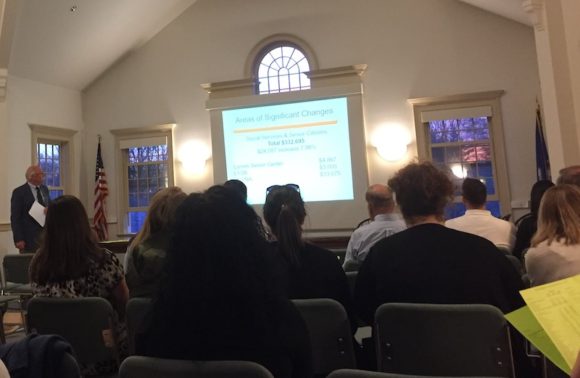
Old Lyme Board of Finance Chairman Andy Russell presents the Town’s proposed 2017-18 budget at Monday night’s meeting.

Around 30 residents showed up for Monday night’s public hearing in the Old Lyme Town Hall Meeting Room of the Town’s proposed budget of $36,355,031 for the 2017-18 fiscal year.  The proposed budget presented by Old Lyme Board of Finance Chairman Andy Russell, which includes $26.5 million for Lyme-Old Lyme (LOL) Schools, represents a 3.26 percent increase over the 2016-17 approved budget.

The Towns of Lyme and Old Lyme divide the LOL Schools’ budget of $33,634, 371 between them based on percentages representing the respective number of students that each town has attending LOL Schools. The total LOL Schools budget for both towns reflects a 0.49 percent increase over the current year, but when translated exclusively to the Old Lyme budget, the sum represents a 3.65 percent increase over the current year’s figure.

Old Lyme’s general government and capital budgets, which make up the balance of the Town budget (excluding the school budget), total $9,819,829 representing a 1.84 percent increase over the current year.  This number comprises $8,774,129 for general government and $1,045,700 for capital spending.

Russell summarized key increases and decreases in the the two sections of the budget, noting that regarding grants to non-profits , “The only one to receive an an increase is the Old Lyme Library.”  He commented on the subject of Debt Service that “The only debt that the Town has relates to the Town Hall,” and that the period remaining on the debt is seven years.

The two largest single items in General Government capital expenditures are replacement of the Cross Lane Playground equipment ($150,000) and renovations to the bathrooms at Hains Park (also $150,000.)

The former expense was the reason that many in the audience attended the meeting.  Stacy Winchell, Lyme-Old Lyme Junior Women’s Club President, which has been working to raise money for the playground, commented in an email after the meeting, “As we have been working diligently for three years in bringing a safe and all-accessible playground to Cross Lane, we wanted to represent to the public that we continue to support and contribute to the return of a playground at Cross Lane.”

Renovations to the Hains Park bathrooms were originally included in the boathouse plans but now needed additional funding.

Another project which received increased funding ($10,000) was a feasibility study to determine the viability of a sidewalk from Town Woods Park to Rte. 1/Boston Post Rd.

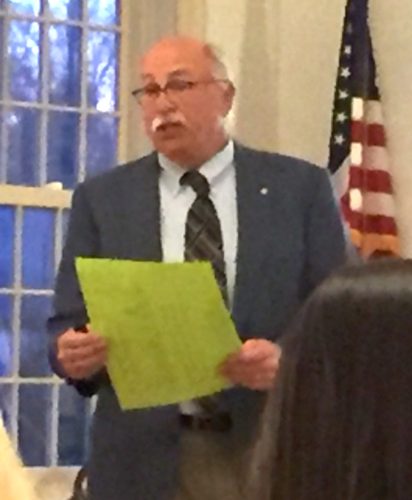
Old Lyme Board of Finance Chairman Andy Russell answers a question about the Town’s proposed 2017-18 budget at Monday night’s meeting.

Russell said the board of finance was proposing to take, “$800,000 out of surplus to soften the blow to taxpayers,” but adding, “$600,000 was taken out of surplus for each of the last two years … but not needed last year.”  Adding, “We probably won’t need it this year,” he noted that the mill rate for 2017-18 is scheduled to increase from 21.2 to 21.75 mills, an increase of 2.58 percent.

Russell cited three examples of how the mill rate will impact property owners.  The first was for a house appraised at $347,200 and assessed at $243,000.  This homeowner paid $5,152 in property taxes in 2016-17, but will pay $5,285 under the proposed mill rate next year.

His second example related to a house appraised at $540,200 and assessed at $378,100.  This homeowner paid $8,016 in property taxes in 2016-17, but would pay $8,224 next year under the proposed budget.

Russell’s consistent message throughout the presentation was that the board always pursues a course that errs on the conservative side.  As a result, he explained, the town enjoys the highest credit rating possible.  Additionally, he noted that the board uses a predicted collection rate on taxes of 98.25 percent whereas the rate is, in fact, typically over 99 percent.

When public comment opened, one resident asked if the cameras being installed in police cars would be transferable between vehicles and Russell  confirmed they would.

Former Old Lyme First Selectman Timothy Griswold, who is now town treasurer,  stated, “The Hains Park bathhouse is a controversial issue.” He agreed the bathrooms “need to be fixed,” but said, “The question should have gone to a Town Meeting … to be aired fully.”  Griswold suggested it was now, “… lost in the budget.”

Russell responded that the question had been much discussed by the board and in the end, members had decided that since, “The Town had approved bathrooms and the boathouse,” the board should now add the necessary funds for the bathrooms into the budget.  David Kelsey commented from the floor that this new sum to fund the bathrooms is now, “… buried in the budget.”  Judith Read also questioned the boathouse project funding asking whether there was a surplus in hand on the boathouse project and if monies for the bathrooms were originally included in the boathouse project.

After the close of public comment, Russell said the proposed budget will now go forward for approval by residents at a town meeting to be held May 15.

Prior to that, Lyme and Old Lyme residents will vote separately in a referendum on the Lyme-Old Lyme Schools $33.6 million budget to be held May 2. Voting will take place from 6 a.m. to 8 p.m. in both towns and the results from each town are combined to determine if the budget has passed.  Voting in Old Lyme will be held in the Cross Lane Firehouse.

Letter From Paris: Paris, Berlin Need to Work Together as the EU Determines its Future

Nicole Prévost Logan

For the French, Germany can be a source of admiration or of irritation . The Franco-German “couple” has been the pillar of the European Union (EU.)   The couple worked beautifully until the departure respectively of Francois Mitterand in 1995 and Helmut Kohl in 1998.  Today more than ever, the two countries need to spearhead initiatives to bring about a new Europe.

Marcel Fratzscher , president of the German Institute of Economic Research, writes on April 6, “Without a strong France, Europe cannot pull out of the crisis. We need France to play the role of a leader with a vision of the European project.”  Without agreeing on everything, the two countries have a lot to learn from each other.

Angela Merkel

Chancellor Angela Merkel, head of the Christian Democratic Party (CDU), will run for a fourth mandate next September.  Hans Stark, professor of Germany civilization at the Sorbonne, believes  the Germans have not had enough yet of Merkel and will elect her again, possibly for the last time.  Her hold on the people is still strong as showed in the CDU winning 40 percent of the votes in the recent Saarland elections. The Social Democrats (SPD) tried to form a coalition with the Left (die Linke) and the Greens, but failed.

Merkel is pragmatic in her policies.  For instance she moved from the center to the left (stepping on Social Democrats’ turf) by adopting ideas attractive to the left such as the acceptance of same-sex marriage or opposition to nuclear arms.  In a nutshell, she remains in the center but maintains a slight tilt toward the left. 

Her longevity is explained by her ability to create consensus.  She has to be an acrobat to lead a country made up of 19 States  (Länder), six of them having come from East Germany and 13 from West Germany. 

It was the intention of the Allied forces occupying Germany to create a multitude of “checks and balances” in order to decentralize power by adding to the number of Länder already existing before the war.  Sailing on the Danube one can see the splendid architecture left by the powerful Prince-Bishops ruling Wurzburg or Bamberg länder.  The voting system by proportional ballot creates the need for coalitions and hence a fragmentation of power. 

Martin Schulz

The main opponent of Merkel in next September’s election will be Martin Schultz, who has just been elected as the president of  Social Democrats (SPD) with 100 percent of the votes. The SPD plummeted after the unpopular reforms made by Gerard Schroder  but has now bounced back. Today the CDU and SPD are running neck and neck, each with about 33 percent of the electorate.

The right wing populist party “Alternative for Deutschland ” (AfD)  represents  9 percent of the vote.  It was not founded until 2013.  Since the  end of the war, Germany has had to live with certain taboos and one of them, was the aversion  to any political system reminiscent of fascism or communism.  Today the former East Germany is more populist than West Germany.  By way of example, in the last elections in Saxony-Anhalt, AfD received 25 percent of the vote. 

Germany is an economic success story, but at what price?  The system, called Hartz I-IV, implemented by Gerard Schroder in 2003, consisted of tough labor reforms and imposing sacrifices on the work force at a time when Germany was called the “sick man of Europe.”

But the results were indeed striking:  unemployment went down by half and is now only 5.9 percent,  exports have risen by 6 percent creating a trade surplus of 250 billion, and growth is at 1.9 percent.  Alexandra Spitz, a German professor of economics, published an article in the Harvard Business Review on March 13, 2017, titled, “The Real Reasons why the German Labor Market is Booming.”  In summary, she explains these reasons are that wages have not increased as much as  productivity; collective bargaining between employers and employees is decentralized, and workers have accepted lower salaries and flexible labor conditions.

Some of the French, who have a generous (perhaps, too generous?) “social model,” believe Germans have very low unemployment, but also millions of “poor workers” with many part-time, low-paid and short-duration jobs.  Other French people do not agree and are impressed by the German performance and willing to borrow some of their ideas.

Thierry Pech, head of the Terra Nova Think Tank, notes, “There has been an internal devaluation of the cost of labor because of the “poor workers.”  This policy can be called “mercantilism.”  It was used to boost the competitiveness of both industry and exports.  This caused  a problem for the European neighbors.  Germany is preoccupied with its own national interests and has displayed a lack of cooperation with others.  “Professor Hans Stark argues, “In 2004, the Eastern European countries, which joined the EU had low wage-economies.  This time it was Eastern Europe’s turn to practice mercantile policies toward Germany.” 

“Qualified workers have access to professional training at any time,” Professor Stark remarks. “Those persons, less qualified but having completed their “cursus,” can benefit from apprenticeships.  Those, without any qualification, fall to the bottom of the pile.  German industry is always looking for qualified workers.  In the sectors where labor is not qualified – construction, services, agribusiness – the salaries remain low.  This may constitute a problem for French farmers for instance.”  A minimum wage was introduced in 2015.

Sigmar Gabriel

Sigmar Gabriel, former president of SPD and now German minister of foreign affairs, says, “Let us stop thinking we are the cash cow in relation to the European budget.  We have also profited from Europe, particularly when the 1999 introduction of the Euro presented a devaluation from the Deutsch Mark.”

Germany has been cautious not to increase its military power (another taboo.)  The Parliament (Bundestag) has blocked the increase of the army (Bundeswehr.)  The government  abstained from taking part in the  Libyan campaign.  Now the defense of territory is becoming a priority again.  Four brigades have been deployed to defend the Baltic states from Russia.

President François Holland invited the leaders of Germany, Italy and Spain, to a mini-summit in Versailles on March 6 to discuss European defense.  Soon after, during an informal meeting in Malta attended by several EU leaders, Merkel declared, “There will be a European Union at different speeds.”

Clearly, this seems to preview what Europe may become – a number of core countries of the EU, working together on specific projects.

Editor’s Note: This is the opinion of Nicole Prévost Logan.

Nicole LoganAbout the author: Nicole Prévost Logan divides her time between Essex and Paris, spending summers in the former and winters in the latter. She writes a regular column for us from her Paris home where her topics will include politics, economy, social unrest — mostly in France — but also in other European countries. She also covers a variety of art exhibits and the performing arts in Europe. Logan is the author of ‘Forever on the Road: A Franco-American Family’s Thirty Years in the Foreign Service,’ an autobiography of her life as the wife of an overseas diplomat, who lived in 10 foreign countries on three continents. Her experiences during her foreign service life included being in Lebanon when civil war erupted, excavating a medieval city in Moscow and spending a week under house arrest in Guinea.


Emily Bjornberg to Speak on Financial Durability at Shoreline League of Democratic Women Meeting Tonight

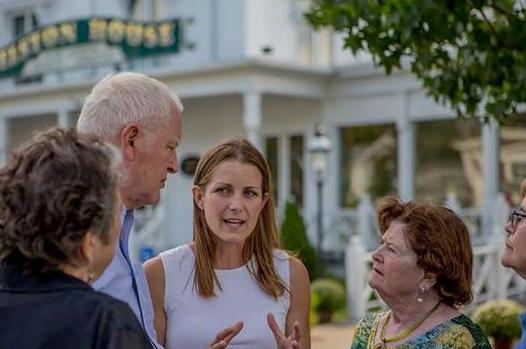
Emily Bjornberg (center) discusses issues with seniors.

Guest Speaker is Emily Bjornberg, Sr. Exec Assistant for Financial Literacy, Office of the Treasurer, State of Connecticut

The Shoreline League of Democratic Women (SLDW) has announced the second guest speaker in their Women@Risk Series covering pressing issues for women and their families. Emily Bjornberg, Senior Executive Assistant for Financial Literacy, Office of the Treasurer, State of Connecticut, will discuss how women can build assets for financial durability. She will also cover Connecticut programs such as CHET (Connecticut Higher Education Trust), CRSA (Connecticut Retirement Security Authority) and ABLE (Achieving a Better Life Experience) trust.

The presentation will be held on Thursday evening, April 20, at 7 p.m., Westbrook Public Library, Community Room on the bottom floor, 61 Goodspeed Drive, Westbrook, CT  06498. An SLDW membership meeting will immediately follow the speaker session. This event is free and open to the Public.

The SLDW (http://www.SLDW.org) is a chapter of the Connecticut Federation of Democratic Women (CFDW), which is a chapter of the National Federation of Democratic Women. The Shoreline League of Democratic Women continues to seek membership from women who live in Clinton, Madison, Guilford, Branford, Killingworth, Old Saybrook, Essex, Westbrook, Chester, Deep River, Old Lyme, and Lyme. SLDW Meetings are held monthly from September through May.

The SLDW is dedicated to educating its members about political and social issues important to women of all ages in the Valley-Shore area. Women in the local district are encouraged to join the SLDW and participate in the organization’s valuable work in the community. Members can be involved in any capacity, whether it is 30 minutes a month, or 30 minutes a year.

As a part of the SLDW educational charter, members will be notified of important pending state and national legislation. For more information, send email to sldworg@gmail.com or contact Belinda Jones at 860-399-1147. Visit their web site at http://www.SLDW.org.

Egyptian Affairs Expert Explains, ‘How the Muslim Brotherhood Lost Egypt;’ Hosted by SECWAC Tonight

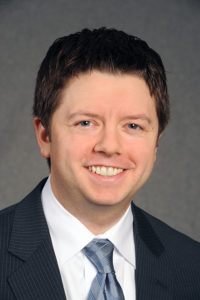
Mark Trager of the Washington Institute for Near East Policy.

The Southeast Connecticut World Affairs Council (SECWAC) hosts Mark Trager – a distinguished fellow at the Washington Institute for Near East Policy and noted expert on Egyptian politics – on Wednesday, April 19, at Connecticut College. Trager will present an address entitled “How the Muslim Brotherhood Lost Egypt”

Trager is the author of “Arab Fall: How the Muslim Brotherhood Won and Lost Egypt in 891 Days,” a recent book that chronicles the precipitous rise to power of Egypt’s Muslim Brotherhood and its sudden demise just a year later. In the book, Trager assesses the current state of Egyptian politics and prospects for the Brotherhood’s reemergence.  Signed copies will be available for sale at the end of the presentation.

Tickets for his presentation are $20 for the general public, and free for area students; tickets can be obtained at info@secwac.org. (Ticket cost can subsequently be applied towards a SECWAC membership.)  The address starts at 6 p.m. at Blaustein Hall at Connecticut College and will be preceded by a 5:30 p.m. reception.

Trager – currently the Esther K. Wagner Fellow at the institute – was in Egypt during the anti-Mubarak revolts and returns frequently to interview leaders in Egypt’s government, military and media. His writings have appeared in the “New York Times,” “Wall Street Journal,” “Foreign Affairs” and “New Republic,” among other publications.

Trager graduated from Harvard University with a degree in government and language citations in Arabic and Hebrew; and subsequently studied at the American University in Cairo as an Islamic Civilizations Fulbright fellow – receiving  his M.A. in Arabic studies with a concentration in Islamic studies. He served as an adjunct professor at the University of Pennsylvania where his doctoral research focused on Egyptian opposition parties.

The presentation is a part of the SECWAC Speaker Series.  SECWAC is a regional, nonprofit, membership organization affiliated with the World Affairs Councils of America.  Its mission is to foster an understanding of issues related to foreign policy and international affairs through study, debate and educational programming.  Through its annual Speaker Series, SECWAC arranges up to 10 presentations a year that provide a public forum for dialogue between its members and experts on foreign relations.

Membership information is available at www.secwac.org.