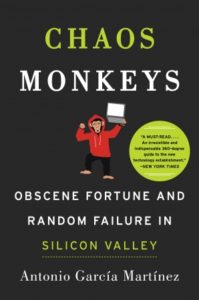
Reading Uncertainly: Chaos Monkeys: ‘Obscene Fortune and Random Failure in Silicon Valley, by Antonio Garcia Martinez

Let’s face it, we are all, every one of us, irrevocably married to this new and all-pervasive technology. We are computers and they are us. So isn’t it time that we learn something more about its source?

Antonio Garcia Martinez takes us on a four-year, inside-tour of Silicon Valley and San Francisco, an autobiography of life in the Valley: long-winded, discursive, sarcastic, cynical, opinionated, and always hilarious.

Martinez, an admitted “gleeful contrarian,” presents fascinating characters with enormous egos, from Zuck (Mark Zuckerberg), Sheryl (Sandberg), and Gokul (Gokul Rajaram); from start-ups to abrupt shutdowns; along with the organizations that shaped his life: University of California-Berkeley, Goldman Sachs, AdCharm, AdGrok, Facebook, Twitter, and, at last, Ayala, a cutter at anchor at Orcas Island in Puget Sound, prior to her escape into the Pacific Ocean. And people as well — since he is also a human being — including several female partners and two young children.

So exactly what is this “Valley?”

“It’s a society,” the author explains, “in which all men and women live in their own self-contained bubble, unattached to traditional anchors like family or religion, and largely unperturbed by outside social forces like income inequality or the Syrian Civil War.

‘Take it light, man’ elevated to life philosophy. Ultimately, the Valley attitude is an empowered anomie turbo-charged by selfishness, respecting some nominal ‘feel-good’ principals of progress or collective technological striving, but in truth pursuing a continual self-development refracted through the capitalist prism: hippies with a capitalization table and a vesting schedule.”

Wow!

His characters display both greed and credibility: they “ … spend their lives in a blizzard of meetings interspersed with email breaks.”

And what are the “chaos monkeys” of his title? They are the “software tools to test a product or a website’s resilience against random serve failures.” Beware the system!

Yet Martinez sees this mélange as being composed of human beings after all, noting, “The tech start-up scene for all its pretensions of transparency, principled innovation, and a counter-culture renouncement of pressed shirts and staid social convention, is actually a surprisingly reactionary crowd.” It is one “wired on caffeine, fear, and greed at all times.” And Facebook, Twitter, and Google have become “all-consuming new” religions. Technology is the Soma of our time.

Despite this cynicism, Martinez cannot help but admire Mark Zuckerberg: “I submit he was an old-school genius, the fiery force of nature possessed by a tutelary spirit of seemingly supernatural provenance that fuels and guides him, intoxicates his circle, and compels his retinue to be great as well …  The keeper of a messianic vision that, though mercurial and stinting on specifics, presents an overwhelming and all-consuming picture of a new and different world … the church of a new religion.”

The author suggests we consider similar leaders in history: Jefferson, Napoleon, Alexander, Joseph Smith, Jim Jones, and L. Ron Hubbard. The leaders and followers in the Valley are simply part of that natural human urge to believe and to be part of something bigger than oneself.

But the Martinez story doesn’t fade into a glowing future. Following Robert Frost’s admonition, the author in early 2016 concludes “a man occasionally reaches a fork in life’s road.”

His last sentence predicts a completely different future: “Thus do I bow off this stumbled-upon stage, hopefully forever, and disappear into the heaving swells of the Pacific Ocean, the only such sanctuary from social mediation we’ll soon have left.”

Sail on, skipper! I give you joy of your decision.

Editor’s Note: ‘Chaos Monkeys: Obscene Fortune and Random Failure in Silicon Valley’ by Antonio Garcia Martinez, is published by HarperCollins, New York 2016.
Felix Kloman

About the Author: Felix Kloman is a sailor, rower, husband, father, grandfather, retired management consultant and, above all, a curious reader and writer. He’s explored how we as human beings and organizations respond to ever-present uncertainty in two books, ‘Mumpsimus Revisited’ (2005) and ‘The Fantods of Risk’ (2008). A 20-year resident of Lyme, he now writes book reviews, mostly of non-fiction that explores our minds, our behavior, our politics and our history. But he does throw in a novel here and there. For more than 50 years, he’s put together the 17 syllables that comprise haiku, the traditional Japanese poetry, and now serves as the self-appointed “poet laureate” of Ashlawn Farms Coffee, where he may be seen on Friday mornings. His wife, Ann, is also a writer, but of mystery novels, all of which begin in a bubbling village in midcoast Maine, strangely reminiscent of the town she and her husband visit every summer.
Letter From Paris: Erdogan Wins Presidential Superpower in Turkey’s Rigged(?) Referendum

Nicole Prévost Logan

The good news about the victory of Recep Tayyip Erdogan in the April 16 referedum, increasing his constitutional powers to govern, is that  his accession to the European Union (EU) has become more unlikely.  If he wins another referendum on whether to restore the death penalty, that will be “crossing the red line,” French president François Holland said and it will remove permanently his demand for membership from the negotiating table.

The electoral campaign for the referendum took place in a country traumatized by several bomb attacks.  It left little room for the opposition to express its opinions.  Acts of intimidation were observed in many voting booths.

In the Netherlands the campaign to gather votes of Turkish expatriates, was particularly  unwelcome at a time when the country was having its own elections. Unhappy with the decision of the Dutch authorities not to allow the Turkish diplomats off the plane, the Turkish government called The Hague the “Nazi capital of Europe” and their action, “barbarian.”

It pretended to be shocked by Angela Merkel’s violation of freedom of expression because political rallies by the Turks were cancelled in Germany.  The Turkish expats in Europe voted overwhelmingly in favor of the referendum.

On April 13, violent riots took place at a soccer match in Lyon for the Europa League quarter final.  Thirty five hundred Turkish supporters of the Besiktas club had bought tickets. But it turned out that 20,000 more, coming from other European countries, had somehow got into the stadium without disclosing their identity.

Recep Tayyip Erdogan won the referendum with a 51.3 percent majority.  In the 18 articles of the new constitution, the principle of separation of powers – executive, judiciary and legislative – has disappeared. The president governs by executive orders whenever he wants.  There is no longer a prime minister. The president  designates ministers and high officials, chooses most of the judges. Parliament will be dissolved and all the new deputies will belong to AKP, the islamo-conservator party of “justice and development.” The president could potentially be in power until 2019.

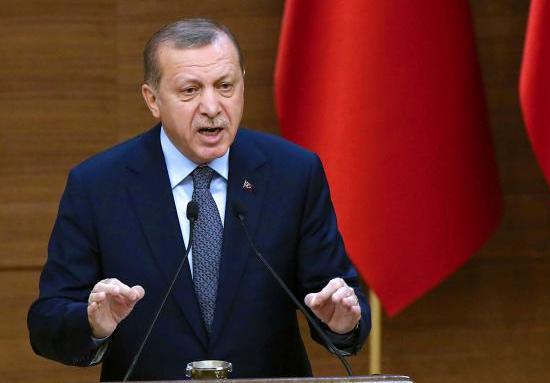
President Recep Tayyip Erdogan.

“Erdogan lost the support of the middle classes of the three main cities – Istanbul, Ankara and Izmir.  A sort of a slap in the face for a man who grew up in Istanbul, was its mayor and considers it as his stronghold, “commented Bernard Guetta, a journalist specializing in geopolitics.  The  European Commission urged Turkey to seek the “broadest possible consensus.”

Anyone who has traveled in Turkey knows that it is made of two different worlds.  The president finds his supporters in the first group:  firstly, poor farmers living in remote areas of the Anatolian plateau without much in common with the population on the coastal regions who have always had contacts  with the West, through trade in the Aegean Sea or the Mediterranean. And secondly, the working class living in the outskirts of the cities.  Their shabby houses are the first ones to collapse during recurrent earthquakes.  The polluted air in industrial areas can reach unbearable levels.

At the other end of the spectrum one finds Roberts College, the oldest American School abroad still in its original location.  It was founded in 1863.  Among its alumni are many of the international elites who have shaped this region of the world .

In the 1950s, Turkey was one of the countries benefiting from the Marshall Plan.  In 1952 it became a valued member of NATO thanks to its strategic geographic location.  This was an invaluable role to play.  But even the relationship of Turkey with NATO is tense to-day.

Dorothee Schmid, head of the Contemporary Turkey program at the Institut Français pour la Recherche Internationale (IFRI), comments: “Turkey advances in the fog.  It is not compatible with international organizations  and its statute at NATO is under question.”

Erdogan  considers himself the heir of the sultans of the Ottoman Empire, which  spread as a crescent from central Europe, the Middle East to the Mediterranean shores of North Africa from 1299 to 1922.

The Turkish president may have also be looking  further back in history to the Hittite empire.  In the second milennium BC it was one of the two great powers in the Middle East, competing with Egypt until the decisive battle of Kadesh in 1274 BC against Ramses II.  The cyclopean walls and massive gate flanked by two sitting lions still standing to-day in Hattusas, or modern village of Bogäzköy,  give an idea of the mighty Hittite empire.

The Turkish president  seems to be driven by his thirst for power:  every two years or so there are either general elections or referendums.  The pull toward autocracy provokes an escalade of tension between the ruler and the people.  During the 2011 revolution, the protest on Tahir Square lasted for 18 days and was followed by a tough repression.  Since  the putsch attempt of July 2016, 1,500 military have been put on trial and tens of thousands arrested or lost their jobs.

Megalomania is another trait of the Turkish president.  He lives in a palace 30 times the size of the White House; he is planning to build the longest bridge in the world over the Dardanelles and a mosque so big that it will be seen from any point in Istanbul.

The priority for Erdogan today is to prevent the unification of the Kurds living both in Turkey and Syria.  The ongoing conflict has caused heavy losses in the two camps and much hatred.  The violence has had an impact on the economy.  Tourism has plummeted  down by 30 percent since last year.  “Turkey feels threatened,” says Ahmet Insel, Turkish economist and specialist on that country.

The agreement between Turkey and the EU *regarding the flux of refugees across the Aegean Sea seems to be working out: in 2015, 10,000 migrants crossed the sea as compared to only 43 to-day.  Insel says, “It is in no one’s interest to put an end to this agreement.”  The 3.5 million refugees now living in Turkey seem to be adjusting after going through difficult times.  The Turkish government is even thinking of offering them citizenship.

Marc Pierini, former French ambassador to Turkey comments, “Turkey remains a major actor in the area.”  Nevertheless it is frightening to see the leverage power Erdogan holds over the EU and by way of an almost tangible demonstration of that power, the question discussed by specialists on the France-Culture radio channel on April 8, 2017, was, “How the exacerbated nationalism of Erdogan will impact the geopolitical imbroglio?”

* see “Letter from Paris,” March 19, 2016

Editor’s Note: This is the opinion of Nicole Prévost Logan.

Nicole Prévost Logan

About the author: Nicole Prévost Logan divides her time between Essex and Paris, spending summers in the former and winters in the latter. She writes a regular column for us from her Paris home where her topics will include politics, economy, social unrest — mostly in France — but also in other European countries. She also covers a variety of art exhibits and the performing arts in Europe. Logan is the author of ‘Forever on the Road: A Franco-American Family’s Thirty Years in the Foreign Service,’ an autobiography of her life as the wife of an overseas diplomat, who lived in 10 foreign countries on three continents. Her experiences during her foreign service life included being in Lebanon when civil war erupted, excavating a medieval city in Moscow and spending a week under house arrest in Guinea.

Talk by ‘Curtains Without Borders’ Tonight on Restoration Plans for 1929 Stage Curtain in Old Lyme Grange

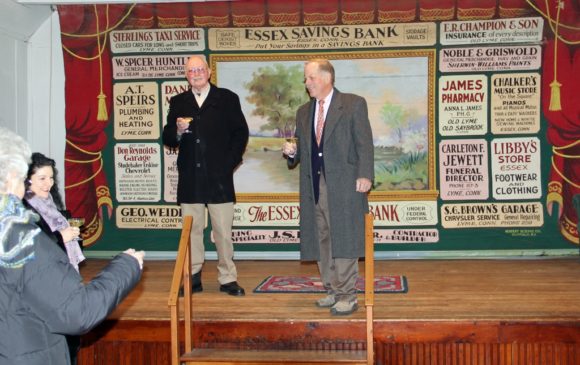
Old Lyme Historical Society board members Mark Lander (left) and Tim Griswold stand in front of the iconic curtain now scheduled for restoration in this file photo taken when the OLHS completed the purchase of The Grange.

When the Old Lyme Historical Society purchased the former Old Lyme Grange Hall on Lyme St in 2014, the members were proud to become the owners of the iconic stage curtain, which The Grange had commissioned and installed shortly after the re-dedication of their hall in its new location on Lyme St. in 1929.

This hand-painted curtain consists of a landscape surrounded by advertisements for a number of businesses in Old Lyme and other local towns. Some of these businesses are still operating 88 years later!

A close-up view of the curtain.

The Grange took wonderful care of the curtain but, after all this time, it needs work to freshen it up and preserve it for another 88 years. The OLHS has contracted with an organization called Curtains Without Borders, which specializes in this type of work. Based in Burlington Vt., they have restored hundreds of these curtains across Northern New England: in Grange Halls, theatres, town halls and schools. Curtains Without Borders will be working their magic between April 21 and 23.

Chris Hadsel, the head conservator of Curtains Without Borders, will give a talk about stage curtains and the restoration project at the Old Lyme Historical Society Hall at 55 Lyme St on Saturday, April 22, at 7 p.m.  There will be no admission charge and all are welcome.  Check the OLHS website to see if there is any change in the time.

2nd Annual Tag Sale Today at LOL High School Supports Mission of Friends of Music

The 2nd annual Friends of Music Tag Sale, will bring bargains galore to the Lyme-Old Lyme High School’s (LOLHS) gym and Commons areas on Saturday, April 22, from 8:30 a.m. to 12:30 p.m.  Proceeds from the sale will help advance the mission of the Lyme-Old Lyme Friends of Music, who provide support to the music programs in Lyme-Old Lyme Schools at all levels.
Items for sale will include housewares, toys, books, CDs and DVDs, sporting goods, furniture, tools, and more.  Clothing and bedding will not be included in the tag sale.
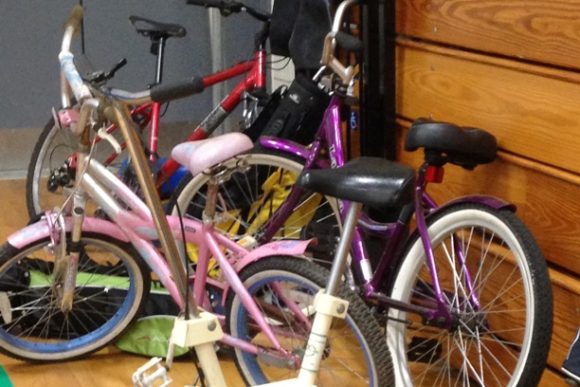
 
Spring cleaning? Moving? Donations of items to the Friends of Music Tag Sale will be gladly accepted on Friday, April 21, from 4 p.m. to 8 p.m. at the high school:  housewares, furniture, sporting goods, toys, books, CDs and DVDs, artwork, tools, etc., in good condition—but no clothing, please.
 

Friends of Music was established in the early 1980s in response to District budget cuts that threatened to affect arts programs in our schools. Today Friends of Music provide support to Lyme-Old Lyme Schools music programs at all levels: materially, by funding unbudgeted and unexpected items, and administratively, by assisting with uniform distribution, staffing at events, and more.


Friends of Music also supports LOLHS students individually by awarding scholarships to selected graduating seniors.


More information on Friends of Music and the 2nd annual Tag Sale can be found at www.friendsofmusiclol.org or e-mail friendsofmusiclol@gmail.com. 
As a registered 501(c)(3) nonprofit organization, Friends of Music can accept matching funds from employers. 

Carney, Ziobron to Host In-Depth Legislative Budget Forum This Evening in Hadlyme, 6pm

State Representative Devin Carney

State Representative Melissa Ziobron

State Representatives Devin Carney, R-23rd, and Melissa Ziobron, R-34th, will hold a legislative budget forum and meet with constituents from 6 to 7:30 p.m. Friday, April 21, at the Hadlyme Public Hall, 1 Day Hill Road.

Carney, a member of the legislature’s Finance Committee and Ziobron, the ranking member of the Appropriations Committee, will provide an overview of Connecticut’s budget and fiscal situation. They will present a summary of the state budget process, the Governor’s proposed budget and what to expect in the remainder of this legislative session.

For more information, contact the legislators’ office at (800) 842-1423.