Editor’s Note: Local resident Tom Soboleski has written several great stories exclusively for LymeLine.com and ValleyNewsNow.com, so when we saw this compelling story by him in the New Haven Register on March 24, we requested their permission to republish it. Having received that permission, we are now pleased to republish this important story here.
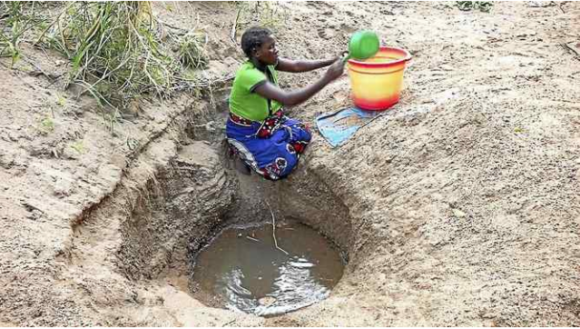
Gathering water in Africa. Courtesy Water Works for Africa
Imagine you could not take a shower every day – because there is no water.
Imagine brushing your teeth without water.
Imagine you had no faucet in your house – because there is no water nearby.
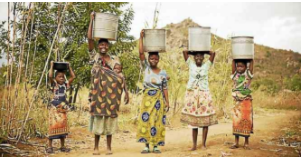
Gathering water in Africa. Courtesy Water Works for Africa
Imagine walking two miles and standing in lines with fights breaking out to obtain whatever water you could. Then carrying it back home in jugs weighing 41 pounds. And the water is dirty and likely has bacteria.
You might say you’d never live there. But some people have no choice. This is their homeland. You might ask why don’t they move. To understand, you’d have to be in their shoes.
These are the conditions in villages of the Chikwawa district, in southern Malawi, Africa. There are numerous villages throughout Malawi in the same circumstances. The time and energy required to obtain life’s most basic need consumes daily life. It is traditional in their culture for women and children to fetch the water. This typically can take four to five hours a day. Men stay home to tend their meager gardens and livestock.
The water, when it’s available, is in shallow wells about 5 to 6 feet square and of similar depth. Because it’s basically in open pits, livestock and wild animals also drink from it. They have no other source. They may also urinate or defecate in or near it. So any water collected has to be boiled before it can be used for drinking, cooking or bathing.
A charity based in New Haven, Malawi Farmers Inc., has dedicated itself to bringing reliable, clean water to the villages of Chikwawa. Formed last year, MFI’s core mission is to help lift these villagers out of poverty. Providing them a source of sustainable, safe water would have a huge impact on village life. Drinking, cooking and washing would no longer be risky. It would allow kids to stay in school and fathers to get jobs. It would mean plentiful crops and healthier livestock. It would mean they could sell crops and create better living conditions.
“You can’t do anything without water,” says Sam Powell, president of Malawi Farmers Inc. The villagers of Chikwawa “are stricken not only with a drought,” he says, “but when they have water, it’s unreliable in terms of it’s not always available or only in limited amounts. The surface water is contaminated. They don’t have deep-water wells. The water’s unhealthy, there’s no sanitation there. There’s animal refuse and human waste.”
There is ample clean water deep underground, but the lack of technology and economic wherewithal prevents it from being tapped. “The water is there,” Powell says. “They can’t access it.”
MFI is working with another non-profit, Water Wells for Africa, or WWFA, based in California, which will identify well locations and hire contractors in Africa to do the drilling and installation. “We’ve partnered up with them,” Powell says, “because they have the expertise in the drilling, the topography, the government’s situation.”
WWFA has been installing wells in Africa for 20 years. Once a well is installed, they will also train local villagers on how to maintain and repair it. Designing it to be rugged enough to not break down is a prime consideration, given that parts would not be readily available in a remote village. “The type of well we want to drill is deep, it’s sustainable,” Powell says. “It’s mechanical, it’s not digital, it doesn’t require any electricity.”
Powell became aware of the water crisis in southern Malawi through his work at the Connecticut Hospice in Branford, where he’s been volunteering for several years. Three years ago a new chaplain, the Rev Austin Phiri, was assigned to the hospice. Austin is a native of the village of Chokani and came to the U.S. six years ago, he says, “because I wanted to experience a different way of doing ministry.”
Father Austin says the water crisis in his country is acute but the Malawi government provides little help. “Every day in my country the people complain we have no running water. The government depends on donors from outside,” to address infrastructure problems, he says. “At the moment there are a number of problems the government is facing. The government is completely broke.”
Appeals to the United Nations have been unsuccessful, Austin says. Proposals have been submitted but the response is always that the UN is involved in innumerable projects and it is unable to help.
Malawi is a land-locked country about the size of Pennsylvania, with a population of nearly 13 million. Annual per capita income was $340 in 2015 according to the World Bank. “In these desperately poor areas of low density and subsistence farming,” Austin says, “it’s less than that. A dollar a day is a lot of money there.”
People begin standing in line at 3 a.m.. “We are so hopeful that there will be a day when things will be improved in my home village,” he says. “They won’t be fighting to get water. There’s always fighting because everybody wants to get good water.”
During the dry season from May to October, there is virtually no rainfall in Malawi. Contaminated water is a leading cause of diarrhea, dysentery and cholera, contributing to nearly 9,000 deaths per year, including 4,500 children under 5, according to the World Bank. Worldwide, diarrhea diseases contribute to more than a million deaths per year of children under 5, according to UNICEF.
Powell says that working with Austin at the hospice and listening to his stories inspired him to do something. “For several years we have been talking about how desperate the plight of those people are. A lot of families are occupying hours and hours and hours of their day just sourcing out water and not doing anything else that’s productive. The infusion of a few dollars in Malawi to drill a simple well – so people can at least water their gardens and drink a glass of clean healthy water – will have a startling effect.”
MFI’s ambition goes well beyond a few wells. It has partnered with a farmer’s group in Malawi to coordinate efforts and identify the most acute needs. Once villages have sustainable healthy water, MFI plans to advise villagers on ways to become more efficient and productive with their farming and upgrade their tools and methods. “This will allow for marketing their crops to produce income,” Powell says. “Right now it’s subsistence farming. Eventually, hopefully with a rich water supply, they will be able to generate income so that their standard of living will rise.”
Through appeals to friends and family, MFI has raised enough money to drill its first well in the village of Chokani during the upcoming dry season. The average cost of a deep water well is $7500, but that can vary widely depending on the local geography, the depth, and the underground geology. The group is holding its first fundraiser, an Italian dinner with entertainment, on March 19 at St. Paul’s Church Hall in West Haven, CT. Tickets can be purchased directly from their website through this link.
Water is something the overwhelming majority of U.S. citizens take for granted. With a twist of your hand, it’s there on demand. For people in the villages of Chikwawa, that would be a luxury. Just installing a permanent well to pump clean water on demand, “will change their whole standard of living,” Powell says. “Their health, their longevity, their prospects for the future. You’ll be able to see the effects; you’ll be able to feel the effects, almost immediately. We have no paid staff. Every dollar that comes in to us will be for drilling.”
MFI is a 501c3 charity recognized by the state of Connecticut and the federal government.
For more information, go to www.malawifarmersinc.org.

 Lyme resident, Sarah Meneely-Kyder, a Grammy-nominated composer, will present a screening of “Letter from Italy, 1944: A New American Oratorio,” a one-hour documentary created by Emmy Award-winning filmmaker Karyl Evans and narrated by Academy Award winner Meryl Streep, on Tuesday, April 18 at 12:30 p.m. in the Community Room of the Old Lyme-Phoebe Griffin Noyes Library in Old Lyme. Following the screening, Meneely-Kyder will answer questions.