

Talking Transportation: On Air Pollution and Transportation

Jim Cameron

Our air stinks. In fact, Fairfield County ranks in the top 25 of most polluted areas in the US, mostly due to ozone levels.

And while much of those noxious gases drift our way from New Jersey and New York City,  a large part of our pollution is home-grown:  it’s due to heavy volumes of traffic, especially diesel trucks, which emit nitrogen oxides (NOx) and volatile organic compounds (VOCs)—key ingredients in ozone formation.

Yes:  I-95 is hazardous to your health.

And all of this gets worse in the summer due to the heat which increases ozone production, often trapping it over our heads due to temperature inversions. By one estimate, almost 200 Connecticut residents die each year due to our air quality.

We will all remember back to June of 2023 when our sky turned orange due to smoke from Canadian wildfires. That created truly hazardous conditions that literally made breathing bad for you.  With global warming, we’ll see things like this happening again.

So, what does any of this have to do with transportation? Mother nature’s pains (like the Canadian wildfires) notwithstanding, it is transportation’s pollution that is the #1 source in our state, EPA blaming it for half of all our bad air.
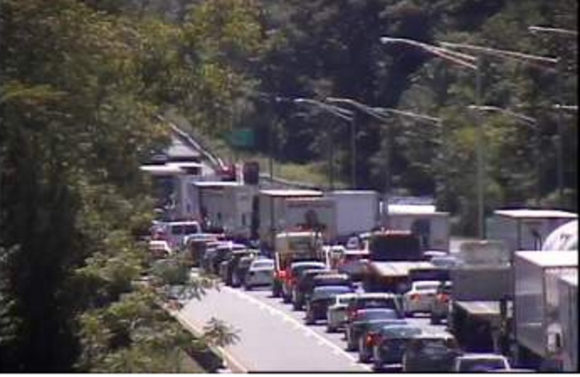
Trucks on I-91. Photo from CT DOT.

Trucks:
These are the vehicles responsible for most of our air pollution.  While medium to large trucks represent only 6% of traffic they cause 53% of nitrogen oxide (NOx) emissions, 45% of fine particulate matter (PM2.5), linked to respiratory and cardiovascular health issues, and 25% of greenhouse gas emissions.

Better air filters may help as does burning biodiesel and enforcing no-idling rules. But the real solution will be electric-powered trucks.  However, the Trump administration has slashed tax credits for new buyers and frozen plans for the rollout of charging stations.

Take the Train:
Riding Metro-North is five to six times more fuel efficient than driving.  Those electric trains’ power-generation gives them the equivalent of 125-160 mpg.  And that’s improved further by the trains’ regenerative braking which means that, even when stopping, they generate more power.

Getting more folks on the train also reduces highway traffic, making those vehicles more fuel efficient because they’re not spewing exhaust in stop-and-go traffic.

But our diesel locomotives (which run on the Danbury, Waterbury and Hartford lines) are a different matter.  For their runs in Connecticut they are big polluters, just like trucks.  The World Health Organization and EPA call diesel exhaust a Class 1 carcinogen, right up there with tobacco and asbestos.  New locomotives that are on order will improve that with battery operation and improved filtration.

Ships:
Yes, both commercial and pleasure craft contribute to air (and in this case noise and water) pollution, again because of their diesel engines.  It’s not by chance that wind-powered sailors refer to powerboaters as “stink potters” and “blow boaters”.  There are some electric-powered boats under development, but they’re more expensive and don’t offer the same range.

So, whether your travels take you on the open waters or (hopefully) open roads, remember that there’s more to the cost of your trip than fuel: there’s the cost to our shared environment. 

Editor’s Notes: i) Jim Cameron is the founder of the Commuter Action Group and advocates for Connecticut rail riders. He writes a weekly column called ‘Talking Transportation,’ which is published by a number of publications in the state.
ii)”Talking Transportation” recently won first place in the general column/commentary category in the Connecticut Society of Professional Journalists Excellence in Journalism Contest.

‘Talking Transportation’ is Back! Five Worst Ideas for Solving Traffic Congestion

Editor’s Note: We are delighted to welcome transport guru Jim Cameron , pictured left, back to LymeLine. He was wrote for us regularly for almost 10 years starting in 2011 and his columns were always popular with our readers. He is the founder of the Commuter Action Group and advocates for Connecticut rail riders. He writes a weekly column called ‘Talking Transportation,’ which is published by a number of publications in the state. Here is the inaugural column of his second season with us.

Five Worst Ideas for Solving Traffic Congestion

While I’m on vacation this week I thought I’d revisit a commentary I wrote in 2014.  Judge for yourself how little has changed in 11 years.

Everybody loves to complain about our traffic.  And for some, the solutions are simple, if impractical.  If there were easy answers to our woes, they’d have been implemented by now.  

Look … this is really a matter of supply and demand: too much demand (highway traffic) and not enough supply (space on those roads).  I think the solution is to manage the demand.  But others say it’s a “supply side” issue. 

So here are a few of the crazier ideas for fixing our traffic that I’ve seen proposed over the  years:

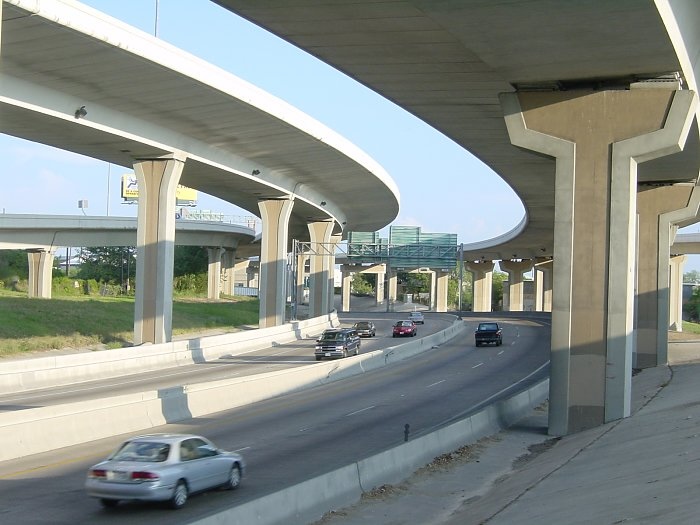
The photo shows a double-decker highway in Texas. Photo credit: TexasFreeway.com

1)    DOUBLE-DECK I-95:        
Seriously, this was once proposed by the Stamford Chamber of Commerce.  Can you imagine the decades of construction and billions in cost, with “upper level” roads having to soar hundreds of feet over existing bridges?

2)    ALLOW TRUCKS ON THE MERRITT PARKWAY:       
There are two words to explain why this can’t happen:  low bridges.

3)    BAN TRUCKS FROM OUR INTERSTATES:          
This was once suggested to me by a Fairfield County First Selectman.  But as I reminded him … trucks are high-occupancy vehicles delivering goods to the stores where you drive your single-occupancy vehicle to shop.  No trucks, no goods, no shopping.

4)    DRIVE IN THE BREAK-DOWN LANE: 
This was then-Governor Rowland’s idea in 2000 and he even wasted a million dollars studying it.  But if you think of that far right-hand lane instead as the “emergency rescue lane”, you’ll see why this doesn’t make sense.  This plan would also require re-striping the road to create narrower lanes, making driving even more dangerous.

5)    WIDENING I-95 TO FOUR LANES:       
Again, billions in cost and decades of construction.  And if you build it, they will come.  The immutable law of “induced demand” means that traffic will expand to fill available space.  Then what, a fifth lane?

There are better ways to manage congestion, some of them already being implemented:

OPERATIONAL LANES:     
Adding a fourth lane from on-ramps to the next off-ramps gives traffic a better chance of merging on and off the highway without blocking the through-lanes.

WIDENING CHOKE-POINTS:      
For example, the exit 14-15 bottleneck in Norwalk.  But this widening project (for less than one mile) cost $50 million and took three years.  The I-84 / Route 8 “Mixmaster” rebuild in Waterbury took six years and cost $253 million.  Both projects were funded mostly with Federal funds, but it’s anyone’s guess what will happen to that money pot under the new administration’s budget cutting.

ADD A ZIPPER LANE:      
Sure, this may require highway widening, but just one lane that’s reversible depending on demand, a system that was used successfully on the Tappan Zee Bridge before its reconstruction.  By moving the extra lane, capacity can be added to the direction where there’s the most traffic.

CHANGE COMMUTING HOURS: 
Does everyone really need to work 9 am – 5 pm?  How about starting earlier or later and spreading out the traffic?  Your employer should understand and you’ll be happier and more productive.

And the very best idea of all:  IMPROVE MASS TRANSIT TO ENCOURAGE DRIVERS to get off of the roads.

As I say, there are no simple solutions to highway congestion.  So when anyone says he or she has one, be skeptical.  It’s easy to identify the problems.  But fixing them will always be hard … and usually expensive.

Editor’s Note: Contact Jim at TalkingTransportationCT@gmail.com.