Chester-Hadlyme Ferry Service Suspended Due to High Water

photo_by_Humphrey_Tyler_301KB

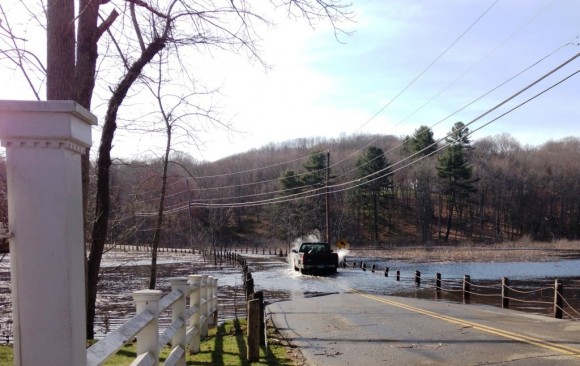
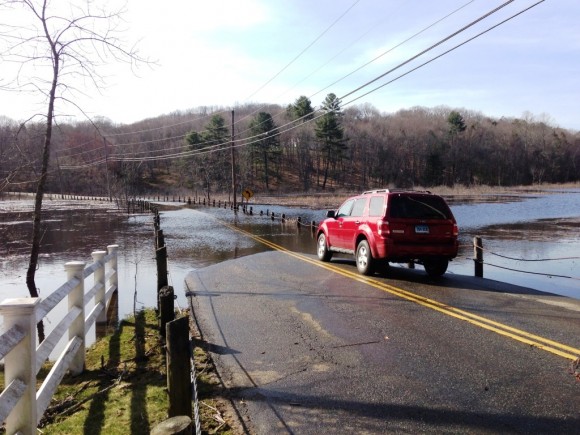
As we’ve said before, we always enjoy opening our Inbox, because (like that infamous box of chocolates) we never know what we’re going to find … well, today it held a couple of photos of the Ferry Road (Rte. 148) causeway in Hadlyme across Whalebone Cove flooded out by Connecticut River “freshet” (high water caused by spring rains  and snow melt upstream in northern New England.)

photo_by_Humphrey_Tyler_truck_in_water

The loyal reader who sent the photos further helpfully advises that service on the Chester- Hadlyme Ferry has been suspended until the water recedes.

The Department of Transportation website states that the duration of time for which the service will be out of action is “unknown.”

Talking Transportation: A Report Card for Metro-North

If Metro-North were a student and commuters its teacher, the railroad’s winter report card would be a D+ and the comment would be “needs to improve”.

As new Metro-North President Joseph Giulietti finishes his second month on the job, he’s making the rounds to meet and listen to commuters.  But his 100-Day Plan for bringing the railroad back won’t conclude until mid-June, so I thought that now would be a great time to survey riders and get a baseline of their sentiments against which we can measure any gains in the months ahead.

Our unscientific online survey ran for seven days and got 642 responses.  Clearly, those who wanted to opine were probably those with gripes, so take the results with a grain of salt.

Asked to give Metro-North a letter grade based on the past months’ performance, the railroad got an average D+.

Asked if service was getting better, 22 percent said yes, 31 percent said it was getting worse and 47 percent said it was “about the same”.

When asked what their biggest complaints were (respondents could list multiple issues),  88 percent said it was late or delayed trains, 60 percent said poor communications when things went wrong, and 59 percent said it was lack of sufficient seating on trains.  Another 30% percent complained about the train cars’ heating / cooling system (or lack thereof), while others (18 percent) said there was insufficient station parking and 15 percent said the stations had poor upkeep.

The survey also asked how commuters reported their gripes.  Ten percent said they never had complaints, 46 percent  said they didn’t complain “because it seemed useless” but 61 percent said they did complain to conductors or to Metro-North.  Of those who did complained almost half of respondents (45 percent) said their problem was never fixed.

We also asked who commuters thought was to blame for the railroad’s problems.  An overwhelming 90 percent blamed Metro-North management, 48% percent said they were due to the Department of Transportation, 35 percent said it was their state legislature’s fault, 28 percent said it was because of Metro-North employees, 12 percent blamed the Federal government, and 9 percent blamed their fellow commuters.

Our last question was most telling:  “Do you feel safe riding Metro-North?” 56 percent said yes, 15 percent said no and 29% percent said they weren’t sure.

We designed the survey to be brief, taking maybe two minutes to answer.  But we also gave space for commuters to comment, and 267 of them did, some at great length.  Here’s a sampling of their opinions:

Sorry to be so harsh … It is 2014, pseudo-modern, wealthy society and the most laughable public transportation system in any advanced country and metropolitan area.

This service is really shameful for the amount that we pay.  I have not been on a train in the last 6 months that has arrived on time.

When I moved here 10 years ago you could set your watch by MetroNorth.  Now the timetable is just a suggestion.

The Danbury Line is the orphaned stepchild of the system.

The lack of self control of “irate” commuters does not help the situation.  Makes us look bad.

The full results of the survey and all of the comments are available online via links from our website, www.CommuterActionGroup.org

Jim Cameron

Jim Cameron

Jim Cameron has been a Darien resident for 22 years.  He is the founder of the Commuter Action Group and also serves on the Darien RTM.  The opinions expressed in this column are only his own.  You can reach him at CommuterActionGroup@gmail.com

Letter From Paris: Two Local Elections — Two Remarkably Different Outcomes

Nicole Prévost Logan

Nicole Prévost Logan

Local elections have just taken place in Turkey and in France.  The outcomes of the elections speak a great deal about these two countries .

Primeminister Recep Tayyip Erdogan of Turkey, already in power for 12 years, is showing no intention of stepping down.  His aura at the polls was barely affected by the scandals and accusations of wrong-doing.  Particularly the violent repression of the popular manifestations on Istanbul Taksim Square, the  allegations of frauds directed not only at him, but at his family, the murky circumstances of score settlings.

His recent strategy includes the taking over 85 percent of the main TV channel and the curbing of social networks like Twitter or Facebook.  Nevertheless  Erdogan’s party, the AKP  (Party of Justice and Development),  passed  the test of the polls with flying colors, not acknowledging the distress of the public opinion.  These events did not speak much for the democratic system of that country and should constitute a red flag for the 28 EU members next time Turkey knocks at their door.

In contrast, the French municipales (local elections) were a reflection of the French opinion’s strong disapproval of the policy  of the Francois Hollande government and brought on major changes.

The municipales,  are always an important and colorful event in France,  when mayors and  council members of 36,500 communes (towns) are elected for six years.  But this time they turned into a tsunami, which modified the political landscape of the country.  The vague bleue (blue wave ) showing the gains of the Right and even the vague bleue marine (navy blue wave ) named after Marine Le Pen, head of the far right Front National.  Just a few figures:  in 2008 in the towns of more than 10,000 inhabitants, the Left had 509 mayors and the Right 433.  In 2004, the Left was reduced to 349 and the Right grew to 572.  Emblematic  was the town of Limoges, which had voted socialist since 1912, and turned conservative.

Paris resisted this tidal wave and remained socialist.  Incumbent Mayor Bertrand  Delanoe had groomed his assistant Anne Hidalgo to be his successor.  Together, they engaged in an intensive and efficient campaign.  The Mayor of Paris is elected according to a special system of voting in three rounds.  The first two rounds each Parisian vote for the mayor and council in each arrondissement.  Then mayors and councils vote for the mayor of Paris.  The fight to the finish between Anne Hidalgo and her conservative opponent Union pour un Mouvement Populaire (UMP) Nathalie Kosciusko-Morizet , was fierce, to say the least.  The former won by 53.34 over 44.06 percent.

The map of Paris to-day is made up of two halves: a blue west, and a red east.   With 11 versus nine arrondissements,   Hidalgo leads but not as much as  Jacques Chirac did in 1983 when he won all of them.  These results will be important in the next senatorial elections since the members of the Senat (high chamber)  are elected by the mayors.

Barely 24 hours after the closing of the polls, president François Hollande appeared on TV.  He declared that he had heard and understood the people’s message of disapproval of the policy he conducted since 2012.  He reassured his audience that appropriate measures would be taken.

A day later he announced the remaniement (reshuffle) of the government.  The soft spoken, kind-looking prime minister Jean Marc Ayrault was replaced by tough and energetic Manuel Valls, former minister of the interior.  The number of ministers was trimmed down from 38 to 16 and the parity men/women respected.  The new ministers are more experienced and some of the “heavyweights” remained, like Laurent Fabius, at the Foreign Affairs desk.

The decision concerning Bercy (ministry of Finances and Economy)  was crucial given the urgency to reduce the budget deficit and increase the competitivité (competitiveness)  of the French industry.  The new prime minister Manuel Valls decided to split the responsibilities between two ministers: Michel Papin handling Budget and Finances , Arnaud Montebourg becoming minister of Economy.  This will be a “hot” area since France has to work in a partnership with Brussels.

Ségolène Royal

Ségolène Royal

The second spectacular move was the nomination of Ségolène Royal as the minister of Ecology, Sustainable Industry and Energy.  She will rank as number three in the new cabinet.  She is an old timer, particularly in the environmental field.  Her appearance in the courtyard of Hotel de Matignon made quite a splash.  Royal is a highly educated woman, used to be Hollande’s companion for 29 years, the mother of their four children and the last contestant for the presidency against Sarkozy in  2002.  Her appointment will be helpful to Valls’ government because she brings her strong connections to the lower working class with her.

The outspoken Housing minister Cecile Duflot left the Matignon in a huff and a puff , showing her overwhelming dislike for Valls.  Her colleagues in the Green party at the Assemblée Nationale, were upset by her move as they were willing to work within the cabinet.

The overhaul of the new government was greeted by salvos of criticisms and gibes from the UMP and naturally from the extreme parties – this is normal in France.   However, the composition of the new government was interpreted, by more unbiased analysts,  as the determination to follow the road map set out by François Hollande at the Jan. 14  press conference and to keep the course on the Pacte de Responsabilité, but to  implement it with more determination, more speed and more pedagogy.

Failure is not an option and Brussels  will not ease off the pressure.

HeadshotAbout the author:  Nicole Prévost Logan divides her time between Essex and Paris, spending summers in the former and winters in the latter.  She will write a regular column for us from her Paris home where her topics will include politics, economy, social unrest — mostly in France — but also in other European countries.  She also will cover a variety of art exhibits and the performing arts in Europe.  Logan is the author of ‘Forever on the Road: A Franco-American Family’s Thirty Years in the Foreign Service,’ an autobiography of her life as the wife of an overseas diplomat, who lived in 10 foreign countries on three continents.  Her experiences during her foreign service life included being in Lebanon when civil war erupted, excavating a medieval city in Moscow and spending a week under house arrest in Guinea.

Information Meeting Tonight on Proposed Bus Route From Clinton to Middletown

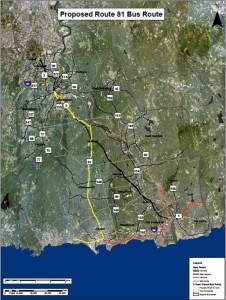
Map of the proposed new bus route from Clinton to Middletown.

Map of the proposed new bus route from Clinton to Middletown.

A public information meeting will be held this evening at 7 p.m. at Clinton Town Hall auditorium regarding the proposed new 9 Town Transit bus service connecting Madison, Killingworth and Haddam to Middletown.

The purpose of the meeting is in part for the public to demonstrate the need for this service by telling the story of how this service could benefit you or someone you know.

Beach Donuts will provide refreshments.

Clinton Town Hall is located at 54E. Main Street, Clinton.

Letter From Paris: Following a New Silk Road

Nicole Prévost Logan

Nicole Prévost Logan

The presidents of the United States and of China were in Europe this week.  It was the first visit of a Chinese president to the European Union’s (EU) headquarters since 1975.  He will meet with the presidents of the Council, Herman Van Rompuy, of the Commission, Manuel Barroso and of the Parliament, Martin Schuls, showing a nascent  interest in  Europe as a political entity.

However, Europe has been the largest trade partner of China for a decade, with German leading the pack.  Why then did president Xi Jinping choose France as one of his four stops in Europe in spite of  that country’s small trade and investment with the Middle Kingdom ?  The reasons are historical, cultural, the Chinese’s attraction to  gastronomy and good wine, and, finally, the desire to acquire more areas of French “savoir faire” and state of the art technology, heretofore unexplored.

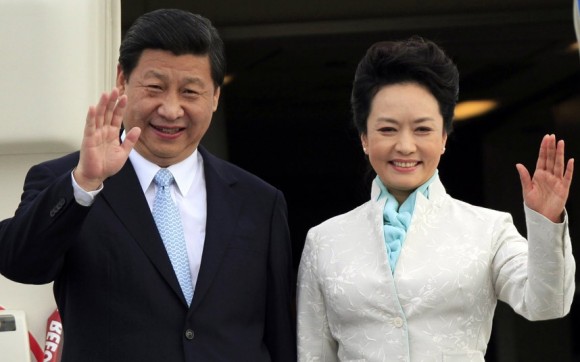
Xi Jinping and his beautiful star singer wife Peng Liyuan opened his three-day state visit in Lyon, the French silk capital, and announced his intention to promote a “new Silk Road.”  Started with French King Francis I, the silk-making industry in Lyon was flourishing by the 17th century.  In the 1920s cultural ties developed between China and France.  Chinese students entered French universities, among them several future political leaders.  In 1964 General Charles de Gaulle was the first Western chief of state to establish full diplomatic relations with the Middle Kingdom.

In this file photo, Xi Jinping and his wife Peng Liyuan wave to the crowd.

In this file photo, Xi Jinping and his wife Peng Liyuan wave to the crowd.

Mutual interests in literature, cinema and art have created special bonds between Chinese and French intelligencia.  Chinese fans of the “Nouvelle Vague” films (new wave) are sometimes more knowledgeable about the names of the directors that the French themselves.  The 1992 film “l’Amant‘”(the Lover), directed by Jean Jacques Annaud, based on the 1984 novel by Marguerite Duras, was a huge success in France.  The plot is the affair a “Chinaman” struck with a young French girl on a ferry boat crossing the Mekong river.  French readers cheered on the high school “Joueuse de Go” (Go player) character created by author Shan Sa, whose courage symbolized the determination of the Chinese population fighting against the impending invasion of Manchuria by the Japanese in 1931.

But the objectives of the Chinese president and of his cohort of businessmen and investors who accompanied him were more down to earth:  they were here for serious business.  Both by making inroads into the French industry and by opening their own market to French goods in order to tilt the massive trade deficit between the two countries.  The car company Dongfeng just acquired 14 percent of the PSA’s (Peugeot-Citroen) shares.   The Chinese have been trying to take over 46 percent of  Club Med’s (touristic villages) capital.

Whether it is nuclear energy  or aeronautic technology, automobile industry, or fast trains, the transfer of technology has always been a touchy point for the French.   The most striking example of this situation is the TGV (Train à grande vitesse) or fast train which was designed by Alstom in France in the 1970s and was further developed  jointly with other Western countries.  Now the Chinese network is ten times longer than the French and in July 2013  “Harmony Express” surpassed the speed of the French trains.

On a televised program, a spokeswoman for the Chinese government was asked the question about transfer of technology.   She said that the Chinese now are pretty much caught up, ( which is certainly true with telecom giants like Huawei and ZTE) and that now their policy was veering toward “partnership and cooperation” – language to be expected from a government spokeswoman.

The Chinese love France.  Millions of tourists speed through the most famous halls of the Louvre.  The growing middle class and the wealthy are increasingly   fascinated by luxury goods.  They are not satisfied anymore by the pirated brands one finds all over the world.  Now they can find the real stuff 72 percent cheaper in France thanks to the system of “detaxe” and by avoiding import duties into China.

During the many years we lived in Africa with the American Embassy, in the 1960s and 1970s, I had a chance to observe that, in those days, the Chinese lived in spartan compounds totally secluded from the local population , working on Guinea tea plantations or building a soccer stadium in the Gambia.  They have come a long way.  To-day they visit France to do their spring shopping and buy Chambertin ou Chateau Lafitte wine, Hermes silk scarves or Vuitton bags.

Agribusiness is a field where improvements would be welcome.   One remembers the problems China suffered a few years ago with contaminated powder milk.  The Chinese are very fond of foie gras and cheese.  They have just discovered the “Jambon de Bayonne.”  It takes many hours of preparation and manual work to prepare the dark red ham meat.  The traditional “savoir faire” has existed since the 13th century in the south west of France.  Its commerce is labeled “IGP” (Indication Geographique Protegéee) or geographically protected.  Pork is one of the main food staple in China and there the huge market is promising.  Will the  transfer of “savoir faire” be followed by the loss of the brand?

During the elegant dinner at the Elysees palace and the following night at the  Opera Royal of the Chateau de Versailles, what was president François Hollande thinking of  — 18 billion euros of new contracts or the difficult political situation he is in right now after the disastrous (for him) recent local elections?

HeadshotAbout the author:  Nicole Prévost Logan divides her time between Essex and Paris, spending summers in the former and winters in the latter.  She will write a regular column for us from her Paris home where her topics will include politics, economy, social unrest — mostly in France — but also in other European countries.  She also will cover a variety of art exhibits and the performing arts in Europe.  Logan is the author of ‘Forever on the Road: A Franco-American Family’s Thirty Years in the Foreign Service,’ an autobiography of her life as the wife of an overseas diplomat, who lived in 10 foreign countries on three continents.  Her experiences during her foreign service life included being in Lebanon when civil war erupted, excavating a medieval city in Moscow and spending a week under house arrest in Guinea.