Tunisian Election Outcome Offers Remarkable Example to Countries Dealing With Terrorism, Violence

Nicole Prévost Logan
Nicole Prévost Logan

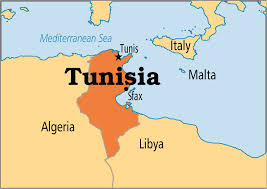
Map_of_tunisiaTunisia did it again!  This small country in North Africa was the one to start the Arab Spring in December 2010.  On Oct. 26 of this year, the parliamentary elections marked the return to some degree of normalcy after a difficult period of assassinations and violence.

The latest elections revealed a “collective intelligence,” to use the words of a French political scientist – the result of a well established civil society.  Instead of a single party hijacking the political scene, the people voted for several parties.  The liberal party Nidaa Taures won with 38 percent of the votes.  In order to reach a majority of 109 seats in the parliament, it is willing to form a coalition – quite unusual in this part of the world.

The Islamist party Ennahda secured second place with only 28 percent of the votes and 69 seats — or 16 seats less than in the previous election.  Wisely it  conceded defeat.  How to explain the resistance of the population to the Ennahda program?

The answer lies for a large part in the key role played by women.  They spearheaded the resistance against the strict enforcement of the Sharia or moral code, which limits their rights in many areas: inheritance, divorce, veil and regulations on clothing, custody of children, adultery sanctioned by stoning or “honor killing,” right to travel, right to open a bank account, and access to higher education, etc.

In the text of the constitution approved in January 2014,  Ennahda had reluctantly agreed to replace the expression “complementarity of men and women” by “equality for all.”  A journalist had the nerve to make the following extraordinary comment, “This was a small victory for a few Tunisian feminists”.
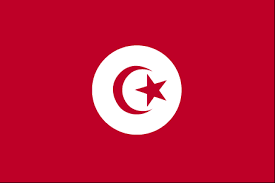
Tunisian_flagThe “Personal Status Code,” which was installed by president Habib Bourguiba in 1956,  had given empowerment to Tunisian women, thus making them the most emancipated in the Arab world.  This revolution was at the center of his program in order to model his country on Kemal Ataturk’s vision of a secular  and modern country.  Incidentally, it is interesting to note that both Turkey and Tunisia have almost identical flags.  Bourguiba is said to have remarked at one time, “… the veil – that odious rag.”

Tunisia can be considered to-day as a bulwark between a dangerously chaotic Libya and an Algeria unable to control terrorism (on Oct.14, a  Frenchman visiting the rugged mountainous area south of Algiers, in order to train young Algerians to become mountain guides, was taken hostage and  beheaded two days later.)   In other words, Tunis is of great importance not only as a model of democratic process coexisting with a moderate Islam but also, one hopes, as an oasis of stability for the whole area.
Nicole Logan

Nicole Prévost Logan

About the author: Nicole Prévost Logan divides her time between Essex and Paris, spending summers in the former and winters in the latter.  She writes a regular column for us from her Paris home where her topics will include politics, economy, social unrest — mostly in France — but also in other European countries.  She also covers a variety of art exhibits and the performing arts in Europe.  Logan is the author of ‘Forever on the Road: A Franco-American Family’s Thirty Years in the Foreign Service,’ an autobiography of her life as the wife of an overseas diplomat, who lived in 10 foreign countries on three continents.  Her experiences during her foreign service life included being in Lebanon when civil war erupted, excavating a medieval city in Moscow and spending a week under house arrest in Guinea.
SECWAC Hosts Hybel on ‘Who Got it Right and Who Got it Wrong … From Kennedy to Obama’ at Conn. College, Wednesday

The Southeast Connecticut World Affairs Council (SECWAC) is hosting a presentation by Dr. Alex Hybel, Professor of Government and International Relations at Connecticut College, New London, titled, “Who Got it Right and Who Got it Wrong … From Kennedy to Obama.”  The discussion will be held Wednesday, Nov. 12, at
 Connecticut College, New London, in the Crozier-William Student Center.  The reception begins at 5:30 p.m. and the talk at 6 p.m.

Hybel’s course work spans a variety of subjects including International Politics, U.S. Foreign Policy, Alternative Approaches to U.S. Foreign Policy Decision-Making, and Democracy in Latin American & Europe’s Mediterranean Region.

He is widely published in this field of policy/decision making, including “U.S. Foreign Policy Decision-Making – From Truman to Kennedy”, “The Power of Ideology – From the Roman Empire to al-Qaeda”, and “The Bush Administrations and Saddam Hussein: Deciding on Conflict”, and is currently working on a book entitled “The Making of Democracies – From the 17th Century to the Present”.

Hybel has a PhD in political science from Stanford University, and has served as Director of Connecticut College’s Study Away/Teach Away Program, in Italy, China, Spain, and South Africa, as well as being a Visiting Fulbright Professor for the Sophia University and The University of Tokyo.  He is a recipient of numerous research grants and fellowships from the National Science Foundation, the William and Flora Hewlett Foundation, and the Pew Initiative in Diplomatic Training, amongst others.

Hybel is a Vietnam Veteran.

Guests are welcome to this member supported organization.  To register as a guest call 860-912-5718 or email info@secwac.org.

A limited number of members and guests may dine with Prof. Hybel following the talk at Conn College Student Center.  To reserve a space, email srueb@aol.com or phone 216-554-1009.  Once confirmed, mail a check for $35 payable to SECWAC to Sandra Rueb, 5 Lieutenant River Lane, Old Lyme, CT 06371.

The Southeast Connecticut World Affairs Council will host another program on Dec. 9, when Charles King, Professor of Government & Government Georgetown University, will speak on, “A Year of Crisis in the Near East.”  King is the author of Midnight at the Pera Palace: The Birth of Modern Istanbul.  A book signing will be held and copies will be available for purchase at this event to be held at the Old Lyme Country Club.

The Southeast Connecticut World Affairs Council (SECWAC) is a regional membership organization that aims to foster an understanding of issues of foreign policy and international affairs through study, debate, and educational programming.  Their principal activity is to provide a forum for nonpartisan, non-advocacy dialogue between members and U.S. policy makers and other experts on foreign relations.

For further information, visit http://www.secwac.org or contact Milton J. Walters
, Chairman, at (p) 203-485-6070
 or (e) mjw@tririv.com

Connecticut River Gateway Commission Donates $5,000 To “The Preserve” Fund

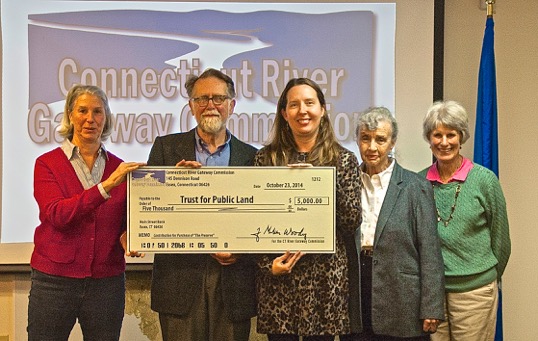
Connecticut River Gateway Commission Chairman Melvin Woody presents a $5,000 contribution to The Preserve Fund to Kate Brown (center), Trust for Public Land Project Manager for “The Preserve” acquisition. On the far left is Commission Vice Chair Nancy Fischbach, and on the right are Commission Secretary Madge Fish & Treasurer Margaret (“Peggy”) Wilson.

Connecticut River Gateway Commission Chairman Melvin Woody presents a $5,000 contribution to The Preserve Fund to Kate Brown (center), Trust for Public Land Project Manager for “The Preserve” acquisition. On the far left is Commission Vice Chair Nancy Fischbach, and on the right are Commission Secretary Madge Fish & Treasurer Margaret (“Peggy”) Wilson.

The Connecticut River Gateway Commission has contributed $5,000 to the Trust for Public Land Campaign to Preserve the 1,000 Acre Forest

The donation will help ensure that the parcel known as The Preserve in Old Saybrook, Westbrook, and Essex will be permanently protected as forestland and wildlife habitat.

The Gateway Commission was established in 1973 to administer the Connecticut River Gateway Conservation Zone.  Eight towns in the lower Connecticut Valley including Lyme and Old Lyme along with Chester, Deep River, East Haddam, Essex, Haddam and Old Saybrook joined together in a compact to create the Conservation Zone in order to protect the scenic, historic and environmental resources of the lower Connecticut River.

Although not within the Conservation Zone, The Preserve lies within the lower Connecticut River watershed.  It is the last thousandacre coastal forest between New York and Boston and includes the headwaters of streams that flow into the Connecticut.

The Commission believes that its protection is important to the ecological health of the watershed and the river.

According to Gateway Commission Chairman Melvin Woody “The Gateway Commission is gratified to join in this vital preservation project.”

For more information about the Connecticut River Gateway Commission, visit  www.ctrivergateway.org or contact J. H. Torrance Downes at (860) 581-8554, or email him at tdownes@rivercog.org.

Clarification: Deadline for Annual Land Trust Photo Contest Extended to Dec. 1

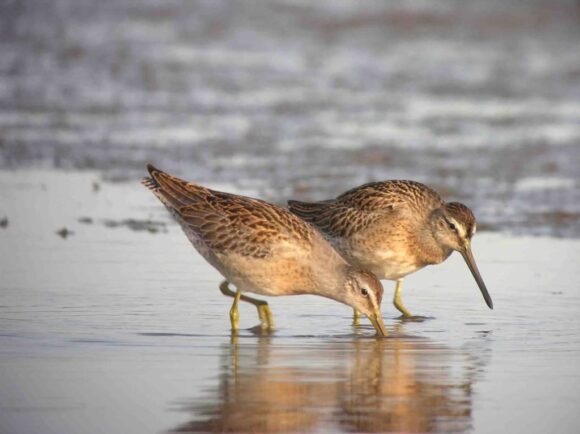
2013 Land Trust Photo Contest winner by Hank Golet.

2013 Land Trust Photo Contest winner by Hank Golet.

Amateur photographers, no matter where they live, may submit photographs of the scenic countryside, wildlife, plants, and cultural and historic features in the towns of East Haddam, Essex, Lyme, Old Lyme, and Salem.
Submissions are being accepted up to Dec. 1. Contest rules are available online athttp://www.lymelandtrust.org/news/photo-contest/ . Entry forms for the contest will be available after September 1 by email only at photocontest@lymelandtrust.org.
A panel of three judges will award cash prizes in the following five categories:Landscape/Waterscape ~ Plants ~ Wildlife ~ Cultural/Historic ~ Youth (photographs of any of the above subjects by photographers aged 14 and younger).Additionally, a special John G. Mitchell Memorial Award will go to the photograph determined to best promote and support biodiversity and the environment.
The Contest judges are William Burt, a naturalist and wildlife photographer acclaimed for his beautiful books; and Amy Kurtz Lansing, an accomplished art historian and curator at the Florence Griswold Museum. New to the panel of judges is Skip Broom, a respected, award-winning local photographer and antique house restoration housewright. Broom replaces the much-appreciated retiring judge, Rudy Muller, who volunteered with the Photo Contest for many years.
All entered photographs, plus all winning photos, will be displayed and celebrated in a public reception in March 2015.
Organizers of the contest, East Haddam Land Trust, Essex Land Trust, Lyme Land Conservation Trust, Old Lyme Land Trust, and the Salem Land Trust, and encourage amateur photographers to join the fun and share wonderful photos from these southern Connecticut towns.Previous Land Trusts Photo Contest winning photos, viewable at https://landtrustsphotos.shutterfly.com/, highlight the beauty of these towns and the pressing need to preserve the environments within these towns.

Old Lyme’s Christiano Featured in Essex Art Show

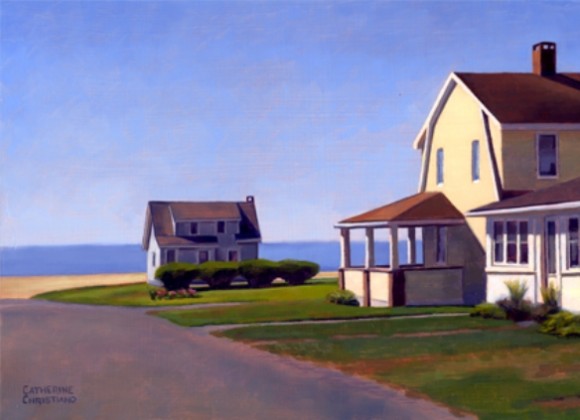
 Catherine Christiano, Cottages White Sands Beach #7, oil on panel, 8 x 11 inches, 2014.

Catherine Christiano, Cottages White Sands Beach #7, oil on panel, 8 x 11 inches, 2014.

Old Lyme artist Catherine Christiano is featured in a three person show at Art Essex Gallery that opens with a public reception Saturday, Nov. 1, from 4 to 7 p.m.

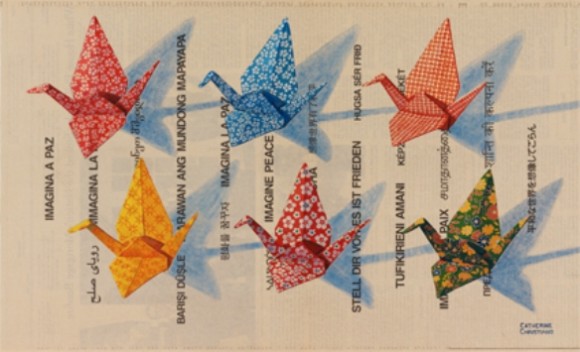
Catherine Christiano, Imagine Peace, oil on newspaper on panel, 11 7/8 x 19 1/2 inches, 2013. Photo credit Paul Mutino.

Catherine Christiano, Imagine Peace, oil on newspaper on panel, 11 7/8 x 19 1/2 inches, 2013. Photo credit Paul Mutino.

She is exhibiting postcard sized oil paintings of the beach communities of Old Lyme, small landscapes, and compelling detailed still lifes painted on newspaper.

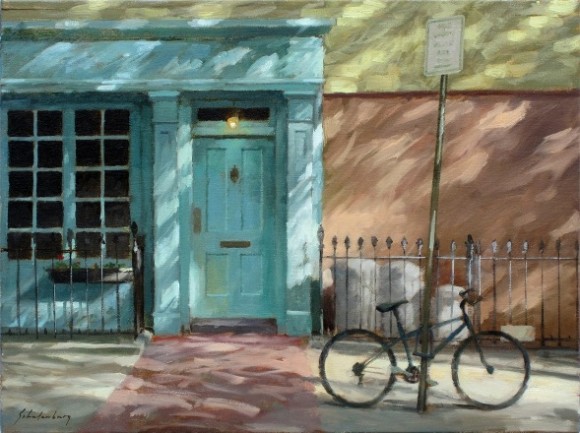
Paul Schulenbug, “Sunlight Through Trees”, oil on canvas, 18 x 24 inches.

Paul Schulenbug, “Sunlight Through Trees”, oil on canvas, 18 x 24 inches.

Also in this exhibition are Cape Cod artist Paul Schulenburg’s meditative oils of everyday scenes that evoke the work of Edward Hopper.

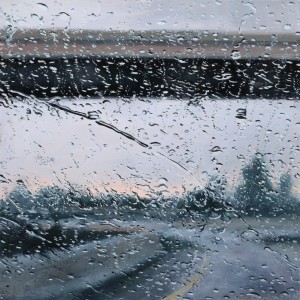
Karen Woods, “Streak”, oil on panel, 8 x 8 inches, 2014.

Karen Woods, “Streak”, oil on panel, 8 x 8 inches, 2014.

The third artist exhibiting is Karen Woods from Boise, Idaho, whose provocative streetscapes viewed through the windshield will be on display.

The exhibition will be on view through Nov. 22.  Art Essex Gallery is located at 10 Main Street in Essex.

For more information, visit http://www.artessexgallery.com/