
Letter from Paris: ‘Loi Macron’ Indicates a Sea Change in French Politics

Nicole Prévost Logan

Nicole Prévost Logan

In January 2015, in a forceful declaration, French president François Hollande officially announced a break with the Socialist program, which had been the basis of his 2012 presidential campaign.  It was a sharp turn toward a more liberal, market-oriented policy.  The Loi Macron, named after the young (33-year-old) Minister of Economy Emmanuel Macron, was to embody the new trend.
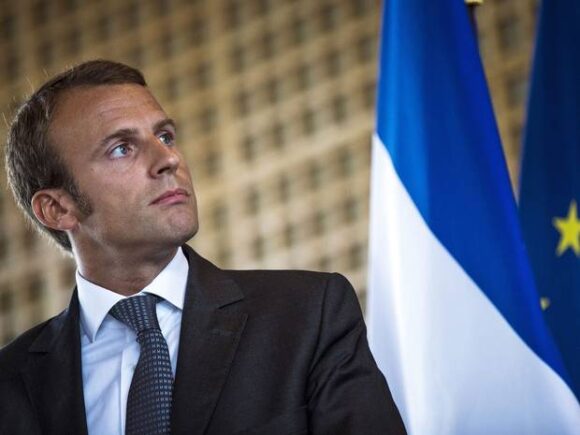
Emmanuel Macron

Emmanuel Macron

Expecting that the law would not pass, the government decided to use a joker – the article 49.3.  It was a gamble since, in the event that the motion de censure (vote of no confidence) of the opposition succeeded, the government of Manuel Valls would be disavowed and fall.  But the motion de censure received only 234 votes when it needed the absolute majority of 289.  The law passed.

The article 49.3 is included in the constitution of the Fifth Republic.  It allows the government to act in force to push a text through the Parliament without the need of a vote. It is a powerful but dangerous device.  It has been used 82 times since 1958.

The last time was in 2006 when Dominique de Villepin, under the presidency of Jacques Chirac, tried to promote the Contrat Premiere Embauche, or CPE (first hiring contract). The students demonstrated in the streets.  Shortly thereafter the CPE received national funerals.  The champion of article 49.3 was Michel Rocard who in the late 1980s used it 28 times.

After 200 hours of consultations and 1,500 amendments granted by the government, it looked as though each article had been accepted separately.  And yet, by the time of the final vote on Feb. 17, the far right (Front National), the far left (Front de Gauche), most of the right (UMP), and the 40 Frondeurs, or splinter group from within the Socialist party, joined in an alliance to put road blocks to stop the government’s proposal. Manuel Valls and Emmanuel Macron made their concluding speeches among jeers and interruptions.  On the face of many deputies could be seen a rather despicable sarcasm.

In fact, the manoeuvre of the government deserves to be applauded since, to push a text in force, was the only way for the Executive to succeed.  The Loi Macron reperesents an enormous task attempting to reform the fabric of French society.  It meant dismantling the century-old system of privileges and protected niches enjoyed by whole segments of the population, including the five million civil servants, known as notaires — in France, notaires are a specific type of French attorneys overseeing all legal transaction while collecting taxes on behalf of the government, doctors, veterinarians, taxi drivers, auction houses officials, etc.

All the professions are regulated and benefit from a a special satus.  The right to work on Sundays, and allowing intercities busses were hard-won victories.  Only indirectly, the Loi Macron dealt with unemployment and ways to jump-start the economy.

The law is insufficient and has its defects, but is a step in the right direction. It represents a real effort to bring changes and to satisfy Brussels. Angela Merkel, in Paris for more discussions about the Ukraine, expressed her satisfaction.

Nicole Prévost Logan

Nicole Prévost Logan

About the author: Nicole Prévost Logan divides her time between Essex and Paris, spending summers in the former and winters in the latter.  She writes a regular column for us from her Paris home where her topics will include politics, economy, social unrest — mostly in France — but also in other European countries.  She also covers a variety of art exhibits and the performing arts in Europe.  Logan is the author of ‘Forever on the Road: A Franco-American Family’s Thirty Years in the Foreign Service,’ an autobiography of her life as the wife of an overseas diplomat, who lived in 10 foreign countries on three continents.  Her experiences during her foreign service life included being in Lebanon when civil war erupted, excavating a medieval city in Moscow and spending a week under house arrest in Guinea.
Letter from Paris: Minsk 2 – Another Truce for Ukraine … Maybe

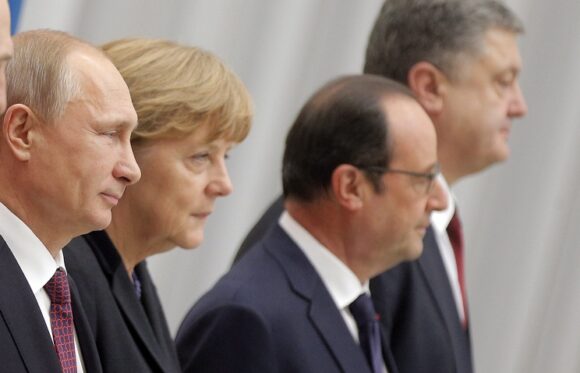
From left to right, Vladimir Putin, Angela Merkel, François Hollande and Petroshenko.

From left to right, Vladimir Putin, Angela Merkel, François Hollande and Petro Porosnhenko. Photo credit EPA/Maxim Shipenkov.

After a 16-hour long marathon of negotiations on Feb. 11, and a great deal of suspense, Angela Merkel and François Hollande wrenched out a hard-won agreement for a cease-fire in Ukraine from Petro Porosnhenko and Vladimir Putin starting on Saturday, Feb. 14 at midnight.  All parties to the agreement were extremely cautious and hoped that “Minsk 2” would last longer than “Minsk 1” signed in September 2014.

More than 5,500 people have died in the conflict during the past 10 months, which makes it the deadliest in Europe since World War II.  There was a sense of relief that the agreement went through and thus a disaster had been avoided.  In the morning, Putin joked that he had had better nights but felt satisfied.

To continue the negotiations rather than slamming more sanctions on Putin, as some Washington pundits advocate, was the objective of Minsk 2.  Sanctions have a cost for Europe (for example, the Russian government retaliated to earlier sanctions by blocking the import of produce from Western Europe.)  More dangerously, they exacerbate the nationalism of Putin and enhance his popularity in Russia.

In the face of a threatening strategy of Daesh* making well planned inroads to destabilise Europe by recent acts of terrorism, Russia and the European Union (EU) have a common enemy.  For decades, the extremist Moslem opposition in Chechnya and Central Asia has been a great fear for the Russian government..

The talks in Minsk started in a polar atmosphere.  Throughout the night, Petro Poroshenko’s and Vladimir Putin’s teams moved like a choreographed ballet.  Early in the morning, Putin left the room, slamming the door, only to reappear a few minutes later. The Franco-German duo is to be credited with an unflappable tenacity to reach an agreement.  The two worked perfectly together.  Merkel needed Hollande since she wants to avoid making foreign policy decisions alone and prefers,“Leading from the center,” to use a formula coined by the German Minister of Defence Ursula von der Leyen.

Screen Shot 2015-02-18 at 12.37.33 AM

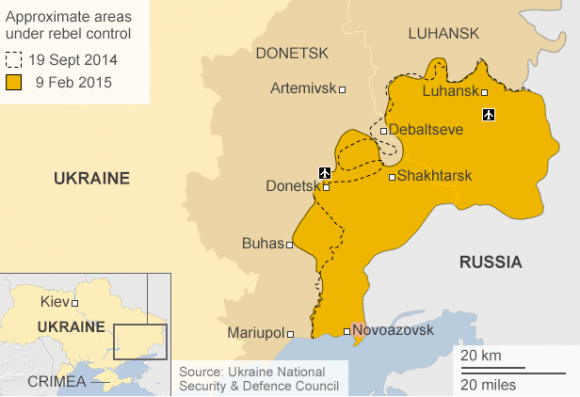
Minsk 2 includes modified provisions to make the process move forward.  The buffer zone – cleared from all heavy armaments – has been widened from 30 km to 70 kms.  The European Council for Stability and Security will be monitoring the application of the agreement.  Putin expressed his demands for the autonomy of the Luhansk and Donestk regions..

The EU widely considers that Ukraine is both a corrupt and failed state.  It cannot afford to help it financially nor envisages its adhesion to the EU any time soon.  Kiev does not want to lose the industrial and mining Donbas region, but its action is disorganized.  For many months, Putin has claimed that he never intervened in the conflict taking place in Eastern Ukraine.

One wonders whether he really controls the Russian separatists, so different from the sophisticated Maidan crowd.  The Donbass miners and blue collar workers are products of massive transfers of population forced by the Soviets at the time of the German offensive to compensate for the relocation of highly skilled workers to the Ural Mountains.  Another headache for Putin is the presence among the Russian separatists of clans whose leaders have political ambitions .

It is hard to understand Putin’s strategy.  Obviously he does not want NATO to choke him nor nuclear misssiles to be installed in the area.  He does not have the means to support the Donbas.  His priority should most likely be to allow a corridor from Rostov on Don, through Mariopol on the Sea of Azov and then leading to the Crimea.  At present his only access to the Crimea is through the Straits of Kerch, which is some distance away.

*The new nickname for ISIS widely used in France, Australia and some other countries because ISIS supposedly dislikes it intensely — it is a loose acronym of the Arabic description of ISIS, which does not acknowledge any statehood for the organization but rather can be roughly translated as, “One who crushes something underfoot,” or, “One who sows discord.”

Nicole Prévost Logan

Nicole Prévost Logan

About the author: Nicole Prévost Logan divides her time between Essex and Paris, spending summers in the former and winters in the latter.  She writes a regular column for us from her Paris home where her topics will include politics, economy, social unrest — mostly in France — but also in other European countries.  She also covers a variety of art exhibits and the performing arts in Europe.  Logan is the author of ‘Forever on the Road: A Franco-American Family’s Thirty Years in the Foreign Service,’ an autobiography of her life as the wife of an overseas diplomat, who lived in 10 foreign countries on three continents.  Her experiences during her foreign service life included being in Lebanon when civil war erupted, excavating a medieval city in Moscow and spending a week under house arrest in Guinea.

High Hopes Hosts Volunteer Enrichment Conference Today, All Welcome

HorsesHigh Hopes Therapeutic Riding, Inc. is hosting a Volunteer Enrichment Conference today, Monday, Feb. 16, which is also President’s Day.  The event, which runs from run from 9 a.m. to 4 p.m., is a one-day conference offering sessions on a variety of topics related to the High Hopes’ volunteer experience.
A small registration fee gives you the choice of four sessions during the day and lunch is also included.  Sign up now and spend an interesting and fun day at High Hopes.

Choose from topics offered during three different sessions and hear experts talk about equine care, people care, great High Hopes stories from our past (did a horse really fall into a swimming pool?) and more.

Presenters include experts like Jane Strong, certified Equine Experiential Learning Instructor, Marty Whittle, a certified Yoga Alliance RYT instructor, Tim Hayes, a nationally recognized natural horsemanship clinician and Carolyn Jagielski, Physical Therapist.

Registration is just $10 and includes a lunch from Coffee’s Country Market and Deep River Snacks.

All are welcome.  

Click here to view detailed information on the presentations from which to choose and/or register.

Saint Ann’s Church in Old Lyme Hosts Four Winter Concerts, Ukrainian Vocal Group Sings Today

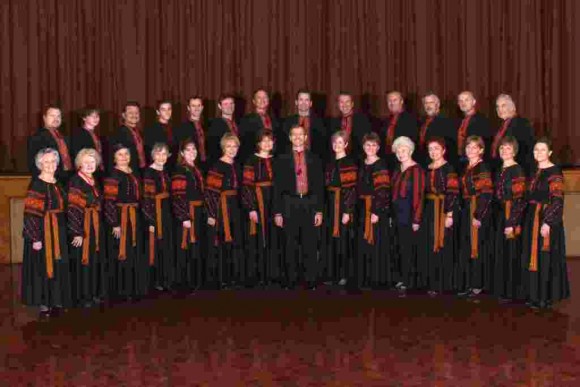
The Yevshan singers who will perform at Saint Ann's Church on Sunday.

The Yevshan singers who will perform at Saint Ann’s Church on Sunday.

Over the winter months Saint Ann’s Episcopal Church in Old Lyme will present four exciting concerts in its ongoing Music Series. Concert performers and dates are as follows:

Sunday, Jan. 18 at 10:30 a.m. and 12 noon – Yevshan Singers

This Hartford-based Ukrainian a cappella vocal ensemble will join Saint Ann’s 10:30 a.m. worship service, singing two Ukrainian sacred songs. They will then perform a “mini-concert” (approximately 30-40 minutes) of their folk music during Saint Ann’s coffee hour. The performance is free and the community is welcome to attend either or both of these events.

Saturday, Jan. 24 at 4 p.m. – Family HooteNanny with The Nields

Gather up the kids and come to Saint Ann’s for an all-ages jam-along/family chorus. Led by Nerissa and Katryna Nields, the HooteNanny is about singing, dancing, playing instrument, big and small, and about indulging the imagination and creativity of the entire family. Admission cost for the concert is $10 per family.

Saturday, January 24 at 7 p.m. – An Evening Concert with The Nields

The renowned folk-rock sister duo of Nerissa and Katryna Nields performs a selection of original music. As Spin Magazine noted, “Listen to the Nields twice and you’ll start to catch the twists in the tales, the quirks and ironies that make every song a short story, and then you’ll be hooked.” Reflections upon life and relationships are the theme of the Nields’ songs–their performance is a must for lovers of intricate vocal harmonies. Admission cost for the concert is $10.

The public is invited to a Pasta Buffet Supper that will be served between the Nields’ two concerts – from 5 to 6:30  p.m.in the Griswold Room at Saint Ann’s. Tastily prepared, the menu will please the taste buds of all ages. Cost for the supper is $5, children 5 and under are free.

Sunday, March 1 at 3pm – Elm City Girls’ Choir.

Saint Ann’s welcomes the return of this pre-eminent New Haven-based choral ensemble. At this concert they will be joined by choral groups from Old Lyme and from the Isaac Middle School in New London. The Elm City Girls’ Choir is comprised of young women, ages 7 to 18, drawn from throughout the state. The choir has performed with many outstanding choral groups, including The American Boychoir, CONCORA, New York Virtuoso Singers, and Yale Schola Cantorum. They have also toured extensively throughout North America and Europe. A free-will donation will be taken; the proceeds will help to support Saint Ann’s concert series for the community.

Saint Ann’s is an Episcopal parish in Old Lyme and, under the direction of the rector the Rev. Canon Mark K J Robinson, invites and welcomes all visitors to attend these performances in their music series.

Saint Ann’s is located at 82 Shore Road (Rt. 156), two miles off I95, exit 70. Parking is adjacent to the church.

For reservations and more information contact Kathy Rowe at 860-434-1621, via email at office@saintannsoldlyme.org , or visit Saint Ann’s online at www.saintannsoldlyme.org

All About Phoebe: Old Lyme Library Hosts Presentation Tonight on Its Namesake

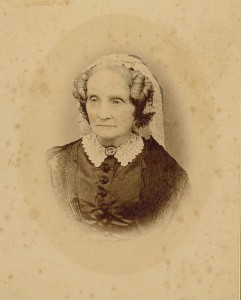
Phoebe Griffin Noyes

Phoebe Griffin Noyes

The Old Lyme Phoebe Griffin Noyes Library will host a unique historical presentation by Carolyn Wakeman on the namesake of the Library on Wednesday, Jan. 14, at 7 p.m.  Co-sponsored by the Florence Griswold Museum, the program titled, Phoebe’s Place: Life and Letters on Lyme Street, celebrates the life of one of the most influential women in the community.

Phoebe Griffin Noyes, after whom Old Lyme’s public library is named, lived for most of her 78 years on the main street through town.  But starting at age 14, she journeyed for a decade to New York where she stayed with an uncle who was a successful lawyer.  Her education in the city shaped both her skill at miniature painting and the home school she later established beside the village green.

This talk, based largely on family letters, describes how one woman’s love of learning and painting influenced the culture of a town and established “a taste for art” in Old Lyme.

Wakeman grew up in Old Lyme and traces her own love of learning to countless hours spent reading on a window seat in the children’s room of the Phoebe Griffin Noyes Library.  After retiring from the faculty of the University of California, Berkeley, in 2008, she became intrigued by Old Lyme’s rich history.

Professor Wakeman is currently the writer and editor of the Florence Griswold Museum’s history blog and author of The Charm of the Place: Old Lyme in the 1920s.

The program is free and open to the public.  Registration is required by calling 860-434-1684 or visit www.oldlyme.lioninc.org to register online under the Events calendar.

The snow date for this event is Wednesday, Jan. 21, 2015 at 7 p.m.

The Library is located at 2 Library Lane, off Lyme Street in Old Lyme.  Winter hours are Monday and Wednesday, 10am to 7pm; Tuesday and Thursday, 10am to 6pm; Friday, 10am to 5pm and Saturday, 10am to 4pm