
Letter from Paris: The Rise of Islam in Europe; Reactions and Results

Nicole Prévost Logan

Nicole Prévost Logan

As we were driving toward Baden Baden in Germany, our tour director pointed to the brand new mosque rising above the red-roofed houses. “This mosque was not there last year,” he commented.  On a recent river cruise through five European countries — Belgium, The Netherlands, Germany, France and Switzerland – it was impossible not to notice the increasing presence of Islam — or at least our perception of it.

In the tense international context of conflict with the Islamic State, there is a feeling in Europe of being caught in a two-pronged threat, both from within and abroad. This is why many believe that it is more important than ever for the Muslims living in Europe, moderate in the majority, to speak up with a loud voice against Daesch violence.

muslim_womenThere are more than 40 million Muslims in Europe, which translates to an average of 8 percent of the population.  France has the largest percentage with 10 percent versus 0.6 percent in the US.  The Muslim inhabitants are mostly concentrated in urban areas, where they can sometimes reach 20 percent and even 30 percent as in Basel, Switzerland.

For an American readership it is hard to grasp the impact of such a concentration on the urban landscape.  Living in Europe, one has to adjust to the changing profile of the Muslim community.  Take, for instance, the recent announcement made by the rector of the Great Mosque of Paris that the number of mosques existing today — 2,000 — in France needs to be doubled.

In early April,  L’Union des Organisations Islamiques de France (UOIF — the Union of Muslim Organizations of France) held its 33rd annual gathering at Le Bourget, north of Paris.  For three days, thousands flocked to this event, bringing their families and looking forward to do some shopping or attending seminars.  French Prime Minister Manuel Valls expressed some concern that the Muslim Brotherhood, which conceived this event, might exert too much influence on the crowds.

One forum attracted many visitors and one, an older man, said, “At the mosque, I am a Muslim — in the street I am a lay person.  When I became French, I accepted the 1905 law of separation of Church and State and I respect the idea of a secular State.”  A young lawyer retorted, “I was born in France, which gave me some rights.  Today I demand that these rights be respected.”  This heated exchange epitomizes the contrast of attitudes between generations of immigrants.

A disturbing trend is the radicalization of the European Muslim community by the Salafists – a conservative Sunni sect.  They want Islam to return to its original form with a strict application of the Sharia.  A journalist describes how, 20 years ago, a suburb outside Montpellier had a theater and drama workshops, where young people loved to practice on the stage.  Today the theater is run down and empty. The Salafists have ordered the premises to be closed, and forbade the women to appear in public.  Le Monde published an article describing the growing number of Salafists in Dusseldorf, but also stressing the distinction between Salafist true believers and “pseudo Salafists,” who are potential jihadists.

Once more France is in the line of fire for its military interventions in several parts of the world.  Recently the screens of TV5 Monde, a television station broadcasting programs in the French language to 200 countries, turned black for 20 hours.  One viewer, in Zarhle, Lebanon, said, “I am not even French, but for me the programs offered by TV5 Monde represent culture, a window onto the free world.”

One can only hope that the ongoing destruction of archaeological sites, the attacks on journalists and the hacking of channels of communication with their social networks, are not going to be followed by further cyber attacks.
Nicole Prévost Logan

Nicole Prévost Logan

About the author: Nicole Prévost Logan divides her time between Essex and Paris, spending summers in the former and winters in the latter. She writes a regular column for us from her Paris home where her topics will include politics, economy, social unrest — mostly in France — but also in other European countries. She also covers a variety of art exhibits and the performing arts in Europe. Logan is the author of ‘Forever on the Road: A Franco-American Family’s Thirty Years in the Foreign Service,’ an autobiography of her life as the wife of an overseas diplomat, who lived in 10 foreign countries on three continents. Her experiences during her foreign service life included being in Lebanon when civil war erupted, excavating a medieval city in Moscow and spending a week under house arrest in Guinea.
Middlesex Land Trust & CT River Gateway Commission Announce New Open Space Acquisition in Haddam Neck

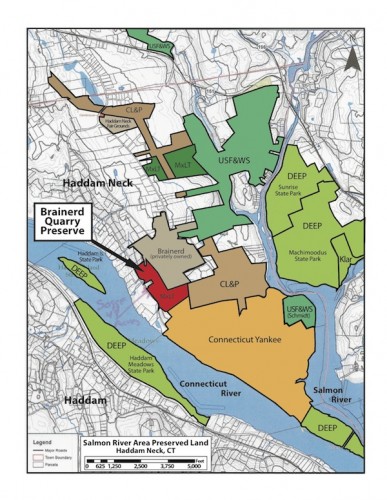
haddamNeckMapRaulBrownFINAL031815_v2In February of this year the Middlesex Land Trust, in partnership with the Connecticut River Gateway Commission, purchased 50 acres of open space for permanent protection in Haddam Neck. This new preserve offers breathtaking views across the Connecticut River to Haddam Meadows State Park from a rough path that runs along the base of dramatic cliffs created from the property’s historic use as a quarry.
The Middlesex Land Trust now owns the preserve and is planning to develop a trail system for the public to enjoy for hiking, passive recreation and education. The tract lies along Injun Hollow Road just north of the 585 acres Connecticut Yankee property.

The land has been named the Brainerd Quarry Preserve to reflect the historic importance of the Brainerd Family in Haddam. Daniel Brainerd was one of the 28 founding settlers of Haddam in 1662, and a century later, in 1762, Deacon Esra Brainerd opened a quarry on the now preserved site. The quarry operated for more than 150 years, shipping stone down river to New York and as far south as Maryland, Virginia and New Orleans.

A 2011 study of the history and archeology of the area describes the Brainerds as “a family of entrepreneurs in the forefront of early industry and commerce in the Connecticut River Valley” and recommends the quarry site as “an ideal candidate for use as an outdoor classroom for studies in local history, geology, mining, early American industry, the Industrial Revolution in Connecticut and other related topics for grammar school, high school and college students.”

This significant property along the Connecticut River is now owned and managed by the Middlesex Land Trust, a regional not-for-profit volunteer land conservation organization that, since 1987, has been dedicated to the preservation of open space in northern Middlesex County.

The purchase was initiated by, and made possible through grant funding from the Connecticut River Gateway Commission, a state-local compact that protects the Lower Connecticut River Valley, one of the “most important ecological landscapes in the United States” according to the Secretary of the U.S. Department of the Interior.

A dedication ceremony for the new Brainerd Quarry Preserve and the opening of the preserve to the public is anticipated for the summer of 2015.

Brett Elliott Appointed New Executive Director at ‘The Kate’

Brett Elliott

Brett Elliott

On Thursday, the Board of Directors of the Katherine Hepburn Cultural Arts Center (“The Kate”) announced the appointment of Brett Elliott as Executive Director.

Elliott served as ‘The Kate’s’ Interim Director since founding Executive Director Chuck Still announced his departure in December.

Sonny Whelen, President of the Board of Trustees, stated, “We couldn’t be happier having Brett join us as our next Executive Director.  In his position as interim director, Brett has shown us that he has all of the skills and leadership qualities to bring the Kate forward as we continue to expand our role in the community.  This is a very exciting time for all of us”.

Starting in 2012, Elliott spent two years in Chicago where he received his MFA in Arts Leadership from DePaul University, a joint program with the Chicago Shakespeare Theater.  Elliott produced several projects for Chicago Shakespeare including the world premiere of “Since I Suppose”, a technology driven, live interactive performance developed by Australia’s one step at a time like this. Elliott also spent a brief period in the finance and operations department at Broadway in Chicago.

Elliott is no stranger to Eastern Connecticut or the Kate.  He worked at the Eugene O’Neill Theater Center from 2009-2012.   He then found his way to ‘The Kate’ through lighting and production work.

Holding a BA in Theater from Saginaw Valley State University, Elliott is a proud product of the Kennedy Center’s American College Theater Festival, an organization, which gave him his start.

“After six years, there is no doubt about the quality, quantity, and variety of entertainment at ‘The Kate’; it truly is a cultural gem on the shoreline,” Elliott stated.  “I am very proud to not only be back at ‘The Kate,’ but to lead this organization at such a vibrant and exciting time.  I look forward to getting to know those in the community, as well as the thousands of patrons that come to the Kate each year,” Elliott concluded.

The Katharine Hepburn Cultural Arts Center, ‘The Kate,’ is a non-profit performing arts organization located in the historic theatre/town hall on Main Street in Old Saybrook. Originally opened in 1911 and listed on the National Register of Historic Places, ‘The Kate’ has been renovated with public funds from the town of Old Saybrook and donations raised by the Trustees of the Center.

It includes a 250-seat theatre and a small museum honoring Katharine Hepburn, Old Saybrook’s most celebrated resident. As befits an organization born of such a public/private partnership, programming is eclectic, offering something for all ages and income levels on the Connecticut shore and in the lower river valley.

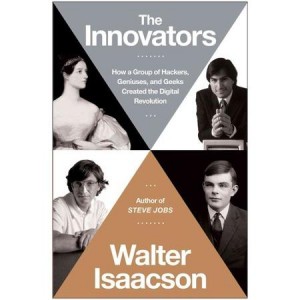
Reading Uncertainly? ‘The Innovators’ by Walter Isaacson

The_InnovatorsThis is the remarkable and intricate story of the computer, the Internet and the World Wide Web, all of which transformed and continue to alter this globe. It is a story of human collaboration, conflict, creativity and timing, from Ada, Countess of Lovelace in 1843 to the more familiar names of Vannevar Bush, Alan Turing, John Mauchly, John von Neumann, Grace Hopper, Robert Moore, Bill Gates, Paul Allen, Tim Berners-Lee, Larry Page, Sergey Brin, and, of course, “Watson,” the almost-human Jeopardy contestant of IBM.
Isaacson stresses the importance of the intersection of individual thinking combined, inevitably, with collaborative efforts.  Ideas start with non-conformists, in many of whom initiative is often confused with disobedience. But it is in collaboration that we have found the effectiveness of the Web, a “networked commons.”

These changes have come about through conception and execution, plus “peer-to-peer sharing.” Isaacson cites three co-existing approaches: (1) Apple with its bundled hardware and software, (2) Microsoft with unbundled software, and (3) the Wikipedia example of free and open software, for any hardware. No one approach, he argues, could have created this new world: all three, fighting for space, are required. Similarly, he believes that a combination of investment works best: Government funding and coordination, plus private enterprise, plus “peers freely sharing ideas and making contributions as a part of a voluntary common endeavor.”

In his concluding chapter, Isaacson raises the question of the future for AI, artificial intelligence. Stephen Hawking has warned, yet again, that we may create mechanisms that will not only think but also re-create themselves, effectively displacing homo sapiens as a species. But Isaacson is more optimistic: he sees and favors a symbiotic approach, in which the human brain and computers create an information-handling partnership. Recent advances in neuroscience suggest that the human brain is, in many ways, a limited automaton (see System One of Kahneman). But our brain, with its ability to “leap and create,” coupled with the computer’s growing ability to recall, remember, and assess billions of bits of information, may lead us, together, to better decisions.

His final “five lessons” are worth inscribing:

  1. “Creativity is a collaborative process.”
  2. “The digital age was based on expanding ideas handed down from previous generations.”
  3. “The most productive teams were those that brought together people with a wide array of specialties.”
  4. “Physical proximity is beneficial.”
  5. To succeed, “pair visionaries, who can generate ideas, with operating managers, who can execute them.”

Isaacson’s final lesson:  humans bring to our “symbiosis with machines . . . one crucial element: creativity.” It is “the interaction of humanities and sciences.”

And we wouldn’t have LymeLine without the Innovators!

Editor’s Note: “The Innovators” is published by Simon & Schuster, New York 2014.

Felix Kloman_headshot_2005_284x331-150x150

About the author: Felix Kloman is a sailor, rower, husband, father, grandfather, retired management consultant and, above all, a curious reader and writer. He’s explored how we as human beings and organizations respond to ever-present uncertainty in two books, ‘Mumpsimus Revisited’ (2005) and ‘The Fantods of Risk’ (2008). A 20-year resident of Lyme, he now writes book reviews, mostly of non-fiction that explores our minds, our behavior, our politics and our history. But he does throw in a novel here and there. For more than 50 years, he’s put together the 17 syllables that comprise haiku, the traditional Japanese poetry, and now serves as the self-appointed “poet laureate” of Ashlawn Farms Coffee, where he may be seen on Friday mornings. His wife, Ann, is also a writer, but of mystery novels, all of which begin in a bubbling village in midcoast Maine, strangely reminiscent of the town she and her husband visit every summer.


Letter From Paris: Greece Given Four Month Debt Deal Extension … But Then What?

Nicole Prévost Logan

Nicole Prévost Logan

During the last week of February 2015, intense negotiations took place between the Greek government and the three members of the “Troika” – the International Monetary Fund (IMF), the Central European Bank (CEB) and the Eurozone.  On Feb. 27, the Bundestag, by a massive majority, approved the four month extension of aid to Greece.

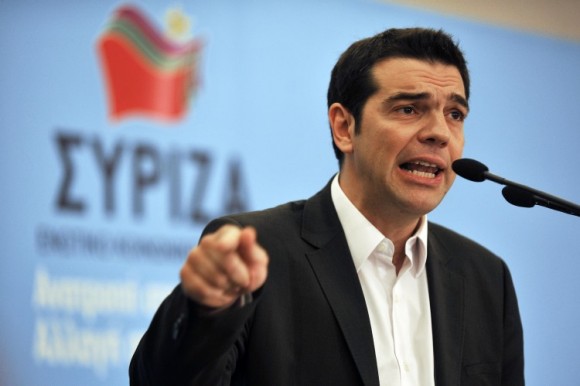
It looked very much like a “déjà vu”scenario: Greece deep in debt, Greece kept alive thanks to several rounds of loans, Greece repeating its promises to curb public spending, and put a stop to fraud, corruption and tax avoidance.  The creditors, however, wanted to give the new government of Alexis Tsipras. a chance to prove itself.  The objective was to strike a compromise between austerity reforms and measures granting some respite to the most vulnerable segment of the population.  The Greek government had five days left before running out of money.

Greek President Alexis Tsipras

Greek Prime Minister Alexis Tsipras

Greece joined the Eurozone on Jan. 1, 2001.  Before 2000, the Greek deficit was about 13 percent of the Gross Domestic Product (GDP.)  By some miracle, in order to meet the criteria for joining the European Union (EU), the deficit was brought down to 3 percent, or more precisely to 3.07 percent.  Eurostat, the statistical office of the EU, the Organization for Economic Co-operation and Development (OECD) and other organizations, pondered over the figures.  The situation was confusing, especially after the Goldman Sachs experts helped Greece with some “creative accounting” by deducting currency swaps and derivatives amounting to 2.8 billion from the calculation of the deficit.

Before 2012, Greece’s creditors were mostly private banks, such as the Société Générale in France.  In March of that year, the banks agreed to cancel 70 percent of their loan or 107 billion.  In 2010 and 2012, the “Troika” granted two rounds of loans, amounting respectively to 110 and 141 billion.  Germany supports 30 percent of the Greek loan, France 23 percent (or 40 billion) and Italy 20 percent.  The participation of the Eurozone members is proportional to the size of their population.  The loans’s maturity is 30 years, 10 percent of the loan carries zero interest and the remainder has interest as low as 2 percent in 2015.  It is important to note these facts in order to counter a lot of disinformation available on the internet.

The discussions, held in Brussels, went well until the disastrous final press conference when the new Greek minister of finances Yanis Varoujakis posturing as a cool Bruce Willis, (to use the Le Monde expression) first demanded that the “Troika” change its name and then asked for a “restructuring” of the debt.  His tour of European capitals, ending in Berlin (where he should have started) was not much appreciated by the German Minister of Finance Wolfgang Schauble, who commented, “We agreed not to agree.”  Varoujakis retorted, “We did not even agree not to agree.”

At a time when refugees and migrants try desperately to reach Europe, the immigration policy of the Tsipras’s recently-elected Syriza party is quite unsettling.  Their plan calls for the retention centers, where refugees and migrants have been held until now, to be turned into “open centers;” to grant citizenship to 150,000 second generation children born in Greece; and to provide housing, schooling and medical care.  How are these programs going to be financed?  The wall built to protect the border between Turkey and Greece fell into disrepair after recent floods.  Maintaining this wall is not a priority announced the government.

There is pretty much a consensus about Greece’s inability to ever pay back its debt.  The creation of the European Funds of Stability and Finances in 2013 to “mutualize” the debt will help Europe absorb the Greek default with more serenity.

But it is far from a done deal.  In four months, before your know it, there will be fierce opposition to write off the debt.  Countries like Portugal or Spain are struggling through austerity and are are not about to continue bailing out Greece.

Nicole Prévost Logan

Nicole Prévost Logan

About the author: Nicole Prévost Logan divides her time between Essex and Paris, spending summers in the former and winters in the latter.  She writes a regular column for us from her Paris home where her topics will include politics, economy, social unrest — mostly in France — but also in other European countries.  She also covers a variety of art exhibits and the performing arts in Europe.  Logan is the author of ‘Forever on the Road: A Franco-American Family’s Thirty Years in the Foreign Service,’ an autobiography of her life as the wife of an overseas diplomat, who lived in 10 foreign countries on three continents.  Her experiences during her foreign service life included being in Lebanon when civil war erupted, excavating a medieval city in Moscow and spending a week under house arrest in Guinea.