Musical Masterworks Presents Two Free Concerts with ‘DeCoda’ in Old Lyme, Nov. 22 & 23


OLD LYME–Decoda, Musical Masterworks’ ensemble-in-residence, has announced two free concerts in Old Lyme as part of its mission to create a more compassionate and connected world through chamber music. 

Musical Masterworks invites the public to an interactive family concert on Saturday, Nov. 22 and a “Celebration of Joy and Gratitude” concert on Sunday, Nov. 23. 

Across a weeklong residency at Musical Masterworks, Decoda brings together students, families, and music lovers for programs that blend classical mastery with contemporary imagination.

The residency features Decoda artists Clara Lyon, violin; George Meyer, violin; Sæunn Thorsteinsdöttir, cello; and Catherine Gregory, flute.

Interactive Family Concert

Saturday, Nov. 22

2:30 to 3:30 p.m.

Old Lyme Phoebe Griffin Noyes Library, 2 Library Lane

Attendees are invited to explore tempo, dynamics, and tone through hands-on music-making as they create a new anthem of thanks. They’ll leave with creative prompts to continue the musical celebration at home during the holiday week.

A Celebration of Joy and Gratitude

Sunday, Nov. 23

2 to 3:30 p.m.

Saint Ann’s Episcopal Church, 82 Shore Road

The program will explore music for flute and strings, spanning Mozart to contemporary reimaginings that include a fiddle-inspired duo by Decoda’s George Meyer and flutist-composer Valerie Coleman. The concert will be followed by a light reception to meet the musicians.

No reservations are required.

TOP STORY: The Ones Who Didn’t Win: A Short History of Electing First Selectmen in Small-Town Connecticut

LYME–Some residents may notice a little quirk in municipal election law when it comes to picking the top officials in small towns like Lyme and Old Lyme. 

Lyme Town Clerk Linda Winzer has years of experience guiding confused citizens through the ballot that separates the three-member Board of Selectmen into separate races for “First Selectman” and “Selectman.”

She said the top vote-getter in the first selectman race earns the title, and the other candidates — those who ran unsuccessfully for first selectman and those running for selectman — are counted together to fill the remaining spots on the Board of Selectmen.

Essentially, the loser of the first selectman’s race is thrown into the race for selectman – but Winzer prefers not to describe it that way. 

Instead, she said the first selectman candidate “who didn’t win” gets a chance to serve the town in a different role instead. 

It’s a distinction that matters in a town where public service and goodwill among neighbors have long trumped competition.

The practical implications of the process were seen this Election Day in Lyme when voters elected Democrat-backed unaffiliated candidate Christy Zelek as first selectman, with opponent Tom St. Louis bumped down to the selectman contest. Of the three remaining selectman candidates — Republican Mary Powell-St. Louis and incumbent Democrats John Kiker and Kristina White — only Kiker won a seat. The third seat went to St. Louis, who outpolled his wife and White.

Kiker was the endorsed Democratic candidate and White, although a Democrat, ran as a petitioning candidate because state law specifies a town committee may only nominate one candidate for selectman when the board of selectmen is composed of a first selectman and two selectmen.

In Old Lyme, the reelection of Democratic First Selectwoman Martha Shoemaker relegated Republican challenger John Mesham to third selectman. That’s where he displaced his running mate, one-term Republican Selectwoman Jude Read, for a seat at the table with incumbent Democrat Jim Lampos. 

Eastern Connecticut State University History Professor Tom Balcerski, director of the university’s Center for Connecticut Studies, said the creation of the first selectman position goes back to a state law passed in 1945. The broader selectmen concept, however, is as old as the American colonies. 

The postwar law included the provision that votes for the “unsuccessful candidate” in the first selectman contest count toward the selectmen’s race. The state Superior court almost 15 years later upheld the standard on the grounds that it was consistent with the “historical plurality rule,” which essentially says the candidate with the most votes wins. The judge went on to say the logic works down the chain as well, with the unsuccessful candidate for first selectman deserving a seat among the rest of the selectmen if he earned enough votes. 

Balcerski postulated that because lawmakers in the post-war era were living in what we now know as a less partisan time, they assumed parties would nominate their strongest public servants to this newly created first selectman role.

“And the idea is that if someone’s running for first selectman, it should not preclude them from still serving,” he said. “There’s this notion of public service on the board itself.”

Balcerski compared it to the similar but much older notion, enshrined in the Constitution until the 12th amendment, that the president would be the highest vote getter and the vice president would be the second highest vote getter. Obviously that didn’t pan out, and now the president and vice president run on a ticket. 

He acknowledged the “Jeffersonian problem” of having a federalist as vice president was a real issue in the national setting. But he argued the landscape is different at the town level. 

“I think it still has to be argued that in a local setting, where it’s neighbor and neighbor, that two people from different points of view can work together,” he said.

The provision also exists as a check to ensure both parties are represented on the Board of Selectmen, predating state minority representation statute protections that limit how many members of the same political party can serve on one board. 

Because neither Lyme nor Old Lyme has adopted a municipal charter, they must follow the state law.

Balcerski, who grew up in New Jersey before becoming an expert on the Nutmeg State,  described the arcane first selectman rule as “very Connecticut.” 

“It’s quirky, but honestly, good luck trying to get a town to change a tradition,” he said. “It’s been around for centuries.”

No Losers

In the 1970s, towns were given the option to opt out of the first selectman election framework by adopting a charter, special act or ordinance. At the center of the push was the town of Willington in the northeast part of the state. 

Willington’s state represenative at the time argued the town should have the right to decide for itself what happens to the unsuccessful first selectman candidate. 

Then-state Rep. Robert “Skip” Walsh of Coventry is described in a 1999 Office of Legislative Research report urging the state not to put its thumb on the scale of small town politics. 

Walsh said the state statute at the time effectively limited each party to a couple of candidates each for first selectman and selectman – “and then one out of the four loses.”

Willington residents at the public hearing in Hartford at the time said the law requiring a losing first selectman candidate to join the Board of Selectmen creates voter confusion, fosters potential conflict between members, gives the unsuccessful first selectman candidate an unusual advantage, and blurs the distinction between the administrative first selectman role and the legislative selectman role. 

Walsh at the time advocated for a more straightforward election approach. 

“One shall win; one shall lose,” he said. “And the loser will be out of the picture, and that’s it.” 

Balcerski said the partisan language in the Willington case is a sharp contrast to state election law, which does not set up civic duty as a binary choice. 

 “That’s partisanship creeping into our view of government,” he said. “If you see a world of winners and losers, under no circumstance should the loser be permitted a share in government.”

He reiterated lawmakers’ sense of optimism when they trusted that political parties would put forth their best candidates, and that those candidates could work together in whatever hierarchy the voters decided. That postwar confidence endures in some of the smallest towns of what’s long been called — with both affection and irony — the “Land of Steady Habits.”

“It actually is not necessarily the biggest compliment, because it comes from the colonial revolutionary period  into the early republic whereby we just kept electing the same people over and over and over,  more even than the rest of New England,” Balcerski said. “But I find that that is just bedrock in this place that we live in.”

Lyme, through it all, has remained rock solid as the ledge it’s built on. The foundation is public service. It’s a point that Winzer, the town clerk, underscored back when she carefully explained how the town’s top board is formed.

“I don’t like using the word loser,” she said. 
Lyme Academy Hosts Annual ‘Holiday Enchantment,’ Dec. 6; Free, All Welcome

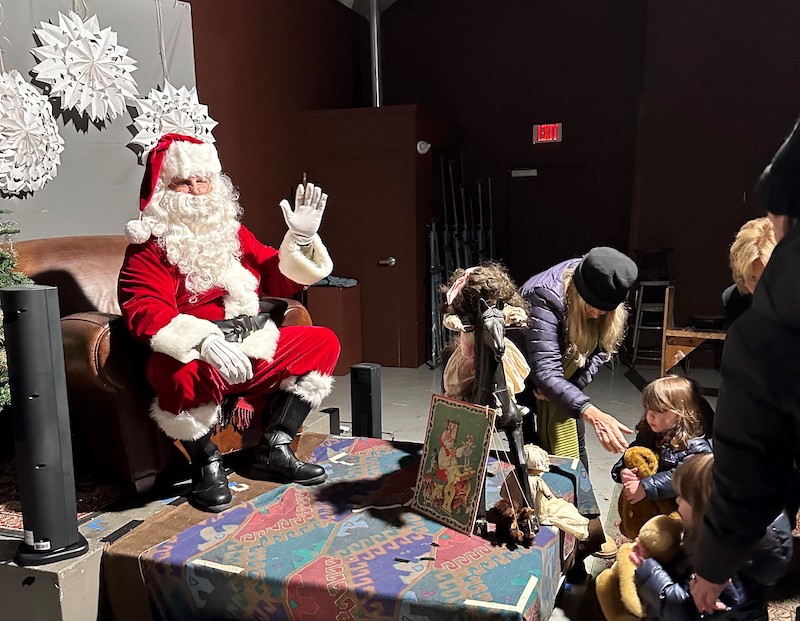
Santa will be available for selfies at Lyme Academy’s ‘Holiday Enchantment’ event on Dec. 6. LymeLine file photo.

Event includes art demos, music, tree-lighting, caroling, smores, hot cocoa & more

OLD LYME — On Saturday, Dec. 6, the Lyme Academy of Fine Arts invites the community to its Fifth Annual Holiday Enchantment and Tree Lighting.

Adults and children are invited to gather on the campus of Lyme Academy on Lyme Street from 3 to 5 p.m. for an afternoon of festive outdoor and indoor activities.

These will include art demonstrations, music by the Old Lyme Town Band and the Lyme-Old Lyme High School Select Singers, visits and selfies with Santa, opportunities for holiday shopping, and holiday craft-making for all ages.

A s’mores galore station and hot cocoa will also be available for all to enjoy. If the weather is chilly, guests will have an opportunity to warm up at one of the many fire pits on site.

At 4:30 p.m., a tree lighting will be led by the Town of Old Lyme’s First Selectwoman, Martha Shoemaker. This will be followed by caroling around the tree.

The Academy’s campus art store, de Gerenday’s Fine Art Materials and Curiosities, is bringing back popular jewelry artist Ann Lightfoot for the event. Every Ann Lightfoot creation higlights design, beauty, and elegance. Raw and delicate natural materials from all over the world are incorporated in her designs. Ann Lightfoot Jewelry makes a perfect holiday gift.

Visit lymeacademy.edu for more information.

TOP STORY: Lyme Tops State in Voter Turnout, With Old Lyme Not Far Behind

LYME/OLD LYME–Voters in Lyme and Old Lyme propelled the towns into the state’s Top Five list for the highest voter turnout, with Lyme leading the way at 66.1%. 

Old Lyme was not far behind at number four, with 60.5% of voters turning out at the polls. 

Roger Senserrich, spokesman for the Office of the Secretary of the State, noted, however, that results won’t be official until all municipalities submit final reconciled results on Nov. 14.

The unofficial data shows Lyme, with a population of  2,352 in the most recent U.S. Census, has 1,938 registered voters. Through a combination of early voting, absentee ballots and Election Day voting, 1,281 of those registered voters cast their ballots. 

Fourteen Lyme voters took advantage of same-day registration, which was available throughout two weeks of early voting and on Election Day. The option gave voters the opportunity to register and cast their vote with one trip to the polls. 

One same-day registration vote was not counted because the ballot’s envelope was not signed, according to Registrar of Voters Dottie Wells. She said Thursday that poll workers are required to act in good faith to make sure the proper processes are followed, and that any mistakes will be emphasized in future training sessions so they don’t happen again. 

In Old Lyme, there are 6,269 registered voters in the town of 7,628 residents. This year’s election resulted in ballots cast by 3,791 of them. Eight took advantage of same-day registration. 

Old Lyme

  • Election Day: 2,060
  • Early Voting: 1,561
  • Absentees: 162
  • Same-Day Registration: 8

Lyme

  • Election Day: 702
  • Early Voting: 517
  • Absentees: 49
  • Same-Day Registration: 13

Editor’s Note: This article has been updated with information just received relating to when the election results will be official, and to correct Old Lyme’s ranking.

TOP STORY: Recounts Possible in Old Lyme Due to Multiple Close Races

Poll worker Barbara Crowley watches closely as Fred Verillo, head moderator at Tuesday’s Lyme-Old Lyme Middle School polling place, collected the receipt from a new vote tabulator on Tuesday evening. LymeLine photo.

OLD LYME–Several tight races between members of the same party have triggered an automatic recount, but one affected candidate has already waived her right to the review process.  

Only 13 votes separate Republican John Mesham and incumbent Republican Selectwoman Jude Read for a spot on the three member Board of Selectmen, based on returns announced Tuesday evening at the culmination of this year’s municipal election. 

The results show Mesham, who lost the race for first selectman against incumbent Democrat Martha Shoemaker, had enough votes to secure a spot as selectman along with Shoemaker and incumbent Democrat Jim Lampos. 

But state law requires a recount when the race is closer than 20 votes. The law also allows the lowest vote-getter in affected contests to call off the recount if they wish to accept the initial results. 

Town Clerk Vicki Urbowicz on Thursday said Read is waiving her right to the recount, which is scheduled for Wednesday, Nov. 12, at 9 a.m. in the Town Hall.

Read did not immediately respond to emailed requests for comment. 

The race for three open Board of Finance alternate seats also spurred two sets of recounts due to close results and a state minority representation law that precludes all of the finance board’s three alternates from belonging to the same party. 

The three highest vote-getters – Fred Behringer, Tom Walsh and Diane Y. Linderman – all ran under the Democratic banner. Behringer, who is unaffiliated but considered a Democrat under the state law because he was endorsed by the Democrats, was elected with 1,967 votes. 

Urbowicz said the first recount affects the 7-vote difference between Walsh’s 1,955 votes and Linderman’s 1,948 votes. While the close vote would not typically matter in a race with three open seats, it’s significant this time around because the minority party representation rule says one of the seats needs to go to a Republican.

That means the highest vote-getter among the Republicans will be seated on the board – except that there’s a close vote there, too. 

Only six votes separate Republican Maria Marchant, with 1,687 votes, and Republican Michael Presti, with 1,681.

Democratic Town Committee Chairwoman Kimberly Thompson on Thursday said it was still “up in the air” whether Linderman would waive the recount. She said the candidates were notified by Town Clerk Vicki Urbowicz that Linderman has until the day of the recount to decide. 

Urbowicz said she has not heard from the Republicans yet about whether the recount sparked by the close Marchant/Presti result will be waived.

Presti could not immediately be reached for comment.