Letter From Paris: Restoration of Notre Dame Cathedral Symbolizes Hope for Both France, the World

Nicole Prévost Logan

April 15, 2021 was the second anniversary of the fire, which ravaged Notre Dame cathedral in Paris, and also the day when France reached 100,000 deaths from COVID-19. President Emmanuel Macron of France stressed that the reconstruction of the cathedral will be the symbol his country’s rebound from the pandemic.

Before giving the latest update of the most recent restoration process, here is a recap of what has been achieved over the past two years. The scope of the work is enormous.

For a long time, whenever I used to walk around the church prior to the 2019 fire, I had noticed that there was always scaffolding somewhere on  the church. It was a reminder for visitors that the cathedral was very old and fragile.

Throughout the centuries, it had suffered many fires and disasters. But the 2019 fire was the most catastrophic of all. It was a miracle that the cathedral survived that last tragedy.

After the fire, with hardly a square inch of the stone building still visible under so much scaffolding, wooden frames, plastic wrapping, tarp covers, and other protective contraptions, it was almost no longer recognizable. It ended up looking like a sick old bird.
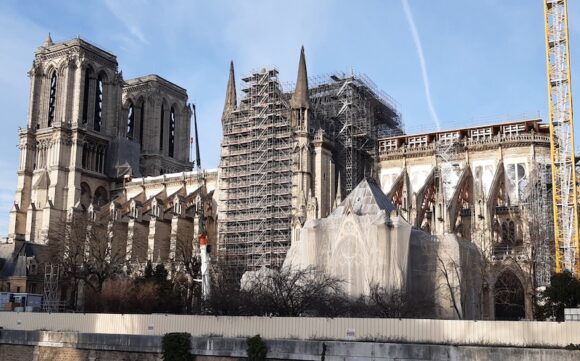
View of the cathedral showing some of the extensive scaffolding. Photo by Nicole Prévost Logan.

The gables and pinnacles at the end of the north and south transepts were in danger of toppling over with the force of the wind. Workers, dangling in the air like alpinists were doing their perilous job of wrapping the carved stones. Hovering over the cathedral cranes and other heavy machinery made the church look as if it was under perfusion.

The stained-glass windows were taken down and replaced by what looked like giant French doors. The collapse of the 19th century spire over the nave had left an enormous gaping hole at the crossing of the transept. Water – regardless of whether it is rain or the power spray used by firefighters – can cause lots of damage. It penetrates the stones, destroying the mortar between them .

The fire obliterated the roof. The lead dripped, spread and left a thick layer of toxic dust everywhere. For months, no one could go inside the cathedral because of the danger from the lead dust and also from the debris falling from the broken vault. A lonely robot, directed by remote control, was able to clear up the charred remains.

The organ and the three rose windows were thankfully preserved, but they will, however, require  lengthy restoration. The 7,800 pipes of the largest organ in the word have been pulled apart and so have been all the stained-glass pieces.

The stunning South Rose window in the cathedral. Photo by Nicole Prévost Logan.

It is particularly comforting to know that the Rose Window at the south end of the transept is intact. Given the light of the sun throughout the day, it is the Rose Window, which gives the cathedral its beautiful warm glow. Notre Dame would not be the same without the scenes of the triumphant Christ depicted through that magnificent window. In 1250, Louis IX, or Saint Louis, donated it after the end of the second crusade.

The April 15, 2019 fire left the cathedral in danger of collapse — in fact, it was a touch-and-go situation. The most urgent step was to consolidate the structure

A gothic cathedral is like a house of cards:- if one side weakens, the whole thing collapses. Because of its daring height and the fact that the outside walls are weakened by several tiers of windows, the structure is fragile.

The medieval master carpenters were real geniuses when they designed the 28 flying buttresses to reinforce the strength of the walls. An arch or beam extends from the walls of the church to a pier against the lateral forces arising from the roof and pushes the walls outwards.

Ken Follett in his 2002 book, The Pillars of the Earth, wrote a gripping story of the 12th century monks attempting to do something never done before, failing many times and starting all over again.

The earliest buttresses of Notre Dame date from the 12th century. They are massive and fairly close to the main structure. Later, during the flamboyant gothic period in the 14th century, the spans of the flying buttresses are longer and more decorated.

The first phase of the restoration — preservation and protection — lasted 15 months. President Macron appointed General Jean Louis Georgelin, former chief of staff under President Sarkozy, to supervise the work.

This photo shows the cathedral’s 14th  century flying buttresses prior to the fire. File used under the Creative Commons Attribution-Share Alike 3.0 Unported license.

The 28 damaged buttresses were reinforced by fitting custom-made wooden “centering frames” under each one of them. Each one of the buttresses had different dimensions, hence the fitting required utmost precision.

Then started the most difficult and dangerous operation: dismantling the scaffolding, which had been erected in May 2018 to repair the crumbling spire created by 19th century architect Eugene Viollet-le-Duc.

That scaffolding had melted, creating an ugly- and mean-looking black mass of 40,000 metal pieces glued together. Rope access workers (called cordists in French) had to pick the pieces by hand one by one, hanging from ropes high in the air. Sensors were placed under that unstable mass.

At one point the alarm sounded. Everybody fled. To disentangle that mass was like playing a giant pick-up sticks game, which involves removing sticks without disturbing the rest of the pile.

Twice the restoration work on the cathedral was interrupted: first when the scare caused by the lead contamination forced all activities to stop. Workers had to wear white haz-mat suits with masks connected to supplies of filtered air. They looked as clumsy as moon walkers.

Subsequently, the lock-down caused by the Coronavirus pandemic in March 2020 shut down operations for three months.

Five days before the fire, as a result of a near-miracle, the 10 ft. tall copper statues of the apostles and evangelists, climbing up the bases of the spire were air-lifted for restoration. Parisians enjoyed watching the ballet in the sky.

The statues are being restored in two workshops located near Perigueux. It takes four month to restore one statue. Pending the completion of the cathedral, all these art works will be exhibited  at the museum of architecture on Place du Trocadero.
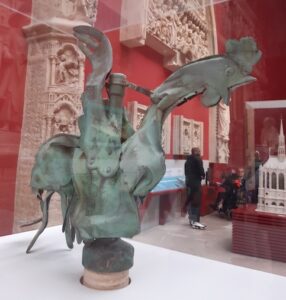
This rooster was on top of the spire. It is now exhibited in the Museum of Archaeology. Photo by Nicole Prévost Logan.

The rooster, pictured left, which used to sit at the top of the spire, will remain in the museum.  A replica will replace it.

Late in June 2020, chief architect Philippe Villeneuve climbed on an inspection tour of the cathedral. He was able to access the top of the vaults, which by then had been cleared of most of the debris.

Villeneuve was pleased to see that the limestone of the vault had resisted the damage caused by the fire itself as well as the water to extinguish the fire. For him, it was a milestone and he declared that the structure was now safe.

The first phase of conservation was over and one could look forward to the restoration to be launched at a later date.

In July 2020 came the decision everybody was waiting for. After months of deliberation and heated discussions between architects, historians and restoration professionals across the globe about how the future Notre Dame would look, a consensus was reached.

Based on a 300-page paper presented by Villeneuve and with the support of the public opinion, it was decided that the cathedral would be returned to its original appearance:- a spire identical to 1859 Viollet-le-Duc’s creation; a lead roof; and a wooden framework to support the roof.

A large part of the restoration work will be carried out using the methods of 13th century builders. Fortunately this type of savoir faire is kept alive in France thanks to a guild of crafted artisans, who are trained as Compagnons du Devoir.

All restoration will be done respecting the safeguards established by ICOMOS (the International Council for Monuments and Sites) founded by the Venice Charter of 1964 to protect historic monuments.

In 1991, UNESCO placed Notre Dame and the banks of the Seine within the area considered as part of the world heritage.

Within 24 hours of the fire, pledges to pay for the restoration poured in and reached close to one billion Euros. The two richest men in France raced to be the highest bidder. François Pinault pledged 100 million and refused to accept tax deductions. Bernard Arnault beat him with a sum of 200 million.

Arnault is the head of the LVMH (Louis Vuitton Moët Hennessy) luxury goods and champagne empire. The readers of this area might be interested to know that Antoine, one of the Arnault’s five children, is building a “cottage” in the Fenwick peninsula in Old Saybrook. He is married to Russian super-model Tatyana.

The Cathedral of Notre Dame de Paris prior to the fire. This file is licensed under the Creative Commons Attribution-Share Alike 2.0 Generic license.

At the two year mark since the fire, it is fitting to give the most recent update on the restoration process of Notre Dame. The task concerns the strengthening of the cathedral’s vault and the preparation of the future wooden framework, which will support the roof.

The scope of this phase to secure the building should be completed by next summer. It is just gigantic.

Most of the cathedral’s interior is now encased in metal scaffolding. An umbrella-like tarp has been installed above the gaping hole, where the spire once stood, for protection against the rain.

The vaults connecting the crossing of the transept were covered with platforms to enable rope-access workers to complete their job of removing the last fallen debris. This operation is still ongoing.

Most of those debris — stone, metal, glass — have been cleared up, analyzed, and used toward the creation of a 3D model, which is a replica of the original architecture and guiding the restorers in their mission.

Wooden scaffolding is being installed to stabilize the fragile areas of the cathedral’s vault, particularly the vaults adjacent to the crossing of the transept. Stonemasons apply plaster to the gaps and the exposed ends of the stones. They reinforce the most damaged areas with fiberglass.

The next step will be the insertion “of half-hangers” (also called “centring frames”)  under the six-rib vaults in the choir, the north transept and the nave. Note that the spire  crashed toward the West, onto the nave.

Above the vault and under the roof, other major work is in progress. The reconstruction of the 12-14th century wooden framework, called “the forest” is being prepared. Made-to-measure “half-hangers” and large-size triangular frames are being wedged under the roof to support it.

One thousand of the best oak trees have already been picked out in several French forests. A CNRS (National Center for Scientific Research) study of the use of timber led to surprising conclusions. Those conclusions differ from what one often reads in non-scientific publications.

The 13th century trees were much younger and smaller than often stated:  60 years, 39 ft. in height, and 12 ins. in diameter. Furthermore, the trees were not left to dry for 18 months but were used while still green, after being felled.

From the top of the cathedral, President Macron, accompanied by Paris Mayor Anne Hidalgo and Minister of Culture Roselyne Bachelot expressed huge thanks to the hundreds of people involved in the restoration: carpenters, scaffolders, rope access technicians, crane operators, master glassmakers, restorers, stonemasons, archaeologists, researchers and donors.

Macron reiterated his vision of the cathedral reopening to worship by 2024 in time for the Olympic games, while acknowledging the fact that the complete restoration will probably take several years longer.

A glimmer of hope is much needed for the weary French population. The latest curfew at 6 p.m., which applied to the whole country, should be lifted in early May, with café and restaurant terraces reopening by mid-May — that should really boost morale!
Letter From Paris: After 47 Years, UK Leaves EU with ‘Thin’ Post-Brexit Deal

Nicole Prévost Logan

After 47 years of co-habitation, the UK has left the European Union (EU) with a “thin” post-Brexit deal.

An end-of-year need for holiday food delicacies, such as caviar, lobster or foie gras, panic about running short of fresh produce — such as lettuce, combined with the Covid-19 procedure slowing down the traffic, caused spectacular chaos with thousands of trucks lining up on highways or parked in Kent’s makeshift areas.

It was a sort of a preview of what a no-deal Brexit would bring.

The atmosphere in the country was unreal.

On Christmas Eve at four in the afternoon, the news broke: The UK and the European Union (EU) have reached an agreement on a narrow trade deal.  There will not be a “hard Brexit” as everybody had feared, with a brutal departure of the British Isles from the continent.  The two sides will remain friends and look forward to building up a commercial partnership and intensifying cooperation in transport, security, police, nuclear power, research and many other areas.

An 11th hour agreement

Reaching an agreement was quite an accomplishment. As late as Dec. 20, the mood was grim on both sides of the English Channel. On that date I wrote an article, entitled: “Betting on a “thin” Brexit deal”.

As follows, is part of my article:

Time is running out.  The transition period, which followed the departure of the UK from the EU on Jan. 31, 2020, is ending on Dec. 31.  If the two sides – UK and EU – do not reach an agreement by then, the “hard Brexit” will feel like falling off a cliff. The alternative is a “soft” Brexit.

On Dec. 13, 2019 , UK Prime Minister Boris Johnson led a successful campaign, the problem is that he based that campaign on three fateful words: “Get Brexit done”  He locked himself in an impasse,  making it hard for him to negotiate further.  He is under pressure from all sides to satisfy the hard-Brexiter Tories, the business circles rejecting Brexit for fear of a tariff war and  public opinion increasingly against a departure from the EU.   

The impossibility to bridge the positions from both sides of the Channel is clear:  the differences are more than deep. They are existential.  

For the British, sovereignty is paramount and the constraints of the Single Market unacceptable. The EU lies on the principles of the “Schengen Space”, consisting of free movement of people, capital, goods and services. Those principles constitute the main asset of the Single Market and are sacred, declared Christine Okrent, a French seasoned journalist and an authority on foreign affairs.

One should not forget that the UK has never been part of the Schengen “Space” nor of the Eurozone.

“Zanny” Minton  Beddoes, editor-in-chief of the Economist describes the negotiators as “playing on their voters’ audiences”.  It may be true in England, but definitely not in the EU. The EU is not budging from its core proposals, and its 27 members remain totally united. It would be miscalculation on Johnson’s part to count on the EU backing down.  

A hard Brexit would be a lose-lose proposition, but the UK would be more affected. Half its trading activities are with Europe, its economy is intertwined with Europe’s, as Beddoes pointed out. In contrast, Brexit has ceased to be a priority for the EU, commented Christine Okrent

In an interview, Michel Barnier, chief negotiator of the EU, declared that a nine month transition was too short. Most trading agreements take at least five years. He said: “Two prerequisites are needed: a free and fair competition (no “Singapore on the Thames”) and a reciprocal access to markets and waters.” 

I predict – and am going out on a limb now – that enough concessions will take place on both sides to reach a “thin” deal (to use Beddoes’ words ) allowing  the negotiations to continue after Dec. 31.  More time is needed to create a tailor-made arrangement to satisfy the UK and help it access the Customs Union or the European Economic Area (EEA), like Norway.  

Those were my predictions on Dec. 20.

The British Union Jack flag flies alongside the EU flag … but not for much longer. Photo by Rocco Dipoppa on Unsplash.

Back to Dec. 24, when the post-Brexit “deal'” was reached. What was fascinating on that historical day, was to hear, in real time, the comments coming from all sides of the political spectrum as well as reactions from the general public.

Johnson was exultant, raising his arms in a victory gesture. The trilingual Ursula von der Leyen , president of the European Commission was the one to announce (in excellent French) that, “a good, fair, and well balanced” deal has been reached.  Towering over her Michel  Barnier added his voice to the official announcement.  It was thanks to his fairness and persistence, that he made the deal happen.

Declaring, “We have kept our promise,” Johnson continued, “We have taken back the control of our economy. Freed from the EU Single Market bureaucracy, we can act very fast. The rapid vaccination program is an illustration of this. Our relationship with the EU will be comparable to the one between Canada and the EU (CETA).”

This is not exactly accurate however because CETA makes it easier to export both and goods and services, whereas the post-Brexit deal does not include the suppression of tariffs on services. The most important thing for Johnson was to say, “I have done it”.  He did succeed unlike other prime ministers – Thatcher, Major, Cameron and May – who failed in their attempts.

Denis MacShane, a Member of Parliament (MP), Minister of State for Europe under Tony Blair, and formerly a member of the Labor party said the population had had enough and wanted to turn the page of the Brexit.

A professor of the French School of Political Sciences was lukewarm about the deal.  The accord does not warrant taking the champagne out to celebrate, he said.  To lose one member of the EU is a loss, a form of “disintegration”

Reuters press agency announced that the British Parliament was expected to approve the deal. Both Houses will be recalled to vote on the decision on Dec. 30.  Johnson has a comfortable majority of 364 out of 650 in the House of Commons.  Many of the 200 Labor MPs will vote in favor of the agreement since they supported the post-Brexit trade deal from the beginning.

The European Parliament will make its decision known in 2021. The agreement text will have to be translated into 23 languages before being approved by the 27 EU member states.

As a 1,246-page agreement, it will take a while to fully comprehend the complex and lengthy text.

Professor Anand Menon, director of “The UK in a Changing World” Think Tank, commented that the lifting of tariffs and quotas will favor the EU since it is where it has a surplus. France has a surplus of 12 billion in her trade balance with the UK. The biggest amount is food products. 150,00 French companies export them to the UK.  Furthermore 80 percent of food and wine transit through France to reach Great Britain.

Quotas and tariffs will not be imposed on products. However, custom and various administrative formalities and procedures at the borders might become cumbersome for both sides. Times will be difficult in the short term for British companies and a cost of 4 percent of the GDP  is expected.

However, from now on the UK will be free to reach bilateral agreements with outside countries, such as New Zealand for the import of meat.

Tariffs will remain on the services . With the post-Brexit deal, the UK becomes a third country in regards to the EU,  80 percent of its economy is immaterial and tied to services and therefore not part of this post-Brexit deal. In order to exercise its financial activities  and access to the Single Market or the Customs Union, the  “passporting” (meaning selling financial services freely) will no longer be an option unless the UK joins the EEA, as Norway has done.

The main sticky point will be to preserve the level playing field and guarantee fair competition on both sides of the Channel.. This will be resolved by the principle of “managed divergence” the parties reserving the right to retaliate.  In other words any hope of creating a “Singapore on Tames “will be under strict scrutiny by the EU.

Dominic Raab, acabinet minister and conservative MP declared that the provisions included in the agreement  are not the end of the story. The “deal” is a living document that will need to be revisited in the future. The rules will  evolve.

As an example, a system has been put in place to settle litigations and will be re-examined in four years. Next February there will be more rules. Raab added that for the next five or six years, the UK will be working on re-establishing new ties with Europe.

On a positive note for Johnson: the UK will not be bound by judgments made by the European Court of Justice

The Irish border

The Irish premier Micheal Martin approved the fact that a hard border between the two Irelands was avoided ; The Common Travel Area with Great Britain will be maintained ; the deal preserves Ireland’s position in the Single Market, he said, it will avoid quotas and tariffs imposed on farmers, businesses and exporters.

Varadkar, another Irish politician seems also satisfied with the deal. Northern Ireland will remain effectively in the EU Single Market. Custom checks will take place in the Irish Sea instead of on land. Sea.

Still unknown but likely to emerge soon  is the question of Scotland. First Minister of Scotland Nicola Sturgeon lashed out at the agreement within minutes.  In 2016, 62 percent of Scottish people voted to remain in Europe.  The Flag of Scotland still flew above the Parliament.  Scotland will probably not wait for the spring to organize another referendum.

Fishing rights

A commercial fishing boat comes into port. Photo by Thomas Millot on Unsplash

Johnson declared, “We have regained the control of our waters.  Although it represents a minute part of the GDP of both sides , this issue occupied a major place in the negotiations because it is essentially the symbol of the British sovereignty.  Barnier knows a lot of about fishing rights.  He was minister of Agriculture and Fishing from 2007 to 2009.

There will be “fishing committees” enforcing control. Johnson demanded that 80 percent of the proceeds from the fishing industry be returned to the UK. He achieved 25 percent, during a transition period of five and a half years.  He will grant 100 millions of UK pounds sterling to help the fishermen.

The fish catch by the Europeans last year was worth 650 million Euros last year. The British waters are richer in fish population than the European waters. The Brits don’t eat much fish. They sell back most of their catch to the EU. During his speech Johnson was wearing a tie covered with fish.

The devil is in the details and annoying changes are going to take place. There will be no more mutual recognition of professional qualifications. British doctors, architects, veterinarians, engineers will have to seek new certification.

Freedom of movement will disappear, and a visa will have to be obtained for a stay longer than 90 days. An EU pet passport will cease to be valid.

The Erasmus student exchange program will not include the UK any more. Instead of a fee of 170 Euros paid to  European universities, foreign students studying in the UK will be charged tens of thousands pounds. To work in England, a permit will be required. In other words a post-Brexit deal will not be “business as usual.”  There will be many changes.

On the last day of 2020, Sky News announced that Johnson’s father, Stanley Johnson, was asking for French nationality.  He is French on his wife’s side and very much a Europhile. In a book coming out later in January, author Christian de Bourbon-Parme has written a biography of Boris Johnson.

Surprisingly, we learn that his name was not Boris but Alexander, that he lived in Belgium when his father was working for the European Commission in 1973. In the book, Johnson is depicted as a person full of humanity. He always loved Europe and was very attached to it — but not the EU.

In spite of of the enthusiastic attitude of the British Prime Minister, the mood was rather somber on both sides of the Channel.

Michel Barnier commented ” There was no winner in this deal. We all lost,” while Ursula von der Leyen added a lyrical note, saying, “Parting is such sweet sorrow.”

Editor’s Note: This is the opinion of Nicole Prévost Logan.

Nicole Prévost Logan

About the author: Nicole Prévost Logan divides her time between Essex and Paris, spending summers in the former and winters in the latter. She writes a regular column for us from her Paris home where her topics will include politics, economy, social unrest — mostly in France — but also in other European countries. She also covers a variety of art exhibits and the performing arts in Europe. Logan is the author of ‘Forever on the Road: A Franco-American Family’s Thirty Years in the Foreign Service,’ an autobiography of her life as the wife of an overseas diplomat, who lived in 10 foreign countries on three continents. Her experiences during her foreign service life included being in Lebanon when civil war erupted, excavating a medieval city in Moscow and spending a week under house arrest in Guinea.

Region 4 Asks Valley-Old Lyme Co-op Football Coach to Resign

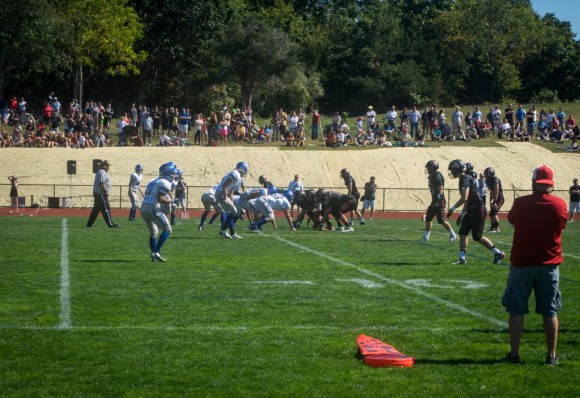
Action from a Warriors game against Old Saybrook played on the Lyme-Old Lyme Varsity Field in 2016. File photo,

AREAWIDE — The press and social media are currently swirling with articles*, opinion pieces* and comments relating to the requested resignation of the extremely popular Valley Regional High School (VRHS) football coach and gym teacher Tim King by the Region #4 Superintendent Brian White.

Region 4 comprises the middle and high school-age students of Chester, Deep River and Essex; each of the three towns operates their own elementary schools.

Lyme-Old Lyme High School (LOLHS) students play football on the VRHS ‘Warriors’ team in a formalized co-operative arrangement, which has been in place for some 10 years. Lyme-Old Lyme (LOL) Schools Superintendent Ian Neviaser explained, however, that the co-op arrangement does not mean LOL Schools had any involvement in the recent actions of the Region #4 Superintendent.

Neiaser said by email, “In our current cooperative football agreement with Valley Regional, Region #4 employs the head coach. Therefore, any action or proposed action is independent of the Region #18 [Lyme-Old Lyme Schools] Board of Education.”

According to news reports, the issue that prompted White to ask for King’s resignation was King’s presence at an Independent Football League practice held in Lyme, which included players from both VRHS and LOLHS. The League was formed in response to the cancellation of the high school football season by the Connecticut Interscholastic Athletic Conference.

Since he is the VRHS/LOLHS football coach, King was not permitted by Region #4 to coach in the Independent Football League. According to numerous reports, King submits he complied with that ruling and many witnesses have substantiated that statement.

Neviaser noted in his email, “Region #18 has no involvement in any independent sports programs that are not a part of our annual budget.”

The captain of the VRHS/LOLHS co-op football team Jack Cox started a petition on change.org, requesting that Tim King should retain his positions at Valley Regional High School. As at 12 a.m., Nov. 23, more than 2,760 people had signed the petition.

Editor’s Note: *Articles and opinions referenced for this article include:
Three local teams to compete in 11-on-11 Independent Football League by Ned Griffen, published Oct. 23, by The Day.

Players, parents upset that Valley/Old Lyme coach King being forced to resign by Ned Griffen, published Nov. 21, by The Day.

Coach asked to resign for involvement in independent football league by Sean Patrick Bowley, published Nov. 21, in the New Haven Register.

Tim King has the community — and the truth — on his side by Mike DiMauro, published Nov. 23, by The Day.

Valley Regional high school coach asked to resign by school district for involvement in independent football league formed during the pandemic in The Courant.

Letter to the Editor: Saunders in 33rd Embodies ‘Compassion, Wisdom, and Joy’

To the Editor:

Abraham Lincoln said, “before the age of forty, God is responsible for our face, and after the age of forty, we are responsible for our face.” Just looking at Brendan Saunders’ face, the gentleman running for senate in the 33rd district, you will understand what Lincoln meant. Saunders’ face radiates compassion, wisdom, and Joy.

Saunders’ wisdom presents itself with his laser focus and deep understanding of the difficulties of balancing one’s budget in the over-taxed, Democrat-run State of Connecticut. He has pledged to work diligently to cut wasteful spending and cutting Connecticut’s obscene taxes. Deep reforms of energy companies are high on his” fix-the problems” agenda.

Probably the most crucial issue is his devotion to our First Responders. He has pledged to oppose any policies aimed at defunding the police. It takes wisdom to think beyond the emotional and understand the dire ramifications of any such short-sighted legislation or tyrannical edict by a Governor.

Joy. Unlike so many “seasoned elected officials,” Saunders is a joyful human being. What could be better for the 33rd district than a happy warrior fighting for us while armed with acute wisdom and deep compassion? Same old, same old endorsement of the policies that have driven Connecticut into a fiscal mess makes no sense.

Sincerely,

Alison Nichols, M.Div.,
Essex.

Death of David Boyd Ward Jr. Announced; Brother of Hunter Ward Sr., Penny Smyth, Both of Lyme

ESSEX — David Boyd Ward Jr. of Essex, passed away at his home on Friday, September 4, 2020, the day after his 73rd birthday. David was born in Middletown, CT, on September 3, 1947, and was raised in Little Silver, NJ, through age 9, settling in Westbrook, CT, shortly after his father died in 1956 …

… A dedicated student of Impressionism, stirred especially by the work of the artists from the Old Lyme art colony, David began his journey en plein air oil painting, later working with the Lyme Art Association curating and hanging shows …

… He is survived by his son Justin Brant Ward and two grandsons, Race and Marston Ward of Alameda, CA; his brother Hunter Ward Sr. and his wife Cheryl Weaver Ward of Lyme; sister J. Penelope Ward Smyth and her husband Paul J. Smyth of Lyme; and brother Richard H. Lee Jr. and his wife Heidi Booth Lee of Deep River. David is also survived by his niece Kim Ward of Cornelius, NC; and nephews Hunter Ward Jr. (Christina) of Old Lyme; Austin Ward Dienst (Meghan) of Seattle; Richard Newton Lee (Samantha) of Dudley, MA; Seth Joseph Lee (Kimberlee) of Lyme; …

Visit this link to read the full obituary published Oct. 11 in the Hartford Courant.