Responding to Last Weekend’s Mass Shootings, Sen. Murphy Authors Op-Ed in ‘The Hill’ Titled ‘The Violence Paradox’

US Senator Chris Murphy (D-Conn.)

WASHINGTON –- Following last weekend’s mass shootings in El Paso, Texas and Dayton, Ohio, U.S. Senator Chris Murphy (D-Conn.), authored an op-ed in The Hill focusing on America’s unique legacy of violence and how Congressional inaction is a signal of endorsement to would-be shooters. Since his time in the Senate, Murphy has been a vocal critic of our nation’s gun laws and have proposed commonsense gun violence prevention legislation.

Excerpts from the op-ed are below and can be viewed here.

“It is a deeply uncomfortable fact that inside some humans lies the ability to rationalize the decision to walk into a Walmart or a crowded bar and start firing a wildly lethal weapon indiscriminately, with the goal of ending as many lives as possible.”

“But as these slaughters – from Newtown to Orlando to Las Vegas to El Paso and Dayton – continue unabated, we need to start asking questions about what within our own makeup explains this mass shooting epidemic, and what control society has over these outlier actions that seem, with each new mind-bending massacre, less like outliers. The answer is that violence is inside us, but so is the ability to end this epic-scale carnage.”

“First, we must face a foundational fact – humans are uniquely hardwired for violence.”

“Our rates of violence over the millennia have gone up and down, but long ago, humans figured out that violence was an effective means of social and economic advancement.”

“Here in America, our legacy of violence is even more pronounced than the rest of the world. Once Europeans landed on the continent, violence as a means of social order became standard order.”

“First, it was the settlers wiping out the local tribes, then it was slaveowners using massive scale violence to enslave African-Americans, and then ethnic groups turned on each other, using violence to contest economic and social space in America’s crowded cities.”

“Along the way, it was the guns that made it easy for the dominant groups to control the subordinate groups. One historian suggests that without the flood of weapons that came with America becoming the early home of the global arms industry, America would be 50 percent less murderous over our long history.”

“Here in America, we are nowhere near as violent as we were in our early years, in large part because of government intervention. It is not a coincidence that the two steepest periods of decline in the rate of murder in the United States occurred right after passage of the two most significant gun laws in our nation’s history – the first national firearms control acts in 1934 and 1938, and the background checks and assault weapons ban bills in 1993 and 1994.”

“The success of those two legislative efforts to significantly depress violence levels in the United States should give us hope as we grieve over these most recent American mass shootings.”

“Laws that keep weapons away from dangerous people, and keep uniquely dangerous weapons – like the AR-15 – away from everyone, work.”

Data shows that states with tougher gun laws have lower gun murder rates. At the federal level, during the 10 years of the assault weapons ban, America’s mass murder rate was almost half that of the following 10 years.”

“At the federal level, during the 10 years of the assault weapons ban, America’s mass murder rate was almost half that of the following 10 years.”

“As the minds of these mass shooters descend into a dark place, unimaginable to you and me, where they rationalize the decision to exorcise their personal trauma through mass violence, I believe they take note of the silence at the highest levels of their nation regarding the choice they are contemplating.”

“Yes, presidents and governors and senators send out statements condemning each mass shooting, and offer “thoughts and prayers” to the victims and their families. But these are empty words, and everybody knows it, especially after no actual policy changes are enacted as the mass shooting era continues to grip America.”

“The absence of any interest in passing laws to condemn mass shootings sends a signal of unintentional endorsement to would-be mass murderers.”

“When it comes to the instincts that lie inside humans, this weekend’s shootings represent one side of the coin. But on the other side is our ability to stop violence. It’s our choice which side lands face up.”

Read the full op-ed here.
Opinion: If You Do One Thing Today, Visit Old Lyme Town Hall to Give Your Thoughts on the Halls Rd. Project

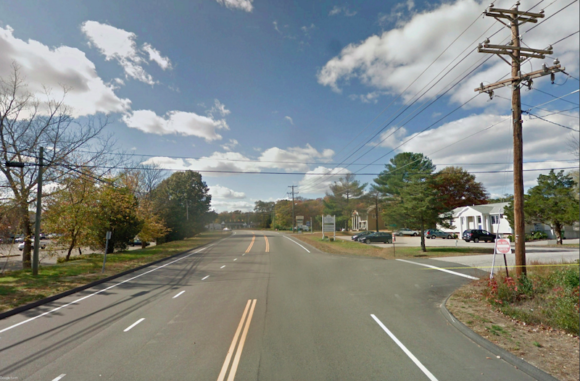
This file photo shows Halls Road today. How do YOU want it to look in five or 10 years? Go and give your thoughts today!

Today the Old Lyme Board of Selectmen (BOS) and the Halls Road Improvement Committee (HRIC) are hosting an Open House at Old Lyme’s Memorial Town Hall from 9 a.m. to 4 p.m.  They really do want to hear from the residents of Old Lyme what their current thinking and opinions are regarding the future of Halls Rd.  Or maybe you just want to ask questions about how we have reached the point where we are now and find out the tentative ideas the committee has already discussed.  Or perhaps you want to vent about the project because you don’t think it’s necessary at all.

We would urge two things:  first, take a minute to read Mark Terwilliger’s insightful op-ed on why, in his opinion, things have to change at Halls Rd.  He explains in simple terms why (again, in his opinion) sticking with the status quo is not an option, making the point clearly and succinctly that the world has changed since the 1950s when the Halls Rd. strip-mall was built.  He argues — and we agree — that if we fail to plan for the future in light of these changes, then change will happen anyway, but in an uncontrolled fashion and not necessarily in the best interests of the town’s residents.

The second thing we would ask is simply that you go to the Open House — whatever your opinions are about the project.  If you don’t go and share your thoughts, how can you then complain when a proposal is finally made?  It’s like that old adage, “You can’t win it, if you’re not in it” — the HRIC has deliberately made this Open House a non-threatening, informal environment so that people are comfortable speaking their minds to committee members.

We’ve heard plenty of comments both on and off the record about the HRIC and the BOS supposedly acting in isolation on the project and taking unilateral decisions.  This Open House is designed to put those rumors to rest and represents a great opportunity to give your input to the future of our town.

Don’t miss it … carpe diem!

Op-Ed: What’s Happening With Halls Road? Looking Back, Looking Forward, a Personal View of the Project

The view (minus traffic!) looking up Halls Road today — how will it look in 10 year’s time?

Editor’s Note: We felt it would be helpful to our readers to provide some context to Saturday’s Open House on the future of Halls Road and the important discussions it involves about the future of Old Lyme. While we were working on an article, Mark Terwilliger submitted his own thoughts on the project. We are publishing his piece here and will now publish our own later in the week.  In the interests of full transparency, we note that Terwilliger is the partner of Halls Road Improvement Committee member Edie Twining.

What’s going on with Halls Road?

The Halls Road Improvement Committee (HRIC) is tasked with leading a town-wide discussion on the future of the Halls Road district. The ultimate goal of these discussions is the creation of a master plan that will guide future outside investments and development in that area.

How did this come about?

Some people in town were pushing for road and traffic changes to improve pedestrian / bicycle access to the shopping area on Halls Road, and asking the town to allocate money for those purposes. The town seemed amenable.

Other people said, “Wait a minute. Why should we make a non-trivial investment in this when we don’t even know what other (private or state) changes are planned, or in the offing, for this district? For that matter, we don’t even know what the town as a whole wants or needs from the future of this district.” And that began the process of looking in a more formal way at what changes we might want to see in the Halls Road district over the course of the next decade or two.

Why not just leave it alone?

Change is coming, whether we want it or not. No one can stop it. Our only choice is either to try to shape that change in the directions we want, or to let the changes happen to us without our input. The only outcome that is flatly impossible is “no change.”

The grocery stores of Old Lyme make a good example of change. In the early 20th century there were multiple grocers, meat markets, and general stores in various districts of Old Lyme. Main Street (as it was called then) had several, one of which was the A&P. The A&P was still the main grocery (and still on Lyme St.) in the 1950s. They told the town they needed to greatly expand their store and nearby parking to stay in business. Eventually the town responded by making two major adjustments.

A group of local investors raised money for a “modern” strip center along Halls Rd., and the town changed the zoning in that area to make it only suitable for such use: they zoned it for commercial use only, and required a 60 ft. set-back from the road to leave ample space for cars. When the A&P expanded further, new investors were sought and the original community investors held only a minority interest.

The A&P eventually went bankrupt, but the owners of the shopping center found a new anchor tenant in the Big Y.

Attracting and keeping businesses requires cooperation and responsiveness on the part of the town. The Big Y has a much larger store nearby in Old Saybrook and several more along the shoreline. I have no idea what the Big Y’s plans are for their smaller Old Lyme store, and anyone who is privy to that sort of information might not be at liberty to say.

Businesses make their own decisions based on their own interests, and that is as it should be. And that is the point. The environment changes, and businesses adapt or die. The town itself has a role to play in creating an environment that favors the kinds of businesses, the kinds of investments, and the kinds of development that will create and support the town as they want it to be.

What should we, as a town, hope to accomplish?

There is more to the town’s role than simply reacting to some proposed change or hustling to stave off a bad outcome. The whole object of the current process is to point to the most positive future for the Halls Road area and devise a sound set of measures to help create it.

If we (with the help of the HRIC and others) can put together a solid picture of the economic advantages of locating certain kinds of businesses in Old Lyme, and if we can demonstrate that we are in broad agreement as to what kinds of development we would like in the Halls Road area, and show that we are prepared to make the changes necessary to permit and promote that kind of development, then we have a much greater chance of attracting developers who will make the significant investments of money and time required to make our plans a reality.

All of these “ifs” will take time, effort, and involvement from many different groups and individuals. The Halls Road Improvement Committee is looking for broad-based participation, particularly in the processes leading to the creation of a master plan that can guide future developments along Halls Road.

A master plan does not create anything by fiat. The objective, rather, is to create a plan that has broad support, has a firm basis in economic realities, and offers attractive opportunities for reputable developers and current owners alike.

If we do not make this effort, if we simply leave the future shape of Halls Road to the uncoordinated, one-point decisions of each current and future property owner with no guidance from the town, we will have no room to complain when things do not go as we wish. That could happen in a big way if we do not plan ahead. Changes well beyond the control of the town or any particular business are already under way.

How have things changed?

Retail stores, particularly in strip malls and big box malls, are under severe pressure from online shopping. More than half of U.S. households are Amazon Prime members. I would guess the percentage is even higher in Old Lyme. The online-centered lifestyle has nearly killed the bookstores and wrecked retail giants.

Curiously, it has also created a new demand for what Old Lyme once had: a centralized meeting place with a mix of stores and homes, public buildings and public parks — a place where one could park the car and walk to do errands, meet friends, hear the latest, or just watch the world go by. It’s the meeting places and public life that are missing in the online-focused world.

Retailers and developers have taken notice and altered their plans accordingly. “Mixed use” is the one environment in which bricks-and-mortar retail still seems to flourish. It is a mix of residential, shopping, dining, entertainment, supermarkets, offices, and walkable public spaces that provide a place to linger and meet with friends.

When cars were the center of life, shopping required a huge parking lot. Now it takes a cell phone. More and more parking lots are half-empty or dead. It turns out you can’t have a neighborhood without actual neighbors, no matter how clever the marketing. When an area includes real, full-time residents, it feels different and alive. It isn’t just a place to run errands, but a place with a full life of its own.

People want the amenities of shops and so forth, but they also want the experience of other people around them. This is the one thing they cannot get when they are online — as they increasingly are whether at work or at leisure. Mixing residential and commercial, public and private spaces creates a more attractive environment for both businesses and residents.

Unmet needs and Halls Road

Older people who have lived in Old Lyme for decades find they must move to another town if they want to downsize. Mixed use housing in the Halls Road area could be an attractive alternative for many in this situation. It would also be attractive for younger people just starting out in life. Adding new uses to the land near Halls Road will also create new sources of tax revenue, providing some relief for existing tax payers.

What next?

The zoning we created to serve the 1950s’ car culture mandates nothing but strip malls — and that may now be an economic dead end. If we want anything new or different, we will have to make the changes to support it.

We as a town are a long way from having a shared vision of what is best for Halls Road. That process will take time and active participation. The HRIC works to lead the process, to make it transparent, and to keep people informed and involved. As a part of that effort, they are hosting an Open House at Memorial Town Hall this Saturday, June 15, from 9 a.m. to 4 p.m.

I urge you to stop by for a few minutes and take a look at some of the ideas that are in discussion. The future shape of Halls Road is not a simple yes or no question. Most of us depend on the services available there, and many of us have ideas about how it could be better.

The HRIC Open House on Saturday is the latest opportunity to get involved in the discussion.

Op-Ed: Avoiding the Tragedy of Brexit

Photo by A Perry on Unsplash.

This op-ed by Senator Chris Murphy (D-Conn.) was first published Feb. 25, by TheHill.com.

In view of the MV2 (Meaningful Vote 2) regarding Brexit, which is being held today in the British Houses of Parliament, we felt its re-publication was highly relevant.

US Senator Chris Murphy (D-Conn.)

British Brexiteers and their U.S. cheerleaders promised a return to Britain’s glory days once they shed the bureaucratic constraints of the European Union. Steve Bannon celebrated Brexit as a victory for far-right nationalism and called for other countries to follow. The reality of Brexit, of course, is turning out to be entirely different. The economy will shrink by 7-10 percent, consumer prices will increase, unemployment will rise, and Britain will likely have to pay the EU to leave – not the other way around. Brexit will weaken Britain, the EU, and the entire Western alliance.

The question now is whether we will throw our lot in with those who want to break up hard-won international alliances, or take a stand in favor of a closer partnership between America and Europe. It would be a disaster if the United States reacted to Brexit in a way that encouraged more countries to leave the EU or other international organizations. We should not take seven decades of European peace for granted. After centuries of never-ending warfare and two world wars, stability in Europe is a core interest of the United States. We should also not take for granted how the allure of future EU membership has kept countries on its periphery promoting positive economic and democratic reform.  And Russia hawks in Washington should remember that one main goal of the Kremlin is to weaken the EU, the primary check on Putin’s hopes to restore the Soviet empire.

This is why the promise of a U.S.-Britain trade agreement, as a reward for Brexit, is such a bad idea. We have no better friend or ally on the planet than Britain. But this special relationship does not require us to jump off the same building they are. Those arguing for Britain’s hard exit from Europe claim that the United States will ride to the rescue and deliver a trade agreement that will repair the economic damage done by Brexit.  Russia cheers on this talk, because they know a U.S.-Britain deal might encourage other countries to leave the EU and expect a bilateral agreement with the United States as well.

At the very least, U.S. supporters of a post-Brexit trade deal with Britain should make clear the negotiated Brexit arrangement must protect the Northern Ireland peace process. A key pillar of the Good Friday Agreement was eliminating physical barriers and security checkpoints between Ireland and Northern Ireland. Pulling the legs out from this agreement by reestablishing a hard border risks upending the delicate balance of compromises that has maintained peace for the last twenty years. Even new technological infrastructure to monitor movement could be inflammatory. Recent surveys have found extreme antipathy in Northern Ireland for any type of north-south border checks. With our large Irish-American population and uniquely close relationship with the UK, the United States played an important role shepherding the peace process and must continue to safeguard the Good Friday agreement. We should be firmly against any Brexit agreement that doesn’t include the Irish backstop or other arrangement to protect the peace process.

When the UK government held the initial Brexit referendum, Brexit promoters implied that Britain could have its cake and eat it too. They claimed that Britain would make money by no longer having to contribute to the EU; that Britain would still be able to trade on favorable terms with the rest of Europe while being free from EU regulations; and that investment would continue to flow to Britain once it scrapped EU rules that were supposedly stifling their economy. It’s now clear that none of those things are true, and that very tough choices are now required. With this picture now clear, it would be wise to allow for a new referendum.

In the United States, instead of cheering on Brexit and promising individual agreements that weaken the EU, we should be doing the opposite – binding ourselves closer to the EU and negotiating a trade agreement that establishes the U.S.-EU bloc as a dominant force. In the coming decades, the size of China’s economy and military will continue to grow. The only way to prevent China from dictating terms in a world where they have significantly more influence is to join forces with Europe to agree on global standards going forward. While the special relationship will endure, Britain’s position will be stronger from within the EU rather than outside it.

The Irish poet Oscar Wilde once said there are only two tragedies in life: one is not getting what one wants, and the other is getting it. Nigel Farage, Steve Bannon, and their allies in the White House are close to getting what they want in Brexit, but the tragedy may yet be avoided.

U.S. Senator Chris Murphy is a member of the U.S. Senate Foreign Relations Committee.

Op-Ed: Forced Regionalization of Our Schools Will be a Disaster For Our Communities

This op-ed was submitted by Tina C. Gilbert of Lyme. It was also sent as a letter to State Senators Paul Formica  (R-20th) and Norman Needleman (D-33rd), and State Rep. Devin Carney (R-23rd.) Gilbert has children in Lyme-Old Lyme Schools and is Vice-President of LCN USA located in Deep River, Conn.  

I am seriously concerned about the lack of awareness and sense of urgency in the Lyme-Old Lyme communities regarding the proposed Bills to force school regionalization, specifically Bill 454 (SB 738). It is a grave mistake for any tax payer in Lyme or Old Lyme  to think this doesn’t affect them just because they don’t have children attending the schools. We know the chances of this getting approved are strong, if not, at this point, unavoidable.

Unfortunately I was unable to attend the recent BOE meeting where I would have addressed my concerns. At the BOE meeting I understand that it was said that Region 18 had “good representation” at last Friday’s hearings on the proposed bills. We had, from my count, 5 children and 5 adults (2 without their children) at the hearing. The town of Wilton, conversely, had well over 100 – if not 150 constituents there. That is good representation. The hearing required three overflow rooms apart from the primary hearing room. Each of them packed with floors occupied by children. I could be mistaken, but I believe that is a very rare occurrence.

Next week, the Committee will vote on whether these Bills move forward. If they vote to move forward, the consequences to our two communities will be devastating and irrevocable. Our local BOE is concerned about the attrition rate of students in Region 18. However, imagine if you will the entire school population coming from the Town of Lyme no longer attending the Middle School or High School. No amount of marketing for out-of-region students or pre-K applicants is going to fill that void. What then are the effects? Jobs gone. Shared programs gone (LYSB). Culture, history, community …. compromised. Taxes increased. Residents leaving. Property values tanking. Parents putting themselves into debt to send their children to whatever private school they can find.
The Town of Old Lyme will follow the Probate system and will be regionalized with East Lyme, Salem and Montville. There will be a regionalized BOE and one Superintendent (that means 3 lose their jobs.) Governor Lamont specifically called out wanting to reduce the number of Superintendents. East Lyme is a large and powerful school. I don’t think it takes a deep thinker to figure out who is going to have more power in the new regionalized district.
We live in the Town of Lyme. We moved here from Deep River so that our children would be in the Region 18 schools. With this forced Regionalization, Lyme will join Deep River, Chester, Essex, Haddam and Killingworth. Children from the farthest reaches of Lyme will be bussed across the river to attend schools there. Bus rides will be well over an hour. Parents who want to be active in their children’s schooling will be challenged with having to follow suit and drive either over the bridge to Rt 9 (and soon pay tolls to do so) or over the bridge in Haddam.  My husband and I recently moved our business to Deep River, so we know how time consuming it is to come back to Lyme Consolidated in the middle of the day for a school event. This is the first year of the last seven that our children have been in the school that we’ve missed nearly every program. Frankly it would be easier for us to have our kids going to school on the other side of the river. But we don’t want that – we moved here for the quality of the education.
From the hearing and follow up discussion, it has become clear that the Forced Regionalization concept is in fact not about the state saving money. The Committee members supporting the legislation made their opinions on that clear. And a Bill supporter who has the ears of these members (including the Chair) put it succinctly as follows:
“Connecticut has too many school districts, and the richest ones are fortresses that have pulled all the ladders up after them while the poorest sink deeper and deeper. Town-based school districts drive wealth inequality and force towns to compete against one another instead of cooperating. Worst of all, they embody institutionalized and systemic racism. They enforce de facto segregation, which is the toxic legacy of redlining and exclusionary zoning, and we will never be able to move forward until that changes.”
In summary, this infers that we residents of Lyme and Old Lyme are a bunch of privileged racists who only want the best for their children and none for others. This tired tactic is offensive and reprehensible.
I am happy that there is broad bipartisan support against these Bills. But that’s not enough. If these Bills fail, the Governor has proposed his own Bill SB 874 with 32 pages of detail on a very powerful school consolidation commission that will make decisions that may or may not have to be put to vote by the legislators. The Governor stated he will sign it into law. There is also discussion of a new Regional Tax layer – to add to our Federal, State and Local taxes – to support all of this.

In the end, Forced Regionalization equals Forced Equalization equals Forced Marginalization. The sum is Disaster to our communities.
The word needs to get out to our communities, so at the very least they are educated on the subject and not blind-sided when they learn of the fate of their children’s education or are shocked when they see their future tax bills.
How can we make this happen? How can we get the word out? We have very little time.