Letter to the Editor: Halls Rd. Overlay District is Good for Old Lyme, False Information Harms the Town

To the Editor:

There’s been a lot of wild talk about Halls Road and the plan to make it a neighborhood in our town center rather than a highway services plaza. The people behind this raft of lies and exaggerations fear change, and preach that by doing nothing, we can prevent change. They are dead wrong. 

Doing nothing will allow Halls Road to become truck stops: the best investment opportunity under current zoning. In the last several years, nearly all of the investor interest in Halls Road has been for new gas stations: three proposals, narrowly fended off. There will be more, and we cannot fend them off forever under the current commercial-only C-30s zoning. 

The best thing we can do is to provide optional zoning that will allow Halls Road to become something better and something that serves multiple, significant needs of the town. 

The Halls Road Overlay District (HROD) proposal does that, providing better returns for investors than they get from gas stations and convenience stores. It also allows the creation of a mixed-use neighborhood with smaller-scale housing and retail that faces Halls Road, not buried back behind empty parking lots. A walkable, mixed-use neighborhood with real neighbors is the best encouragement to businesses that serve the town, not the highway. We need these different types of housing, not just for older folks down-sizing, but also for new families moving in. Our emergency services are all-volunteer. We need younger people to keep them staffed. Smaller-scale housing is crucial to serving their needs.  

Of course, those who hate and fear all change are spreading wild exaggerations and outright lies about HROD. Everything you read in their posts is nonsense. Because they’re not really interested in the truth, they feel free to make things up with crackpot logic and nightmare fantasies. It’s easier than reading the actual HROD document (available online) and doing the hard work to go through the regulations in detail to understand what the real limits on development are. 

If you do the math (and I have done it) the various limitations and requirements (e.g. parking) in the HROD proposal mean that, in 20 or 30 years, there may be as many as 400 apartments or condos in all of Halls Road, along with a shopping street that runs for perhaps a third of its length. The density of dwelling units per acre at full development is within the range already long-established in Old Lyme zoning for multi-family residential anywhere in town. The hysterical numbers and idiotic cartoons are all fantasy. 

Note that my numbers are based only on the HROD regulations, and do not consider all the other constraints on development, such as septic and environmental, which must certainly be considered in any new construction. 

People who came to Old Lyme from towns that were grossly over-developed are particularly prone to think that allowing any development will be the thin end of the wedge. I remind them that we in Old Lyme are firmly against suburban sprawl. That’s why we suggested putting the much-needed smaller-scale housing in a place that is already covered with paving, and where it can help keep our local businesses profitable. Doing so spares the last bits of open space. If you forbid it at Halls Road, you may be sure you’ll find it built out in the countryside, where it will do less good and more harm. 

HROD is good for Old Lyme, and the folks telling lies to terrify their neighbors are harming the town.

Sincerely,

Mark Terwilliger,
Old Lyme.

Letter to the Editor: ‘Intelligent, Thoughtful, Community-minded’ Margules is ‘Excellent Candidate’ for Old Lyme Planning Commission

To the Editor:

I recommend Howard Margules as an excellent candidate for the Old Lyme Planning Commission. I have worked on several projects with Howard in his capacity as Chair of the Economic Development Commission (EDC) and member of the Halls Road Improvements Committee (HRIC). He is intelligent, thoughtful, and community-minded. He is dedicated to the prosperity and livability of Old Lyme. He does his work and takes his commitments seriously. He will bring to Planning his fine analytical skills, broad experience, and a proper regard for context (the Big Picture).

Howard helped to set up Old Lyme’s Shoreline Gateway Committee and was its Chair early on. He also volunteers in important community services outside of Town government. Throughout, Howard’s concern has been for the economic well-being of our town and its people. In my experience, he never loses sight of that.

Howard has said Planning and Zoning should be merged in Old Lyme, as is done in most local communities of our size. Whatever the merits of that suggestion (and I believe it has some), I know that Howard Margules will be a significant asset to the Planning Commission today in attending to its assigned responsibilities. If you want the Planning Commission to work effectively for Old Lyme, Howard Margules is the right man for the job.

Sincerely,

Mark Terwilliger,
Old Lyme.

Op-Ed: Old Lyme Zoning Commission’s Vote Against Halls Road Overlay District Proposal is Potentially a Vote “for Decay”

We owe it to ourselves and to those who come after us to … meet the challenges of our own time. If we do not, we will have voted for decay

On March 27, the Old Lyme Zoning Commission voted 3-2 in favor of the Halls Road Overlay District (HROD) proposal, with two alternate members casting the negative votes. Because the Planning Commission had previously given the proposal a “negative referral,” a vote of 4-1 was required for passage, and the measure failed. 

The problems the HROD was designed to address still exist. We believe the proposal is a viable response to those challenges, and that its rejection was a set-back for Old Lyme. 

The new overlay district would have created an alternative to the commercial-only C30-S zoning along Halls Road, while leaving that older zoning intact. The HROD was aimed at promoting the creation of a walkable, bike-able, mixed-use shopping street along Halls Road—a new town center for Old Lyme that took as its model Lyme Street in its centuries-long role as a living, mixed-use town center. 

The HROD is a significant piece of zoning regulation. It takes some effort to understand how it works, and to comprehend the implications of its detailed requirements. Those of us who worked on it spent years talking with local residents, business owners, property owners, town officials, regional regulators, developers, and land use lawyers to create the document we presented to Planning and to Zoning. After hundreds of hours, we understood it well. 

Planning took a few hours to consider it, and flatly refused to allow HRIC the opportunity to answer any of their questions. The Zoning Commission held two public hearings totaling a few hours, then held its final vote after two more hours of deliberation in which no new fact or evidence of any kind was allowed to be introduced, even by Commission members. From the comments in each body’s final deliberations, it is clear that several of the participants had only the vaguest understanding (and sometimes a total misunderstanding) of the document. This was not a reasonable way to arrive at a good decision on a measure of this importance to Old Lyme’s future. 

HROD was an attempt to meet the changes now shaping our economy, and to secure our town’s main business district in that new environment. Failing to pass HROD does not make those changes go away. It just leaves us relying on 1950s approaches to 2030s conditions. 

Without HROD, there will be no one to bid against those who see Halls Road as a truck stop. There have been three proposals for gas stations/convenience stores in the last couple of years, and no proposals to build anything else. 

Without HROD, there will be no mixed-use, walkable town center where people can live, work, shop, and enjoy the sort of human contact the Internet can never provide. 

Without HROD, smaller-scale housing—if it comes at all—will be spread over the few remaining open acres, dotted here and there, and we will lose the opportunity to create a vibrant, living, mixed-use neighborhood in the heart of our town. 

Without HROD, our main shopping district will lose the support that a mixed-use neighborhood provides for retail—the pedestrian traffic and walk-in trade that makes such neighborhoods the one bright spot in retail investment. 

Times are changing, as they always do. In the middle of the last century Old Lyme made radical zoning changes to meet the future they saw then. We owe it to ourselves and to those who come after us to do likewise and meet the challenges of our own time. If we do not, we will have voted for decay.

Op-Ed: What’s Happening With Halls Road? Looking Back, Looking Forward, a Personal View of the Project

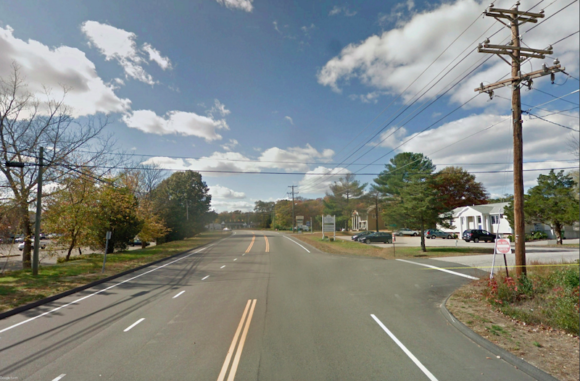
The view (minus traffic!) looking up Halls Road today — how will it look in 10 year’s time?

Editor’s Note: We felt it would be helpful to our readers to provide some context to Saturday’s Open House on the future of Halls Road and the important discussions it involves about the future of Old Lyme. While we were working on an article, Mark Terwilliger submitted his own thoughts on the project. We are publishing his piece here and will now publish our own later in the week.  In the interests of full transparency, we note that Terwilliger is the partner of Halls Road Improvement Committee member Edie Twining.

What’s going on with Halls Road?

The Halls Road Improvement Committee (HRIC) is tasked with leading a town-wide discussion on the future of the Halls Road district. The ultimate goal of these discussions is the creation of a master plan that will guide future outside investments and development in that area.

How did this come about?

Some people in town were pushing for road and traffic changes to improve pedestrian / bicycle access to the shopping area on Halls Road, and asking the town to allocate money for those purposes. The town seemed amenable.

Other people said, “Wait a minute. Why should we make a non-trivial investment in this when we don’t even know what other (private or state) changes are planned, or in the offing, for this district? For that matter, we don’t even know what the town as a whole wants or needs from the future of this district.” And that began the process of looking in a more formal way at what changes we might want to see in the Halls Road district over the course of the next decade or two.

Why not just leave it alone?

Change is coming, whether we want it or not. No one can stop it. Our only choice is either to try to shape that change in the directions we want, or to let the changes happen to us without our input. The only outcome that is flatly impossible is “no change.”

The grocery stores of Old Lyme make a good example of change. In the early 20th century there were multiple grocers, meat markets, and general stores in various districts of Old Lyme. Main Street (as it was called then) had several, one of which was the A&P. The A&P was still the main grocery (and still on Lyme St.) in the 1950s. They told the town they needed to greatly expand their store and nearby parking to stay in business. Eventually the town responded by making two major adjustments.

A group of local investors raised money for a “modern” strip center along Halls Rd., and the town changed the zoning in that area to make it only suitable for such use: they zoned it for commercial use only, and required a 60 ft. set-back from the road to leave ample space for cars. When the A&P expanded further, new investors were sought and the original community investors held only a minority interest.

The A&P eventually went bankrupt, but the owners of the shopping center found a new anchor tenant in the Big Y.

Attracting and keeping businesses requires cooperation and responsiveness on the part of the town. The Big Y has a much larger store nearby in Old Saybrook and several more along the shoreline. I have no idea what the Big Y’s plans are for their smaller Old Lyme store, and anyone who is privy to that sort of information might not be at liberty to say.

Businesses make their own decisions based on their own interests, and that is as it should be. And that is the point. The environment changes, and businesses adapt or die. The town itself has a role to play in creating an environment that favors the kinds of businesses, the kinds of investments, and the kinds of development that will create and support the town as they want it to be.

What should we, as a town, hope to accomplish?

There is more to the town’s role than simply reacting to some proposed change or hustling to stave off a bad outcome. The whole object of the current process is to point to the most positive future for the Halls Road area and devise a sound set of measures to help create it.

If we (with the help of the HRIC and others) can put together a solid picture of the economic advantages of locating certain kinds of businesses in Old Lyme, and if we can demonstrate that we are in broad agreement as to what kinds of development we would like in the Halls Road area, and show that we are prepared to make the changes necessary to permit and promote that kind of development, then we have a much greater chance of attracting developers who will make the significant investments of money and time required to make our plans a reality.

All of these “ifs” will take time, effort, and involvement from many different groups and individuals. The Halls Road Improvement Committee is looking for broad-based participation, particularly in the processes leading to the creation of a master plan that can guide future developments along Halls Road.

A master plan does not create anything by fiat. The objective, rather, is to create a plan that has broad support, has a firm basis in economic realities, and offers attractive opportunities for reputable developers and current owners alike.

If we do not make this effort, if we simply leave the future shape of Halls Road to the uncoordinated, one-point decisions of each current and future property owner with no guidance from the town, we will have no room to complain when things do not go as we wish. That could happen in a big way if we do not plan ahead. Changes well beyond the control of the town or any particular business are already under way.

How have things changed?

Retail stores, particularly in strip malls and big box malls, are under severe pressure from online shopping. More than half of U.S. households are Amazon Prime members. I would guess the percentage is even higher in Old Lyme. The online-centered lifestyle has nearly killed the bookstores and wrecked retail giants.

Curiously, it has also created a new demand for what Old Lyme once had: a centralized meeting place with a mix of stores and homes, public buildings and public parks — a place where one could park the car and walk to do errands, meet friends, hear the latest, or just watch the world go by. It’s the meeting places and public life that are missing in the online-focused world.

Retailers and developers have taken notice and altered their plans accordingly. “Mixed use” is the one environment in which bricks-and-mortar retail still seems to flourish. It is a mix of residential, shopping, dining, entertainment, supermarkets, offices, and walkable public spaces that provide a place to linger and meet with friends.

When cars were the center of life, shopping required a huge parking lot. Now it takes a cell phone. More and more parking lots are half-empty or dead. It turns out you can’t have a neighborhood without actual neighbors, no matter how clever the marketing. When an area includes real, full-time residents, it feels different and alive. It isn’t just a place to run errands, but a place with a full life of its own.

People want the amenities of shops and so forth, but they also want the experience of other people around them. This is the one thing they cannot get when they are online — as they increasingly are whether at work or at leisure. Mixing residential and commercial, public and private spaces creates a more attractive environment for both businesses and residents.

Unmet needs and Halls Road

Older people who have lived in Old Lyme for decades find they must move to another town if they want to downsize. Mixed use housing in the Halls Road area could be an attractive alternative for many in this situation. It would also be attractive for younger people just starting out in life. Adding new uses to the land near Halls Road will also create new sources of tax revenue, providing some relief for existing tax payers.

What next?

The zoning we created to serve the 1950s’ car culture mandates nothing but strip malls — and that may now be an economic dead end. If we want anything new or different, we will have to make the changes to support it.

We as a town are a long way from having a shared vision of what is best for Halls Road. That process will take time and active participation. The HRIC works to lead the process, to make it transparent, and to keep people informed and involved. As a part of that effort, they are hosting an Open House at Memorial Town Hall this Saturday, June 15, from 9 a.m. to 4 p.m.

I urge you to stop by for a few minutes and take a look at some of the ideas that are in discussion. The future shape of Halls Road is not a simple yes or no question. Most of us depend on the services available there, and many of us have ideas about how it could be better.

The HRIC Open House on Saturday is the latest opportunity to get involved in the discussion.