
Op-Ed: Lyme Academy Offers Thanks for Community Support

As the first month of our new academic year draws to a close we would like to extend our deepest thanks to the businesses and non-profit organizations that once again extended a warm welcome to the students of Lyme Academy College of Fine Arts of the University of New Haven. We welcome nearly 140 students to campus this year with 45 living in our Southwick Townhouses, adjacent to our campus, and 20 living in the newly constructed Post and Main apartments in Old Saybrook. All of our new and returning students were greeted with welcoming smiles and sweet treats on both sides of the River in Old Lyme and Old Saybrook, alike.

Along Lyme Street, the Chocolate Shell, Nightingale Cafe, and the Old Lyme Ice Cream Shoppe and Café all welcomed our students with tasty offerings. The owners of Old Lyme Inn opened the doors of their Side Door Jazz Club to the students and family members who attended our midsummer student meeting. During our orientation program, the doors were opened once again. The baby grand piano and the luxurious ambiance of Side Door Jazz Club provided the perfect setting for the performance of our very own, sophomore Alexandra Naimoli, at our first Lyme Light event of the year.

A special highlight and tradition of our orientation program for incoming students was the museum tour and delicious ice cream social on the patio of Café Flo, hosted by Jeffrey Andersen, Director of the Florence Griswold Museum and David Rau, Director of Education and Outreach. This was the first of a series of museum/gallery visits that will occur throughout the year. Other neighboring galleries and museums that students will visit during their fall semester at LYME include the Lyme Art Association, the Cooley Gallery, and the Lyman Allyn Museum.  The generosity of the staff of these organizations to give of their time and share their knowledge allows us to provide valuable experiences that complement students’ career development during their years at LYME as well as networking resources that will prove valuable as they progress in their careers.

In Old Saybrook, it has been nearly a month since the Post and Main Apartments became the home away from home for twenty students from LYME. We are extremely grateful to the community of Old Saybrook for warmly embracing our students.  Susan Beckman, the Economic Development Director in Old Saybrook and Judy Sullivan, Executive Director of the Chamber of Commerce took time from their busy schedules to gather together maps, guides to local resources and other gifts. Welcome baskets filled to the brim with treats from local businesses greeted our students as they moved into Old Saybrook. And the presents continued throughout the first week; including gifts from Pursuit of Pastry, Dunkin Donuts, Jack Rabbit’s restaurant, Caffé Marche, and offers of free dance lessons from the Fred Astaire Dance studio. A special highlight was a tour of the Kate with Executive Director Brett Elliot. During the tour, students were surprised with a $50 Gift Card, to a show of their choice, made possible by a very generous donor.  Local businesses like Saybrook Point Inn are reaching out to students with offers of employment, and a number of organizations are working with us, and our students on myriad programs still to come.

The charm of Lyme Street and Main Street, variety of restaurants, hiking paths and miles of beach offer countless opportunities for exploration and enjoyment. Both Old Lyme and Old Saybrook make for wonderful homes for our students and, in turn, our students bring a special vibrancy to these warm and welcoming communities. We are looking forward to discovering and sharing many new and exciting experiences in both of these communities as well with many organizations as in neighboring towns including Essex, New London and Mystic where our students have been invited to participate in field studies, internships and create and display art in the year ahead.

In 2014, shortly after I began my tenure as Campus Dean, I was asked “What do students do with their time when they aren’t in class?”  I can now answer “Plenty!”  All thanks to our friends in the community.

As LYME continues its partnerships in the region with remarkable films, lectures, exhibitions, and studio art workshops, we are grateful for all this community does for us, and our students.  We are so proud to be an integral part of the lower Connecticut River Valley and look forward to continued collaboration with our neighboring organizations throughout the coming year.
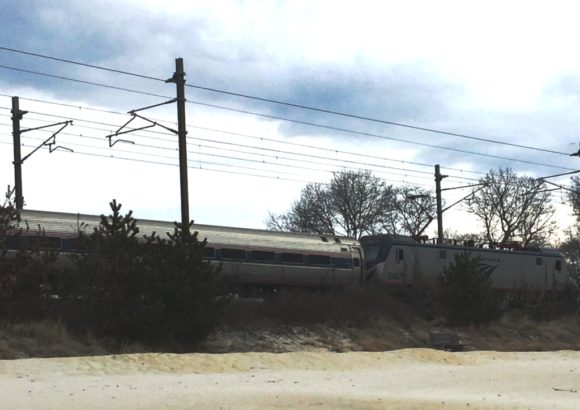
Opinion: With Thanks to the Groups That Have Already Sent Comments About the High-Speed Train Route to the FRA … Now It’s Our Turn

An Acela train travels through Rocky Neck State Park this morning.

We are fortunate here in Old Lyme that three different organizations made the decision to commit a vast amount of resources, primarily in terms of innumerable volunteer hours, to prepare pages and pages of well-researched comments on the Federal Rail Authority’s (FRA) Tier 1 Environmental Impact Statement (EIS).

These comments prepared respectively by the Town of Old Lyme, the Connecticut Fund for the Environment (CFE), and the Connecticut Trust for Historic Preservation and SECoast (its special project dedicated to organizing and educating the public to protect Southeastern Connecticut and the Lower Connecticut River Valley) have now been submitted their comments to the FRA ahead of the March 1 deadline for receiving comments.

It should be stressed, however, that the FRA is not obliged to respond to these comments in detail (as it was in the previous stage of the project) prior to issuing its Record of Decision (ROD), which is anticipated as early as March 1 but now seems likely to be issued later in the month at the earliest.

Reading the comments — 82 pages by the Town of Old Lyme,  a five-page-letter by the CFE, and 41 pages by the CT Trust for Historic Preservation and SECoast — one can only marvel at the level of detail and comprehensive analysis displayed coupled with incisive and objective reasoning. The overall message of all three groups is crystal clear — the FRA failed to communicate its plan effectively, failed to analyze its impact sufficiently, and failed to justify its choice of proposed route convincingly.

A veritable army of people assisted with the production of the Town’s comments, the covering letter for which was sent by Old Lyme First Selectwoman Bonnie Reemsnyder; the CFE letter is signed byAndrew W. Minikowski, Esq., Legal Fellow of the CFE; and the CT Trust for Historic Preservation’s comments are authored by Daniel Mackay, Executive Director of the Trust, and Gregory Stroud, Director of Special Projects and founder of SECoast. We owe an enormous debt of thanks to these individuals and the many, many more — some named, some unnamed in the documents — who have freely given of their time and expertise to formulate these coherent arguments against the FRA’s currently proposed route.

It should be noted that all the documents stress the respective organization’s support for the concept of an improved passenger rail service from Washington DC to Boston, Mass.

We, as a community, now owe it to these people who have worked so hard on our collective behalf to support their efforts and write or email the FRA today (tomorrow, March 1, is the deadline) with your own opinions about the Old Saybrook to Kenyon, RI bypass.  As Stroud said yesterday morning in response to a question asked at a presentation he made at the First Congregational Church of Old Lyme, “The FRA needs to hear from individuals.  It’s the number of comments that they receive, which will make an impact.  You don’t have to write a masterpiece.  It doesn’t have to be long.  Just write and, at minimum, mention the bypass specifically and say you do not support it.”

Comments should be sent by email to: info@necfuture.com or by mail to:
NEC FUTURE
U.S. DOT Federal Railroad Administration
One Bowling Green Suite 429
New York, NY 10004

So … top of your “To Do” list for today is to write that email or letter … you owe it to yourself, but more than that, you owe it to these selfless people who have already given so much for us, but ultimately, you owe it to your community.

Thank you so much.

Read a related Letter to the Editor from Town Attorney Jack Collins at this link.


Op-Ed: Old Lyme Urgently Needs New Historic Survey; Current One Dates Back to 70s Leaving Town Vulnerable to High-Speed Rail and Other State, Federal Projects

11/06 UPDATE: We note that an item on tomorrow’s regular Historic District Commission agenda is “FRA Plan Update.”  The meeting is scheduled to start at 9 a.m. in the Old Lyme Town Hall.

Editor’s Note: The author of this op-ed, Gregory Stroud, is the Executive Director of  SECoast, the non-profit dedicated to organizing and educating the public to protect the Southeastern Connecticut and the Lower Connecticut River Valley.

Sometime, perhaps three or four years ago, when the Federal Railroad Administration (FRA) first began plotting potential routes for a high-speed rail bypass across southeastern Connecticut, they would have consulted existing state and federal historic surveys to assess the impacts, and adjust the routes accordingly.

Surveys provide the government with a dispassionate, nuts-and-bolts, accounting and evaluation of a community’s worth. The government conducts all kinds of surveys, surveys of mineral resources, timber resources, and yes, even historic resources. And just as a town out in Iowa would be foolish to neglect its survey of farmland — lest the government decides to build an incinerator in Dubuque, or the Mississippi tops its banks in Keokuk — a small town of extraordinary historic worth, like Old Lyme, would be foolish to neglect its historic survey.

A historic survey matters not just for high-speed rail, but because it will inform every state and federal infrastructure project heading our way: the inevitable reworking of the existing rail corridor, the widening of I-95, the routing of new utilities, and the building of new cellphone towers. In fact, just two weeks ago the Connecticut Department of Transportation began revamping its 2004 study for I-95 through Old Lyme.

Over the next 25 years, Old Lyme faces a veritable multi-billion-dollar wave of infrastructure projects, forcing the state and federal government to make any number of difficult decisions. In simple terms, it’s a competition for limited routes and limited dollars. Unfortunately for Old Lyme, we entered this competition four or so years ago with a historic survey that was shamefully out of date. Think 40 years out of date — hip-huggers, bell-bottoms. Our baseline historic survey dates to the early 1970s. You can imagine, a lot has changed in terms of method and standards over the last four decades, leaving Old Lyme undervalued for state and federal planning.

We will never know whether an updated survey might have persuaded the FRA to draw its purple line elsewhere. There is no point in grousing about the past. But as every other town and region along the Northeast Corridor prepares for the competition, Old Lyme can’t wait around and hope for better.

So, what’s the cost? Nothing. Zero. Zip. The State Historic Preservation Office can fully fund the cost of a survey up to $30,000 — that should be plenty. And for whatever reason, if Old Lyme prefers all the bells and whistles, the town can apply for an additional $15,000 of federal funding. That would require a 50 percent match, but some or all of this could be covered by a grant from the Connecticut Trust.

I’m not whistling in the dark. Some time ago, I asked Daniel Mackay, the executive director of our statewide partner at the Connecticut Trust for Historic Preservation, “on a scale of one to ten, how important is an up-to-date historic resource survey?” “An eleven,” he replied. And if you’ve ever met him, you’ll know that Mackay is not prone to hysteria or exaggeration. This past weekend, at a conference in New Haven, I polled half-a-dozen experts on the topic. Everyone from the State Historic Preservation Office to academics agreed, without hedging or hesitation, that an updated survey was “commonsense,” that it would be “crazy” not to do it. And not just the preservationists, in my conversations with lawyers, they similarly agree.

I first raised the issue with town government on February 1. Since that time, we have raised the issue over a dozen times in writing, in meetings, and phone calls. Luckily, there is a rolling deadline. It’s still not too late.

Op-Ed: Follow NEC Future’s Own Findings, Abandon Alternative #1, Statement from Old Lyme Selectwoman MaryJo Nosal to the FRA:

Today we welcome representatives from the U.S. Department of Transportation Federal Railroad Administration (FRA) at Lyme-Old Lyme High School, 4:30PM. The following is a statement I planned on reading if the meeting format had allowed for public comment:

Congress established the Northeast Corridor Commission in 2008 and it was “chartered to facilitate collaborative planning and unified action” for the NEC Future process. The Commission’s report, NEC FUTURE and Investing in the Northeast Corridor: Advancing the American Economy (02/19/2016) (http://www.nec-commission.com), estimates the annual economic loss to our nation’s economy due to frequent Northeast Corridor (NEC) service disruptions at $500M. Equally important, the report clearly and strongly supports the needed investment in a NEC which includes the mid-size cities to advance the potential of the railroad as an engine for the American economy. “The potential for more transformative economic gain may lie in mid-sized cities such as Baltimore, Hartford, Newark, New Haven, Providence, and Wilmington. Their economies, with anchors such as research universities and corporate headquarters, stand to benefit from more reliable and frequent service, providing faster access to the financial and human capital resources of major hubs. Such investment in infrastructure would support recent economic and demographic trends and align with local economic development plans already in place. Additional capacity, improved travel time, and new origin-destination pairs could ensure the viability of projected growth in major markets, spark growth in mid-sized markets, and put the U.S. on par with peer regions around the world when competing for economic growth. Other cities, such as Hartford, not on the NEC mainline, have the potential to benefit with higher levels of investment. Today, infrequent service and lengthy travel times place limits on the potential growth mid-size cities might realize in terms population and jobs. Service improvements in consideration through the NEC FUTURE process would dramatically decrease the travel time from mid-sized cities such as Wilmington, Providence, and Hartford to the larger strong markets in New York, Boston, and Washington.

The FRA should support the Commission’s findings by selecting the alternative, or modifications of the alternative, which provides increased mainline access to the NEC for customers and businesses, and significant improvement in travel time to hub cities by expanding NEC service to the underserved mid-size markets including New Haven and Hartford, CT. Eliminate the Old Saybrook-Kenyon Rhode, Island bypass option as it certainly does not meet the stated goals of the NEC Future and in fact, is in opposition to the Commission’s findings as it threatens an established economy of a small historical town and does not provide significant access or significant time savings to hub cities.

Opinion: Let Your Presence Make a Difference (Since Your Voice Can’t be Heard) — Go to the FRA Meeting

Back in February of this year, we wrote an opinion piece titled, “The Menace in our Midst.”  about the proposed high speed rail route through Old Lyme, about which we as a community had just heard. Surprisingly, not a whole lot has changed since then with the exception that the Federal Railroad Administration (FRA) has finally decided to pay Old Lyme a call. That meeting is this afternoon at 4:30 p.m. in the Lyme-Old Lyme High School auditorium.

We’re re-publishing most of our editorial from February, but changing the message.  Back then, we urged readers to write to the FRA and say what you thought about Alternative 1 during the official Comment Period.  Today, our message is simply, “Go to this afternoon’s meeting.” You will not be able to speak — at this point it seems public comment is not being allowed, but our numbers will tell a story … so let’s pack that hall!

The saddest thing about all of this is that we all (or most of us) support high speed rail — please read the open letter to the FRA from Alex Twining that we received last night, which discusses some different solutions to Amtrak’s challenges in the northeast.

Here’s our editorial from February:

In the space of just a few short weeks, the residents of Old Lyme have become aware of a menace in their midst. Most unusually for these same residents, their response has been to a man (or woman) identical.  When that happens in this town — unquestionably, a rare event — you can be sure that, ‘Something is rotten (to misquote Hamlet) in the state of Old Lyme.’

The ‘menace’ in this case is Alternative 1 of the four high-speed railtrack routes proposed by the Federal Railroad Authority (FRA) in their Northeast Corridor (NEC) Future plan.

But let’s backtrack for a second — why is the FRA proposing these new routes? Their objective is, “to improve the reliability, capacity, connectivity, performance, and resiliency of future passenger rail service … while promoting environmental sustainability and continued economic growth.”  Let’s say right away that we are fully supportive of this objective — we are huge fans of rail-travel — you cannot grow up in Europe without taking rail travel for granted.  The trains there are fast, clean and efficient … they are a way of life.  We absolutely wish it were the same in the US.

So what is the difference here?  Why has the reaction to Alternative 1 been so strong, so united, so passionate?  In case you are unaware, Alternative 1 calls for the high speed rail track to cross the Connecticut River over a new bridge a little higher up the river than at present and then travel to the center of Old Lyme bisecting Lyme Street by eliminating both the western and eastern campuses of Lyme Academy College of Fine Arts before turning north and crossing I-95.  [Note: This has now become a tunnel under the Connecticut River according to the latest information from the FRA.]  The 1817 John Sill House, currently owned by the Academy and situated on its campus, would likely be acquired by the FRA by eminent domain and then demolished.

The impact of a high-speed railtrack through that sector of town would be totally devastating for our community, effectively destroying its very heart.

This editorial could now run for pages to explain the full spectrum of impact to Old Lyme of this proposal.

We could discuss the horrific effects on our incredible local environment — one which has inspired artists for generations including some of the greatest impressionist painters in American history and one officially designated as a “Last Great Place.”

We could talk about the untold damage to the storied structures on Lyme Street and list the irreplaceable buildings that will either be completely destroyed or permanently scarred by this new train track construction, many of which are either National Historic Landmarks or on the National Historic Register.

We could mention that Lyme Street is the joyful, bustling hub of our little town — it has a unique personality and touches every aspect of our community life.  It is home to our town hall, our public schools, our daycare, our youth services, our library, our churches, our village shops, our art college, our art association (the oldest in the country), and the Florence Griswold Museum (a national institution.)  Can you even begin to imagine Lyme Street with a high speed railroad running across it?

And let’s just consider for a minute what this proposal, if implemented, would achieve?  Bearing in mind that you can already travel from London to Paris (286 miles) in 2 hours and 15 minutes, would we be able to hop on a train in Old Saybrook and be in Washington DC (334 miles) roughly two hours and 45 minutes later?  No, the current travel time of six hours would be reduced by a grand total of 30 minutes to 5 hours and 30 minutes.  Unbelievable.

As we said, we could go on for pages but others have kindly taken care of that for us.  There was a splendid press conference yesterday, which spelled out the craziness of Alternative 1 from every angle — coldly, clinically and objectively.  The Old Lyme-Phoebe Griffin Noyes Library has a full print copy of the NEC Future tome if you care to read it in its entirety.  There are links galore on the Old Lyme Town website to the statement and attachments submitted yesterday (Feb. 10) on behalf of some 20 local organizations to the FRA.

So please read and educate yourself on Alternative 1, but most importantly, please, please write to the FRA with your thoughts.  There are many questions as to why and how this proposal was able to be presented without a single public hearing being held closer than 30 miles away from a town on which it was having such a major impact.  But that is history now …

Back to today — the FRA is coming this afternoon … will you be there?