
Op-Ed: HOPE Explains Background, Process to Their Affordable Housing Proposal in Old Lyme

This Op-Ed was written by Lauren Ashe, Executive Director of HOPE Partnership.
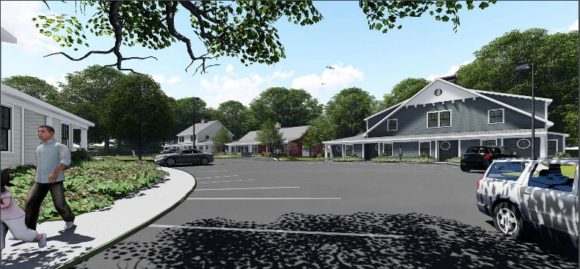
Rendering for planned development at 16 Neck Road, also referred to as River Oak Commons I & II. Photo submitted by HOPE Partnership.

As many are aware, HOPE Partnership with Women’s Institute for Housing and Economic Development, our development partner, is in the process of seeking the necessary approvals to develop new, affordable housing communities on Neck Road in Old Lyme.  We are writing today to share the story of HOPE and the path that brought us to this point.

In 2001, a group of local faith leaders became aware of a growing problem in the community, children in their homework clubs living in hotels or academic rentals without safe and stable homes.  This realization prompted a call to action for community and faith leaders to provide housing options for the families in the community.   HOPE Partnership, a 501(c)3 nonprofit, was formed  in 2004 with the mission of developing affordable housing  in lower Middlesex County and surrounding towns.  In 2012, HOPE, in partnership with the Women’s Institute, opened Ferry Crossing, an affordable development made up of 16 townhomes, located in Old Saybrook and since that time it has been fully occupied and has a waiting list for individuals hoping to make it their home.

While HOPE was working in Old Saybrook, Old Lyme Affordable Housing (OLAH) was making similar efforts in Old Lyme.  Old Lyme Affordable Housing was also formed by concerned community members with support from the faith community and the town of Old Lyme.  In 2015, OLAH merged with HOPE Partnership to ensure their work would continue.  With this combining of efforts, HOPE pledged to make developing affordable housing in Old Lyme a priority.  As part of HOPE’s efforts, we actively pursued opportunities to meet with community groups to educate and advocate for affordable housing.  We had a table at both the Lion’s Club Car Show and the Mid Summer’s Festival in 2017. Focusing on the need in Old Lyme, we met with members of three Old Lyme churches; Christ the King, Saint Ann’s and the First Congregational Church of Old Lyme as well as the Old Lyme Lions Club.

Every year HOPE hosts a “Friendraiser” to share our efforts in the communities we serve.  In 2016, it was there that the owner of property on Neck Road learned of our work and approached us to discuss working together to solve the issue of the lack of affordable housing in Old Lyme.  Once discussions began it was HOPE’s task to determine the viability of building a community at the location.

Working with local engineers, architects and housing consultants, HOPE and the owner of the property applied for and received a subdivision of the property  into four separate lots in October 2017 from the Town of Old Lyme’s Planning Commission.  HOPE’s plans include the two ”front lots” on Neck Road, while the owner will retain the two “rear” lots closer to the River .  In November 2017, the team invited neighbors as well as stakeholders in the community to discuss the preliminary plans for the properties.

During HOPE’s feasibility process a Phase I Environmental Study and a Hazardous Material Survey were conducted with satisfactory results.   HOPE has conducted multiple soil tests to ensure that septic and water capacity are sufficient to meet the needs of the development and all regulations.  An archeological study was conducted as well as discussions with the Connecticut Trust for Historic Preservation which  determined there was nothing of historical value in need of protection.   A traffic study was conducted in October 2017. The study is being updated using more current data now available, and an additional study will be conducted over Memorial Day weekend to determine the traffic impact on the area. This impact study will be provided to the Town’s own independent Traffic Engineers in sufficient time for review.  The Town’s Inlands Wetlands and Watercourses unanimously approved HOPE’s application for Lot 1 on May 22nd, with stipulations to add rain gardens in between buildings to capture more water onsite; to require owner to clean and inspect wetlands area and to have a plan to treat invasive species.

With preliminary studies and test results in hand, HOPE and its development partner, Women’s Institute, determined that the property would be a suitable location for affordable housing this past spring.  HOPE officially announced its intention to move forward at its annual Friendraiser at the Old Lyme Country Club in April 2018.  We continue to meet with community groups and have shared our plans with the Lyme-Old Lyme Junior Women’s Club, the Mentoring Corps for Community Development (MCCD), representatives from the school district, Christ the King Church and First Congregational Church of Old Lyme. What we heard from these organizations was a need to serve incomes of households that would meet community needs – such as young adults who grew up in Old Lyme but cannot afford to move back after college, the volunteer firefighters in the community, or the families sending their students to school in Old Lyme.

We also heard the importance to preserve the cultural entranceway to Old Lyme. We have responded with a design that is set back the length of a football field from the road, mirrors the road patterns of the adjacent neighborhoods, has space for a community room and on-site property management to oversee the ongoing maintenance of the grounds and building, and building designs that reflect the historic aesthetic of Old Lyme.  This new neighborhood will serve to convert an underutilized parcel to a tranquil neighborhood for 37 families, supported by public transportation and contributing to nearby commercial activity.

Affordable housing provides a solid foundation for a strong community.  Residents who live in a home that is affordable have funds to purchase food, provide health care and satisfy other living needs.  Residents of affordable homes also have the economic means to purchase goods and services in their communities creating economic stability.

The exact mix of unit rents and income limits is still being finalized for a number a reasons.  Because we restrict the rents of our housing to ensure that it remains affordable to households who can’t afford a home at market rate in Old Lyme, we need to leverage a variety of private and public sources to provide a mix of debt and equity that will sustain the project for decades to come. Each one of these sources will have different financial and policy goals.

When determining the rental and income limits in a project, we take a three tier approach.  1) We determine the greatest community need, based on local engagement and formal market studies, and examine how this need aligns with the mission of HOPE and our partners; 2) We determine how much income the property will need to make through rents to pay for ongoing expenses, maintenance, and capital improvements so that the development is fiscally responsible and sustainable for the duration of the deed restrictions; and 3) We must meet the various needs of lenders and funders in the project that all have different policy requirements for how they want funds to be used and who they are aiming to serve.  This approach will impact how many apartments will be set aside for families earning very low incomes to meet community or state policy goals, versus how many might be left at market rate to ensure there is greater revenue to offset lower rent limits.  Until all financing is fully committed, these projections will be re-examined continuously.

Thanks to a financial commitment received through Guilford Savings Bank and the Federal Home Loan Bank of Boston on April 30, 2018, the project will have access to a reduced rate mortgage, which at this time should allow us to preserve 100% of the units as affordable. Affordable is defined by HUD as spending no more than 30% of their income on housing costs.  For these units, the household income ranges will be from $20,000 to $71,000, all based on the area median income in Old Lyme. The remainder of the development will be funded through a variety of sources, private investor equity through the Low-Income Housing Tax Credit program (LIHTC), energy efficiency rebates through the utility companies, and CT Dept. of Housing bond financing.

River Oak Commons I will consist of 7 residential buildings (23 affordable units) and 1 pump house.  River Oak Commons II will consist of 4 residential buildings (14 affordable units) and 1 community building, including an office for an onsite property manager.

Our next step in the process is to obtain approval for our applications from the Old Lyme Zoning Commission.  The public hearing is set for June 5th at 7:30pm at the Old Lyme Town Hall.
Op-Ed: SECoast Questions Proposed HOPE Development in Old Lyme

Organization Stresses Support of Affordable Housing

This Op-Ed was written by Gregory Stroud, Executive Director, SECoast

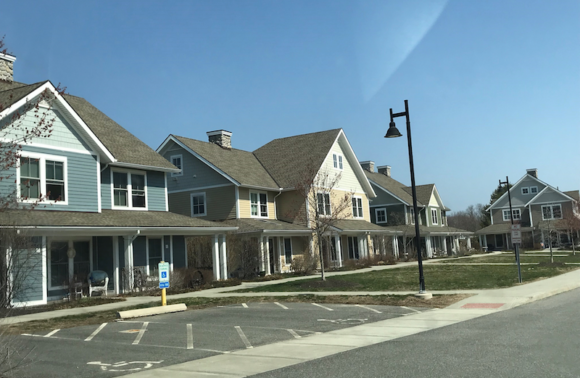
This photograph shows a representation of Hope Partnership’s ‘model’ Ferry Road development six years after completion.  Photo by Gregory Stroud.

No doubt by now, most of you have heard of the Hope Partnership housing development planned for 16 Neck Road. It’s a subdivided property tucked in beside the northbound I-95 exit 70 into Old Lyme, a wooded 12.5 acre lot with a steep entrance road, and a long stretch of deep-water access to the Long Island Sound. The property once assessed for $1.2 million, was purchased by a local developer on December 31, 2015 for a relative song—$455,500.

As things stand today, our expectation is that the purchaser, Graybill Properties, will keep and develop the back two lots for private houses, with river views and water access, and will sell the front two lots facing Neck Road for development as “affordable housing,” all told perhaps 37 or 41 two- three- and four-bedroom units, twelve buildings, and 113 parking spaces.

The development falls under a state law, commonly known as 8-30g, which doesn’t exactly give for-profit and non-profit developers carte blanche, but it does place a heavy burden of proof on local government to stop them, if a town fails to meet a very narrowly-tailored threshold of 10 percent deed-restricted affordable housing stock. Old Lyme currently stands at 1.56 percent, and by this method of counting, it’s not at all clear that the town can or will ever meet or sustain the minimum threshold of affordability.

To be sure, affordable housing has a checkered 30-year history in Connecticut, with often wealthy enclaves successfully gaming the system to shirk their statutory responsibilities, and sometimes unscrupulous developers gaming the system to build luxury apartment complexes, and harvest tax advantages, wherever profitable. In our particular case, we feel confident in saying that neither is the case, but that does not mean our current debate has not been colored on various sides by these broader frictions and frustrations.

Proponents of the project have at times avoided a serious discussion of the project by out-of-hand dismissing legitimate local concerns as NIMBY (Not In My Back Yard)—a form of name-calling rather than logical argument. Opponents of the project have frequently suggested darker motives for the development, without evidence. Town leaders have pitched the project as an effective defense against less scrupulous developers, despite the obvious truth that this project will not nearly allow Old Lyme to meet its near-impossible 10 percent obligation. There has no doubt been anger and ugliness, and more than a few transitory facts and figures in and around the project. We can do better.

Although we have significant and still unaddressed questions concerning the genesis of this project, the methods for choosing and advancing this project, how it fits into broader unstated plans of profit, funding, and development for Old Lyme, nevertheless we are confident that the two primary organizations behind it—Old-Saybrook-based Hope Partnership, and their statewide partner The Women’s Institute—are motived not by profit, but by a genuine, if perhaps overriding, philanthropic mission.

Nor does Old Lyme—despite its reputation among some as a haven of wealth and privilege—have a history of skirting the law or blocking affordable housing projects. In fact, in this case First Selectwoman Bonnie Reemsnyder and Selectwoman Mary Jo Nosal, have invited and actively encouraged the development of this project in Old Lyme. We have little doubt that many in Old Lyme will bend over backwards to help see this project to completion.

But now putting all that aside, we are left with two basic questions: Is this a ‘good’ project? And do our concerns about health, safety, or other legally reviewable matters, clearly outweigh a need for affordable housing?

To the first question, we say largely not. To the second question, we say that it remains unresolved. For this reason, while we have decided to remain neutral at present on this project—we will neither promote, nor actively endeavor to block it—it is our view that the project leaves such substantial details and questions unresolved that it would constitute an act of negligence for zoning, planning, wetlands, or other town commissions to give this project approval, or even conditional approval, without significant additional scrutiny and assurances.

To this end, we spent more than two hours on May 2 with board and staff members of Hope Partnership, and The Women’s Institute, which was followed by numerous hours reviewing evident and serious issues of pedestrian and traffic safety, fire code, environmental, and other concerns. We followed up with an additional nearly hour-long conversation with Kristin Anderson, the development manager for the project, as part of The Women’s Institute. We remain deeply, and sincerely troubled by the project, and the feasibility of addressing these concerns.

We leave our detailed criticism to later public comment, but that said, it is telling we think, that the bulk of assurances which we did receive, regarding the goodness, the compliance with fire code, and the traffic and pedestrian safety of the project, are premised on a series of troubling and doubtful assumptions as follows:

  • that some un-proposed and unfunded redevelopment of Rte. 156 and Halls Road may in the future allow for safe pedestrian access between the development and the nearby Halls Road Shopping District;
  • that the 2018 State Building and Fire Safety Codes would drop a mandate for sprinklers by a vote in the legislature on July 1;
  • that CTDOT will alter the traffic signs and the terminus of Exit 70 in a manner, and time, which will allow for safe vehicle access to the site.

To be frank, all that we are really sure of here, is that this project has sailed through a number of planning, zoning, and wetlands meetings, with the strong backing of elected local officials, an array of ephemeral facts and arguments, an ever-growing scope, and a heck of a lot of good intentions.

But for all the good intent, the stubborn present reality of this project remains an essentially regressive model of suburban tract housing, with no clear safe access on foot, by bicycle, school bus, or public transit, awash in blacktop, skirting requirements of septic within the watershed and at the mouth of the Connecticut River, exempted from requirements of open space for land which will later be developed, and by an Old Lyme Plan of Conservation and Development, which is two sentences from nonexistent.

This is a project, as currently drawn, which reaches toward a lower common denominator of fire code. If requirements for sprinklers are dropped, should we cheer? It’s a plan at present, which encourages children to play inside, and burdens struggling families with the necessity of two cars.

Of course, no project can meet every ideal measure, and many families happily live out their days without sidewalks and within suburban tract housing. Should we hold affordable housing to a higher standard? Aren’t affordability and good intentions, reason enough? It’s an argument more often we’ve seen used for hot dogs and hamburgers in school lunches.

The reality is that 16 Neck Road is not just a housing development, it’s the entrance to the town. 16 Neck Road is the first step, a driving force, a funding source and point of leverage for a much larger unspoken and questionably-coordinated redevelopment of Old Lyme. Are we in such a rush, that without any real detail, this is how we choose to begin? 

Believe me, the public hearing on May 14 isn’t just another hoop, it’s the moment when Hope Partnership and the Town of Old Lyme decide whether to pull the trigger.

We say, yes to affordable housing in Old Lyme, but only with a better affordable plan.

Op-Ed: High Hopes Suggests MLK Day is Appropriate Day to Think About Giving Back to Your Favorite Non-Profit, Hosts Volunteer Orientation 4-7 Today

With the arrival of Martin Luther King Day today, it is worth looking back on the question Martin Luther King Jr. asked of an audience in Montgomery, Ala., in 1957, when he said, “What is life’s most persistent and urgent question?”

Consider that question right now and what your answer would be?

  • How can we achieve world peace?
  • Is global warming real?
  • Which college shall I choose?
  • Is life really a race to nowhere?
  • What is the number 42?

For Martin Luther King, the answer to this question was quite simple: ““What are you doing for others?”

So, in acknowledgement of Martin Luther King Day, High Hopes challenges you to answer that question with a pledge of a specific number of volunteer hours to a local non-profit.

A pledge is a promise, a promise to yourself, to the non-profit and to the many thousands of people who depend on Connecticut’s non-profits every day for human and social services, for therapy and comfort, for clothes and food, sanctuary and safety. By writing down your pledge, it becomes more real, more urgent, more of a commitment, and more achievable than a New Year’s resolution or an unspoken intention at some time in the future.

Choose an organization that speaks to your soul.

We would love you to volunteer at High Hopes, and whatever your future career interest, we can promise a rewarding experience. But wherever you decide to pledge your time, make sure that the organization’s mission speaks to your soul.

At High Hopes, we say “Volunteers give something of themselves and receive back another person’s hopes and dreams.” But while looking for a suitable quote for this piece, we came across this definition taken from the International Volunteer HQ – Volunteer Abroad Pinterest Board(n:) Volunesia – the moment when you forget you’re volunteering to help change lives because it’s changing yours.

Experiencing Volunesia is something we hear again and again from our volunteers.

Our therapeutic equine assisted activities operate year-round, six days a week from morning until evening. Our staff and volunteers work together, forming a vital team that is essential to our ongoing success. Individual reasons for volunteering may differ, but giving of oneself and forming special connections with people and horses creates a common bond for everyone involved in our program.

We could not operate without our volunteers and our needs are many. Our volunteers are all ages, genders, creeds, and ethnicities. Volunteering is giving freely, conscientiously and predictably of your time, but that does not mean to say that you will not benefit just as much, if not more than you give.

High Hopes is a center of excellence for Equine Assisted Activities and Therapies, as well as recognized for its high standard of non-profit management. Trainee Instructors travel from around the world to receive a High Hopes’ Education (we currently have trainees from Bosnia and Australia!) We extend that training to our volunteers through enrichment activities and subsidized training events.

For high school students, we offer an excellent way of demonstrating on-going volunteer commitment. Just one hour volunteering each week is considered of value by college admissions officers. For our participants, it will give them the confidence of a familiar volunteer face each week.

If you are involved in sports and can only volunteer during the summer – that’s no problem. Summer is one of our busiest times when we run five individual weeks of all-abilities, community-focused summer camp, as well as disability-specific programs.

For college students, we know that the experience gained at High Hopes is second to none for those wanting to enter the fields of Early Childhood Education, Human Growth & Development, Nursing, Medicine and Professions Allied to Medicine.

For many of those who have served in the armed forces or are retired, maintaining a connection or continuing to give back is a vital part of staying physically and mentally active.

For homemakers, seasonal visitors and homeschoolers, High Hopes’ flexible programs enable you to commit to a volunteering schedule that suits you, enables you to get out of the house, and build a new and supportive social network.

Ready to learn more?  Then you can make a volunteer pledge to High Hopes at this link or join us for one of our General Orientation and Side-walker Training Sessions on any of these dates:

Monday, Jan. 15: 4 to 7 p.m.
Saturday, Feb. 3: 1 to 4 p.m.
Saturday, March 10: 1 to 4 p.m.
Saturday, April 14: 1 to 4 p.m.
Saturday, May 5: 1 to 4 p.m.

Or join us for a Volunteer Open House on Saturday, March 17, between 10 a.m. and noon. Take a tour of High Hopes, meet our team, talk to an existing volunteer, watch a lesson or discuss a volunteer schedule to suit you.

Op-Ed: Wayland, Lord Will Continue Tradition of Excellent Leadership in Lyme

By Tony Lynch

I half-jokingly refer to Lyme as “Lynch’s last stand”.  I’m a refugee from Greenwich, Southport and Glastonbury.  All three of those towns were bucolic farming communities when generations of my family moved to them.  All three are now densely populated suburbs, with attendant traffic, chain stores and restaurants.

Most of us likely moved here because we cherish the wide open spaces, light traffic and the absence of traffic lights, stores, restaurants and industry.  With careful stewardship on the part of our town government and volunteer organizations, Lyme stands a good chance of remaining as pastoral as it is today.

Lyme also has one of the lowest property tax mill rates in the state, yet through careful fiscal managment, has still been able to complete a Town Hall and Library project, convert the landfill to a transfer station, and support the Lyme Land Conservation Trust and the Nature Conservancy in preserving open space.  This year, our leaders also had the foresite to anticipate that the state would cut it’s contribution to the education budgets of towns like ours.  As a result, we are one of few towns in the state that were not surprised by that development and thus didn’t have to increase local taxes to compensate.

This past July, after more than two decades of excellent leadership, our First Selectman, Ralph Eno, retired.  We now have the opportunity and responsibility to elect a successor who will continue to shepherd our town in a similar way.

Which leads to my unequivocal endorsement of Mark Wayland for First Selectman.  Mark is a 3rd generation native of Lyme whom I have come to know and respect as a fellow leader of Lyme-Old Lyme Boy Scout Troop 26.  In the years that we served together, Mark demonstrated excellent leadership skills, uncompromising ethics and a natural ability to foster teamwork among our youth and adults.  Not one to shy away from a challenge, Mark completed Wood Badge training, Scouting’s pinnacle adult leadership program that only a small percentage of leaders complete.  The curriculum emphasizes project management, conflict resolution, listening, mentoring and team development – all essential skills for a First Selectman.  Mark rose through the ranks and currently serves as the Troop’s Scoutmaster.  He also serves as a Selectman in Lyme and as a volunteer with the Lyme Fire Company.

Mark recently commented that “I knew at an early age how special our town is, and I want to keep it that way for future generations to enjoy as much as I have”.  Together with Selectman Parker Lord, I believe Mark will succeed to our great benefit.

Whether you are a Democrat, Republican, or Independent voter (like me), I urge you to come out and vote on Tuesday and join me in electing Mark Wayland as our First Selectman and Parker Lord as Selectman to continue the excellent leadership our town has enjoyed for many years.

Op-Ed: Old Lyme Should Return to Local Health Department; Dramatic Increases in Ledge Light Fees Adversely Impacting Local Residents, Small Businesses

Editor’s Note: The author, Dawn Root, is the owner of Old Lyme Seafood.

Old Lyme joined Ledge Light Health District (LLHD) on Nov 1, 2016 after approval at a Town Meeting by a margin of only 3 votes (82-79).  The time between the first public hearing (scheduled on Aug 29 during prime vacation season, with only 10 days’ notice) and the Town Meeting vote held on Sept 27 was less than a month.  That’s not enough time for public debate on a fundamental change to our town government that has a direct impact on all Old Lyme residents, businesses and organizations.

At the Sept 2016 Town Meeting, we were told that joining LLHD would result in significant cost savings, but it has not.  Previously, Old Lyme residents and businesses paid fees to our Town that helped offset our local health department costs. However, fees paid to LLHD don’t offset town costs, so become additional costs.

LLHD septic and well permit/review fees typically increased between $25-$150.  High septic and well fees have a greater impact on Old Lyme than other LLHD towns, such as New London, Groton, Waterford, East Lyme, because a greater portion of Old Lyme residents and businesses rely on wells and septic systems.

Most LLHD licensing and inspection fees increased between 2- and 10-fold (e.g.: from $50 to $300, or from $20 to $205-$245), and fee adjustments for seasonal vs year-round, or small vs large establishments were eliminated.  Such dramatic fee increases have been particularly challenging to Old Lyme small businesses and organizations because many are seasonal, or serve a much smaller local population than other LLHD communities.

LLHD also introduced many new fees, including $100 late fees, $100 re-inspection fees, and $50 repeat violation fees. When one considers total costs paid to LLHD, there are no costs savings.  The LLHD fee increases have already become a substantial burden to many local residents, small businesses and organizations, as demonstrated by over 100 Old Lyme residents and business owners signing a petition to bring the matter back to another Town Meeting.

The possibility of a future cost reduction was also mentioned at the Sept 2016 Town Meeting, but it was tied to eliminating an extra payment that Old Lyme makes to LLHD to maintain LLHD staff at Town Hall.  Without these extra payments, on-site health staffing may be significantly reduced; currently, LLHD provides on-site staff in Stonington and East Lyme only 2-4 hours/week.

Importantly, we were told that by joining LLHD, Old Lyme would not lose control of this important town function because Old Lyme would “have a seat at the table” on the LLHD board.  In reality, Old Lyme will have minimal influence over future LLHD decisions regarding costs, fees, staffing, and service, because representation on the LLHD board is based on population, and Old Lyme is by far the smallest town in the LLHD – representing only 5% of the total LLHD population (see table below).

Lastly, we were told that Old Lyme could simply try LLHD for 2 years and switch back to a local health department after giving LLHD 6 months’ notice.  Please join me, and many other Old Lyme residents and small business owners adversely impacted by the LLHD changes, in requesting that Old Lyme return to a local health department that will be more responsive to the unique needs of our small, and very special, community.   

LLHD-Member Town Populations (CT Dept. of Public Health 2016 estimates)

Town Population % of LLHD Total
Groton 39,261 27%
New London 26,984 19%
Waterford 19,101 13%
East Lyme 18,886 13%
Stonington 18,647 13%
Ledyard 14,911 10%
Old Lyme 7,469 5%
LLHD TOTAL 145,259 100%