Gardening Tips from ‘The English Lady’ for June, Which ‘God Invented [Because] Spring is a Tough Act to Follow’

“Cast ne’er a clout till May is out” is the medieval English saying means do not put away your long johns until May is over; well, we certainly have had a few very cool nights recently, which is just wonderful … allowing sleeping with the windows open.

I cannot remember the last time we had a real spring like the one we are experiencing this year, with plenty of rain. May is typically a dry month, although with the effects of global warming, no weather is typical these days. However, this beneficial rain is wonderful for all the spring plant growth happening in the beginning of the growing season.

Peonies by Jessica Fadel on Unsplash.

I am so in awe of the miracle of Mother Nature; the symbiotic relationship between plants and others of God’s creatures. As I look out of my window into my field, I can see the buds opening on my long stand of peonies, which brings to mind just one of those symbiotic relationships — the friendly partnership between ants and peonies.  

I am often asked “Maureen, should I worry about ants on my peonies?” The answer is “That’s not a problem, lots of ants on the peonies just demonstrate that you have healthy plants with big buds producing more nectar and therefore attract the ants”.

Make sure Peonies get plenty of water and after blooming, apply a light dose of organic 5-10-5 fertilizer and check the soils PH it should be between 6.5 and 7.0.  It is hard to ruin a good peony border but you can err in the fertilizing process, so go easy on the organic aged manure (never thought I would say that) and apply just the light dose of fertilizer — to reiterate apply the fertilizer after blooming.  

Now, in June, I pinch off the side-buds on my large stand of peonies, thus ensuring big blooms on the rest of the plant.  

On the subject of ants; if you see them “let them live,” because often their presence indicates that we have aphids around and ants feed off aphids; they are very useful creatures.

Another very useful creature in the pest wars; is the lowly toad so I always put out some toad houses (which you can purchase from the garden center) around and about in your borders.  You can also use an old clay pot that is cracked and make sure that the crack is two to three inches wide for the door so the toad can enter. Also put a small saucer as a floor under the pot with some rocks, which you keep damp, so that your friendly bad-bug-eater has his or her ideal home environment.

MULCH:

Mulch your gardens in June; when the ground has warmed up to about 45 or 50 degrees. When you mulch, be careful mulching around trees; do not get the mulch any closer than four inches from the trunk, as any closer it can promote rot and disease in the tree itself. Also trees that are mulched too deeply near the trunk invite mice and other rodents to come nest and then gnaw on the trunk.  

The garden as a whole can be mulched to a depth of between two and three inches. I prefer fine hardwood mulch in the dark brown color but no dyed red mulch please … keep the garden looking natural and not like a Disney theme park.

ROSES:

An ‘Evelyn’ rose by David Austin, the author’s favorite.

June is the month when Roses begin to bloom. I prefer David Austin roses that I find are the most trouble free roses, are repeat bloomers and have wonderful fragrances. Some of my favorites are A Shropshire Lad, a soft peachy pink, Abraham Darby with blooms in apricot to yellow, Fair Bianca a pure white, Heritage, a soft clear pink. My absolute favorite is Evelyn, pictured at right, which has giant apricot flowers in a saucer shape and the fragrance is second to none with a luscious fruity tone, reminding me of fresh peaches and apricots.  

Feed your roses with an organic rose food called Roses Alive, which you can obtain from “Gardens Alive” on the internet, feed them once a month until mid August, then stop feeding so they can go into a slow dormancy.

Japanese beetles are very attracted to roses, so any Japanese beetle traps should be placed far away from your borders on the perimeter of the property. Or check TheEnglishLady.com on the Organic Products page for other solutions to the beetles and other unwanted pests.    

A tip for keeping cut roses fresh: cut the roses in the morning before 10 am, just above a five leaf cluster and place stems in a container of lukewarm water.  Inside the house recut the stems under warm running water, forming a one and a half inch angular cut, then place in a vase filled with warm water.  Do not remove the thorns on cut roses, I have found this practice reduces their indoor life by as much as three days.  

HYDRANGEAS:

These need plenty of water, (in the fields they were originally found close to water being a wetland plant before they were introduced into our gardens), also organic aged manure, good ventilation, organic fertilizer and full sun.

Wisteria in full bloom is always a sight to behold. Photo by Alyssa Strohman on Unsplash.

WISTERIA:

Regular pruning through spring and summer is the main factor to help this arrogant vine to flower — and by that I mean several times during the season. Prune every two weeks at least six inches on each stem.  

CLEMATIS:

If you have a wilt problem with clematis, you notice it early because the shoots wilt and die. Unfortunately this disease is impossible to cure, as it is soil-borne. Therefore you cannot plant another clematis of that species in that area but you can plant the Viticella clematis selection; these are vigorous, free flowering blooms and are not susceptible to wilt.  Some good choices in this variety are Blue Belle, Etoile Violette (both are purple) and Huldine, which is a white,  

CONTAINER GARDENS:

If you have room for one pot, you have room for a number — placed close together in different shapes and sizes, they can create your own miniature garden. Apart from regular pots, the most unexpected objects make really interesting containers. A friend, who cut down trees this past winter, left the stumps and hollowed them out to make containers — one large and two smaller stumps together — a really interesting combo.  

At the same time look in your basement, shed or barn to see if you have an old wheelbarrow, which, even if it has a wheel missing, will present an unusual angle as a planter. Or you may come across a large chipped ceramic jar — I, in fact, have an old two foot tall ceramic vinegar container, replete with a hole where the vinegar tap was inserted, ideal for drainage, which will look great on my newly-painted blue bench next to my red milk shed.  

LAWN CARE:

Do not forget to add organic grub control through July, so that you keep down the mole infestation; remember no grubs, less food for the moles.  

POWDERY MILDEW:

Keep an eye open for powdery mildew, especially after a rain and the humidity returns.  In a sprayer, mix two tablespoons of baking soda, two tablespoons of vegetable or horticultural oil in a gallon of water and spray the mildew.  Summer phlox is particularly prone to this affliction; I recommend Phlox Miss Lingard or Phlox David, white ones of the species, these are the most mildew resistant.  

Monarda, commonly known as Bee Balm, is also affected by the mildew; the one I have found to be the most resistant is Cambridge Scarlet. Do be careful when introducing Monarda into the garden; they, like Purple Loosestrife and Evening Primrose are extremely invasive and can take over your entire border.  

On the subject of invasive plants, if you plant mint, plant it only in containers, otherwise mint will spread throughout your borders.  

I hope these tips are useful to you in this busy time of year in the garden and I’ll see you in the garden or on my website next month.

Contact Maureen at maureenhaseleyjones@gmail.com

About the author: Maureen Haseley-Jones, pictured left, is a member of a family of renowned horticultural artisans, whose landscaping heritage dates back to the 17th century. She is one of the founders, together with her son Ian, of, The English Lady Landscape and Home Company. Maureen and Ian are landscape designers and garden experts, who believe that everyone deserves to live in an eco-conscious environment and enjoy the pleasure that it brings. Maureen learned her design skills from both her mother and grandmother, and honed her horticultural and construction skills while working in the family nursery and landscape business in the U.K. Her formal horticultural training was undertaken at the Royal Botanic Gardens at Kew in Surrey.

Hundreds Celebrate Summer Solstice With Stroll Down Lyme St. Enjoying ‘Make Music Day’

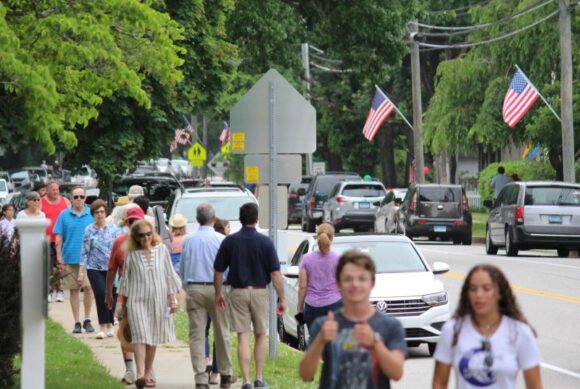
Lyme Street was filled with cheerful folk enjoying the sounds of ‘Make Music Old Lyme’ and visiting with friends they had not seen in a long time due to pandemic restrictions. Photo by Cheryl Poirier.

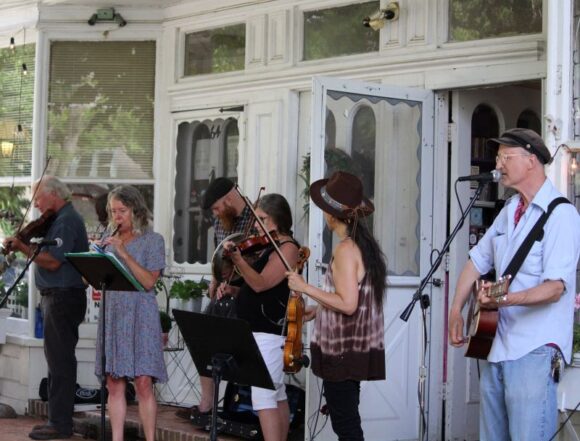
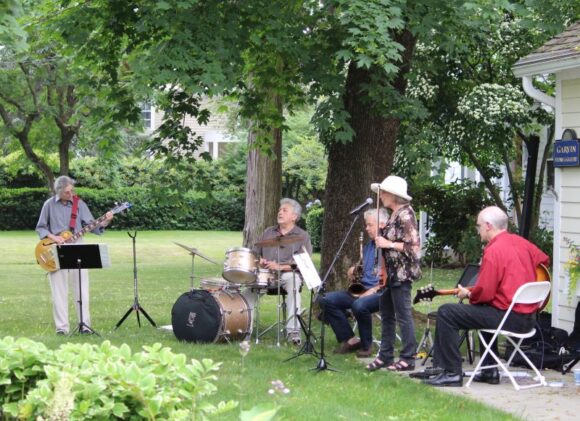
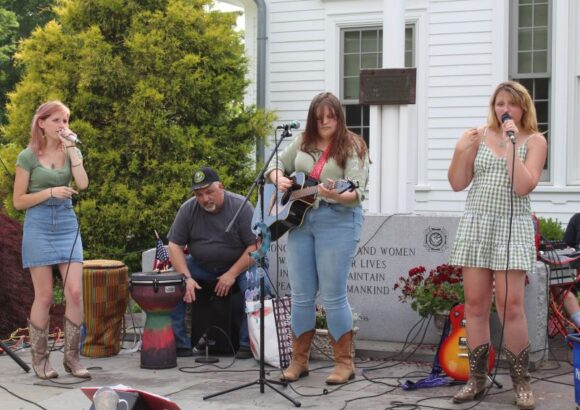
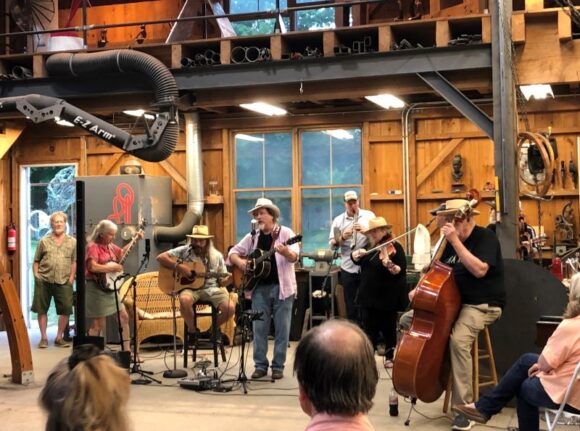
OLD LYME — ARTICLE UPDATED, PHOTOS ADDED: The air was warm and spirits were high early on Monday evening when more than 500 people took a stroll on Lyme Street to enjoy the music of a dozen bands and solo performers, who together created Make Music Old Lyme. 

‘The Voice’ finalist Braiden Sunshine drew a large crowd in front of Center School. All photos by Alan Poirier except where otherwise indicated.

It turned into an evening of wonderful musical entertainment and also the opportunity to reconnect with friends after a very long and challenging year.

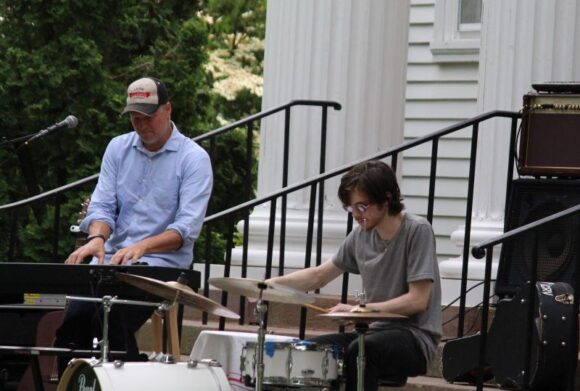
Plywood Cowboy played on the steps of the First Congregational Church of Old Lyme.

The celebration spanned the length of Lyme Street from the First Congregational Church of Old Lyme, where Steve Dedman of Plywood Cowboy played all the way up to the Lyme Academy of Fine Arts where the Old Lyme Town Band entertained on the front lawn.

The Old Lyme Town Band gave a rousing performance in front of Lyme Academy of Fine Arts.

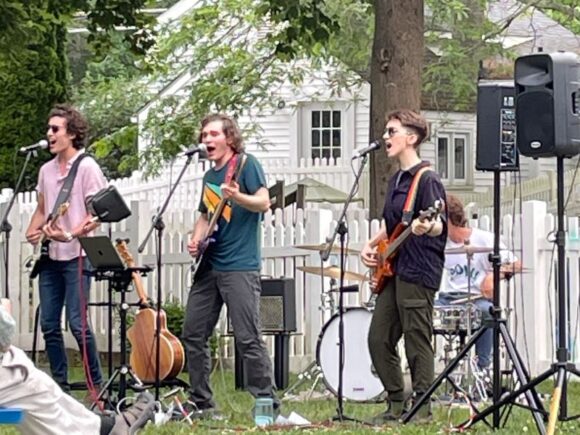
A number of people brought chairs and moved from performance to performance to enjoy the evening full of folk, indie rock, Americana, and more.

Welcome to Space performed at Lymes’ Youth Service Bureau as part of ‘Make Music Old Lyme.’ From left to right are Thomas Pennie, Colin Hallahan and Jess Kegley with Noah Rumm on drums. All four are members of the Lyme-Old Lyme High School Class of 2019. Photo by Tracy McGlinchey.

Many residents were surprised to learn that all of the musicians donated their time and talent to support the international Make Music Day credo of free music for all.

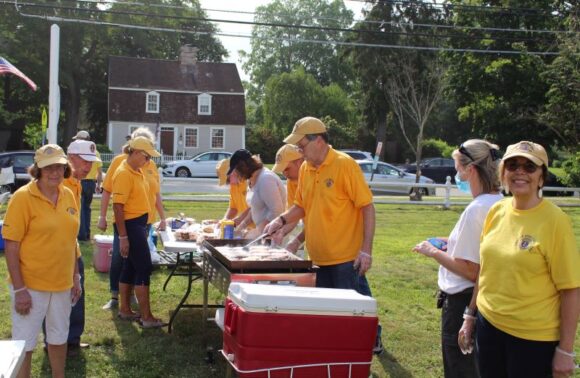
The Lyme-Old Lyme Lions did brisk business selling hot dogs and hamburgers.

The Lyme-Old Lyme Lions Club sold over 100 hamburgers and more than 100 hot dogs …

Steve Patarini and Dean Montgomery performed on the new patio of the Phoebe Griffin Noyes Library.

… and meanwhile, The Chocolate Shell generously offered a 10 percent on all purchases.

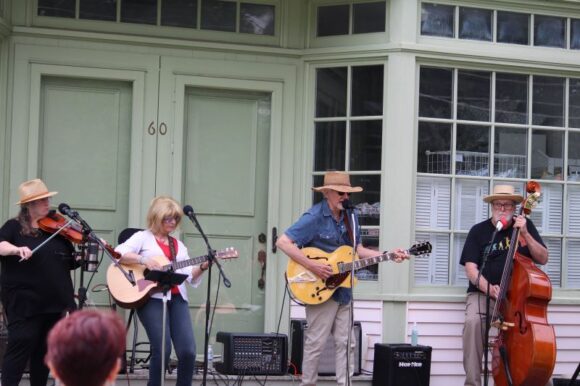
Hot Strings Café could be found in front of Patricia Spratt for the Home.

Cheryl Poirier, a lead organizer of Make Music Old Lyme, told LymeLine after the event that she felt it was, “A highly successful night  … [and] a great time was had by all!”

The Nightingale Fiddlers and Friends played in front of … where else, but Nightingale’s Acoustic Cafe?!

The comments we have seen about the event on our Facebook page and here on LymeLine strongly suggest that was the universal opinion!

The Moving Target Band played in front of The Village Shops.

The event was part of an international celebration of free music for all produced by the Old Lyme Arts District in conjunction with the Southeastern Connecticut Cultural Coalition and Nightingale’s Acoustic Cafe arranged the musical lineup.

The Midnight Anthem delighted crowds in front of Old Lyme’s Memorial Town Hall. Photo by Cheryl Poirier.

This was the third year Make Music Old Lyme has been presented; it was cancelled last year due to the COVID-19 pandemic.

Whiskey and Aspirin and friends performed in front of The Cooley Gallery.

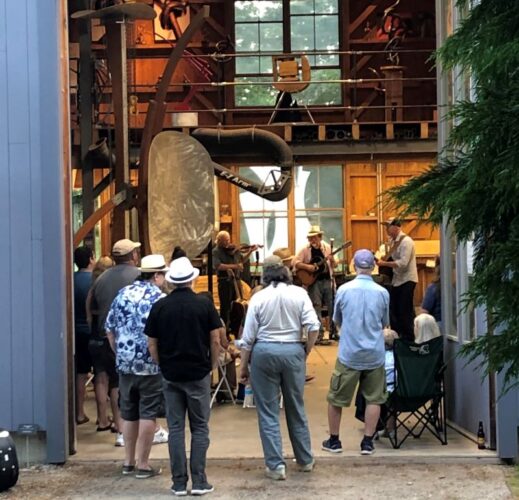
At the end of the two-hour event, a ‘Kazoo Parade’ led by Dan Stevens brought people to Studio 80+ Sculpture Grounds, where a final jam session involving many of the performers continued.

After a jovial musical march up Lyme Street, several of the musicians stopped a while at Gil Boro’s studio to make more music. Photo by Cheryl Poirier.

Make Music Old Lyme returns next year on the Summer Solstice, Tuesday, June 21, 2022.

The grand, unplanned finale at Studio 80 + Sculpture Grounds made for a perfect end to an amazing evening. Photo by Cheryl Poirier.

In It Together: Binge Drinking is Bad for the Brain … Even for Teens

Underage binge drinking is a reality in all communities and Lyme and Old Lyme are no different. Photo by Kelsey Chance on Unsplash.

Summer is here, parties are happening, and alcohol consumption will increase. This is a good time of year to dive deeper into the effects of binge drinking on the brain and development.

You have surely heard that abusing alcohol hurts your health. But how many years of drinking do you think it takes to visibly affect your brain? Ten years? Twenty?

Turns out that it doesn’t take that long at all — in fact, scientists can already see changes in the brains of teenagers who drink.

In a research study, Professor Susan Tapert of the University of California at San Diego used an MRI to scan the brains of teens who binge drink — defined as drinking four or five (or more) drinks in a couple of hours. Dr. Tapert found that the “white matter” in their brains — the part that transmits signals, like a TV cable or a computer USB cord — was abnormal compared with the white matter of teens who do not binge drink.

Transmitting signals is a big part of what the brain does, so affecting the white matter in this way could also affect a person’s thinking, learning, and memory.

The really scary part is that these teens weren’t alcoholics, and they didn’t drink every day. All they did (to be considered “binge drinkers”) was drink at least four (for women) or five (for men) drinks in one sitting, at least one time during the previous three months.

A Youth Survey conducted by Lymes’ Youth Service Bureau (LYSB) in 2019 in Lyme and Old Lyme found that 67 percent of students in grades 7-12 reported having engaged in binge drinking at least once in their lifetime. The survey also found that 24 percent of students in grades 7-12 reported binge drinking within the past 30 days and 34 percent of all 12th graders reported the same thing. 

Underage binge drinking is a reality in all communities and ours is no different.  

How could it be possible for just a few sessions of heavy drinking to affect the white matter of the brain? Well, science has shown that alcohol can poison brain cells and alter the brain’s white matter in adult alcoholics.

Dr. Tapert thinks that teenagers’ brains are even more susceptible this way. She states, “Because the brain is still developing during adolescence, there has been concern that it may be more vulnerable to high doses of alcohol.”

And the bottom line?

If you’re a teen, drinking to the point of getting drunk could damage the white matter of your brain—even if you do it only once in a while.                               

Tips for parents about how to talk to your kids about alcohol, and more information on the LYSB’s survey results are  available at this link.

Article source: The National Institute on Drug Abuse (NIDA)

Alli Behnke

About the Author: Alli Behnke, MSW, MA is the Prevention Coordinator at Lymes’ Youth Service Bureau. She has been a Social Worker for 20 years working in the fields of prevention, therapy, youth leadership, and health coaching. Alli believes strongly in providing accurate information, education, and tools for success when empowering the Lyme/Old Lyme Prevention Coalition and REACH Youth Coalition to work together on strengths-based campaigns. The Coalitions address substance abuse and other risky behaviors challenging our youth and families. Contact her at abehnke@lysb.org or visit  www.lysb.org to become involved in this important community work.

Old Lyme’s ‘Crosby Fund for Haitian Education’ Changes Lives in One of Poorest Parts of Globe

The Crosby Fund for Haitian Education is guided by the deep conviction that a brighter future for Haiti depends on educating its youth and preparing them for professional careers in Haiti.

How has an idea conceived in Old Lyme, Conn. been able to grow into an organization that is making a critical difference in the lives of more than 500 students in one of the most economically-deprived parts of the Caribbean island of Haiti, which, in turn, is one of the poorest countries in the world?

The answer lies with one woman, Rebecca ‘Becky’ Crosby, who along with her husband Ted, founded the Crosby Fund for Haitian Education (CFHE) back in 2003.

How did it all begin?

Crosby explains her first trip to Haiti was in 1999 and came about through the First Congregational Church of Old Lyme (FCCOL) when Amy Bruch was working there as an Associate Minister. Bruch had connected with the late Dr. Wayne Southwick of Old Lyme, the retired chairman of the Department of Orthopedics and Rehabilitation at Yale University.

Annually, Dr. Southwick led a team of doctors from Yale to the Albert Schweitzer Hospital in Deschappelles, Haiti, where they performed surgeries round the clock and at no charge for local people. Deschappelles is located in the rural Artibonite Valley about 90 miles north of the nation’s capital, Port-au-Prince.

Inspired by Southwick’s work, Bruch decided she, in turn, wanted to take a team of volunteers to the same hospital to support his efforts. She successfully organized the trip pulling together a group through the church, one of whom was Becky Crosby. They took a sewing machine with them, Becky recalls, and their primary task was to make privacy curtains for the hospital.

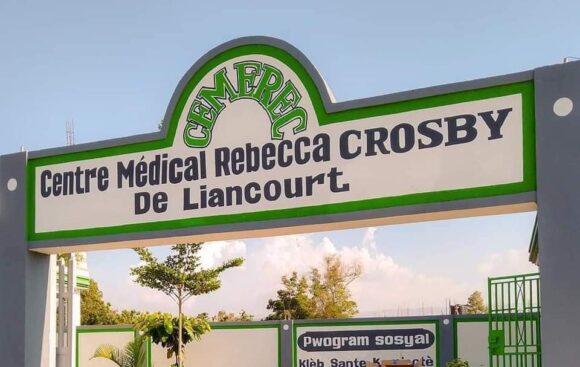
Ted and Becky Crosby attended the opening of a new Medical Center in Liancourt, Haiti in May 2021. The Center was founded by one of the graduates of the Crosby Fund for Haitian Education program, Dr. James Kerby Estimé, who named the Center in Becky’s honor.

During their time on the island, Becky noticed a young man, who was regularly sitting outside the place the volunteers were staying. One day Crosby asked him why he was not in school and he explained that he had previously been fortunate to have a sponsor from the US, but that those funds had ceased. Since school is not free for anyone in Haiti, he was no longer able to attend as his family simply could not afford it, and he hoped by interacting with some of the American visitors in town that he might be able to find a new sponsor.

Becky says, “I was surprised to learn that school was not free,” and made the decision almost on the spot to pay for the young man — Oltin — to finish his high school education. Doing that turned out to be harder than she thought since there was no postal service in Haiti and the young man had no bank account. Becky, however, was determined and finally found a way to pay his tuition through an American doctor working in Haiti.

Three years later in 2002, Becky returned to Deschappelles to meet with Oltin on his graduation from high school. She recalls, “I saw him and it was a wonderful visit.” She adds significantly, “I could not believe what the gift of an education could do.”

She started to research the overall statistics for education in Haiti and was stunned to find that only 55 percent of children in the country attend elementary school, a number which drops to 15 percent for those who graduate from high school, and finally falling to a mere 2 percent, who go onto university.

Less than half of Haitian families can afford school for their children, therefore, one of the Crosby Fund for Haitian Education’s main goals is to provide full scholarships for students from Pre-K through university.

It suddenly became crystal clear to Crosby that, “If you want to build Haiti, you need to educate the youth.” At that transformative moment in her life, she made a personal commitment to try and do something to meet that almost overwhelming objective.

Returning home, she shared the idea with her husband Ted, who was supportive of the concept, and in response set off on his own fact-finding trip to Haiti in 2003.

After Ted returned and expressed his full commitment for the project, Becky returned to Haiti again and began to, “Come up with ways to create the organization” there and “Form a board to select the students [who would receive scholarships.]

Returning to her home in Old Lyme, a determined Becky started work to find donors locally, who were willing to fund students in Haiti, who would otherwise not finish high school.

Not an easy task by any standard, but a short while later, she had successfully recruited 32 people willing to do just that and thus were formed the first seeds of the Crosby Fund for Haitian Education. Becky says, “We started with 32 friends who sponsored 32 students,” adding with a chuckle, “I had no idea when I started where this was leading.”

The Crosby Fund for Haitian Education also offers a wide range of additional academic support at their Education Center in Haiti’s Artibonite Valley.

Where is the organization today?

The numbers are nothing short of staggering.

A total of 523 students are now supported under the organization’s banner including 98 in post-secondary schools, 53 at university and 45 in medical technician or vocational training facilities. More than 80 schools across the Artibonite Valley are now involved in the program.

More than 90 percent of the Crosby Fund’s scholarship students advance to university or technical school and subsequently, CFHE graduates are employed at three times the national average.

Moreover, Faulkner Hunt of Lyme, who serves as CFHE’s Marketing Director, states, “Our goal is to get kids educated,” not just as an end in itself, but, “To get them to a place where they are gainfully employed.”

Has establishing the CFHE had any unexpected effects?

The project has been life-changing for Becky on a personal level in many ways.

Most significantly, when the CFHE had reached a total of around 300 students under its wing, she felt she had to step down from her role as Associate Minister at the FCCOL — a position she had taken after Catherine Zall’s departure (Zall had followed Bruch) — and devote her energies full-time to the fast-growing organization.

The Medical Center in Liancourt, Haiti, which is named after Becky Crosby.

She explains that she stepped down with three clear objectives in mind.

The first was to find or build some sort of “permanent place” for the CFHE, which could both house the staff and offer classroom space. The second was to establish an endowment fund and the third, and perhaps most important, to set up “some sort of staff in the US” to work on “succession planning” for the organization to establish continuity for it in perpetuity.

Becky says proudly, “All of this things are now in place,” which in turn has helped enormously with “Planning for the future.”

Building the Education Center in Deschapelles met the first goal. The three classrooms and and computer lab allow for a wide range of tutoring opportunities, which Becky emphasizes are extremely important, mentioning, “Math is a huge problem.”

Literacy, especially among adults, is another major challenge. “The students’ parents could not read or write … they had no idea how to read a report card,” Becky explains. The CFHE follows a state-run literacy program for adults, which currently has 56 students enrolled, but has recently adopted a youth literacy program sponsored by USAID, which had 52 students registered in January 2021.

With more than a trace of emotion in her voice, Becky said, “It is so moving to see someone my own age struggling to write their own name … and then go back [after the program has been completed] and see them writing easily. It is very, very touching.”

How are the students selected who are to receive scholarships?

Becky explains, “We have a great staff in Haiti, which includes six graduates of our program.” Using their knowledge of the community, they select candidates whom they determine will benefit from financial support. The process clearly works since the graduation rate of students supported by CFHE is significantly higher than the national average.

The 2020-2021 academic year saw 221 scholarships granted to secondary students in grades 7 to Philo (a 13th college preparatory year.) These students attend 37 schools in the region.

Apart from scholarships and tutoring, another piece of the Crosby Foundation’s work is their career development program. Becky says passionately, “Graduates need jobs … it’s tough to get a job … we’re trying to keep them in Haiti.” The program assists graduates in securing internships and jobs across Haiti, and Crosby points out it has already produced doctors, nurses, computer programmers and administrators, most of whom are now employed in Haiti.

She adds the CFHE has also helped students along other career paths including assisting four agronomy students set up a farming business.

What is the impact of donations from Lyme, Old Lyme?

An extraordinary aspect of the financial support for CFHE is that the “vast majority” comes from Lyme and Old Lyme according to Hunt. He comments it is remarkable, “These two little towns  can take up so much compassion for a little area in Haiti,” adding, “It’s such a great example of selflessness.”

Referring to all the CFHE donors, Becky says, “I wish I could bring them all to Haiti so they could see what they’re doing for the youth of Haiti. I wish I could share that experience with the people, who have helped us.”

Looking Ahead

Becky expands enthusiastically on what she calls “the real joy” of the achievements of the CFHE, saying, “When a kid you’ve picked off the streets does really well at school, even university, gets a job, gets married, has kids that go to school … Bingo, that’s the dream! This is what we are trying to do. It’s not going to happen overnight … we don’t expect miracles … but ultimately it’s nation-building one step at a time.”

Editor’s Note: For more information about the Crosby Fund for Haitian Education, visit their website or follow them on their Facebook page. If you would like to donate to support the work of the CFHE, visit this link. All contributions regardless of size are gratefully accepted.

A la Carte: A New Twist on an Old Favorite with an Unexpected History

Lee White

Sometimes I try to come up with recipes that have themes or special times of years, such as holidays like Memorial Day, the Fourth of July or Labor Day.

But I sometimes I forget, before Columbus landed first in the Bahamas and later on the coast that would become America, that the native Americans were here first.

I also forget about the white people, who came soon after Columbus, who herded Black Africans, took them from their homes and families to work, against their will, in the white people fields and houses in the 17th century.

A new documentary from Netflix called “High on the Hog” tells the story of these enslaved people, who tried to keep their own lives and traditions alive along with their culinary journey.

In this documentary, I learned that Thomas Jefferson  and George Washington owned Black chefs, who went with the masters to Paris, brought back French techniques and recipes, which they blended with the ingredients available in the New World. For their own food, in the slave quarters, they took the ingredients the white owners didn’t want — the leftover pieces of vegetables and fruits,  the peels of potatoes and, most of all, the bits of beef, sheep and chickens the owners threw away. 

The recipe below was adapted from a recipe I found in a cookbook from 2001.

Until I saw this documentary two weeks ago., I never knew the first recipe for macaroni and cheese was created by enslaved Black people working in their masters’ kitchens. 

I hope you stream “High on the Hog” on Netflix.

Queens (N.Y.) Mac and Cheese
Adapted from Macaroni & Cheese: 52 Recipes, from Simple to Sublime (Villard, New York, 2001)
Yield: 4 to 6 servings

6 tablespoons butter, plus extra for baking dish
1 pound elbow macaroni
3 12-ounce cans evaporated milk (2 percent milk works well, too)
1 tablespoon Dijon mustard
2 tablespoon Red Devil sauce (or less, to your taste)
4 cups (1 pound) coarsely grated sharp Cheddar cheese
½  pound Velveeta or American cheese, cut into one-half inch cubes
½  cup heavy cream
1 egg, lightly beaten
Kosher salt and freshly ground pepper
1 cup panko (Japanese bread crumbs), or fresh bread crumbs

Preheat oven to 350 degrees. Lightly butter a 3 and ½ -quart deep baking dish or 9 by 13 baking pan.

Bring a large pot of salted water to a boil over high heat and cook the pasta until al dente, 8 to 10 minutes. Drain, pour into a large mixing bowl and toss with 4 tablespoons of the butter.

In a small saucepan over medium heat, bring milk to a scald and add to the macaroni. Add mustard, Red Devil sauce and Cheddar and stir well (the cheese should start to melt. Add Velveeta and cream and stir well. The macaroni and chunks of cheese should be swimming in the sauce. Add egg and mix well. Season with salt, if necessary, and plenty of pepper.

Pour into the prepared baking dish that has been place on a sheet pan to catch spills (the baking dish will be completely full. Sprinkle with the bread crumbs and dot with remaining 2 tablespoons of butter. Bake until golden brown and bubbling, 25 to 30 minutes.

About the author: Lee White has been writing about restaurants and cooking since 1976 and has been extensively published in the Worcester (Mass.) Magazine, The Day, Norwich Bulletin, and Hartford Courant. She currently writes Nibbles and a cooking column called A La Carte for LymeLine.com and the Shore Publishing and the Times newspapers, both of which are owned by The Day. She was a resident of Old Lyme for many years, but now lives in Groton, Conn.