Nicole Prévost Logan
After 47 years of co-habitation, the UK has left the European Union (EU) with a “thin” post-Brexit deal.
An end-of-year need for holiday food delicacies, such as caviar, lobster or foie gras, panic about running short of fresh produce — such as lettuce, combined with the Covid-19 procedure slowing down the traffic, caused spectacular chaos with thousands of trucks lining up on highways or parked in Kent’s makeshift areas.
It was a sort of a preview of what a no-deal Brexit would bring.
The atmosphere in the country was unreal.
On Christmas Eve at four in the afternoon, the news broke: The UK and the European Union (EU) have reached an agreement on a narrow trade deal. There will not be a “hard Brexit” as everybody had feared, with a brutal departure of the British Isles from the continent. The two sides will remain friends and look forward to building up a commercial partnership and intensifying cooperation in transport, security, police, nuclear power, research and many other areas.
An 11th hour agreement
Reaching an agreement was quite an accomplishment. As late as Dec. 20, the mood was grim on both sides of the English Channel. On that date I wrote an article, entitled: “Betting on a “thin” Brexit deal”.
As follows, is part of my article:
 Time is running out. The transition period, which followed the departure of the UK from the EU on Jan. 31, 2020, is ending on Dec. 31. If the two sides – UK and EU – do not reach an agreement by then, the “hard Brexit” will feel like falling off a cliff. The alternative is a “soft” Brexit.
On Dec. 13, 2019 , UK Prime Minister Boris Johnson led a successful campaign, the problem is that he based that campaign on three fateful words: “Get Brexit done” He locked himself in an impasse, making it hard for him to negotiate further. He is under pressure from all sides to satisfy the hard-Brexiter Tories, the business circles rejecting Brexit for fear of a tariff war and public opinion increasingly against a departure from the EU.
The impossibility to bridge the positions from both sides of the Channel is clear: the differences are more than deep. They are existential.
For the British, sovereignty is paramount and the constraints of the Single Market unacceptable. The EU lies on the principles of the “Schengen Space”, consisting of free movement of people, capital, goods and services. Those principles constitute the main asset of the Single Market and are sacred, declared Christine Okrent, a French seasoned journalist and an authority on foreign affairs.
One should not forget that the UK has never been part of the Schengen “Space” nor of the Eurozone.
“Zanny” Minton Beddoes, editor-in-chief of the Economist describes the negotiators as “playing on their voters’ audiences”. It may be true in England, but definitely not in the EU. The EU is not budging from its core proposals, and its 27 members remain totally united. It would be miscalculation on Johnson’s part to count on the EU backing down.
A hard Brexit would be a lose-lose proposition, but the UK would be more affected. Half its trading activities are with Europe, its economy is intertwined with Europe’s, as Beddoes pointed out. In contrast, Brexit has ceased to be a priority for the EU, commented Christine Okrent
In an interview, Michel Barnier, chief negotiator of the EU, declared that a nine month transition was too short. Most trading agreements take at least five years. He said: “Two prerequisites are needed: a free and fair competition (no “Singapore on the Thames”) and a reciprocal access to markets and waters.”
I predict – and am going out on a limb now – that enough concessions will take place on both sides to reach a “thin” deal (to use Beddoes’ words ) allowing the negotiations to continue after Dec. 31. More time is needed to create a tailor-made arrangement to satisfy the UK and help it access the Customs Union or the European Economic Area (EEA), like Norway.
Those were my predictions on Dec. 20.

The British Union Jack flag flies alongside the EU flag … but not for much longer. Photo by Rocco Dipoppa on Unsplash.
Back to Dec. 24, when the post-Brexit “deal'” was reached. What was fascinating on that historical day, was to hear, in real time, the comments coming from all sides of the political spectrum as well as reactions from the general public.
Johnson was exultant, raising his arms in a victory gesture. The trilingual Ursula von der Leyen , president of the European Commission was the one to announce (in excellent French) that, “a good, fair, and well balanced” deal has been reached. Towering over her Michel Barnier added his voice to the official announcement. It was thanks to his fairness and persistence, that he made the deal happen.
Declaring, “We have kept our promise,” Johnson continued, “We have taken back the control of our economy. Freed from the EU Single Market bureaucracy, we can act very fast. The rapid vaccination program is an illustration of this. Our relationship with the EU will be comparable to the one between Canada and the EU (CETA).”
This is not exactly accurate however because CETA makes it easier to export both and goods and services, whereas the post-Brexit deal does not include the suppression of tariffs on services. The most important thing for Johnson was to say, “I have done it”. He did succeed unlike other prime ministers – Thatcher, Major, Cameron and May – who failed in their attempts.
Denis MacShane, a Member of Parliament (MP), Minister of State for Europe under Tony Blair, and formerly a member of the Labor party said the population had had enough and wanted to turn the page of the Brexit.
A professor of the French School of Political Sciences was lukewarm about the deal. The accord does not warrant taking the champagne out to celebrate, he said. To lose one member of the EU is a loss, a form of “disintegration”
Reuters press agency announced that the British Parliament was expected to approve the deal. Both Houses will be recalled to vote on the decision on Dec. 30. Johnson has a comfortable majority of 364 out of 650 in the House of Commons. Many of the 200 Labor MPs will vote in favor of the agreement since they supported the post-Brexit trade deal from the beginning.
The European Parliament will make its decision known in 2021. The agreement text will have to be translated into 23 languages before being approved by the 27 EU member states.
As a 1,246-page agreement, it will take a while to fully comprehend the complex and lengthy text.
Professor Anand Menon, director of “The UK in a Changing World” Think Tank, commented that the lifting of tariffs and quotas will favor the EU since it is where it has a surplus. France has a surplus of 12 billion in her trade balance with the UK. The biggest amount is food products. 150,00 French companies export them to the UK. Furthermore 80 percent of food and wine transit through France to reach Great Britain.
Quotas and tariffs will not be imposed on products. However, custom and various administrative formalities and procedures at the borders might become cumbersome for both sides. Times will be difficult in the short term for British companies and a cost of 4 percent of the GDP is expected.
However, from now on the UK will be free to reach bilateral agreements with outside countries, such as New Zealand for the import of meat.
Tariffs will remain on the services . With the post-Brexit deal, the UK becomes a third country in regards to the EU, 80 percent of its economy is immaterial and tied to services and therefore not part of this post-Brexit deal. In order to exercise its financial activities and access to the Single Market or the Customs Union, the “passporting” (meaning selling financial services freely) will no longer be an option unless the UK joins the EEA, as Norway has done.
The main sticky point will be to preserve the level playing field and guarantee fair competition on both sides of the Channel.. This will be resolved by the principle of “managed divergence” the parties reserving the right to retaliate. In other words any hope of creating a “Singapore on Tames “will be under strict scrutiny by the EU.
Dominic Raab, acabinet minister and conservative MP declared that the provisions included in the agreement are not the end of the story. The “deal” is a living document that will need to be revisited in the future. The rules will evolve.
As an example, a system has been put in place to settle litigations and will be re-examined in four years. Next February there will be more rules. Raab added that for the next five or six years, the UK will be working on re-establishing new ties with Europe.
On a positive note for Johnson: the UK will not be bound by judgments made by the European Court of Justice
The Irish border
The Irish premier Micheal Martin approved the fact that a hard border between the two Irelands was avoided ; The Common Travel Area with Great Britain will be maintained ; the deal preserves Ireland’s position in the Single Market, he said, it will avoid quotas and tariffs imposed on farmers, businesses and exporters.
Varadkar, another Irish politician seems also satisfied with the deal. Northern Ireland will remain effectively in the EU Single Market. Custom checks will take place in the Irish Sea instead of on land. Sea.
Still unknown but likely to emerge soon is the question of Scotland. First Minister of Scotland Nicola Sturgeon lashed out at the agreement within minutes. In 2016, 62 percent of Scottish people voted to remain in Europe. The Flag of Scotland still flew above the Parliament. Scotland will probably not wait for the spring to organize another referendum.
Fishing rights
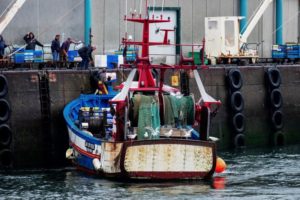
A commercial fishing boat comes into port. Photo by Thomas Millot on Unsplash
Johnson declared, “We have regained the control of our waters. Although it represents a minute part of the GDP of both sides , this issue occupied a major place in the negotiations because it is essentially the symbol of the British sovereignty. Barnier knows a lot of about fishing rights. He was minister of Agriculture and Fishing from 2007 to 2009.
There will be “fishing committees” enforcing control. Johnson demanded that 80 percent of the proceeds from the fishing industry be returned to the UK. He achieved 25 percent, during a transition period of five and a half years. He will grant 100 millions of UK pounds sterling to help the fishermen.
The fish catch by the Europeans last year was worth 650 million Euros last year. The British waters are richer in fish population than the European waters. The Brits don’t eat much fish. They sell back most of their catch to the EU. During his speech Johnson was wearing a tie covered with fish.
The devil is in the details and annoying changes are going to take place. There will be no more mutual recognition of professional qualifications. British doctors, architects, veterinarians, engineers will have to seek new certification.
Freedom of movement will disappear, and a visa will have to be obtained for a stay longer than 90 days. An EU pet passport will cease to be valid.
The Erasmus student exchange program will not include the UK any more. Instead of a fee of 170 Euros paid to European universities, foreign students studying in the UK will be charged tens of thousands pounds. To work in England, a permit will be required. In other words a post-Brexit deal will not be “business as usual.” There will be many changes.
On the last day of 2020, Sky News announced that Johnson’s father, Stanley Johnson, was asking for French nationality. He is French on his wife’s side and very much a Europhile. In a book coming out later in January, author Christian de Bourbon-Parme has written a biography of Boris Johnson.
Surprisingly, we learn that his name was not Boris but Alexander, that he lived in Belgium when his father was working for the European Commission in 1973. In the book, Johnson is depicted as a person full of humanity. He always loved Europe and was very attached to it — but not the EU.
In spite of of the enthusiastic attitude of the British Prime Minister, the mood was rather somber on both sides of the Channel.
Michel Barnier commented ” There was no winner in this deal. We all lost,” while Ursula von der Leyen added a lyrical note, saying, “Parting is such sweet sorrow.”
Editor’s Note: This is the opinion of Nicole Prévost Logan.

Nicole Prévost Logan
About the author: Nicole Prévost Logan divides her time between Essex and Paris, spending summers in the former and winters in the latter. She writes a regular column for us from her Paris home where her topics will include politics, economy, social unrest — mostly in France — but also in other European countries. She also covers a variety of art exhibits and the performing arts in Europe. Logan is the author of ‘Forever on the Road: A Franco-American Family’s Thirty Years in the Foreign Service,’ an autobiography of her life as the wife of an overseas diplomat, who lived in 10 foreign countries on three continents. Her experiences during her foreign service life included being in Lebanon when civil war erupted, excavating a medieval city in Moscow and spending a week under house arrest in Guinea.

 Noting that, “In attendance were people like, Andy Einhorn (an incredible music director on Broadway) Ron Young (an original cast member for Hello Dolly) and many more, Cheney added, “We realized that we had something very special and so we decided to offer it for free on YouTube … it’s a wonderful retrospective of how the Broadway musical has evolved and changed over a century.