Gardening Tips for January by The English Lady: New Year, New Chapter, New Opportunities

Paper-white narcissi have a beautiful fragrance. Photo by Masaaki Komori on Unsplash.

Happy New Year everyone!

Recently on Dec. 21,  we experienced the Winter Solstice and turned the corner so that with each day, we move gradually from the dark into the light to a longer, brighter day.

A few weeks ago, I planted my Paper-white Narcissus on pebbles, with just enough pebbles to anchor the bulbs in place or you may use potting soil. I use tall glass vases and it is most important keep the pebbles moist with enough water to cover the bottom of each bulb.

I brought my Rosemary plant indoors in September, Rosemary are not hardy outdoors in our zone six and. I spray the plant twice weekly with water and run a cold-water humidifier and two germ guardian air cleaners with UV lights for personal health and the health of my plants.  

After planting the Paper White Narcissus, I placed them in a dark cool closet until the foliage is about four inches tall. Today I moved them from the dark closet to a cool room with indirect light and where the temperature remains at about 65 degrees. When the buds are almost ready to open, I will place them in a brighter area to be enjoyed, not only for their bloom but also the heady fragrance. which permeates the house.   

The new bloom gets me out of the winter doldrums, which is particularly heavy this year with the pandemic, and anything I can do to lift my spirits is welcome. I know that the severe changes that are occurring with global warming combined with pollution in the air, water and the earth, are severely damaging our planet and I know this year, our new government will begin in earnest to heal our planet for ourselves and the future for our children.    

Your personal contribution to saving our planet is to organically tend the soil with compost, manure and natural brown mulch, which builds the humus component in your soil. Your plants and vegetables will thrive, as will you.  Throughout the year allow your garden to anchor you, connecting heart, body, mind and spirit to Mother Nature’s lifegiving bountiful gifts and spiritual energy.  

The harsh winds of January and February extract moisture from trees and shrubs, especially the evergreens. Winter winds are more harmful to plants than cold temperatures, not only causing plant breakage but also soil erosion. For that reason, it’s helpful to have a few bags of topsoil and mulch in the garage. With these items on hand, any roots can be covered when they become exposed by wind or frost heave. 

Roots exposed to the elements for any length of time can kill the plant, so when you notice exposed roots quickly cover exposed areas with soil and mulch. When spring arrives, and the earth warms up, the plant can be resettled in place together with composted manure and the natural brown mulch to provide protection and nutrition.

On a sunny day in January, take a walk round the garden to breathe in the fresh air and as you walk, make some notes and decide what worked for you last year and what you will never try again. 

Later when back indoors, sitting in your armchair, browse through the catalogues that began arriving a few months ago. You have already begun making lists of plants that you are thinking of buying. However, a word of caution when gazing at the photos, which are meant to tempt you with their lovely but “doctored up” pictures of plants that you feel certain will make your garden sensational this year.   

Don’t be fooled, instead try to make 2021 the year for realistic and organized change. Please do not allow your imagination to go haywire and be caught up in the fantasy of the brightly colored, high maintenance garden pictures shown in the catalogues.  Suit your garden to your lifestyle that will work within your time frame and physical abilities.  If you follow that construct, you will have the time to sit, relax and smell the roses, without being overwhelmed or disappointed.    

As you sit and plan for the coming season, it’s important to keep your budget in mind. It’s hard to believe as you look outside at the uninspiring landscape that in a few months, early spring sunshine and pleasant breezes will warm the soil. When the soil is dry enough to tread on, winter debris may carefully be cleared away. Then with a clean palette you can add that lovely layer of manure and compost (the ratio being three parts manure to onepart compost).

Following those tasks, I find it personally satisfying to make a clean edge on the borders, this simple task makes such a difference to the look of any garden.  With all that prep done, April showers will arrive, the sun shines and you are ready for the fun stuff, the placing and planting!  

For those of you who are vegetable gardeners and look forward to a bountiful year with fruits and vegetables and with rain, extra irrigation and sunshine to produce this delicious bounty. As we advance into spring, we can expect the invasion of the good and bad insects, moles, voles and other critters, which can be dealt with naturally.

Your memory of your garden from last season may be lost in the enthusiasm of a new season, so I am asking you to be kind to yourself, for last year you became overwhelmed with too much gardening, and not enough time to relax and smell the roses. 

Here are some suggestions you might follow to avoid that problem:

  • Send some of your borders back to grass.
  • Make some of the high maintenance perennial borders, into mixed shrub borders. To accomplish this, take out some of the high maintenance perennials and donate them to a worthy cause.
  • Plant small and medium size evergreen shrubs; some green, some blue and some of the lovely evergreen gold variety, amongst the perennials.  To these, add small flowering deciduous trees and shrubs that will begin flowering in April and successively through June. The Carlesii viburnum, also known as Korean Spice is a favorite small shrub of mine, with its white buds that open to a pale pink and that has the most delightful fragrance.
  • Add a Ben Franklin tree with its white cup like blooms and gold center that flowers in August through September.
  • Nestle three Blue Mist shrubs in the mixed border; this plant will delight with purple blooms and fragrant leaves into September.
  • On a fence or trellis, plant white autumn clematis.
  • Add a groundcover as an evergreen framework – my favorite is Myrtle with its glossy leaves and miniature blue flowers that emerge in April.

Do garden fairies live here? Photo by Cosmic Timetraveler on Unsplash.

It is never too soon to introduce your children and grandchildren to the wonders of the garden and as an extra enticement, introduce them to the garden fairies.  Through the years I asked children to draw a picture of the garden fairy and make a list of questions to ask the fairies who live in the wild patch.  We all have a wild patch in the garden; and at this point you are probably saying, “Maureen, my garden is one large ‘wild patch’.

In the interim, the children became so excited and enthused about their lists and pictures of the fairies, for what you have shown them is the transformation of science into magic. These days we seem to have forgotten about fairy tales, dreams and magic; it’s way past time to bring those wonderful energies back into our lives and into the lives of our children.  

In spring and on into summer I would find my children or their friends impatiently checking the garden wanting to see their planting efforts come into bloom. In the vegetable garden they gathered to check what was ready to eat from the produce they had planted.  I have found that this introduction to the garden has inspired these children to enthusiastically plant and tend gardens of their own as adults. 

My son Ian is a great example of this as he has partnered with me through the years in the garden – and thus the old adage that ‘the student is better than the teacher’ has certainly proved to be correct. Ian is a designer par excellence and I invite you to check his website LandscapesbyIan.com and his Facebook page for lovely examples of his work. 

In my March gardening tips, I’ll offer you some suggestions of ornamental trees, shrubs and long blooming perennials. With that list in hand, it is preferable to obtain your plants from local garden centers that carry tried and true plants that will flourish in zone six.   

On the other hand, if you feel that over the years, you have been throwing good money after bad in your garden and despair when you feel that your garden never looks right, get in touch with a landscape company (like my son’s!) who will keep your budget in mind whether you want to do your own work, or wish for a design to install yourself.  

On the other hand, when you are planning your garden for this coming season there are important facts to keep in mind:  

  • What are the plants requirements for sun, shade, soil, and water?
  • Will they survive in this zone, Zone 6?
  • What are the growth patterns of the plants?  Do they grow fast or slow?

Rhododendron Catawbiense is a stunning addition to any garden.

You do not want a 50 ft. tree up against the house with tremendous roots that will play havoc with your house foundation.  Or do you want that lovely but very large, Catawbiense Rhododendron, all 10 ft. of it, climbing through your dining room window in five years? 

To find those facts, either check the plants in a book, on the Internet or read the labels attached to the plants in the nursery. 

Check every aspect of the plant before you buy.  The red or green Lace leaf Japanese maple looks lovely in spring but is it something you can enjoy, without its leaves in the winter?  Personally, I not only enjoy the foliage of plants and trees but also the shape and bark of trees without foliage in winter.  

For those of you just beginning a garden, let us be honest and dispense with the myth that gardening is a relaxing hobby. At the end of that first day of digging, lugging soil, manure and fertilizer, and planting everything at the proper depth; you will feel that you are going to keel over.  

Then you remember that you still need to water the newly-installed plants as you drag your tired body to switch on the hose. Thank goodness, the mulching can wait until tomorrow or next weekend, right? Right!   

Watering by the way can be meditative. Imagine that the hose is your umbilical cord so that as you nourish the earth and the plants, the earth can nourish you. 

By now the sun has gone down, and you trudge indoors muttering to yourself, “What the heck did I get myself into?”  To this comment I say, “You did not have to tackle all of the garden in one day”.  

In gardening, there is always tomorrow, or next week, and even though the label says to plant it by the end of May or June, believe me folks, a few weeks later does not matter, the garden will wait for you.  

You may be saying to yourself at this point, “Maureen are you trying to put us off gardening”? No folks, but I would remiss, as someone who has gardening in my blood (as well as manure) for over 400 years to tell you, however reluctantly, not only the pleasures, but some of the aches and pains.

The idea is not to bite off more than you can chew.  For first time gardeners, don’t scatter your energies all over the garden, tackle and complete one area at a time. That area should be priority one until it is complete.  

If you have a new home with no landscaping, some hardscape may be required.  Hardscape is walls, walkways, patios, ponds, decks and so on. The sound and look of a water feature in the garden is delightful, it need not be elaborate, a fountain is fine – the reflection of water is Mother Nature’s mirror.

If you are not able to do this construction yourself, get in touch with a landscape contractor now, so that a plan can be done now, installed and ready by spring.  I say to connect now as Ian tells me that many landscape products are short on supply this year.   

All of these endeavors mean you getting yourself in shape physically, so get off that couch, put away the catalogues and your plant lists, stretch, then wrap yourself up in warm gear and take that walk.   

As you walk, look at the trees in winter, the elegant shape of them, the lichen on the stonewalls, and the moss tucked in cracks and crevices.  Clear your mind and allow nature’s spirit to surround you.  As you walk, look at a garden or two in your neighborhood; gardens which you have admired when they were in bloom and see what they look like in winter.  

I remember one of my professors when I studied at the Royal Botanic Gardens at Kew saying, “In winter you can tell a really good landscape by its bones, without the flesh of flora and foliage.” In spring, get in touch with those neighbors whose gardens you admired and ask them some of the secrets of their garden. They will be happy to talk with you not only of their successes but their failures – true gardeners are realists when they speak about their gardens and love to share.  

Well everyone, I’ve given you plenty to think about right now so enjoy your daydreaming of the season to come and I’ll see you next month in your garden.

About the author: Maureen Haseley-Jones, pictured left, is a member of a family of renowned horticultural artisans, whose landscaping heritage dates back to the 17th century. She is one of the founders, together with her son Ian, of, ‘The English Lady Landscape and Home Company.’ Maureen and Ian are landscape designers and garden experts, who believe that everyone deserves to live in an eco-conscious environment and enjoy the pleasure that it brings. Maureen learned her design skills from both her mother and grandmother, and honed her horticultural and construction skills while working in the family nursery and landscape business in the U.K. Her formal horticultural training was undertaken at the Royal Botanic Gardens at Kew in Surrey.
Contact Maureen at maureenhaseleyjones@gmail.com

Legal News You Can Use: Understanding CT’s New Paid Family & Medical Leave Act

Happy New Year!  Welcome 2021! 

As Connecticut employers bid farewell to the year of “unprecedented times,” not so fast, I say.  This New Year ushers in a significant change in employment law for Connecticut employers of all sizes.  Connecticut has joined a handful of other states in creating a Paid Family and Medical Leave Act (PFMLA) that drastically changes the landscape of family and medical leave in this state.

Prior to the enactment of the PFMLA, Connecticut state law (CT FMLA) required only employers with 75 or more employees to provide 16 weeks of family and medical leave, and the leave could be unpaid.  Similarly, under the Federal FMLA, employers with 50 or more employees were required to provide 12 weeks of leave, paid or unpaid.

For Connecticut employers, however, the PFMLA changes family and medical leave by:

  • eliminating the threshold of a minimum number of employees (75 down to 1);
  • mandating 12 weeks of leave (instead of 16);
  • expanding the range of circumstances for which an employee may take a leave; and
  • providing wage replacement for all employees who take leave.

The PFMLA essentially provides most Connecticut workers with access to paid leave life events previously covered under the current federal and state FMLAs, as well as the Connecticut Family Violence Leave Act (CT FVLA), such as to:

  • To address the worker’s own serious health concern;
  • To care for a child after birth, adoption or foster placement;
  • To provide care to a seriously ill or injured family member;
  • To address qualifying exigencies arising from the foreign deployment of related service-member;
  • To serve as an organ or bone marrow donor; or
  • To address certain matters relating to family violence.

Under the new PFMLA, not only larger employers, but now even small Connecticut employers (with at least one employee), are required to comply with the mandates of the PFMLA.  Of note, the PFMLA generally excludes federal employees, Connecticut and municipal employees who are members of unions, employees of local and regional boards of education, and non-public elementary and secondary school employees.

Aside from employees of excluded employers, all other employees in the State of Connecticut will entitled to paid leave under the PFMLA starting on Jan. 1, 2022. In fact, even those who are self-employed or sole proprietors are eligible to opt-in to the program in certain circumstances where they contribute a portion of their income to the state fund.

How Does the Paid Family Leave Program Work?

The PFMLA authorized and established a quasi-state agency, the Connecticut Paid Leave Authority (“CPLA”), to administer the PFMLA program and trust fund.  The PFMLA program will be funded by employees and voluntary self-enrolled participants through the collection of wage deductions, capped at 0.5% of wages, beginning on Jan. 1, 2021. Payment of benefits to eligible employees will begin on Jan. 1, 2022.

The CPLA is the state-agency that will accepts applications for paid leave benefits, reviews those applications and if approved, administer benefits to eligible employees, those who are self-employed and sole proprietors. The CPLA is also responsible for collecting employee contributions and working with the Office of the Treasurer to properly invest and manage the contributions so that funds are available to pay benefits.

Employers must comply with the PFMLA by either using the state-run program administered by the CPLA or, the PFLMA provides employers with the option to apply to the CPLA for an exemption because the employer opts to provide the PFMLA benefit to their employees through an approved private program that provides all of the same rights, protections and benefits as the PFMLA (e.g. private insurance carriers such as long-term/short-term disability insurance carriers are providing private programs).

Note that an employer’s private plan must also comply with specific application requirements, including the requirement that a majority of the employer’s employees working in Connecticut vote in favor of the private plan. In the event that an employer receives an exemption and provides a private plan, the withholdings from employee paychecks are held by the employer, instead of the CPLA.

The first step for employers is to register their business with the CPLA (registration opened on November 1, 2020) and, if necessary, to apply for an exemption if providing the benefit through a private program.  Please note that third parties, such as payroll providers, may handle the application procedures with the CPLA and there are separate processes for these third parties when registering with the CPLA.

 Why is Jan. 1, 2021 Important to the PFMLA for Connecticut Employers?

When the law was enacted in June, 2019, the Connecticut legislature selected Jan. 1, 2021 as the commencement of the first “phase” of the program. Commencing with the first pay-period following Jan. 1, 2021, the mandatory payroll deductions from employee wages to fund the state program commence and employers not otherwise exempt must begin withholding the required amounts from employee wages and submitting the same to the CPLA.

During this first phase, the program is being seeded through these payroll deductions for one year; however, employees may not apply for benefits under the program until January 1, 2022.

 How Much Will Employees be Paid During PFMLA leave?

Under the PFMLA, an employee will receive a weekly benefit for the full 12 weeks of leave. An additional two weeks may be available for pregnancy-related issues.

If an employee’s weekly wages are less than or equal to the then-current Connecticut minimum wage multiplied by 40, the weekly benefit rate under the PFMLA will be 95 percent of the employee’s average weekly wage.  If an employee’s weekly wages exceed the Connecticut minimum wage multiplied by 40, the weekly benefit rate will be 95 percent of the Connecticut minimum wage multiplied by 40, plus 60 percent of the amount by which the employee’s average weekly wage exceeds the Connecticut minimum wage multiplied by 40. The benefit rate is capped at 60 times the Connecticut minimum wage.

Employers may supplement the paid leave benefits provided by the PFMLA, as long as the total amount received by an employee does not exceed 100 percent of their usual weekly wages.

What Should Employers Be Communicating to Employees Now?

At this time, employers should communicate with employees regarding the payroll deductions that begin Jan. 1, 2021, and regarding the benefits that will be available to them via the PFMLA as of January 1, 2022.  The CPLA provides a poster that may be displayed in your workplace and/or distributed to employees.

Employers and employees alike may refer to the CT Paid Leave Employee Factsheet or may contact Attorney Kristi Kelly at Suisman Shapiro Attorneys-at-Law at kkelly@sswbgg.com or 800-499-0145 to obtain legal advice on this and other employment-related topics.

Old Lyme Says Poignant Farewell to the ‘Ever Thoughtful’ Mervin F. Roberts (Neel Roberts)

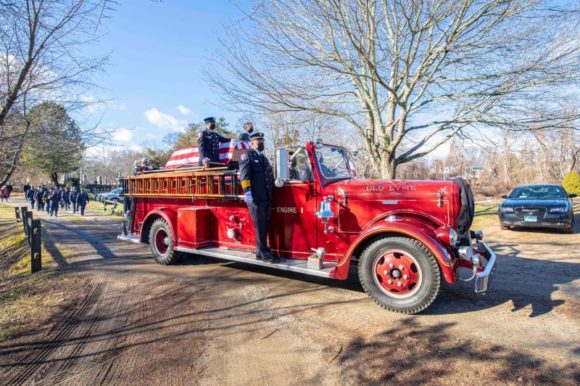
The firetruck bearing the coffin of Mervin F. Roberts begins its journey to the Duck River Cemetery. Photo by Gregg Jacobson.

OLD LYME — Mervin F. Roberts, 98, of Old Lyme, who passed away in the early hours of Wednesday, Dec. 30, 2020 was laid to rest in a poignant graveside ceremony held Saturday, Jan. 2, 2021 at Duck River Cemetery in Old Lyme.

The Old Lyme Fire Department (OLFD), of which Mr. Roberts had been Chaplain for 50 years, played an integral role in the ceremony, transporting Mr. Roberts’s coffin down Lyme Street with an honor guard in front and a procession of firetrucks behind.

The procession of firetrucks passes the First Congregational Church of Old Lyme. Photo by Gregg Jacobson.

This was the eulogy read by Mervin Roberts’s daughter, Martha Delana McNair, at the graveside service for Mr. Roberts. It was written Thursday, Dec. 31, 2020 in Chiang Rai, Thailand, by Mr. Roberts’s son Neel Roberts, who has been with the Overseas Missionary Fellowship (OMF) since 1987. Neel Roberts was unable to attend the ceremony in person due to COVID-19 restrictions.

Donations in Mr. Roberts’s honor can be made to OMF at this link. Neel’s wife, Chalor, works with the tribal Shan community in Mae Sai, Northern Thailand, where they cross over from Myanmar, often destitute after losing their farm and water buffalo to the Burmese military. Chalor uses donations to provide scholarships the children need to enroll in public school. She helps them register for school and buy books and uniforms, while taking nothing for herself since she is supported along with Neel by the OMF.

The firetruck bearing the coffin travels down Lyme Street. Photo by Gerry Graves.

I will not try to summarize an active life of 98 years in 10 minutes. Mervin Francis Roberts, whom I will call Dad for convenience sake, wrote several memoirs for family and friends. If you have come to the funeral, you probably already have a copy or can borrow a copy from someone who has one or two.

The earliest known quote attributable to my dad was, “I’m not Mervin, I’m obnoxious.” When he got older he claimed, “I am all charm.” Strictly speaking both statements demanded some poetic license.

He, like most people was multifaceted. He memorized the periodic table when it only had about 100 elements. In his 90s he could look at a stone or piece of porcelain or a fuel additive or solvent for glue and describe its qualities based on the molecular structure of its parts. This was a man who could count fish and differentiate what species they were as they poured out of the water-cooling discharge pipes at the Connecticut Yankee power plant. As an engineer / naturalist / scientist he was a stickler for details. When it came to personal history, he was a bit of an un-licensed poet.

He was an only child, but he grew up surrounded by cousins whose families were a major part of his life until the very end. He lived on the outskirts of New York City and later spent a fair bit of time under the city when he was chief ceramic inspector for the Port of New York Authority while the Holland Tunnel was being dug.

Alfred University was the university of choice for him. His father’s choice. Evidently, his father made the right choice for him. He learned much about ceramics and the care of horses, and while there he found his future wife, Edith May Foster. It seems that she was not as certain as he was about whether he was Mr. Right but he staked his claim by buying an army surplus jeep for $50 and parking it in front of her parents’ house and thus persuaded the other suitor that she was already claimed.

Together they established a home where love and respect reigned for 60 happy years of marriage. In her old age he would often buy her chocolates. My dad did not spare the rod, but I only saw him fly off the handle once. I once made the mistake of using the words mom and dumb in the same sentence. Very big mistake. Lesson learned.

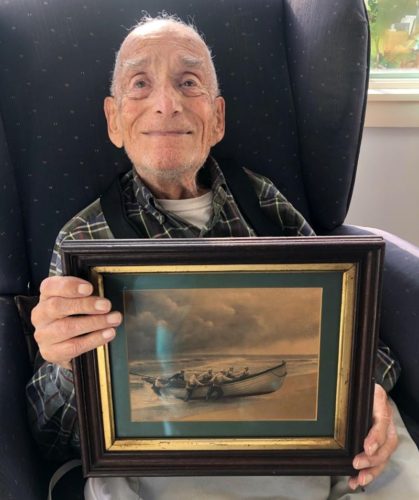
A smiling Mervin F. Roberts of Old Lyme is pictured here Oct. 31, 2020 at his home in Old Lyme.

Dad was the most unsentimental person I have ever known. Therefore, I hesitate to use the word love in sentences like, “He loved the ocean.” He very much enjoyed the ocean and was especially attracted to those places where the ocean met the land. He was very interested in all the life forms that were to be found along the shore and especially in the marshes. So it was natural that when career choices allowed him to choose a place to call home, Old Lyme became the place. He spent nearly 60 years here. Old Lyme was the perfect setting for him.

It was not only that it was surrounded by water. It was also full of people who had time for people. I almost started to write about his friends and neighbors but realized that would be redundant. He made neighbors into friends. On some occasions he helped them to deal with snapping turtles that were laying eggs in their back yards. On other occasions he blessed them with his home-made snapping turtle stew. The friendships were mutual. When the family that had received the stew moved away 2 years later, they returned the stew to him in its original container.

He placed a high value on volunteerism. At the start of World War II, he volunteered for the Navy and as a reward picked up some friends for life. Years later he became a volunteer fireman and again gained lifelong friends.

For over 50 years he was the chaplain in the Old Lyme Fire Department. For the first 20 or more of those years, he was often one of the first responders, driving one of the trucks and blowing the horn if he passed our house for the benefit of his son, our brother, Billy. If you want to know how to volunteer, you should go up and ask a fireman today. Dad would certainly appreciate that.

Dad was not a politician, nor did he have much interest in politics. He had a great interest in the well-being of the town and therefore gave much time to both appointed and elected roles.

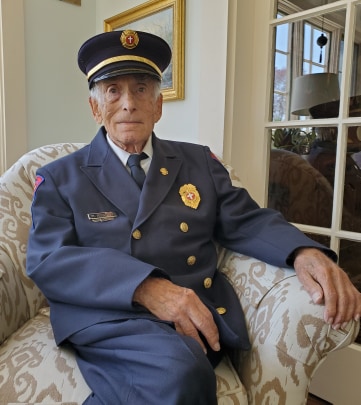
Old Lyme Fire Department (OLFD) Chaplain Mervin Roberts pictured in his OLFD uniform at home in May 2020.

One of his big causes was sewer avoidance.

When he was 91, he was sounding a bit discouraged in his crusade to have each householder take responsibility for his own ground water. I told him that at his age he could pass the baton on to someone else. Seven years later, a few months before his death he was still fighting the good fight for sewer avoidance and Connecticut River oysters that would be safe to eat. So he didn’t take my advice but I am proud of him for the fact.

I should note here that he stuck with the various boards and committees in large part because he had friends who were equally concerned in the community. It was part of his core philosophy which I think he picked up from reading about Ancient Athens: that the well-being of a community is the responsibility of its citizens.

It is to be hoped that at this memorial service this sense of responsibility will not become a mere passing note but might be imparted in fuller measure to all who wish to honor his memory.

He wrote many books about pets and never grew attached to any particular snake, turtle, ferret, lovebird, gerbil or guppy. His key to success in writing and making the photographs for these books was that he showed respect for the experts. Those who knew more than he did would be given due credit in his books and therefore they not only freely shared their own hard-earned knowledge, but also made lasting relation with him as well.

As an author, whether of “The Tidemarsh Guide to Fishes” or of a letter to the editor of a local newspaper regarding some inane behavior of a bureaucrat in a corner office, he never shot from the hip. He thought, wrote a draft, corrected the draft and then always handed it to someone else to check the grammar, content and tone of voice. The final products showed his confidence in his statements precisely because he valued the input of others. On the other hand in a normal conversation where differences of opinion appeared, he might close with “bunkum”, or “you’re all wet” but he never said that until he had given the other party time to express their opinions.

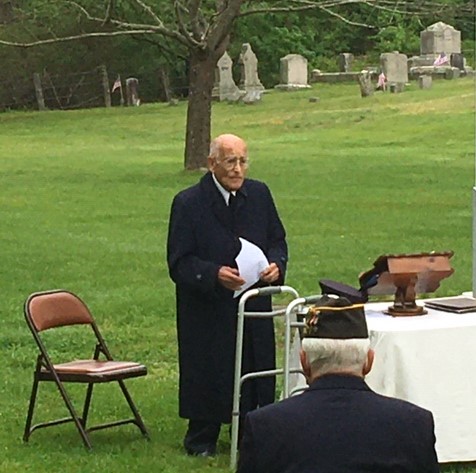
Old Lyme Fire Department Chaplain Mervin Roberts reads what turned out to be his final Homily at the 2020 Memorial Day Service held in Duck River Cemetery.

While Dad was not sentimental, he did love people very intentionally. I never saw him shed a tear. He may have, but I never saw one. Love was a conscious decision and required much thought. And he was ever thoughtful.

In his later years he was involved in charitable activities in India and South America. Here he combined his scientific knowledge with his people skills. His background was aquaculture – the art of raising fish for food. But in some cases, he realized that the expressed need was not the real need. He would take time, days in reading the technical literature, days in contacting experts in other places, days in travel. He knew that a problem like hunger or poverty could not be solved by simply throwing money at it.

One of the last projects he was involved with began as a fish project but in the end, it was changed into a goat project because he as the fish expert, after careful study, came to realize that goats and not fish would help the people of that particular community in Southern India. Even here he did not simply recommend goats. He invested much time in learning how families in that community functioned, what laws existed about grazing animals, and how to address communal issues that delayed the original success of the project.

It was not enough that something had been done for the poor. He stuck with the people who were promoting the project until it became clear that the real people in need were the ones benefiting from it.

Dad had a sense of humor. Growing up in New England I never experienced an earthquake until one day in my teens the windows began to rattle. I rushed downstairs only to discover that my dad was watching a Peter Sellers Pink Panther movie on TV and was laughing so hard that the house shook. He didn’t tell jokes about in-laws but it was not infrequent that he would hear a good joke at the barber shop and come home to make a long-distance call to one of his brothers-in-law so that they could hear it too.

Dad was definitely an evolutionist. His ways of expressing his theology or views about God evolved too. We strongly suspect they have evolved considerably more over the past few days than in all his previous 98 years.

There were however a few core principles in his theology that went back to his college days when he joined the church in Alfred. One was that through prayer the peace of God would guard your hearts and minds in Christ Jesus. I was on several occasions amazed when tragedies struck that he appeared unshaken. He was not unfeeling. He did feel pain but it did not cause him to forget that others needed his strength and clear headedness in the crisis. His heart was guarded. His actions proved that his mind was on how he might help others, be they family, neighbors or even strangers in their times of need.

The second principle which was merely another aspect of the first was expressed at our dinner table several thousand times in prayer. He would often end a mealtime prayer with this phrase, ‘help us to be mindful of the needs of others, around this table, around Old Lyme and around the world.’

It was a prayer that he saw answered in his own life on countless occasions and I believe we are all the beneficiaries of that prayer.

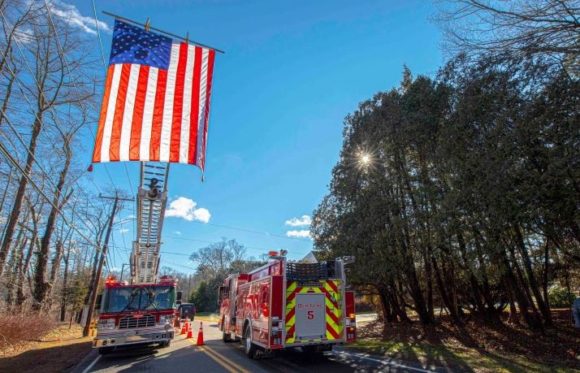
The Old Lyme Fire Department formed an honor guard at the head of the funeral cortege. Photo by A firetruck proudly flying the Stars and Stripes in Mr. Roberts’s honor stands at the entrance to Duck River Cemetery. Photo by Gregg Jacobson.

This is Mr. Roberts’s official obituary:

With his wife, the former Edith May Foster, Mervin Francis Roberts first came to Old Lyme in 1960. He and Edith May became active in church, government, fire department and town life.

Merv was born in New York City in 1922. He was a Naval Officer during WWII. He served in the Navy for four years, and then in the Reserve. He was awarded 4 campaign medals, two with Combat Stars. After his service, he returned to complete a degree in Ceramic Engineering at Alfred University.  He served as a Merchant Marine Officer, Scout Master and Commissioner, Town Shellfish Commissioner, Water Pollution Control Commissioner, Sunday School teacher, Counselor to the Governor of Connecticut for Marine Resources, Selectman of the Town of Old Lyme, Chaplain of the Fire Department and Justice of the Peace. He also was a Consultant of Aquaculture, worldwide, and a Counselor to two bishops in South India, concerning animal husbandry for women to alleviate poverty. For years he was the Tender of the Gate at the Old Lyme Cemetery. He was awarded Town of Old Lyme Citizen of the Year, and American Man of Science, American Legion’s Legionnaire of the Year, 2015-6. He was a teacher and lecturer, gunsmith, inventor, pioneer photographer of high-speed animal movement, waterman, duck hunter, and last but not least, he got his haircut at Seckla’s Old Lyme Barbershop.

Merv wrote 50 books and pamphlets on pets, natural history, and animal husbandry. 

He and Edith raised 6 children: Edith Ann Main, Robin Frances Roberts, Martha Delana McNair, Nancy Jean Briggs, Neel Foster Roberts, and William John Roberts. He is survived by a multitude of beloved nieces and nephews, grandchildren and great-grandchildren. 

In his words, “Don’t mourn my death but rather celebrate my life for surely I’m glad to have been around.” 1997.

The firetruck bearing the coffin enters Duck River Cemetery. Photo by Gregg Jacobson.

Old Lyme First Selectman Timothy Griswold gave the following tribute to Mr. Roberts exclusively to LymeLine.com:

With the passing of Merv Roberts, Old Lyme has lost one of its most remarkable citizens. He was a Town Citizen of the Year, a Town Selectman, Chaplain of the Old Lyme Fire Department and active in so many other ways.

As his body became more frail, I think his mind became sharper. Just last September, Merv, as a Shellfish Commissioner, wrote a letter to the National Railroad Corp. asking whether any toxic ingredients would be used in the concrete, paint or steel used to build the new railroad bridge over the Connecticut River.  Not bad for a 98-year-old.”

We shall miss his interesting speeches at the Memorial Day Parade observances. I feel privileged to have known Merv and thank him for all he did for Old Lyme.

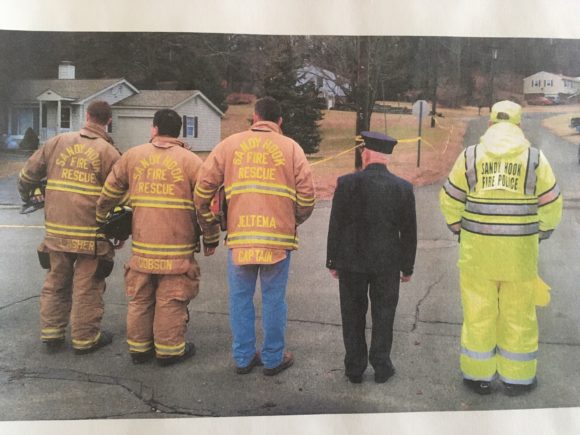
Mervin Roberts (first from right) attended the funerals of the children murdered Dec. 14, 2012, at Sandy Hook School in Newtown, Conn.

Michele Dickey of Old Lyme, who was in the same grade as Mr. Roberts’s daughter Martha through their time together at Old Lyme Schools until they graduated together in the Lyme-Old Lyme High School Class of 1970, sent us these personal recollections of the graveside ceremony for Mr. Roberts:

I attended with my husband, Mike; we were joined first by our daughter, then my cousin-in-law, Dorie Smith, who is a friend of Edie’s, and her daughter, Meghan. We were joined for a while by friend Diane Losea Roeder, another classmate of Martha’s and mine, who came down from Northampton, Mass.

Mike noticed the wide range of people in attendance: lots of young people and lots of oldsters as well, many using  canes and walkers or requiring some assistance, even elderly fire fighters on the arms of friends. 

A firetruck proudly flying the Stars and Stripes in Mr. Roberts’s honor stands at the entrance to Duck River Cemetery. Photo by Gregg Jacobson.

 It was significant that a ladder truck with a huge American flag suspended from its raised ladder was outside the gate of Duck River Cemetery, where Merv acted as “gatekeeper” for many years and has since passed the torch to son-in-law, Ken Main. (Should you ever get locked in after dark, as we did just last week, don’t worry—the gate is held closed by a bungee cord, not a chain and padlock.)

Shortly after we gathered at the grave site, a color guard entered, followed by family members in front of the fire truck bearing Merv’s coffin. The rest of the Old Lyme Fire Department (OLFD) marched behind.

After the coffin had been taken off the truck and situated, contrary to the details in the program, military honors took place immediately by a Navy color guard: rifle shots, taps, the removal and folding of the flag draping the coffin and presenting it to the family.

Following this was a sweet young girl’s rendition of “The Sailor’s Hymn”; the program attributed this simply to Elle, of Duck River Lane.

Martha McNair read a long eulogy for her father written by brother Neel Roberts, a missionary in Thailand whom the pandemic prevented from attending. This eulogy was so complete! Informative, poignant, funny at times. Unless you were an immediate family member, you probably learned something about Merv when you heard this.

And when the fire whistle rang in the middle, Martha stopped reading to ask, with a little laugh,  “Does anyone have to leave?” No one did, which was surprising because the town’s whole force seemed to be there paying their respects.

We heard later that a truck each from Lyme and East Lyme took part as well.

Robin Ritze, Merv’s granddaughter and daughter of Edie Main, sang “Amazing Grace” and was joined by many present, whether we were supposed to sing along or not.

Skip Beebe of the OLFD next offered, “Reflections on a Life Well Lived.”

All present were asked to join next in the reciting of Psalm 23.

This moving, hour-long service concluded , as would the service of any firefighter, with the ringing of the bells. Skip explained that firefighters are called to a fire by the ringing of a bell, and when all is over, the bell is rung again to signify that the emergency is over.

Therefore, at the conclusion of Merv Roberts’ funeral, the OLFD bell was rung three times to indicate that a job well done [Mr. Roberts’s life] is now completed.

At the cemetery. Photo by Gerry Graves.

Olwen Logan, publisher of LymeLine.com, commented:

I feel so privileged to have known Mr. Roberts. Both “a scholar and a gentleman,” he was an extraordinary man and such a mine of information. He wrote several op-ed’s for LymeLine and was never hesitant to give his opinions on a wide range of topics. Mr. Roberts led a truly amazing life and wrote many books. He gave me an autographed copy of ‘The Tidemarsh Guide to Fishes’ and it is one of my most treasured possessions to this day.

Michele Dickey wrote a wonderful article about Mr. Roberts in May of last year in which he reflected on his 50 years service as Chaplain of the Old Lyme Fire Department. We also published an article including a video of Mr. Roberts reading his final Memorial Day Homily aloud.

Finally, through a recent fortuitous series of events, LymeLine.com helped connect a boat named the ‘Mervin F. Roberts’ with the Wood Island Life Saving Station Association (WILSSA) in Kittery Point, Maine. The President of the WILSSA, Sam Reid, came to Old Lyme to meet in person with Mr. Roberts. The boat has now been transported to Maine to be restored in the WILSSA Maritime Museum and we know Mr. Roberts was very happy with that outcome.

A fundraising campaign is underway locally to assist with the expense of moving the boat. Read our article covering the whole story of the boat, why it is so named, and why it is such an important find for the WILSSA at this link.

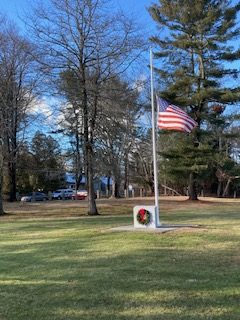
The flag flies at half-mast in Duck River Cemetery in honor of Mervin F. Roberts, a scholar and a gentleman. RIP, Mr. Roberts.


Kristi Kelly of Old Lyme Named a Director of Suisman Shapiro Attorneys

Attorney Kristi D. Kelly of Old Lyme.

OLD LYME — Suisman Shapiro Attorneys-at-Law has announced that Attorney Kristi D. Kelly of Old Lyme has been named a Director of the Firm, effective Jan. 1, 2021. Roger T. Scully, III, of East Lyme was also named a Director in the same announcement.

“We congratulate our new Directors on this well-deserved professional achievement,” said Robert G. Tukey, Managing Director of Suisman Shapiro. “Hard work and dedication deserve recognition; both Kristi and Roger have demonstrated commitment and leadership within the firm and throughout the eastern Connecticut community.”

Atty. Kelly focuses her practice on labor, employment, and municipal law, as well as assisting veterans in their claims for VA disability benefits.

She regularly advises and represents numerous public and private clients in all areas of state and federal labor and employment law, including, for example, collective bargaining, internal investigations, discipline, grievances, and arbitration. Other areas include prohibited practice charges, family and medical leave compliance, discrimination and harassment claims, compliance and violations of state and federal wage and hour laws, and wrongful termination matters.

Atty. Kelly is the 2020 Recipient of The Honorable Anthony V. DeMayo Pro Bono Service Award presented by the Connecticut Bar Association in recognition of those who tirelessly fight for fundamental fairness, championing the legal rights of the poor and accused, and who consistently go beyond the “call of duty” and inspire others to do the same.

She serves as President of Higher Edge, Inc., a non-profit organization providing college access services to low-income and/or first-generation college students.

Atty. Scully’s practice focuses on civil litigation with a concentration in personal injury law. He also represents individuals and businesses in a variety of complex legal matters. Since 2018, Attorney Scully has been named to the Connecticut and New England Super Lawyers lists as a Rising Star.

He has also been recognized by U.S. News & World Report‘s Best Lawyers in America – Ones to Watch for 2021. Attorney Scully serves on the Connecticut Bar Association’s 2020-2021 Board of Governors representing District No. 16. He is also a board member for the New London County Bar Association.

Suisman Shapiro is the largest law firm in eastern Connecticut, providing residents and businesses along the coast from New Haven to Providence with a full range of legal services. The firm was established more than 75 years ago and is firmly rooted in the community.

Editor’s Note:

Senior Moments: A New Year’s Message from our California Correspondent

John Guy LaPlante

Happy New Year, my Friends!

Yes, I’m late, I know. Good intentions sometimes go wrong.  But still I want to wish each and every one of you a happy and prosperous and satisfying New Year!

For more than 99 percent of you this is already 2021, though a tiny number of you are living in far-off lands on a different time clock.

As always, I’ve made my New Year’s resolutions and that’s always a great start.

Sadly 2020 has been an awful year, as we all know. The Covid-19 pandemic has been killing so many and making so many others so terribly ill.

And what a severe impact it has had on business, putting so many people out of work, making it difficult to buy food, pay the electric and water bill or put gas in the car, or make routine payments for the rent or the mortgage or insurance policies of various kinds and so, so many other things. 

And think of all the people who usually travel near and far to spend time with their loved ones. Very difficult this year. For some, impossible.

But my younger son, Mark, a professor of finance at the University of Wisconsin in Madison, made it here to Morro Bay [on the Californian coast] to spend a week with me. He managed that by flying first class, which he normally does not do. He thought there would be more empty seats up there. And he was right.

And think of the difficulty of students from grade school all the way up through graduate school continuing their education because of social distancing imperatives and so forth.

Plus so many other difficulties that do not come readily to mind.

So right now wishing somebody a Happy New Year is really a tough order.

But things are brightening up.

We will very soon have a new president and vice-president …

And out of the blue, so to say, we have had the incredibly good news that we have at least three new vaccines that have proven to be effective! And have been approved! And will begin helping people not many months from now but probably as soon as late spring or so!

Notice those three exclamation marks? They deserve to be there!

This afternoon I stopped by my neighborhood Rite Aid pharmacy and asked the head pharmacist, “When do you think we’ll be getting the vaccine?”

“We’ve been told by late March!”

I considered that very good news.

And soon our Treasury in Washington will be doling out more money to help people get by.   

All which will make the near future easier for life to get back to normal for just about all of us. All things really worth celebrating. I doubt anybody would deny that 

Speaking for myself, I have been most fortunate. Less than a year ago I was living in an assisted living community. A very nice one. But I definitely wanted out because I no longer needed that. 

I wanted  to live a normal life again on my own. And I was judged able to do that. Which  I yearned to do. What a happy day!

And as we know, the news has been full about how Covid-19 has severely affected the life of people in such facilities. So many residents have died as a result. 

And people still living there are going through hell because of new rules imposed to keep them safe. 

Now think about this. Just before moving into that nice place, I was hospitalized with a case of double pneumonia.

And that awful diagnosis plus my very old age made it a nearly sure thing that I would become infected.

But I have been tested and found to be negative. How about that?

Which is very ironic. Because my older son, Athur, age 63, a lawyer, came down with the virus and was hospitalized. As was his wife Marita, a super-duper intensive-care R.N., though more lightly.  

But it will be weeks before they will be able to get back to work.

So again the nasty question comes up.  Why did these two hard workers, whose calling is to help people, become infected, but I, so much older and 99 percent retired, was spared?  Well, anyway so far.

The further good news is that nobody else in my family, who span three generations, has been affected medically or economically. That’s really worth celebrating

In just a few months I will be starting my 93rd year on this earth. And I am still living by myself on my own. But with my loving daughter Monique and son-in-law David living nearby. How fortunate I am!

So let us hope that at the end of this brand-new year of 2021, life will be back to normal for New Year 2022! 

Oh, I want you to know that wherever you are, I’m thinking of you, cheering for you, and hoping that for New Year 2022 all kinds of good things will be coming your way.  And even sooner, I hope.

Editor’s Note: John Guy LaPlante is a veteran writer and journalist, who prior to his move to Morro Bay, Calif., lived in Deep River, Conn. His award-winning columns and articles were previously published in the ‘Main Street News’. He is the author of two books, “Around the World at 75. Alone! Dammit!” and “Asia in 80 Days. Oops, 83! Dammit!” He completed his service as a Peace Corps Volunteer in Ukraine in early 2010 after a 27-month tour of duty. He was the oldest Peace Corps Volunteer ever to serve. John always welcomes comments on his articles. Email him at johnguylaplante@yahoo.com