A View from My Porch — The Shady History of Connecticut Tobacco, Part 1: The Age of Discovery to the Jamestown, Virginia Colony

The Shady History of Connecticut Tobacco. Photo by Shaun Meintjes on Unsplash.

It’s been a while since my last View, which was A Primer on The American Rescue Plan. Since then, I have spent some time thinking about tobacco; and frankly, that’s a subject on which I have rarely, if ever, reflected.  Then again, it’s not COVID, or its aftermath; and has nothing to do with the events of Jan. 6, 2021, or their aftermath.

George Burns in 1961. American comedian, actor, singer, and writer.  NBC/photographer-Elmer W. Holloway. 

To explain, Christina and I saw an excellent production of Say Goodnight, Gracie late last year at the venerable Ivoryton Playhouse with a CDC-compliant and COVID-cautious audience. 

Goodnight is a one-man play based on comedian George Burns’ reminiscences of his life with Gracie Allen. George was usually seen with a cigar in hand, and it became one his trademarks; and a prop in the Ivoryton production. If your knowledge of vintage television extends no further back than Seinfeld, the Burns and Allen Show was broadcast from 1950 to 1958; and Burns used “Say goodnight, Gracie” as the sign-off at the end of each episode.

Moreover, the New York Times carried a story by Corey Kilgannon in mid-November regarding a group of Morehouse College students, who traveled from Atlanta in the early-1940s to earn money for tuition by working on tobacco farms in Connecticut’s Farmington River Valley. Martin Luther King, Jr. was one of those students; and, in January, the United States commemorated what would have been the civil rights leader’s 92nd birthday.

If you’ve read any of my past columns, you know that I enjoy reading history; and especially enjoy ferreting out what’s unique. All that said, I have never used any tobacco product. 

My treatise on CT tobacco, which is presented in two parts, is not a review of the well-documented health risks associated with first- or second-hand tobacco smoke; but, ultimately, an historic review of how tobacco became a cash crop in Connecticut.

In doing my research, I was amazed at how often tobacco intersected the course of history. 

I became acquainted with tobacco farming in the late-1970s while serving my active duty at a Naval Hospital in Southern Maryland. At the time, there were several large farms growing “sot weed”, as it’s also been called, in both Calvert and St Mary’s counties; much of it in the latter by Amish and Mennonite farmers, who grew it both as a market commodity and for personal use.  

To provide some context for Part 2, which explores tobacco farming in CT, I am going to examine–albeit at a high level–the development of the international tobacco trade, beginning with the early voyages of the European explorers.

Discovery of Tobacco in the New World

Spanish and Portuguese explorers were introduced to Nicotiana tabacum in the late 15th and early 16th centuries by the indigenous peoples of the Americas and the Caribbean, who had already cultivated, consumed, and traded it for hundreds of years. The explorers returned to Europe with bales of tobacco and, more significantly, began large scale tobacco cultivation and export from their colonies in the New World.

Note that tobacco was unknown to Europe before those voyages. 

The English were probably first introduced to tobacco by Sir Walter Raleigh in 1586, on his return with the settlers rescued from the ill-fated Roanoke Island colony. However, it is likely that the use of tobacco had been passed onto British sailors by Spanish and Portuguese sailors well before the Roanoke rescue.
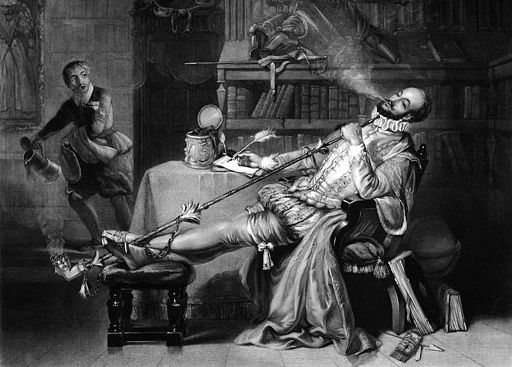
“Raleigh’s First Pipe in England” – an illustration included in Frederick William Fairholt’s Tobacco, its history and associations. 1859. 

Sir Walter became an avid and influential advocate of tobacco, and many other English nobles then also indulged. He is said to have presented tobacco to Queen Elizabeth I; and, of course, smoking then became the rage in the Royal Court.

Recreational use of the addictive stimulant soon covered England and much of Europe in smoke; and, unfortunately, many believed that it had health benefits and that smoking cured all manner of illnesses, including gout, hysteria, and cancer; and when applied externally, could be used for bites from poisonous reptiles and insects, ringworm, and to increase the growth of hair. 

Pipe-smoking then grew rapidly across all levels of English society and the English demand for tobacco became the greatest in the Old World. One historian described it as a “insatiable.” Note that the use of cigarettes as the primary vehicle for consuming tobacco did not become commonplace until well after the Industrial Revolution. 

However, the English had a serious problem — availability of tobacco. By the late 1500s, not a single English tobacco plantation existed in the New World, which meant that obtaining it relied on trade, smuggling, or capturing vessels bound for Portugal or Spain. This supply problem is cited by many historians as one of the precipitating factors in the decision to establish a permanent colony in the Americas. 

King James I, in his 1604 “Counterblaste to Tobacco,” voiced his opposition to the “noxious weed” and his concern that tobacco smoking had serious social and health implications. He then raised the taxes on tobacco in an effort to reduce use.

The Tobacco Mystique

Despite the King’s “Counterblaste,” tobacco developed an “aura” amongst the “smoking public.” For example, the opening speech of Moliere’s Don Juan begins, “There is nothing like tobacco. It’s the passion of the virtuous man; and whoever lives without tobacco isn’t worthy of living.”

A century later, Sir Arthur Conan Doyle continued in that vein in The Red Headed League, wherein a contemplative Sherlock Holmes, while considering a complex problem, informed Dr. Watson that, “It is quite a three pipe problem, and I beg that you won’t speak to me for fifty minutes.”

Finally, in World War I, General John Pershing appealed from France: “You ask me what we need to win this war”; and I answer “tobacco, as much as bullets.”

The King Addresses England’s Tobacco Deficit

In 1606, King James I granted a charter to the Virginia Company of London to establish permanent colonial settlements in the New World. Although their primary motivation was the hope of reproducing the wealth and riches that the Spanish brought home after they looted the Aztec empire; the Company also supported the English national goals of offsetting the expansion of other European nations abroad, finding a sea passage through the New World to India and Asia, and converting the indigenous peoples to the Anglican religion.

Their journey began that December and in May,1607, three ships with over 100 male colonists and another 40 crew members arrived in the New World to start a settlement at Jamestown, which they named after their king.

Location, Location, Location

Jamestown was selected because its waters were deep enough to enable the English to secure their ships at the shoreline, its position was defensible, and there was no native inhabitation. The reasons for the latter quickly became obvious.

The settlement was on a mosquito-infested, swampy peninsula, downstream from nearly 15,000 native Algonquians, who lived in more than 100 villages, and were ruled by a powerful leader, Powhatan (the “Powhatans.”)

Immediate Problems

The settlers arrived without sufficient food supplies and an inadequate group of skilled farmers, skilled tradesmen, and laborers. Their group included a large number of wealthy members of the gentry, whose background did not include much manual labor. 

Their water source was brackish and unsanitary, and they developed typhoid and dysentery. Worse still, mosquitoes in the marsh carried malaria. Their governing council, which was proscribed by the king, lacked authority and was ineffective. 

They had landed during a prolonged drought, which made finding fresh water and planting any crops at all very difficult. 

Relations with the Powhatans, whose harvests were also impacted by the drought, were tenuous; and degraded into open conflict, as the English, who were forced to rely on them for most of their food; eventually escalated from trade, to raiding the smaller villages. 

By the end of 1607, Jamestown was close to failing, and only the periodic arrival of supply ships from England held the colony together.

At this point, I am going to change tack from this play-by-play analysis of the trials and tribulations of the settlers, and discuss the activities of some key people who made the venture succeed (spoiler).

Captain Christopher Newport

Newport was an English seaman and privateer, who was captain of the largest of the three ships that carried the earliest settlers to Jamestown; and in overall command of the convoy on that first voyage. He also made several supply trips between England and Jamestown, which, as noted above, “held the colony together.” 

In 1609, he became Captain of the Company’s newly launched “Sea Venture,” which was the flagship of a new larger convoy carrying settlers, provisions, and the first group of government officials to Jamestown. On that voyage, the “Sea Venture” sailed into a fierce storm, ran aground, and was forced to temporarily land in Bermuda to make repairs.

Captain John Smith

Smith became the colony’s leader in 1608, the fourth in a succession of council leaders. His administration had the advantage of the King’s second charter, which created a much stronger form of governance under the now “Governor” John Smith, and included a period of military law that carried harsh punishments for those who did not obey.

Smith quickly instituted the policy: “He that will not work, will not eat.” Unfortunately, he was injured in late-1609 and returned to England. His departure was followed by a period of warfare with the Powhatans and the deaths of many settlers from starvation and disease.  

John Rolfe

Rolfe arrived in Jamestown in 1610 with the “Sea Venture” convoy along with 150 other settlers. He began cultivating tobacco, using seeds from Trinidad, or the West Indies, and began development of Virginia’s first profitable export. Note that how Rolfe came by the tobacco seed is not known.

In 1614, Rolfe married Powhatan’s daughter, Pocahontas. The couple traveled to London in 1616 with their infant son Thomas, with the expectation of stimulating investment in the Jamestown settlement. Pocahontas, who was christened Rebecca before the voyage, was presented to English society as an example of the “civilized savage.”

She died before returning to Virginia. Their marriage created a climate of peace between the colonists and the Powhatans; which continued for eight years as the “Peace of Pocahontas.”

Virginia Tobacco was an Unqualified Success

Rolfe’s new and milder tobacco proved immensely popular in England, helping to break the Spanish monopoly and creating a stable economy for the colony. 

By 1617, the colony was exporting 20,000 pounds of tobacco annually; doubling that amount in the following year. Historian Lee Pelham Cotton estimates that by 1640, London was importing nearly a million and a half pounds of tobacco per annum from Virginia.

James I’s “noxious weed” had become the economic staple of Virginia; and would ensure the survival of the colony.  By the beginning of the 17th century, the Virginia Colony became the wealthiest and most populated British colony in North America, which was probably the impetus for commissioning further settlements in the New World.

Indentured Servitude and Slavery

From the beginning (i.e., about 1500), the Portuguese had enslaved the indigenous natives in their colony of Brazil to work on their sugar cane, cocoa, and tobacco plantations The import of African slaves began mid-16th century, but the enslavement of indigenous peoples continued well into the 17th and 18th centuries. 

The British hesitated to establish slavery in Virginia because they relied on indentured servants for the grueling labor in the tobacco fields. However, the growing demand for Rolfe’s tobacco resulted in a huge need for more field laborers; and, unfortunately, coincided with declining numbers of indentured servants willing to emigrate from England. The number of slaves increased significantly thereafter.

Author’s Notes:

In Part 2, I will review the expansion of English settlements into New England, with particular focus on how tobacco developed as a cash crop in Connecticut

I will also consider Martin Luther King, Jr.’s experience in the early-1940s as a college student “working tobacco” in the Farmington River Valley.

I will present the literature and the cinema that romanticized Connecticut tobacco; and finally, contrast the 1998 Tobacco Settlement with the more recent Opioids Settlement 

However, before I close this essay, I wish to share my opinion that Disney got it all wrong. 

The 1995 production of “Pocahontas” tells the story of Captain John Smith’s romance with Pocahontas, which progresses, much to the disapproval of her father, Chief Powhatan. Smith’s fellow Englishmen plan to rob the Native Americans of their gold. As the story continues, her father tried to execute Smith by clubbing him to death. Pocahontas prevented the bloody killing by resting her own head on his.

Of course, I could not corroborate any of this; but, refer you to the section above on John Rolfe.

What’s troubling is that, given Disney’s probable incorrect review of history, it may also be possible that Davy Crockett was not the “King of the Wild Frontier.”

Editor’s Note: i) This is the opinion of Thomas D. Gotowka.
ii) The photo published above of George Burns is in the public domain in the United States because it was published in the United States between 1927 and 1977, inclusive, without a copyright notice.
iii) The photo published above of Sir Walter Raleigh is available from the New York Public Library’s Digital Library under the digital ID 1107712: digitalgallery.nypl.org→digitalcollections.nypl.org. {{PD-US}}

Tom Gotowka

About the author: Tom Gotowka’s entire adult career has been in healthcare. He will sit on the Navy side at the Army/Navy football game. He always sit on the crimson side at any Harvard/Yale contest. He enjoys reading historic speeches and considers himself a scholar of the period from FDR through JFK. A child of AM Radio, he probably knows the lyrics of every rock and roll or folk song published since 1960. He hopes these experiences give readers a sense of what he believes “qualify” him to write this column.

 

Griswold, Ward Vote to Appoint Colwell to Old Lyme EDC Against Recommendations of Commission Chair

OLD LYME — UPDATED June 15. We incorrectly quoted the number of votes by which Mona Colwell lost the Region 18 BOE election in our original article. We apologize for the error. The article has now been corrected. At Monday evening’s Old Lyme (OL) Board of Selectmen (BOS)’s Special Meeting in a somewhat unexpected move, both First Selectman Timothy Griswold (R) and Selectman Matthew Ward voted to appoint Mona Colwell to the OL Economic Development Commission (EDC). Incumbent EDC member Candace Fuchs, a Democrat, was not reappointed.

Both Ward and Colwell are unaffiliated but were endorsed by the Republicans in the Nov. 2021 election for, respectively, the board of selectmen and the Region 18 Board of Education (BOE). Ward was elected but Colwell failed in her bid for a BOE seat.

The board was considering which of three candidates to appoint to two open seats on the EDC. Fuchs was the incumbent for the position with the five-year-term ending Jan. 31, 2027. The other candidate, apart from Colwell, was Republican Wendy Russell.

Colwell stated in her application to serve on the EDC that she has, “Been very active as a volunteer in numerous capacities for the Region 18 School District,” and, “Worked as a small business promoter for over twenty years.” In her application, Russell noted she is a Regional Director of Sales and Marketing for the Waterford Hotel Group and has been appointed to numerous boards related to tourism.

The matter had been discussed at the previous BOS meeting on Jan. 18, but was tabled pending a request by Selectwoman Martha Shoemaker that, prior to any vote being taken on the candidates, Griswold should seek the opinion of the EDC Chair regarding whom she would like to see appointed.

Griswold concurred and duly asked EDC Chair Cheryl Poirier for her input regarding the appointments. Poirier responded saying by email, “[Fuchs] is a strong advocate for the EDC working in alignment with the recommendations outlined in the Town’s 2020 POCD. She has been a very responsible and needed contributor to the EDC. I support her reappointment.” Regarding Russell, Poirier stated, “I believe Wendy could provide positive impact to the EDC … I encourage her appointment.”

David Rubino, a current member of the EDC, had also commented by email to the BOS on Colwell’s potential appointment, saying that he encouraged the BOS, “to reappoint Ms. Fuchs to the EDC.

When discussion began, Shoemaker made a motion to, “Reappoint Fuchs to a five-year term ending January 31st, 2027.” Ward seconded it but when Griswold called for a vote, Ward did not support it. Griswold also voted no, and so the motion failed.

The phone lines were not fully muted and both a shocked, “Wow” and separately, an expletive could be clearly heard.

Ward then made a motion to appoint Colwell to fill the open five-year term ending Jan. 31, 2024.

Shoemaker opened the discussion with a statement, saying, ” I believe as town leaders we are here to set a good example. A person’s character or personality traits should not be a topic of discussion at any town meetings.” She added that she felt the board of selectmen should not be perpetuating that type of behavior but rather doing their best to stop it.”

Shoemaker’s statement sparked an animated discussion as Ward set out to distance himself from Griswold’s comment in the previous meeting that Fuchs was “abrasive,” saying it was “inappropriate.” He continued that theme, however, saying he felt the email Rubino sent to the BOS was similarly inappropriate, as were comments made about Colwell in the November 2021 election.

In his email to the BOS, Rubino had called out Colwell’s outspoken position against COVID vaccinations and also her Tweet that “Those restaurants in Boston that have complied with the Boston mayor’s vaccine mandate should be “boycotted and bankrupted”.”

Ward asked, “Do I agree with everything she says?” then responded firmly to his own question, “No I don’t.” But he maintained Colwell has a right to her opinions and “Berating her in public is inappropriate. She is never going to want to volunteer for anything ever again.”

Shoemaker pointed out that there is a difference between Colwell’s opinions and facts, but moreover, the board has asked the opinion of the EDC Chair and now seemed ready to ignore it.

Griswold joined the discussion saying, “I think we should look at Mona … she has skills here. We have to give her a chance.”

Regarding any assumption that an incumbent has an automatic right to be re-elected, Griswold stated, “I don’t think you have a monopoly on a position.”

Griswold concluded, “I think having Mona on there would be a distinct asset.”

Griswold called for a vote: Ward supported the motion and Shoemaker voted against. Griswold used his vote to break the tie and thus pass the motion to appoint Colwell.

Ward made a second motion to appoint Wendy Russell, a Republican, to the open five-year term ending Jan. 31, 2027. Both Ward and Shoemaker supported the motion, which duly passed.

Asked Tuesday for her opinion on the decision to appoint Colwell, Poirier told LymeLine by email , “I provided the board of selectmen the reasons why Candace Fuchs was a collaborative, productive EDC member that deserved reappointment. I am disappointed that my input did not weigh more heavily in Tim and Matt’s choice.”

She continued in a positive vein, “Now my focus as EDC Chair is keeping the commission moving forward with new initiatives we have started such as a ribbon-cutting program, the new ExploreOldLyme.com website, and the Shoreline Gateway Committee, which the board of selectmen approved last night.”

Responding to the same question on Tuesday regarding Colwell’s appointment, Shoemaker said by phone, “I am disappointed that we took the time to ask a [commission] chairman for their recommendation and then did not follow hat recommendation.”

We also messaged a similar question to Griswold but had not received a reply by press time.

Editor’s Note: Visit this link to read our previous article: Appointments to Old Lyme EDC Tabled After Absence of Input from Commission Identified, One Candidate Described as ‘Abrasive’; Discussion to be Continued at Tonight’s BOS Meeting This article includes the full text of both Poirier and Rubino’s emails mentioned above, and also generated additional comments

Lyme Library Hosts Author Presentation on ‘Sweethearts at Sea,’ Tonight

LYME — On Wednesday, Feb. 9 at 7 p.m., Lyme Public Library presents Sweethearts at Sea: A Love Story in the Age of Whaling. 

Historian Amanda Goodheart Parks, PhD, will present the story of whaling captain John Marble and his wife Elizabeth from Fall River, Mass., who defied 19th-century social customs by sailing together aboard whaleships.

This event is sponsored by the Friends of the Lyme Public Library.

Contact the library at (860) 434-2272 or lymepl.org for details.

Gardening Tips for February from ‘The English Lady,’ Lift Your Spirits by Thinking Spring … and Beyond

Lift your spirits in these winter months by starting to plan how you would like your garden to  look in the summer or fall. Photo by Jan Canty on Unsplash.

Maureen Haseley-Jones is “The English Lady.”

Hello everyone, with all the pain and suffering we are all experiencing right now with the pandemic still upon us, I wanted to lift your spirits and cause you to begin planning for this season in your garden.

Mother Nature’s gifts of renewal, growth and nourishment tell us that in this wonderful pastime called ‘gardening,’ we can escape from the trials and tribulations of our world. Each day we move gradually from the dark into light, to a longer brighter day, and finally, we welcome spring.

Paper-white narcissi have a beautiful fragrance. Photo by Jonathan Diemel on Unsplash.

A few weeks ago, I retrieved my second batch of Narcissus from the brown paper bag in the refrigerator and planted them on pebbles, with just enough pebbles to anchor the bulbs in place or you may use potting soil. I use tall glass vases and it is most important keep the pebbles moist with enough water to cover the bottom of each bulb.

I brought my Rosemary plant indoors in September, Rosemary is not hardy outdoors in  zone six. I spray the plant twice weekly with warm water and run a cold-water humidifier and two germ guardian air cleaners with UV lights for personal health and the health of my plants.  

After planting the paper-white Narcissus, I placed them in a dark, cool closet until the foliage is about four inches tall. Today, I moved them from the dark closet to a cool room with indirect light and where the temperature remains at about 65 degrees. When the buds are almost ready to open, I will place them in a brighter area to be enjoyed, not only for their bloom but also the heady fragrance, which permeates the house.   

The new bloom gets me out of the winter doldrums and their gentle fragrance lifts my spirits. I know that the severe changes occurring with global warming combined with pollution in the air, water and the earth, are severely damaging our planet. 

Your own  personal contribution to saving our planet is to tend the soil organically with compost, manure and natural brown mulch, which builds the humus component in your soil. Your plants and vegetables will thrive, as will you.  Throughout the year allow your garden to anchor you, connecting heart, body, mind and spirit to Mother Nature’s life-giving bountiful gifts and spiritual energy.  

The bitter cold harsh winds of January and February extract moisture from trees and shrubs, especially the evergreens. Winter winds are more harmful to plants than cold temperatures, not only causing plant breakage but also soil erosion. 

Cover any roots that become exposed during the winter with topsoil. Photo by Markus Spiske on Unsplash

For that reason, it’s helpful to have a few bags of topsoil and mulch in the garage. With these items on hand, any roots can be covered when they become exposed by wind or frost heave. Roots exposed to the elements for any length of time can kill the plant, so when you notice exposed roots, quickly cover those areas with soil and mulch.

When spring arrives, and the earth warms up, the plant can be resettled in place together with composted manure and the natural brown mulch to provide protection and nutrition.

On a sunny day this month, take a walk round the garden and breathe in the freshening air and as you walk, make some notes and decide what worked for you last year and what you will never try again. 

Later, when you are back indoors, relaxing in your armchair, browse through the catalogues that began arriving a few months ago. You have already begun making lists of plants that you are thinking of buying. 

A word of caution, however, when gazing at the photos, which are meant to tempt you with their lovely but “doctored up” pictures of plants. Don’t be fooled!
Instead, decide that this season in the garden will be for sensible and organized change. Do not allow your imagination to run amok and be caught up in the fantasy of the brightly-colored, high-maintenance garden pictures shown in the catalogues. 

Suit your garden to your lifestyle that will work within your time frame and physical abilities. If you follow that construct, you will have the time to sit, relax and smell the roses, without being overwhelmed or disappointed.    

As you sit and plan for the coming season, it’s important to keep your budget in mind. It’s hard to believe as you look outside at the muted landscape, that in a few months, sunshine and gentle breezes will warm the soil. 

When the soil is dry enough to tread on, winter debris may carefully be cleared away. Then with a clean palette, make a clean edge on the borders; this simple task makes such a difference to the look of a garden. Then in mid -April, add that lovely layer of manure and compost (the ratio being three parts manure to one part compost). 

With that prep done, you are ready for the fun stuff, the placing and planting!  

For those of you who are vegetable gardeners and look forward to a bountiful year with fruits and vegetables; spring rain, extra irrigation and sunshine will produce a  delicious bounty. As spring moves along, so will the appearance of both good and bad insects, moles, voles and other critters, that can be dealt with naturally. My remedies for these problem, I will give in an upcoming gardening letter.

Your memory of your garden from last season may be lost in the enthusiasm of a new season, therefore, I am asking you to be kind to yourself. If last year you became overwhelmed with too much gardening, and not enough time to relax and smell the roses, the following are some suggestions you might follow to avoid that problem:

For example, send some of your borders back to grass.

If you are tired of mowing all your grass areas, spread wildflower seeds in the grass and enjoy the pleasure of a prairie meadow.

Make some of the high-maintenance, perennial borders, into mixed shrub borders. To accomplish this, take out some of those high-maintenance perennials and donate them to a worthy cause. 

In their place, plant small and medium size evergreen shrubs; some green, some blue and some of the lovely evergreen gold species. With these shrubs and their year-round beauty, add small flowering deciduous trees and shrubs that begin flowering in April and successively through June. The Carlesii viburnum, also known as Korean Spice, is a favorite small shrub of mine, with its white buds that open to a pale pink with the most delightful fragrance.  

Add a Ben Franklin tree with its white, cup-like blooms and gold center that flowers in August through September. 

Nestle three Blue Mist shrubs in the mixed border; this plant will delight with purple blooms and fragrant leaves into September. 

On a fence or trellis, plant white autumn clematis.

Add a groundcover as an evergreen framework – my favorite is Myrtle with its glossy leaves and miniature blue flowers that bloom in April.    

It is never too soon to introduce youngsters to the wonders of the garden.

I feel it is never too soon to introduce your children and grandchildren to the wonders of the garden and begin by introducing them to the garden fairies. Through the years, I have asked children to draw a picture of the garden fairy and make a list of questions to ask the fairies, who live in the wild patch in the garden. 

We all have a wild patch in the garden; and at this point you are probably saying, “Maureen, my garden is one large ‘wild patch.’ Children became so excited and enthused about their lists and pictures of the fairies, as what you are showing them is the transformation of science into magic. These days we seem to have forgotten about fairy tales, dreams and magic; it’s way past time to bring those wonderful energies back into our lives and into the lives of our children.  

In spring and on into summer I would find my children or their friends impatiently checking the garden wanting to see their planting efforts come into bloom. In the vegetable garden, they gathered to check what was ready to eat from the produce they had planted. I have found that this introduction to the garden has inspired these children when they become adults to plant and tend gardens of their own enthusiastically.

My son Ian is a great example of this as he has partnered with me through the years in the garden – and, in him, the old adage that ‘the student is better than the teacher’ has certainly proved to be correct. Ian is a designer par excellence and I invite you to check his website LandscapesByIan.com and his Facebook page for lovely examples of his work. 

In my March gardening tips, I’ll offer you some suggestions of ornamental trees, shrubs and long blooming perennials. With that list in hand, it is a good idea to obtain your plants from local garden centers that carry tried and true plants that will flourish in Zone 6.  

On the other hand, if you feel that over the years, you have been throwing good money after bad in your garden. You are feeling desperate as you feel that your garden no matter what you do, never looks right. If that is the case then get in touch with a landscape company (for example, LandscapesByIan.com), who will keep your budget in mind whether you want to do your own work, or wish for a design to install yourself.  

Let your imagination run wild as you start to plan your garden … and then bring it back to reality as you start to consider what is really manageable.

On the other hand, when you are planning your garden for this coming season, there are important facts to keep in mind:  

What are the plants requirements for sun, shade, soil, and water? 

Will they survive in this zone, Zone 6?  

What are the growth patterns of the plants? Do they grow fast or slow?  

You do not want a 50 ft. tree up against the house with tremendous roots that will play havoc with your house foundation.  Or do you want that lovely but very large, Catawbiense Rhododendron, all 10 ft. of it, climbing through your dining room window in five years? 

To find those facts, either check the plants in a book, on the Internet or read the labels attached to the plants in the nursery. 

Check every aspect of the plant before you buy.  The red or green Lace Leaf Japanese Maple looks lovely in spring but is it something you can enjoy, without its leaves in the winter? Personally, I not only enjoy the foliage of plants and trees but also the shape and bark of trees without foliage in winter.  

For those of you just beginning to garden, I must be honest and dispense with the myth that gardening is always a relaxing hobby. At the end of that first day of digging, lugging soil, manure and fertilizer, and planting everything at the proper depth; you will feel exhausted.  

Then you remember that you still need to water the newly-installed plants as you drag your tired body to switch on the hose. Thank goodness, the mulching can wait until tomorrow or next weekend, right? Right!   

Watering can be meditative … by any method. Photo by Anthony Lee on Unsplash.

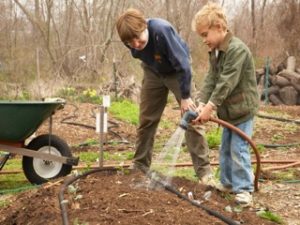
Watering, by the way, can be meditative. Imagine that the hose is your umbilical cord so that, as you nourish the earth and the plants, the earth can nourish you. 

By now the sun has gone down, and you trudge indoors muttering to yourself, “What the heck did I get myself into”?  To this comment I say, “You did not have to tackle all of the garden in one day”.  

In gardening, there is always tomorrow, or next week, and even though the label says to plant it by the end of May or June, believe me folks, a few weeks later does not matter, the garden will wait for you.  

You may be saying to yourself at this point, “Maureen, are you trying to put us off gardening?” No folks, but I would remiss, as someone who has gardening in my blood (as well as manure!) for over 400 years to tell you, however reluctantly, not only the pleasures, but some of what can cause aches and pains.

The idea is not to bite off more than you can chew. For first-time gardeners, don’t scatter your energies all over the garden, but rather tackle and complete one area at a time. That area should be priority one until it is complete.  

If you have a new home with no landscaping, some hardscape may be required. Hardscape is walls, walkways, patios, ponds, decks and so on. The sound and look of a water feature in the garden is delightful. A water feature need not be elaborate, a fountain is fine – the reflection of water is Mother Nature’s mirror.

If you are not able to do this construction yourself, get in touch with a landscape contractor now, so that a plan can be created right away, then installed and ready by spring. I say to connect now as many landscape products are short on supply this year.   

All of these endeavors mean you getting yourself in shape physically, so get off that couch, put away the catalogues and your plant lists, stretch, then wrap yourself up in warm gear and take that walk.   

As you walk, look at the trees in winter, the elegant shape of them, the lichen on the stonewalls, and the moss tucked in cracks and crevices. Clear your mind and allow nature’s spirit to surround you. As you walk, look at a garden or two in your neighborhood; gardens which you have admired when they were in bloom and see what they look like in winter.  

I remember one of my professors when I studied at the Royal Botanic Gardens at Kew saying, “In winter, you can tell a really good landscape by its bones, without the flesh of flora and foliage.” 

In spring, get in touch with those neighbors whose gardens you admired and ask them some of the secrets of their garden. They will be happy to talk with you not only of their successes but their failures – true gardeners are realists when they speak about their gardens and love to share.  

Well folks, I’ve given you plenty to think about right now so enjoy your daydreaming of the season to come and I’ll see you next month in your garden.

About the author: Maureen Haseley-Jones is a member of a family of renowned horticultural artisans, whose landscaping heritage dates back to the 17th century. She is one of the founders, together with her son Ian, of, The English Lady Landscape and Home Company. Maureen and Ian are landscape designers and garden experts, who believe that everyone deserves to live in an eco-conscious environment and enjoy the pleasure that it brings. Maureen learned her design skills from both her mother and grandmother, and honed her horticultural and construction skills while working in the family nursery and landscape business in the U.K. Her formal horticultural training was undertaken at the Royal Botanic Gardens at Kew in Surrey.

Around 18 Inches of Snow Blanket Lyme, Old Lyme

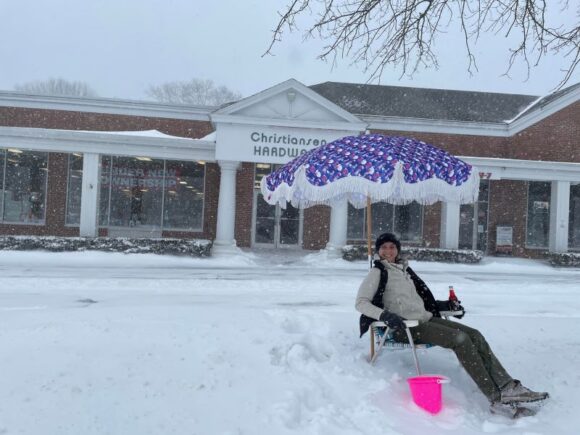
On Saturday, Jess Talerico, co-owner of the new Old Lyme Hardware (formerly Christiansen’s), took the snow in her stride. She relaxed for a few minutes outside the store on the Old Lyme Marketplace sipping a drink under a sun umbrella to give her shelter from the storm.

LYME/OLD LYME — Somewhere between 16 and 18 inches of snow fell on Lyme and Old Lyme during Saturday’s nor’easter leaving a white wonderland in its wake.

Snow measurements we have received from residents suggest between 16 and 18 inches fell in the Lymes. Photo by J. Talerico.

Roads were almost deserted in our towns at the height of the storm.

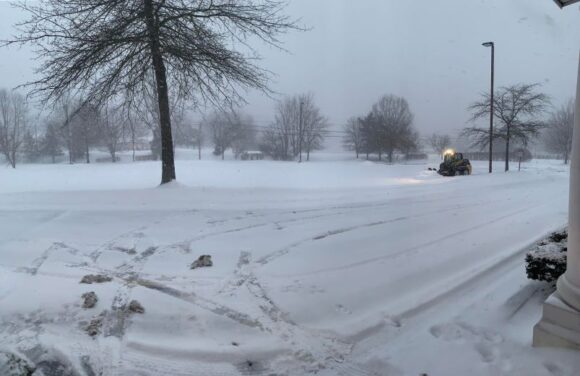
A snow plow begins the monumental task of clearing Old Lyme Marketplace. Photo by J. Talerico.

Despite the strong winds and significant amount of snow, it does not appear that any residents lost power.

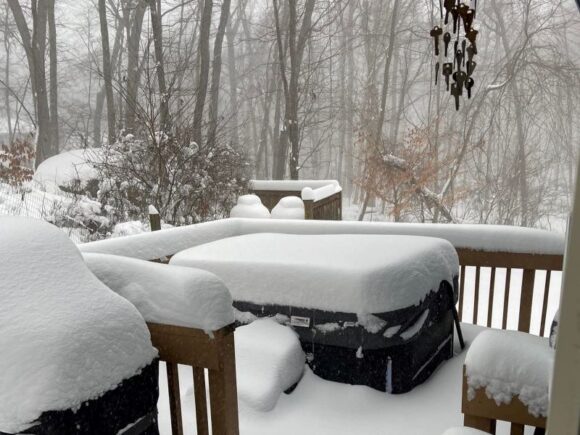
More than 16 inches of snow fell in Old Lyme, where this photo was taken. Photo by L. Hautaniemi.

Crews are working diligently to clear the roads and a number of vehicular accidents have been reported.

A town-wide parking ban remains in effect in Old Lyme through 12 a.m. Sunday, Jan. 30. Move any vehicles on the street into a driveway so the streets can be safely plowed.

Both Lyme and Old Lyme Congregational Churches have moved their Sunday, Jan. 30 services to Zoom only. Saint Ann’s Episcopal Church in Old Lyme has cancelled its 8:30 a.m. Sunday service.

Here are some general rules to follow as you start to dig out from the storm:

  • Check on your neighbors. Older adults and young children are more at risk in extreme cold.
  • Reduce the risk of a heart attack. Avoid overexertion when shoveling snow.
  • Use generators outside only.
  • Stay indoors and  dress warmly.
  • Prepare for  power outages.
  • Listen for emergency information and alerts.
  • Travel will be hazardous. Stay off the roads as much as possible.
  • Your cell phone will be an important tool during this emergency — make sure it is charged.
  • Stay away from downed power lines and call 911 to report them.
  • Exposure to cold temperatures and sustained winds will contribute to hypothermia and dehydration. If you go outside, dress in layers and wear hats, scarves and gloves. Remove wet clothing as soon as you are back indoors.
  • If there is a fire hydrant on or near your property, please help by keeping it clear for emergency use.
  • Call 911 to report all emergency situations.

Snow was no problem for this dog. Photo by Beth Sullivan.

Dogs and other four-legged animals can have fun in the snow but be sure to keep a keen eye on them to prevent them from getting caught in drifting snow or staying outside in the frigid temperatures for too long

Blitz decided digging in the snow was the order of the day for him! Photo by Beth Sullivan.