Letter to the Editor: Management of Major Projects in Old Lyme is Problematic

To the Editor:

With reference to Howard Margules recent Op-Ed published in LymeLine.com, ineffective leadership by Old Lyme’s First Selectperson has been the root cause for ongoing issues with the Lymes’ Senior Center renovation and the going-nowhere Halls Road Improvement Project. The failure to appoint competent individuals to manage these projects is a major factor in their ongoing issues.

Only in Old Lyme is a renovation project, (the Lymes’ Senior Center) that is 9 months behind schedule and $900,000 over budget before construction begins, called a successful and well run project.

Only in OId Lyme are town residents told the Halls Road Improvements are coming when all major funding requests from the state and federal agencies have been denied due to failures at the local level to submit a proper application.

Old Lyme’s Board of Selectmen make the appointments to the committees that are responsible for the projects mentioned above yet major decisions affecting these projects are made primarily by the First Selectperson thus eliminating an honest discussion by the full board. This is an ongoing problem.

Sincerely,

William Folland,
Old Lyme.

Op-Ed: Old Lyme Needs to Do Better on Major Projects

Editor’s Note: This op-ed was submitted by Howard Margules of Old Lyme. 

Our town’s major projects—Halls Road, Lymes’ Senior Center, Sewers, Shoreline Gateway, and Affordable Housing—are all vital to our town’s future economic viability. 

They also share something else in common: they have been “works in process” for quite a while, and all remain unfinished. It is important to point out that these projects have been ongoing across multiple administrations, regardless of which political party is in power; so this is not a partisan issue but one that crosses party lines. 

Why do these projects take so long to complete, and what can be done to expedite them?

Over the last ten years I have been involved, one way or another, in most of these projects. 

I am a current member of both the Halls Road Improvement Committee and the Planning Commission and the former Chair of the Economic Development Commission. Thinking back on my front-row experiences has led me to some observations on those questions and suggestions for improving timely project completion.

Relying on Volunteers

Our town is very fortunate to have a motivated, engaged volunteer corps staffing our town Boards, Committees and Commissions. I have worked with good people from both parties, and I have been generally impressed with the competence, knowledge and commitment they bring to the job. And, they are doing this work for “free.” 

But, there are issues with relying on volunteers. 

First, there is a town requirement that the Boards and Commissions be balanced politically. This occasionally leads to appointments made simply to fulfill the political balance requirement rather than appointing the most qualified individual.

Additionally, there have been instances where the Committee or Board Chair has had no input in the selection, or, objected to the appointment, but was overruled, even though the person appointed was not the best candidate. 

Second, our town relies almost solely on volunteers to address some very complex projects which often require specific expertise and knowledge that may be absent in our volunteers. 

Additionally, most Boards and Commissions only meet once per month, which is acceptable for routine issues but inadequate for addressing major complex projects. 

Finally, it is also difficult to put too much pressure or expectations on volunteers since they can always elect to just bow out. Relying almost totally on volunteers makes it hard for the town to complete major projects successfully in a timely fashion.

Low Accountability

Many municipalities, especially larger ones, employ a full- or part-time professional planner, to lead major projects. They are professionals with the expertise required to address the complex issues major projects raise. Most importantly, they are held accountable as professionals for completing projects. 

Currently, we don’t have the structure or ability to hold any one person accountable. Accountability gets more complicated given the number of Boards and Commissions involved, various interests that have to be satisfied, and political agendas that occasionally get in the way.

Lack of Collaboration

All of these major projects require approvals from multiple Boards and Commissions Typically, this is done sequentially. One Board or Commission generates proposals that then require approval from another body. Of course, it is natural then for everyone to want to add their two cents. 

The sequential review and approval process frequently leads to varied opinions, occasionally to conflicts, and thus delays. Each set of potential conflicts must be resolved in sequence, drawing out the process and the projects unnecessarily. 

In my view, it would be more beneficial to provide a mechanism for the Boards and Commissions to collaborate initially, perhaps reaching broad consensus and some level of buy-in before the official approval process. 

The Board of Selectman should form a specific project committee for each major effort. We do have some such now, but they do not include representatives of the bodies that will have to provide approval later on. 

The relevant Boards and Commissions or representatives of those bodies need to be involved early in the project, if not from its inception. 

Relevant Expertise

Expert advice (engineering, law, environmental science, design, etc.) is required for these major projects. We are very fortunate in Old Lyme to have a wide range of skills represented in our citizenry and we have benefitted from their help over many years. 

Unfortunately, those with the most relevant skills are often still working, raising children, etc. and have little time to volunteer. We can take advantage of these local skills where they are available, but major projects need consistent and constant expert input, even if it means we must hire professionals to assist.  

Even to manage the work of hired experts can require Board or Commission members to climb a steep learning curve.This is another area in which a professional planner could be very helpful.

Leadership

Finally, these complex projects require engaged leadership from the Board of Selectman. The Board of Selectmen needs to assist with coordination, monitoring, oversight, timetables, expense control, lobbying public officials for funding, and commit to completing projects on time and on budget.

Our town will face more challenges going forward. If we are to successfully face these challenges and secure our economic future, we need to enhance our approach to supporting and managing major projects.

Local Vets Complete Training as Veterans Representatives for Towns of Lyme, Old Lyme, Killingworth

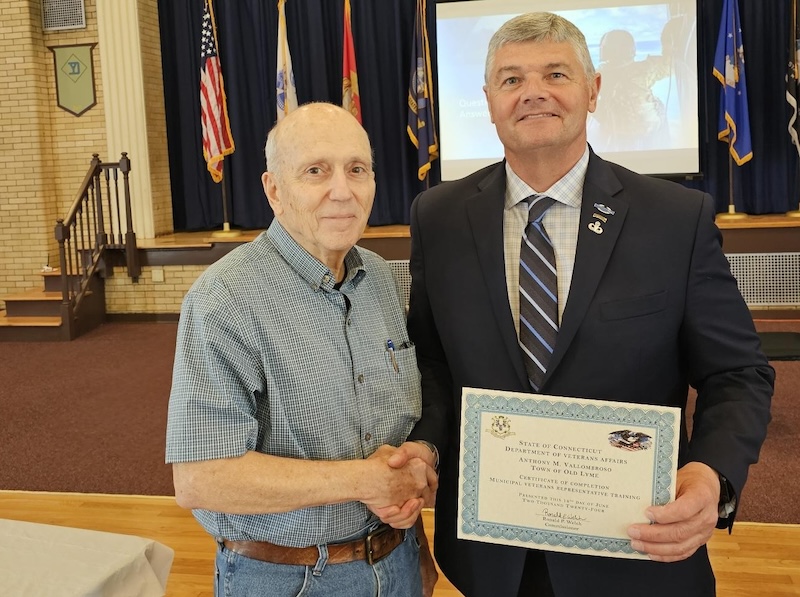
Tony Vallombroso, who has been the Old Lyme Veterans Representative for many years, received his Municipal Veterans Representative completed training certificate from Ronald P. Welch, Commissioner of the Connecticut Department of Veterans Affairs.

ROCKY HILL, CT/LYME/OLD LYME—On June 14, the Connecticut Department of Veterans Affairs (VA) conducted an annual training program for the Veterans  Representatives of each Connecticut municipality.   

The event was held at the main VA campus at Rocky Hill, Conn. 

Completed training certificates were handed out by Ronald P. Welch, Commissioner, Connecticut Department of Veterans Affairs.

Every Connecticut municipality is required by state law to have a Veterans Representative—usually a volunteer—who is trained annually to help community veterans understand their VA benefits and handle related issues. 

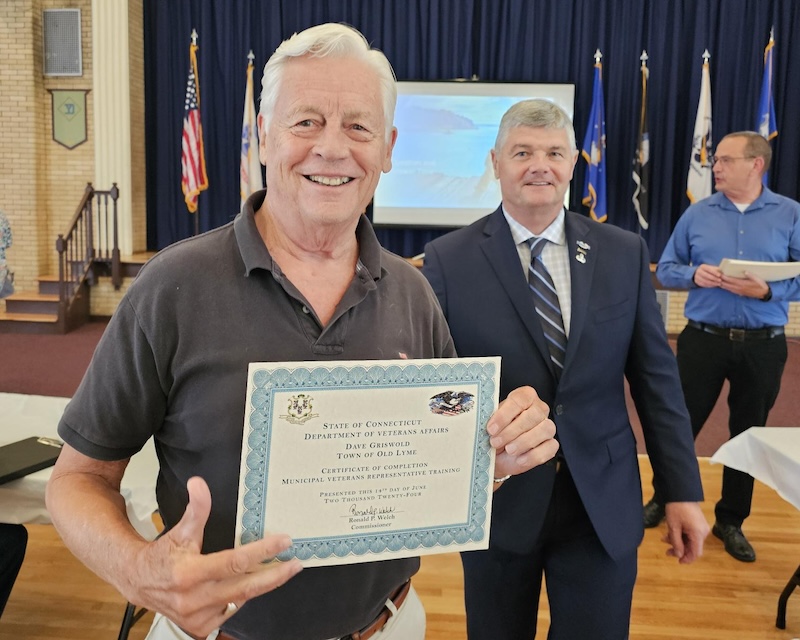
Incoming Veterans Representative David Griswold proudly holds his completed training certificate.

Tony Vallombroso has been the Old Lyme Veterans Representative for many years. David Griswold of Old Lyme will be working with Vallambroso as an incoming Veterans Representative.

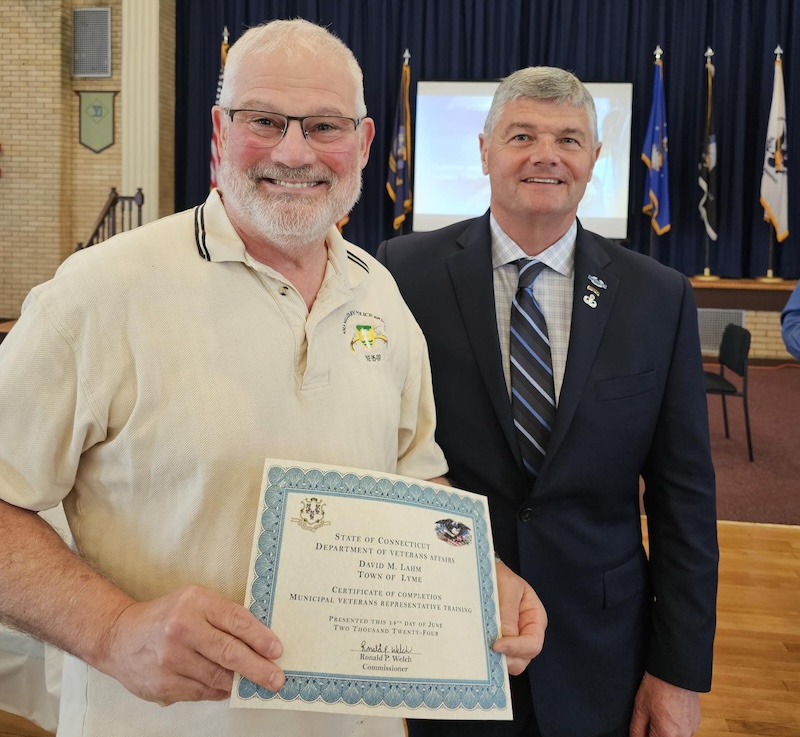
Lyme First Selectman David Lahm is the Veterans Representative for Lyme.

David Lahm is the Veterans Representative for Lyme, as well as serving as the Town’s First Selectman. 

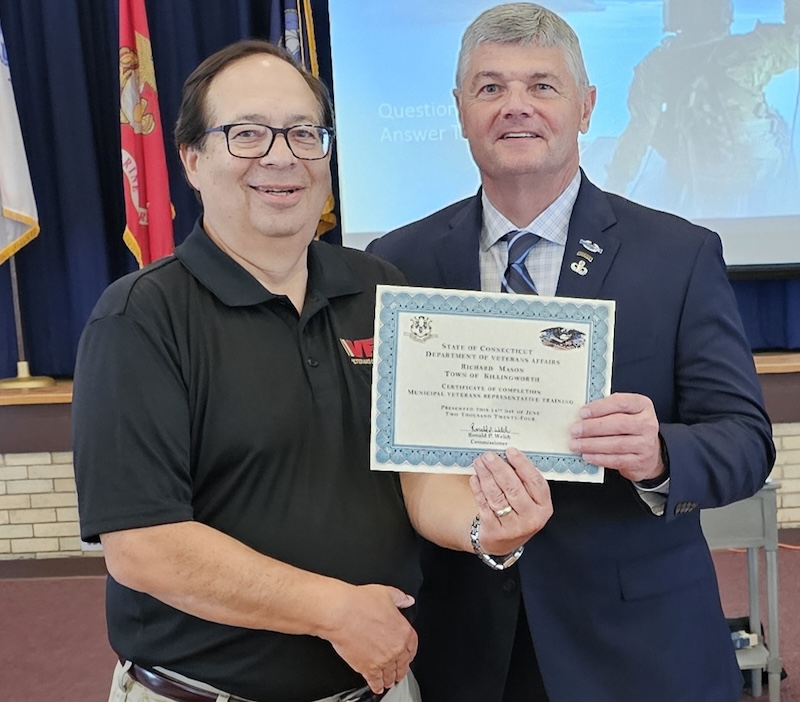
Old Lyme VFW Post 1467 Commander Richard Mason serves as the Killingworth Veterans Representative.

Richard Mason is commander of Old Lyme VFW Post 1467 and also the Veterans Representative of Killingworth.  

Below is a list of dignitaries, who attended the training event:—

  • Ronald P. Welch, Commissioner, Connecticut Department of Veterans Affairs
  • The Honorable Stephanie Thomas, Secretary of the State
  • Edward C. Payton, Interim Deputy Director, VA Connecticut Healthcare
  • Astrid Perez, Director, Veterans Benefit Administration, Hartford Regional Office
  • Stuart Topliff, Town Assessor, Town of Rocky Hill, Property Tax Exemptions
  • Heather Tweeddale, Connecticut Department of Administrative Services (Talent Solutions), Employment with the State of Connecticut
  • Nicholas Savaria, U. S. Department of Veterans Affairs (Veterans Health Administration)
  • Jessica Gagen – Military Services Coordinator, VBA Overview/Claims Trends/Automated Claims Review
  • Donna Bois – Assistant Veteran Readiness and Employment Officer (AVREO)
  • John S. Carragher, Advocacy and Assistance
  • Chuck Leone, Residential Programs and Services
  • Laura Nelson, Sgt. John Levitow Healthcare Center
  • Pam Porter, Cemetery and Memorial Services
  • Nicole Dykstra, Connecticut Department of Labor (American Job Centers)
  • Ariana Deeley, Director, Hartford Vet Center

Clarifications on Project Status Update From Halls Rd. Improvement Committee

OLD LYME —LymeLine reader William Folland raised the need for some clarifications on the project status update we posted Saturday from the Halls Rd. Improvement Committee (HRIC).

Halls Rd. Improvement Committee Chair Edie Twining has now responded to Folland’s requests for clarification.

We felt it would be helpful to our readers to post both comments ‘side by side,’ though we urge readers to read the comments as posted against the article because, in this article, we have extracted from Twining’s full comment.

Folland said:

“The grants (LOTCIP and TA) that the town has submitted to fund this project is for construction costs only, the town will most likely be required to fund design costs.

The preliminary design cost, for infrastructure upgrades (sidewalks plus) on Halls road is appox. $624,000

Despite knowing funding the need to keep this project ongoing no town funds were provided in the towns 2024/2024 budget for this project.

To date town approved funds have been spent on the bridge design, no town approved funds have been spent on sidewalks.

The bridge design is incomplete with design requirement flaws, in addition a fishing pier and floating dock must be included in the plan. This will add sugnificiant cost to the project, a cost that most likely will be required to be funded by the town.

Back to funding: The grants (LOTCIP and TA) that the town has applied for will require a 20% match for cost of construction further driving up the towns funding obligation.

In closing: The issues that i have mentioned above represent only a fraction of problems yet to be resolved. The project would benifit greatly with the addition of a professional town planner to guide the HRIC.”

Twining responded:

“Some of the wording in your clarification could be misleading.
1. The $624,000 is not an estimate for preliminary design costs (as your wording implies), but the best current estimate of the total cost to accomplish all the remaining design work needed to bid and build “Complete Streets” (sidewalks, lighting, etc.). The grants applied for to date were construction grants, and expressly excluded funding for design. Our grants team continues to seek funding for the design portions of the project.

2. To date the town has spent none of its own revenue on the Bridge and Trails Design Project, as that work has been completely funded by two grants and managed entirely by volunteers. The DEEP’s request for a fishing pier and parking spaces in return for giving Old Lyme the DEEP’s property on the east bank of the river was not anticipated, and was not in the original funding. There have been no flaws in the design requirements, but rather delays in proceeding with this added design cost for the water access. This added work is under negotiation with the assistance of the town’s Harbor Management Commission.

3. The grants applied for all have different requirements, some need 20% matches, some only fund construction, some only fund planning etc. Some of the grant programs that require matching funds allow other grants to cover the 20% match. Some consider funds already spent by the town to be eligible as part of those matches. We are fortunate to have a committee member with grant experience, as you know.

4. The Halls Road Master Plan, as you learned in the past four months, has multiple pieces to the puzzle. Funding from the town is currently committed to the Senior Center and School Facility renovations. Those are big projects that will eventually be completed. And, yes, efforts on the scale of Halls Road and these current projects could benefit from a part-time Town Planner.

5. The safe passage of our school children and the entire Old Lyme community to and from our commercial center will continue to be an issue until funding is possible for the Halls Road Master Plan through the town and outside sources. We believe the need to support the businesses in our commercial center and to connect them to the rest of town is a nonpartisan goal that will significantly benefit our town and its future.

In closing, what you refer to as problems we see as challenges. Problems are easy to identify (or imagine). Solutions are what we need, and that is where our work is. It was good to have your help with that.”

Project Status Update from Halls Road Improvement Committee

OLD LYME—On Monday, June 17,, the Halls Road Improvement Committee (HRIC) met with the Old Lyme Board of Selectmen and presented a document summarizing the status of the project. The HRIC Chair Edie Twining asked if we would be willing to publish the document as she felt it would be of interest to our readers. We are happy to oblige and the document is published in its entirety below.

Where are we today? 

HRIC is working to implement the Halls Road Master Plan to secure the future prosperity of our main commercial district by: encouraging investment in town-facing businesses; allowing mixed use; making it more attractive, inviting, and safe for pedestrians and cyclists; and integrating it more fully with the life of the town. That implementation requires multiple, parallel efforts. The efforts all work together, but can be divided according to the main regulatory agencies and stakeholders whose approval is required for each. 

Plan Element Agency/Stakeholders

Complete Streets (sidewalks/ trails along motorway) CT DOT
Bridge & Trails: (walk/bike routes to Halls Road) DEEP, OL Harbor Management., Corps of Engineers
Halls Rd. Overlay District: (allow new zoning options) OL Planning and Zoning Commissions.

“Complete Streets” is a DOT term for their commitment to considering something beyond motorized vehicle traffic flow when authorizing proposed changes along their rights-of-way. They view favorably proposals that integrate roadways with sidewalks, lighting, landscaping, cross walks, bike lanes, bus stops, and other access to alternative transportation—as ours does. For purposes of grant applications, HRIC has adopted Complete Streets to describe that part of the project that seeks public infrastructure improvements along the roadway of Halls Road. 

Any work along a state motorway absolutely requires a DOT “encroachment permit,” regardless of how the project is funded. In practice, such permits are usually sought in connection with applications for grants administered by DOT, and we applied for DOT’s Local Transportation Capital Improvement Program (LOTCIP) grant in 2022 accordingly. 

HRIC sought DOT’s review of our LOTCIP proposal, asking if the project is appropriate and worthy of going forward. They would not do a full, formal review until DOT was ready to allocate funds, but we received confirmation on May 24, 2024 from Grayson Wright at DOT that “DOT agrees that this project makes sense and has no major concerns.” DOT indicated that new LOTCIP funds would not be available until 2027-2028. DOT recommended we secure additional funding for the project in the interim, and suggested we consider pursuing the project in phases. 

HRIC Grants team met with CT Rep. Devin Carney (R-23rd), CT Sen. Martha Marx, (D-20th), US Rep. Joe Courtney’s office, CT DOT; and our local Council of Governments (RiverCOG) to learn what Old Lyme needs to do to move the Complete Streets Project along, including potential funding opportunities. In addition, we have talked with Old Saybrook and Essex to learn how they obtained funding and approvals for their recent sidewalk projects. 

In May, the town applied through RiverCOG for the Transportation Alternatives Program (TAP) grant for construction funding for the entire Halls Road Public Improvements project, including both Complete Streets and Bridge & Trails. The request was for $7,177,500. If our request is approved (in whole or in part), we could expect to receive funds in 3-5 years. This program is offered every 5 to 7 years. 

Bridge & Trails Project design work was initially fully-funded with 2 grants to provide concept design, surveys, permitting, and construction documents for a prefabricated pedestrian bridge crossing the Lieutenant River at the old bridge abutments on the Lieutenant River, along with trails on both ends connecting to Halls Road. 

DEEP owns a triangle of property on the east bank of the Lieutenant River between the centerline of the old Cross Road (which crossed at the old abutments) and today’s Halls Road. DEEP is prepared to donate this property to the Town, but has requested that, in return, a fishing pier and 8 parking spaces be included in the project. Old Lyme’s Harbor Management Commission has also requested that a floating dock be added to the pier. These changes to the initial project scope require additional design work and more extensive surveys and permitting. HRIC is currently working out the expected costs and investigating options to fund them. 

In April, the town applied to Joe Courtney’s office for the 2024 Community Project Funding grant, asking $2 million to help support construction costs for the Bridge & Trails Project. If approved, those funds would be available in 2025.

HROD (Halls Road Overlay District)
After being considered by the Planning and the Zoning Commissions in 2022-2023, the application was denied. Since then, HRIC has worked to address the Commissions’ concerns. There were concerns about infrastructure suitability (water & septic) in the district as well as the need for DOT’s approval of the public improvements needed on the right of way. To answer these questions a soil review was conducted by CLA Engineers, Inc. which showed that the infrastructure is suitable for additional development. As noted above, CT DOT has provided both verbal and written support for the right of way details of the Halls Road Master Plan. HRIC will reapply with the revised HROD proposal in this fall.

What are the next steps for HRIC? 

HRIC is working to create and publish an RFP to do the remaining design work for the Halls Road Complete Streets Project (CDs, etc.). We first need to determine how this project will be framed, as a phased project or single full scope. Phasing increases design costs by about 10% (duplicating some work), but may give us greater flexibility and make more grant opportunities available. 

HRIC will continue to seek funding for the design portion of the Halls Road Complete Streets Project from town and/or through grant opportunities. Many of the potential funding sources investigated thus far require the town to provide matching funds. This could be up to 20 percent of the total ask, and typically can be sourced either through town funds or other grant funding. 

We expect to finalize costs for the additional design work for Bridge & Trails fishing pier/dock this summer. HRIC will work with Harbor Management to review all fishing pier/dock concepts and approvals. HRIC will seek funding from town and/or through grant opportunities to support the design and construction of the pier/dock.

HRIC will submit the revised HROD proposal to Planning and to Zoning in November/December 2024. 

Where do we want to be?  

By 2026 we would like to see work beginning to replace the sidewalks between Lyme Street and the Lieutenant River. We would also like to see construction initiated for the Bridge & Trails project. 

By 2025 we would like to see the HROD approved. With approval, we would recommend that an HRIC Marketing Committee be formed to seek investors and developers for the district. This is a key extension of the HRIC project to ensure good developers learn about our Master Plan with the aid of a developer’s packet describing the HROD and its Design Guidelines. The town will also need to create a Design Review Committee to assist investors in designing projects that fit Old Lyme’s character, and to advise Zoning on Special Permit applications under HROD. 

What do we need to do to get there?

Post RFP for Complete Streets design project.

Continue to seek grant programs for the public improvements along Halls Road.

Finish fishing pier addition to Bridge & Trails Project and post design for bids.

Secure approval of town Planning Commission and Zoning Commissions for revised HROD proposal. 

Create the HROD Marketing Committee & Developer’s Packet

Create the HROD Design Review Committee

Develop HRIC Budget request for town to support costs for Complete Streets design work, HROD legal fees, and Bridge & Trails. 

Explore hiring a Planning Consultant to assist in managing the implementation of the Halls Rowd Master Plan, going forward. 

A Note about Design and its Place in Major Projects: 

Design is an iterative process of generating ideas, testing, and mapping them out in increasing accuracy and detail. In commercial and highway projects there are broadly recognized stages of that process, but it can be confusing when all of them are called simply “design.” This is an effort to describe the stages, from vague ideas to finished construction, and to show the terms typically used to name them. 

The Design Process 

  • Predesign – Review master plan concepts, permit requirements, conduct survey including utility layout and right of way parameters. Include complete streets program requirements.
  • Concept Development – Based on Predesign information develop concept for approval by all regulatory agencies and client.
  • Design Development – Based on Concept Design feedback develop design to base final documentation drawings. Ensure all permitting is understood and preview final drawing set.
  • Construction Documents – provide final permitted drawing set including all options needed for Bid Set Submittals
  • Bidding Process – Submit requests for bids, review with client and assist in selecting best company for project.

Project administration – Oversee all project Requests for Information, Additional Clarifications and process invoices from contractor.