Gardening Tips from ‘The English Lady’ for June, ‘The Time of Perfect Young Summer’ (Gertrude Jekyll)

June is, ‘The Time of Perfect, Young Summer’ (Gertrude Jekyll)

Maureen Haseley-Jones is “The English Lady.”

We have had a few cool nights recently, which are just wonderful and allow one to sleep with the windows open.  I cannot remember the last time we had a real spring such as we are experiencing this year, with plenty of gentle rain. This beneficial rain is wonderful for all the spring plant growth and such a pleasure to see.

I am so in awe of the miracle of Mother Nature; the symbiotic relationship between plants and all of God’s creatures.

As I looked out of my window from my old home a few years ago,  I could see the buds opening on my 30-foot-long stand of Peonies, which had been planted by the original homeowner in the early 1900s. That sight brought to mind one of the symbiotic relationships, the friendly partnership between ants and peonies.

I am often asked, “Maureen, should I worry about ants on my peonies?” The answer is, “That’s not a problem, lots of ants on the peonies just demonstrate that you have healthy plants with big buds producing more nectar, which therefore, in turn, attract the ants.”

Peonies:
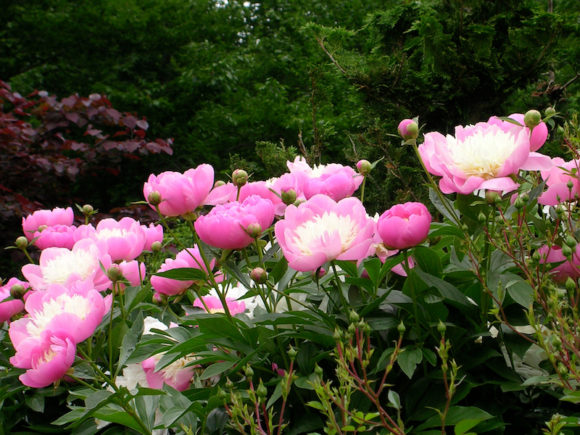
A stand of peonies is always stunning.

Make sure Peonies get plenty of water and after blooming, apply a light application of composted manure and check the soils PH which should be between 6.5 and 7.0.  It is hard to ruin a good peony border but you can err in the fertilizing process, so go easy on the organic aged manure.

Following the bloom, do not cut the peonies down until November, after the first frost. Now, in early June, I pinched off the side buds on my large stand of peonies, this ensures big blooms on the rest of the plant.

Ants:

On the subject of ants; if you see them “let them live,” because often their presence indicates that we have aphids around and ants feed off aphids; very useful creatures.

Another useful creature in wars against pests is the lowly toad. I suggest putting some toad houses in and around your border.  You may purchase toad houses from the garden center if you so desire. Or you can do as I do which is to use an old clay pot that is cracked and make sure that the crack is two to three inches wide for the door so the toad can enter. Also put a small saucer as a floor under the pot with some rocks, which you keep damp, so that your friendly bad bug eater has his or her ideal home environment.

Mulch:

Mulch your gardens this month when the ground has warmed up to 55 degrees.  When mulching, take care mulching around trees. Apply the mulch at least six inches from the base of the trunk, any closer can promote rot and disease in the tree itself. Any trees that are mulched too deeply near the trunk invite mice and other rodents to come in order to nest and gnaw on the trunk.

Your garden can be mulched to a depth of between two and three inches.  I prefer fine dark brown hardwood mulch but please do not use dyed red mulch, keep the garden natural, not looking like a Disney theme park.

Roses:

June is the month when Roses begin to bloom.  I prefer David Austin roses, I find these roses are the most -trouble free Roses and offer so much reward being repeat bloomers with wonderful fragrances.

Some of my favorites are:

  • ‘A Shropshire Lad,’ a soft peachy pink
  • ‘Abraham Darby,’ with blooms showing a blend of apricot and yellow
  • ‘Fair Bianca,’ a pure white
  • ‘Heritage,’ a soft clear pink

And my favorite ‘Evelyn’, which has giant apricot flowers in a saucer shape and the fragrance is second to none with a luscious fruity tone, reminding me of fresh peaches and apricots.

Feed your roses with composted manure, keeping the manure and mulch about six inches away from the base of the rose, then adding a few more inches of manure once a month until mid-August, at that time stop feeding for the roses to gently move into a slow dormancy.

Japanese beetles are very attracted to roses therefore, any Japanese beetle traps should be placed far away from your borders on the perimeter of the property.

A tip for keeping cut roses fresh: cut the roses in the early morning and cut just above a five-leaf cluster and place stems in a container of lukewarm water. Inside the house, recut the stems to produce a one-and-a-half inch angular cut, under warm running water, then place cut roses in a vase filled with warm water.

Do not remove the thorns on cut roses. I have found that removing the thorns, reduces their indoor life by as much as three days.

Hydrangeas:

Blue hydrangeas. Photo by Gemma Evans on Unsplash.

These need plenty of water, (in the fields where they were found growing close to water and classified as a wetland plant before they were introduced into our gardens), also apply aged manure around the Hydrangeas, have them spaced at least four feet apart for good ventilation, which will help to prevent mildew and plant them in full sun. If you have blue Hydrangea macrophylla and want a more vibrant shade of blue, add some peat moss on top of the manure, the peat is acidic and will produce a lovely shade of blue.

Wisteria:

Regular pruning through spring and summer is the main factor to help this arrogant vine to flower; by that I mean prune several times during the season. Prune every two weeks at least six inches on each stem.

Clematis wilt:

If you have this problem with clematis, you will notice it early because the shoots wilt and die. This disease is impossible to cure, as it is soil borne, so it is not possible to plant another clematis of that species in that area of the garden.

However, you can plant the Viticella clematis selection; these are vigorous, free flowering blooms and are not susceptible to wilt.  Some good choices in this variety are Blue Belle, Etoile Violette, both are purple and Huldine, which is white,

Container Gardens:

Unexpected objects can make interesting plant containers. Photo by Annie Spratt on Unsplash.

If you have room for one pot, you have room for a number; placed close together in different shapes and sizes, they can create your own miniature garden.

Apart from regular pots, the most unexpected objects make interesting containers. A friend, who cut down trees this past winter, left the stumps and hollowed them out to make containers, one large and two smaller stumps together, an interesting combo.

At the same time look in your basement, shed or barn to see if you have an old wheelbarrow, even if it has a wheel missing it will present an unusual angle as a planter.

Or you may come across a large, chipped ceramic jar (I, in fact, have an old two foot tall ceramic vinegar container, replete with a hole where the vinegar tap was inserted, ideal for drainage), which will look great on my newly-painted blue bench next to my red milk shed.

Lawn Care:

Do not forget to add organic grub control through July, so that you keep down the mole infestation; remember no grubs, less food for the moles.

Powdery Mildew:

Keep an eye open for powdery mildew, especially after a rain when humidity returns. In a sprayer, mix two tablespoons of baking soda, one tablespoon of vegetable or horticultural oil in a gallon of water and spray the mildew.

Hydrangeas and Summer phlox are particularly prone to be affected by this problem. I recommend Phlox Miss Lingard or Phlox David, white ones of the species, which are the most mildew resistant. Monarda, commonly known as Bee Balm, is also affected by the mildew; the one I have found to be the most resistant is “Cambridge Scarlet”.

Do be careful when introducing Monarda into the garden; this plant, like Purple Loosestrife and Evening Primrose, is extremely invasive and can take over your entire border.

Still with invasive plants, if you plant mint, plant it only in containers, otherwise mint will spread throughout your borders.

I hope these tips are useful to you in this busy time of year in the garden. Stretch, hydrate and enjoy the burgeoning promise of your garden and I’ll see you next month.

If you would like some more gardening advice, contact my son Ian at LandscapesbByIan.com. I am sure you would enjoy speaking with him as he is full of knowledge since, as the saying goes, “The apple does not fall far from the tree.”

About the author: Maureen Haseley-Jones is a member of a family of renowned horticultural artisans, whose landscaping heritage dates back to the 17th century. She is one of the founders, together with her son Ian, of, The English Lady Landscape and Home Company. Maureen and Ian are landscape designers and garden experts, who believe that everyone deserves to live in an eco-conscious environment and enjoy the pleasure that it brings. Maureen learned her design skills from both her mother and grandmother, and honed her horticultural and construction skills while working in the family nursery and landscape business in the U.K. Her formal horticultural training was undertaken at the Royal Botanic Gardens at Kew in Surrey.
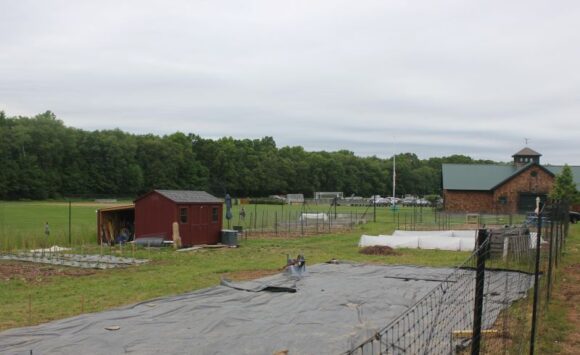
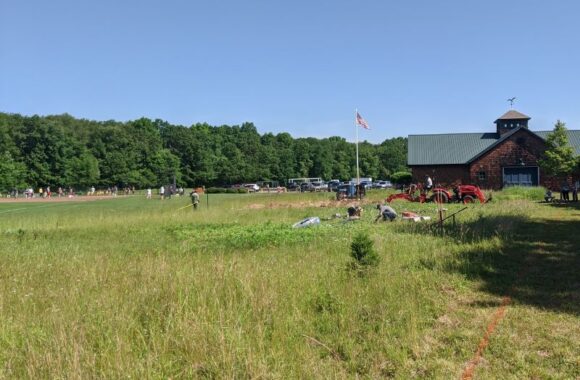
Lyme-Old Lyme Food Share Garden Celebrates Its First Anniversary

The Lyme-Old Lyme Food Share Garden in June 2022. Photos by Sheila McTigue-Ward.

Growing.  Caring.  Sharing. 

OLD LYME — American horticulturist and botanist Liberty Hyde Bailey offered a tasty kernel of wisdom when he noted, “Plants do not grow merely to satisfy ambitions or to fulfill good intentions. They thrive because someone expended effort on them.”

The good intentions of the Lyme-Old Lyme Food Share Garden (LOLFSG) began in earnest one year ago when volunteers convened at Town Woods Park during the first weekend of June 2021 to build a garden.

A flurry of ‘firsts’ soon followed – first trench, first fence, first raised beds – and one year later, the LOLFSG is on the verge of its first harvest!  The garden now boasts more than 30 in-ground rows and six raised beds.  Planted crops include peas, carrots, lettuce, tomatoes, peppers, cucumbers, kale, squash and more.

The ‘someone’ or more aptly, ‘someones” expending effort to cultivate the LOLFSG’s goals are the intrepid volunteers who dig trenches, haul mulch, erect fencing, plant seeds, water, weed and more.

LOLFSG is a nonprofit organization fully run by volunteers and without their concerted and ongoing efforts, the goal to support access to healthy food and reduce food insecurity by growing produce and donating it to local food pantries and kitchens would not be possible.

As the garden expands, the need for volunteers also grows.  The LOLFSG invites individuals of all ages to participate, including supervised children.   Teens interested in earning community service hours are also encouraged to volunteer.

Workdays are Wednesday and Saturday mornings from 9 a.m. to 12 p.m.   No gardening experience is necessary and tools/equipment are provided, including toddler-sized varieties.  Come when you can and leave when you must … every hour of work advances the mission of the garden.

An email is sent prior to each work session to identify tasks for the upcoming work session.

To join the volunteer mailing list, contact amelia.malsbury@gmail.com.

Updates and additional information and photos are available through Facebook, Instagram or https://www.lolfoodsharegarden.org/.

This was the garden in June 2021.

Editor’s Note: Congratulations and kudos to all involved in this remarkable project, especially Jim Ward, who both conceived the idea and has subsequently led the project from its inception.

Town of Lyme Awarded Sustainable CT Certification, One of Only Four Towns in State to Achieve Prestigious Bronze Level

LYME, CT – On Wednesday, June 1, the Town of Lyme announced that is one of four Connecticut municipalities to be recognized this spring for achieving Sustainable CT certification. Lyme met high standards in a broad range of sustainability accomplishments to qualify for the prestigious bronze-level certification.  

Sustainable CT is a statewide initiative that inspires and supports communities in becoming more efficient, resilient and inclusive. The organization announced its 2022 spring certified communities this week.  

In learning of the award, Lyme First Selectman Steven Mattson said, “I would like to thank the hard-working team of volunteers on our Sustainable Committee, as well as the volunteers on our boards and commissions, elected officials and Town staff who made this accomplishment possible. The award is further proof that Lyme is a great place to live.” 

In its application for Sustainable CT certification, the Town of Lyme demonstrated significant achievements with 18 actions in 12 sustainable impact areas. The Town was awarded points for its:-

  • Emphasis of the importance of open space
  • Adoptions of an equity resolution and an affordable housing plan
  • Expanded communications with residents
  • Active promotion of resources for:
    > maintaining dark skies
    > fighting invasive plant species
    > buying local
    >linking residents to area social services and public transportation.  

Programs of note that were launched as part of the Town’s efforts to receive certification include the Lyme Pollinator Pathway and Lymes’ Creative Arts.

More information on all of these activities can be found at this link

Lyme Sustainable Committee Chair Gavin Lodge said, “Being designated as a Sustainable CT municipality is a great honor and reflects a true team effort on the part of many volunteers, boards and commissions.”

In particular, Lodge thanked the 11 volunteers, who serve on the Sustainable Committee:

  • Sue Cope
  • Sarah Crisp
  • Diana Fiske
  • Liz Frankel
  • Carleen Gerber
  • Wendy Hill
  • Carol House
  • John Kiker
  • David Lahm
  • Jim Miller
  • Alan Sheiness
  • Cynthia Willauer. 

The Town needed at least 200 points to achieve bronze certification and received 275 points. Lodge said the next step would be looking at taking Lyme to silver certification, the highest current level of certification available. 

Sustainable CT has seen strong momentum and growth as a valuable, high-impact  program. One-hundred twenty-nine municipalities have registered for the program.

Collectively, 64 municipalities have earned Sustainable CT certification. Certification lasts for 3 years, with submissions rigorously evaluated by independent experts and other Sustainable CT partners.  

“Congratulations to our newest Sustainable CT certified communities,” said Lynn  Stoddard, executive director of the program. “They join a growing number of certified  towns and cities that are demonstrating municipal practices that make our communities  more inclusive, healthy, connected and strong.”  

The program includes actions that help towns and cities build community connection,  social equity and long-term resilience. It includes an action roadmap and support tools  that are especially relevant as towns seek practices and resources to promote racial  justice and respond to the ongoing challenges posed by COVID-19. 

Sustainable CT is independently funded with strong support from its three founding  funders: the Emily Hall Tremaine Foundation, the Common Sense Fund and the Smart  Seed Fund.

Additional support is provided by the Community Foundation of Eastern  Connecticut, Connecticut Community Foundation, Fairfield County Community  Foundation, Main Street Community Foundation and other sponsors. 

The Town of Lyme and all 2022-certified communities will be recognized later this year at Sustainable CT’s annual certification awards ceremony and celebration scheduled to be held in November.

For more information about Sustainable CT, contact Sustainable  CT Communications Manager Jim Hunt at 860-259-4732 or jamesh@sustainablect.org

Op-Ed: Author Responds to Issues Raised by Town of Old Lyme Property on Buttonball Rd., Requests Absence of Acrimony

Old Lyme municipal property located at 36-1 Buttonball Road has been the subject of considerable discussion in news publications and on social media.  

By way of disclosure, I am the Old Lyme Open Space Commission secretary, but I write strictly as a private citizen who has volunteered to help preserve the town’s natural resources and scenic charm.

Two issues have been raised regarding this property – that the Open Space Commission has “hidden” the land from the public, and that the Commission is opposed to public access to it.

Regarding the first – in the roughly five years that I’ve served on the Commission, I do not remember this property ever being the subject of a discussion. 

As the principal author of the town’s approved 2020 Open Space Plan, I was aware that a definitive inventory of town-owned open space was lacking. Thus, the plan reads: 

“The Town of Old Lyme owns 936 acres of open space land in six sizable open space areas accessible for hiking and public access, and two other areas [Lords Woods and Eklund Pond].

NOTE: This total does not include various parcels of town open space owned by fee within subdivisions. When added, that land will increase the above town total.”

Any property omissions in the Plan or on Open Space webpages have not been intentional. They are rather a result of record-keeping issues.  As an example, at a recent Town Meeting, property at 18-2 Short Hills Road, Old Lyme was accepted as “open space.” It’s my understanding that the deed to this parcel identifies it as “town property” without reference to open space. This example is not meant to criticize the town land use office but is offered instead as an illustration of how an open space inventory can become complicated, particularly going back decades with land records. 

The adage “squeaky wheels get grease” bears mentioning as well.  As with many of the town’s boards and commissions, members of Open Space are all volunteers, we often serve on multiple agencies, and time is exhausted meeting basic stewardship demands, pursuing new acquisitions, and addressing various issues that arise, such as a pending, time sensitive request under current review to allow equestrian use on trails. Unlike regulatory agencies, Open Space has no town staff to assist in its work. 

Research into land records has unfortunately languished due to a continuing need to address more immediate demands. 

I commend Harbor Management for its work in seeking public access to our waterways, particularly as someone who personally enjoys kayaking. 

Regardless of the past history of 36-1 Buttonball Road, Harbor Management’s highlighting of the property has brought it into new focus.

The jurisdiction of particular agencies over the land is a legal question to be determined. It does appear, however, that a predecessor of the current Commission actively obtained this property on the town’s behalf. That said, my hope is that various town agencies can work together cooperatively on this property.

The second point to address is allegations that Open Space is “fighting” to keep the public from this property.  

The Commission has a charter that the town’s citizens approved in a Town Meeting vote, and which is now an ordinance (underlining added):

“Supervise and manage acquired open space lands for passive recreational use by the public, protect and preserve the natural resources and wildlife contained therein and develop appropriate standards and limitations for the use of parcels of land acquired pursuant to the provisions of this article to assure their continued use as open space.” § 20-56 D.

At issue is whether public access over salt marsh to a creek that runs into the Black Hall River is advisable. Years ago, the Conservation Commission addressed that exact issue and for its own reasons declined to pursue that access. 

In revisiting the property today, the First Selectman asked Open Space to seek an objective, expert review on whether salt marsh or wildlife might be impacted by river access at the site. The Commission is doing just that and has agreed to share information with Harbor Management and Inland Wetlands. Pursuant to a request from the town’s chief executive and in line with its mandate, it’s a charge the Commission needs to follow. The process will be transparent, and any finding will be public. 

A concomitant issue is a condition that was attached to the town’s acquisition of the property from the State of Connecticut that requires its use for river access. It has been argued that absent that specific use, the property may be reclaimed by the state. Thus, such access, as asserted, seems to be the controlling concern, so it is first being addressed. 

At the same time, some have suggested the property would be suitable for viewing the Black Hall River and the surrounding marshes. The area is populated by an array of wildlife, including nearby active osprey nests, and often seen egrets, great blue herons, eagles, and various other species. 

36-1 Buttonball Road would make a wonderful viewing area for town residents to enjoy the area’s natural beauty and to observe wildlife. I would fully support that use, and I suspect my fellow Commission members would as well.

During the entire time I’ve served, Open Space has been committed to promoting public access to the town conserved property. In fact, a good portion of my volunteer time has been spent drafting public messages to just that effect. Last evening, the Commission, with the Old Lyme Land Trust and the Old Lyme Inn, sponsored a “hikers’ happy hour” on Champlain South to encourage visitation.

An unfortunate by-product of the 36-1 Buttonball Road discussion has been the denigration of the Open Space Commission co-chairs.  

Amanda Blair has devoted hundreds of hours of volunteer time to the town on behalf of open space. She personally shepherded a detailed and complex purchase of the McCulloch farm to closing, and the subsequent necessary amendments to its conservation easement, to allow public access to this beautiful property.

Evan Griswold has served the town for decades, including on Open Space from its origin. He is one of the most dedicated conservationists I know and always has the best interests of nature and the town in mind. Contrary to public comments, Mr. Griswold, as the commission lead in view of Mrs. Blair’s recusal, is not against public access to 36-1 Buttonball Road. He is rather doing what the commission’s charter requires and what the First Selectman has requested – attempting to prudently balance the interaction between people and nature. 

In its various property negotiations and purchases and in its stewardship of town land, the Open Space Commission has strived to respectfully conduct town business. Let us all proceed courteously and without acrimony.

Take a Champlain South Hike and/or Join ‘Hiker’s Happy Hour’ at Old Lyme Inn, THIS AFTERNOON

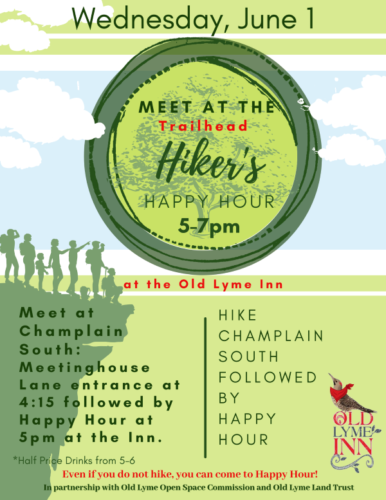
OLD LYME — The second Hikers’ Happy Hour of 2022, sponsored by the Open Space Commission, the Old Lyme Land Trust, and the Old Lyme Inn, will be held THIS AFTERNOON on Wednesday, June 1.  

A guided walk will leave at 4:15 p.m. from the Meetinghouse Lane entrance to Champlain South Open Space. A portion of the walk will follow an old 17th and 18th century roadway, where tracks from iron-wheeled carts are still visible in bedrock. 

After the hike, a friendly happy hour at the Old Lyme Inn will follow from 5 to 7 p.m.  Even if you do not hike, you’re still welcome at the Inn for Happy Hour!

Hikers should wear comfortable walking shoes and bring insect repellent.

In the event of rain, meet at the Old Lyme Inn for Happy Hour instead of the trailhead.

Information on the Champlain South Open Space and its trails may be found at: https://www.oldlyme-ct.gov/sites/g/files/vyhlif3616/f/uploads/olos_champlainsouth9.14.2020.pdf