Old Lyme’s Planning Commission Meets Today to Discuss, Possibly Approve Neck Rd. Subdivision; Open Space Issues Raised

~ Gated Community of Nine Lots Proposed on Same Site as 2018 Controversial Proposal for 37 Affordable Housing Units  REVISED PLAN INCLUDING CONSERVATION EASEMENT NOW SUBMITTED

~ Old Lyme Open Space Commission Asks Planning Commission to Request $105K Fee From Developer due to Absence of Open Space in Plan, Monies to be Used Towards Purchase Of Other Open Space in Town

~ CT River Gateway Commission Requests Planning Commission to Require Conservation Easement be Placed Along Banks of CT River at Western Property End

OLD LYME — UPDATE 9/29 11:09am: During a phone call this morning, Old Lyme Land Use Coordinator Eric Knapp informed us that Keystone Capital Corporation has now submitted a revised site plan for 16 Neck Rd., which includes a Conservation Easement as requested by the Connecticut River Gateway Commission (see article below.)

He noted that Section 5.9.9 of Old Lyme’s Subdivision Regulations regarding ‘Fee-in-lieu of Open Space’ state: In lieu of the above requirements to provide land for open space purposes, the Commission may authorize the subdivider to pay a fee to the Town, or provide a combination of land and fee, in accordance with the provisions of Section 8-25 of the Connecticut General Statutes.

A question for the Planning Commission at this evening’s meeting will now be whether the revised site plan including the Conservation Easement will satisfy the requirement for Open Space or whether some combination of land and fee (as cited in the Regulations above) will be pursued.

OLD LYME — UPDATED 9/28 at 11:59pm: The Old Lyme (OL) Planning Commission will hold a Special Meeting/Public Hearing tomorrow evening, Thursday, Sept. 29, at 5 p.m. in Old Lyme’s Memorial Town Hall.

After the Pledge of Allegiance, there are only two items on the agenda and since it is a Special Meeting, no changes or addition to the agenda can be made.

The first agenda item is the continuation of the Public Hearing regarding the application by Keystone Capital Corporation for the resubdivision of 16 Neck Rd. into nine lots.

The second item, assuming the Public Hearing is closed, is for members of the board to discuss and then possibly vote on the proposal.

The land at 16 Neck Rd. is the same area where the HOPE Partnership endeavored to secure approval for a 37-unit Affordable Housing development back in 2018, which became a highly controversial topic in the community.

The new proposal is for a gated community of nine building lots.

Both the OL Open Space Commission and the Connecticut (CT) River Gateway Commission have submitted letters to the Planning Commission regarding the project. Both letters can be viewed in full at the links given above.

Several other individuals have also submitted letters and emails related to the project.

According to minutes of the last meeting of the Planning Commission held Sept. 8, Commission Chairman Harold Thompson, “Stated it was unfortunate that some of the comments were only received in the last two days, which does not provide the applicant adequate time to address these issues.”

The minutes further note, “Thompson apologized and stated it should not take the commission two months to receive responses from the reviewing agencies.” In light of the situation, he proposed the Public Hearing should be continued until Sept. 29, which was agreed by Commission members.

The Open Space Commission’s letter, dated Sept. 6 and signed by its co-chairs Amanda Blair and Evan Griswold, states, “It appears that no open space is indicated on the applicant’s plan and, even if land were set aside, the gated premises to be accessed by private roadway would not afford public access.”

The letter continues, “In accordance with the provisions of C.G.S. § 8-25, when there is not a suitable area within a subdivision and when there are other areas with[in] Town that the Open Space Commission considers more beneficial to be preserved, the Planning Commission may authorize the applicant to pay a fee in lieu of open space of up to 10% of land’s pre-subdivision appraised value.”

The two-page letter proposes that, although, “It is the Planning Commission’s discretion to determine such payment,” the Planning Commission should request the 10 percent fee of the purchase price from the developer, which it states, “… would equal $105,010.”

These monies would then be used by the Open Space Commission to assist in the purchase other open space properties in the town as they arise. The letter explains, “Although we cannot identify the specific parcels, we will report to you that the Open Space Commission is now actively talking to or considering approaching the owners of at least four properties in Town for acquisition.”

Asked about the possibility of the Open Space Commission receiving a fee in lieu of the absence of open space in a building proposal, Griswold responded in a phone conversation with LymeLine that, “This  has happened before,” citing the example of a proposed development on Binney Rd. submitted, “Around three years ago.”

He added, however, that a similar previous request by the Open Space Commission regarding a proposed development on Mile Creek Rd. was declined by the Planning Commission on the basis it was, “A family-oriented subdivision.”

The CT River Gateway Commission four-page letter, dated Sept. 8 and signed by the Deputy Director of the River COG [Council of Governments] Staff, Gateway Commission Torrance Downes, describes the property at 16 Neck Rd. as, “A highly visible riverfront parcel.” 

In summary, the letter says, “The Gateway Commission would recommend [a Conservation] easement be placed along the banks of the Connecticut River at the western end of the property.”

It goes on to request that the Planning Commission should, “… use all of the regulatory tools available in its decision-making process to manage the development of the site – at least with respect to the western hillside of the property facing the Connecticut River.”

The letter continues, “Protection of natural areas including mature tree stands is recommended for consideration of open space designation,” noting, “Retention of an attractive and rural community appearance, which would include the treed hillsides of the Connecticut River, should be “one of the most important criteria used in land use decision making”.”

The letter concludes, “Community Appearance recommendations state visual details including preservation of natural site features and vistas are critical components of the town character Old Lyme is charged with protecting.”

Members of the community can address either or both of these issues during the Public Hearing or submit letters or emails to the Old Lyme Land Use Department prior to the meeting.

Lyme-Old Lyme Food Share Garden Celebrates Donations Totaling Over One Ton This Season

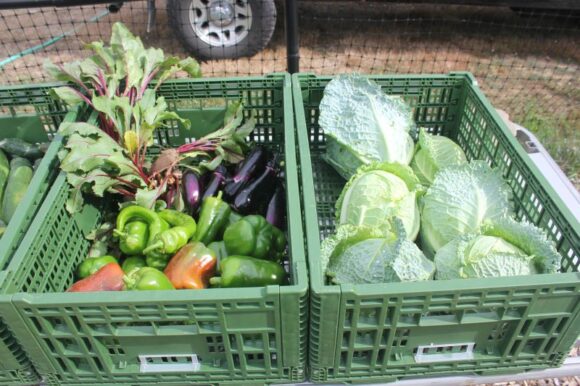
A small selection of a recent day’s harvest from the Lyme-Old Lyme Food Share Garden.

Second Annual LOLFSG Open House Slated for Saturday, Sept. 24, All Welcome

OLD LYME — The Lyme-Old Lyme Food Share Garden (LOLFSG) celebrated a milestone this week!

Following a much-needed rain event, mid-week volunteers harvested kale, tomatoes, string beans, peppers, eggplants, and more.  In doing so, the garden reached a total donation threshold of more than 2000 pounds of produce in its first growing season.

The LOLFSG President Jim Ward commented, “This incredible accomplishment is due to the dedication of volunteers and community support.”

Ward noted that the realistic LOLFSG goal for the 2023 season is to double production and is already looking forward to a “Two-Ton Tuesday.”

To celebrate the successful inaugural growing season and to learn more about the garden, all are invited to visit the 2nd Annual LOLFSG Open House on Saturday, Sept. 24, at the garden from 9:30 to 11:30 a.m.

The garden is located at Town Woods Park behind the Field House and playground.

FRA Announces $65.2 Million Grant for New CT River Bridge Between Old Lyme, Old Saybrook

This photo shows the Amtrak bascule bridge between Old Lyme, Conn. (to the left) and Old Saybrook, Conn. (to the right) in the open position. This image by Denimadept is licensed under the Creative Commons Attribution-Share Alike 2.5 Generic, 2.0 Generic and 1.0 Generic license.

Second $20M FRA Grant Supports Phase 1 (Two of Seven) of CT DOT’s Plan to Replace Power Substations Along New Haven Line

HARTFORD, CT/OLD LYME – On Aug. 18, Gov. Ned Lamont and Connecticut’s Congressional delegation announced that Connecticut has been awarded two grants totaling more than $85.2 million from the Federal Railroad Administration (FRA) for major infrastructure improvement projects on the Northeast Corridor.

The funds will be used for two significant capital projects that improve safety and reliability along the Connecticut-owned New Haven Line and the Amtrak-owned Shore Line East, ensuring no disruptions occur along the Northeast Corridor. They are being awarded under the Federal-State Partnership for State of Good Repair Grant Program.

The first grant, in the amount of $65.2 million, will support the replacement of the existing Amtrak-owned Connecticut River Bridge between Old Saybrook and Old Lyme with a modern and resilient new moveable bridge.

The project will improve safety, reliability, and trip time. Maximum speeds will increase from 45 miles per hour on the current span up to 70 miles per hour. The increase to 70 mph afforded by a more modern miter rail design will be a marked improvement: however, speed restrictions on the curves on either side of the Connecticut River Bridge will still be required but will be optimized to achieve maximum impact.

The existing 115-year-old Connecticut River Bridge poses a significant risk of long-term disruption to the Northeast Corridor due to its age and condition. The bridge was opened in 1907 and is the oldest rolling lift bascule span bridge between New Haven, Conn. and Boston, Mass.

The bridge spans the Connecticut River 3.4 miles north of the mouth of the Long Island Sound. It serves the Northeast Corridor main line and is used by Amtrak’s intercity service, Shore Line East (SLE) commuter rail service, and freight operators. Approximately 38 Amtrak trains, 12 CTDOT (SLE) trains, and six Providence and Worcester Railroad trains travel across the bridge each weekday, a total of 56 trains per day.

The bridge has a movable span that is raised up to allow boats to pass. The Connecticut River Bridge fails to open and close properly, which has led to cascading delays to rail and maritime traffic. Due to its age and deteriorated condition, the operational reliability of the existing bridge is at high risk.

The new bridge will be built along a new southern alignment, with an offset of 52 ft. from the centerline of the existing bridge to the centerline of the new bridge.

The replacement bridge will maintain the two-track configuration and existing channel location and provide a moveable span with additional vertical clearance for maritime traffic. Delays from bridge openings will be significantly reduced, and Amtrak will realize maintenance savings from the new structure.

This grant marks the second Federal-State Partnership program contribution toward the project since an additional $65.2 million was awarded in fiscal year 2020. The Connecticut Department of Transportation and Amtrak will provide a 38 percent match of the grant.

The second grant, in the amount of $20 million, will support phase one of the Connecticut Department of Transportation’s overall plan to replace the seven power substations along the New Haven Line, beginning with the replacement of the first two.

These substations have not been repaired or renovated since the 1980s.

The upgraded substations will be more reliable, more energy efficient, and less costly to maintain. The aging power infrastructure poses a significant risk of rail service disruption, and maintaining the assets is essential to ensuring reliable train service for passengers.

Connecticut Gov. Ned Lamont commented, “We all know how critical the Northeast Corridor is for job creation, economic growth, and environmentally friendly transportation. Our administration has a vision for faster, more reliable, and greener public transportation, and we are doing everything possible to make that vision a reality. Thanks to these grants, that reality is moving one step closer.”

In a joint statement, the members of Connecticut’s Congressional delegation said, “The Northeast Corridor is one of the busiest rail lines in North America, with more than 144,000 commuters using the New Haven Line and Shore Line East daily to travel to work or visit family.”

The statement continues, ” This critical Federal Railroad Administration funding will provide desperately needed improvements to the New Haven Line and Shore Line East, paving the way for more reliable and faster public transportation. This important investment in Connecticut upgrades the power supply and removes a major chokepoint along Shore Line East by replacing the outmoded, deteriorating Connecticut River Bridge.”

Connecticut Transportation Commissioner Joe Giulietti noted, “We appreciate the Federal Railroad Administration’s ongoing support of Connecticut’s rail infrastructure, which will help improve safety and reliability along the Northeast Corridor.”

Dennis Newman, executive vice president of strategy, planning and accessibility for Amtrak, stated, “Amtrak is grateful to the Federal Railroad Administration for awarding two grants totaling more than $85.2 million to fund critical infrastructure projects on the Northeast Corridor in Connecticut – the New Haven Line Power Program and Connecticut River Bridge.”

He added, “The funding from these grants will help modernize the infrastructure in the state and improve the reliability of both commuter and intercity train services to provide a better travel experience for Connecticut residents and visitors.”

Editor’s Note: This article is based on a press release issued Aug. 18, from the Office of CT Gov. Ned Lamont, and information published on the Amtrak.com website about the Connecticut River Bridge.

Rochelle Davis Named Lyme Land Trust ‘Volunteer of the Year’

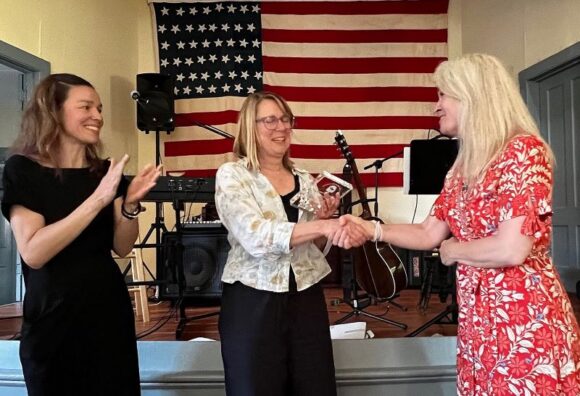
Lyme Land Trust Environmental Director Sue Cope (left) and Lyme Land Trust Executive Director Kristina White (right) of the Lyme Land Trust present Rochelle Davis with the 2022 Volunteer of the Year Award. Photo by Dan Hulseberg.

LYME — Rochelle Davis, volunteer steward of the Grassy Hill Preserve, was awarded the Lyme Land Trust ‘Volunteer of the Year’ Award at the organization’s annual meeting.

During the last two years, Davis worked to improve habitat in the Grassy Hill Preserve Meadow to promote biodiversity. She has transformed a field filled with invasive plants to one populated by native plants that support a variety of pollinators and wildlife.

Davis single-handedly removed dense thickets of invasive plants, including autumn olive trees and multiflora bushes. 

At home, she propagates native plants from seeds to replant in the Preserve.

Davis shares detailed reports via the app “iNaturalist,” where she started a “Grassy Hill Preserve” virtual project to digitally catalogue the species in the preserve. The project can be accessed by anyone who visits the iNaturalist website or has the app on their device.

Over 130 flora and fauna observations have been documented to date.

She regularly walks the preserve and actively manages what is growing, at all times going above and beyond what is asked of a steward. 

Rochelle Davis won the Lyme Land Trust’s 2021 People’s Vision Award in the ‘Imagining Lyme’ contest with this photo ‘Mushroom in a Forest, Beebe Preserve.’ The photo was chosen by the public out of all submissions.

Davis has also actively participated in the Lyme Land Trust project Imagining Lyme – A Visual Exploration of Lyme’s Preserves since its inception two years ago. She has been awarded for several photos of distinction and won the 2021 People’s Vision Award – chosen annually by the public out of all the submissions, with her photo Mushroom in a Forest, Beebe Preserve.

During the award presentation, Sue Cope, Lyme Land Trust Environmental Director, said, “ The power and example of what one dedicated human can do in a year for one preserve has been staggering and we are so incredibly grateful for Rochelle’s time and effort.” 


Old Lyme Land Trust Builds, Installs Four New Benches on Different OL Preserves

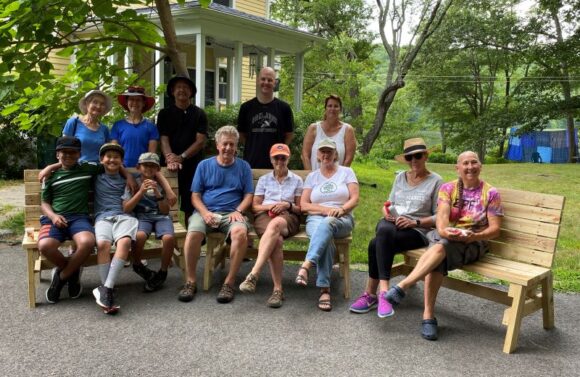
OLD LYME — On July 16, the Old Lyme Land Trust (OLLT) hosted a well-attended Bench Building Workshop. The supply of 2″ x 4” pressure-treated planks required for the project was all precut by OLLT steward Ted Freeman.

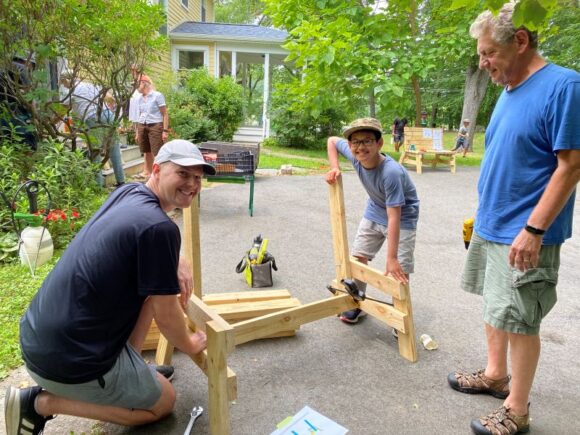
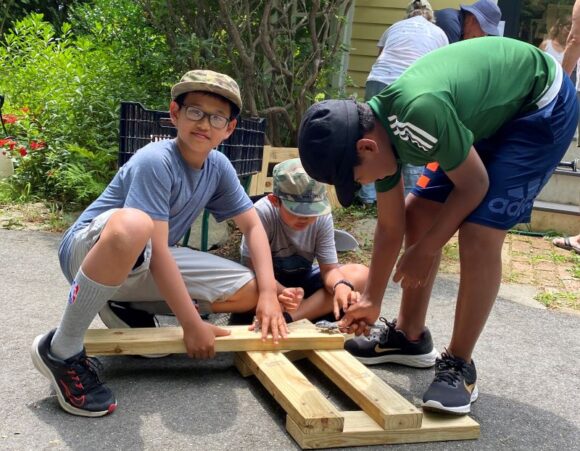
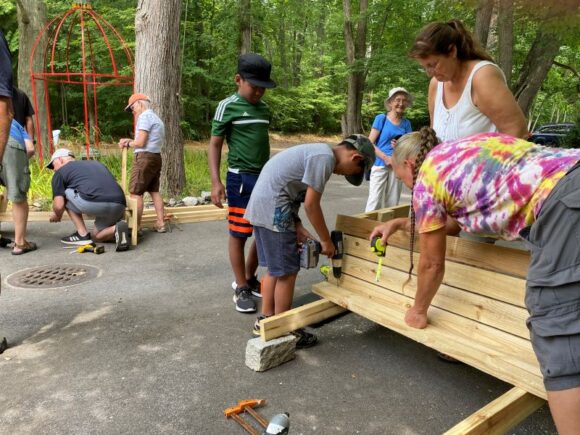
This, combined with the simple design of the seats and seat backs. made the workshop a matter of just drilling and driving screws to construct the benches.

Among the 15 volunteers, who attended the event, there were several younger boys eager to help.

The older folks patiently helped teach them how to drill and drive a screw, and pretty soon all four benches were built.

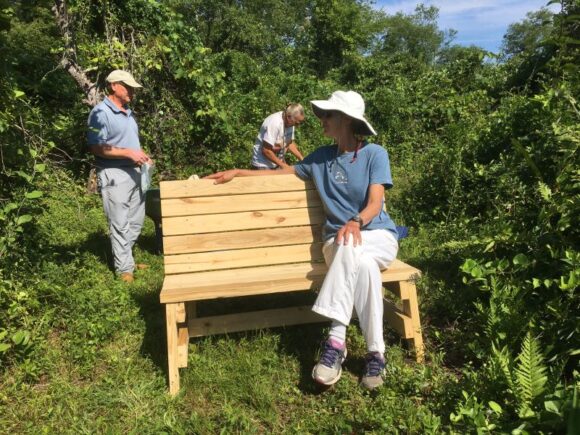
Trying out the bench at the Belton Copp Preserve!

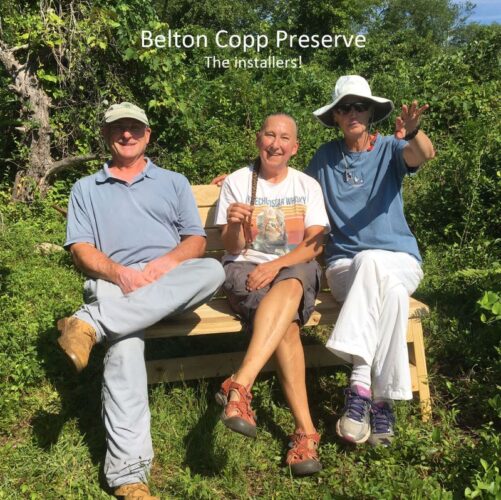
The week of July 17-24 marked the placement of the first three benches at OLLT Preserves.

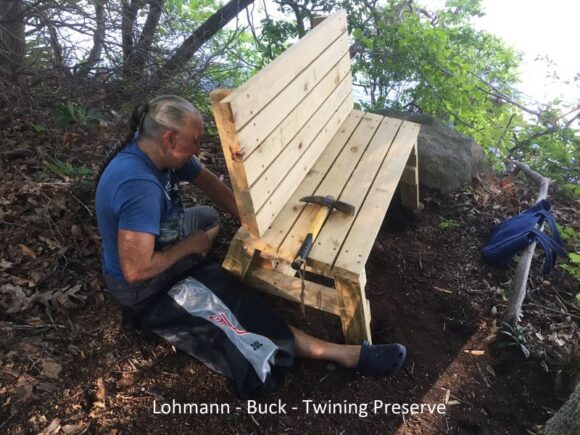
The first was delivered by boat to the Lohmann-Buck-Twining Preserve at the far end of the Blue Trail and offers a beautiful view down the Lieutenant River.

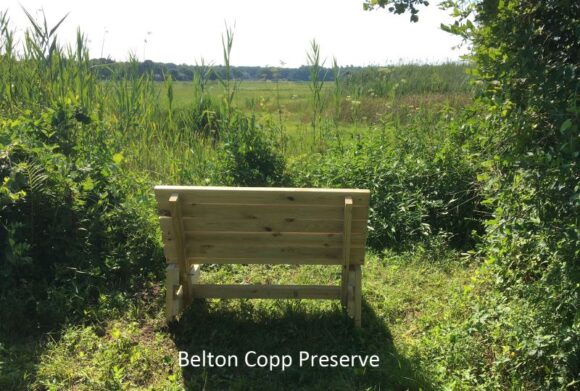
The second bench went to the Belton Copp Preserve and overlooks the sunset views towards Black Hall River.

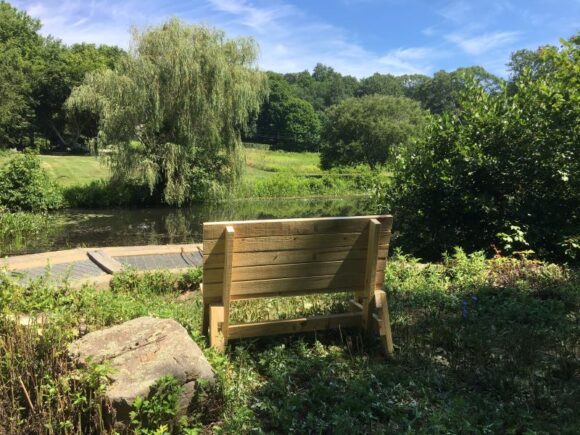
The third bench is located at the Griswold Preserve alongside the mill dam and fish ladder (see photo below.)


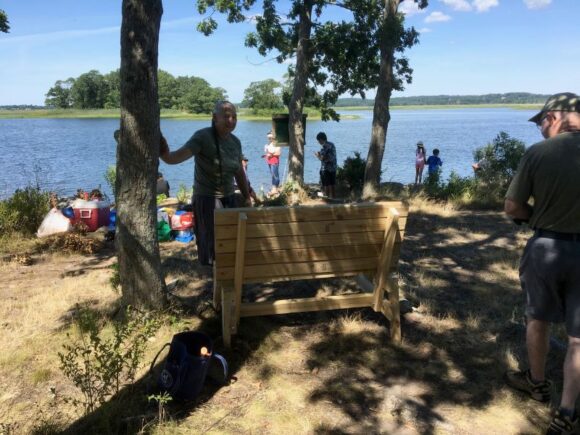
The fourth bench was installed the following week at Watch Rock Preserve overlooking the Back River, where egrets and osprey are often seen across the water (see photo below.)