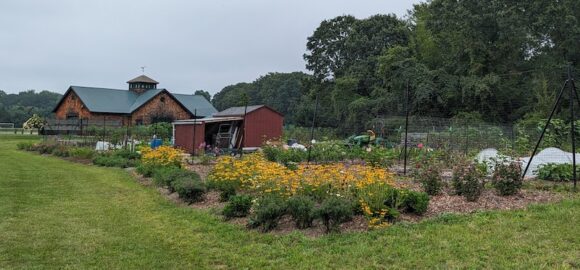
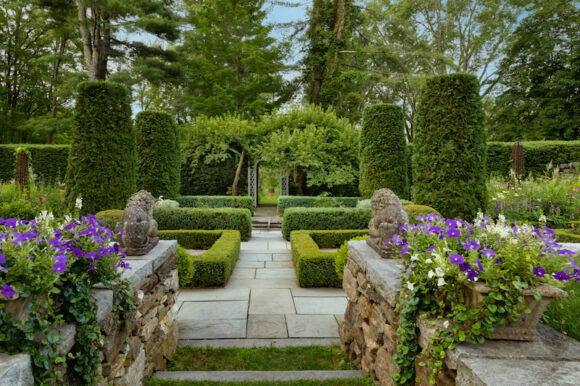
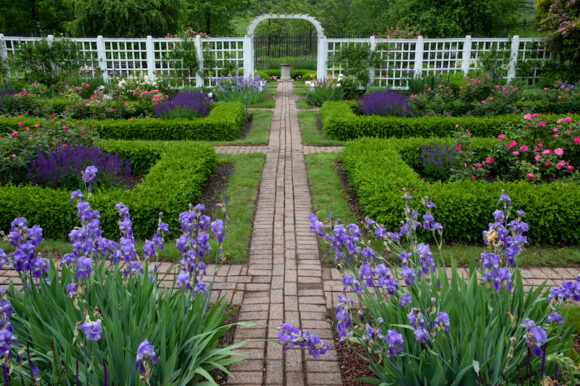
View of the highly productive Lyme-Old Lyme Food Share Garden. Photo by J. Ward.
OLD LYME — The annual Lyme-Old Lyme Food Share Garden (LOLFSG) Sponsor a Row campaign kicked off Oct. 1.
The LOLFSG is extremely grateful to individuals, families, organizations and businesses, who sponsored the garden this season.
Volunteers gave more than 800 hours, donated more than 2000 pounds of food to local food pantries, installed a pollinator pathway along one edge of the garden, composted more than 1000 pounds of donated food waste, and are in the process of an on-site garden expansion.
The annual cost to maintain a garden bed from seed through delivery is approximately $250.
All money raised by this campaign will go directly towards the operating expenses of the garden, including seeds/transplants, fertilizer, weed barrier fabric, irrigation tape, electricity and tools.
In appreciation, each $250 donation from October 1, 2023 – March 31, 2024 will be recognized with a sign at the garden and on the LOLFSG website.
Donations of any amount are also welcome. Donations can be made at lolfoodsharegarden.org or mailed to LOL Food Share Garden Inc., PO Box 395, South Lyme, CT 06376.
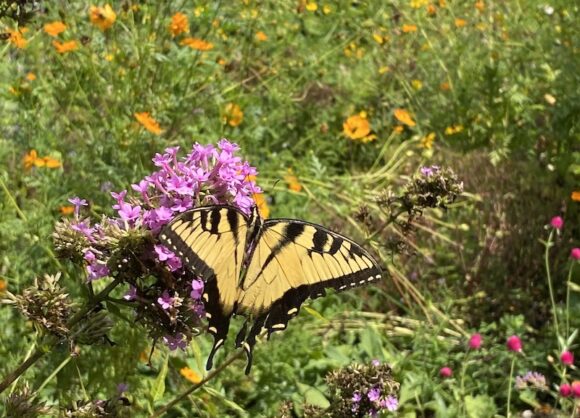
A swallowtail butterfly lands on late summer flowers.
Rain through August and September has been quite plentiful, that said, our gardens need rain as do our reservoirs.
In the meantime, if you are planning to plant evergreens; late September going into October is the best time to plant evergreens in our zone. Evergreens planted now can begin to establish strong roots before winter and providing them with adequate water is essential.
I suggest making a hole in the soil with an iron stake or other piercing instrument and feeding the hose into the hole and allowing water to reach the roots in a slow manner for at least a half hour after planting and continue to do so a few times each week until the ground freezes in November. Cover the earth around the plants with a light layer of composted manure and mulch. However, do not mulch right up to the bark of the plants as this encourages rodents to nest and gnaw on the bark of the plants.
HYDRANGEAS
Blue hydrangeas. Photo by Gemma Evans on Unsplash.
I receive many questions on pruning Hydrangeas, with fellow gardeners asking me, ‘Maureen, why did my Hydrangeas not bloom this year’? The reason that Hydrangeas do not bloom is that gardeners prune them at the wrong time. If you feel that your Hydrangea macrophylla has become too large and requires pruning, then go ahead and prune them in the first few weeks of September. The reason for so doing is that Hydrangeas set their buds for next season by the end of September; pruning any later will cut off those buds, which will negate any chance of bloom for next season or even the following season.
Prune any old woody stems that have not bloomed well and any weak new shoots. After pruning, apply a few inches of composted manure, and some peat, followed by a top dressing of natural brown bark mulch. The peat aids acidity in the soil, which is necessary as Hydrangeas may become chlorotic if the soil is too alkaline. By the way, chlorotic means abnormal reduction or loss of normal green coloration of the leaves of plants.
On another note, Hydrangeas do not like to be transplanted; transplanting them can result in little to no bloom for many seasons. For that reason, I suggest when planting new Hydrangeas, make sure they are at least five feet apart, so they have room to grow and to receive adequate ventilation and this way they will never need to be transplanted.
This fall, as you contemplate your landscape, think on the past season as to what worked for you and what you will never try again.
Unfortunately, mint has taken over the border beneath my Franklinia tree. Many years ago, my friend Roz was kindly lending a hand in the garden and planted mint in the garden instead of a large container that I placed for that very purpose. I was busy with other garden chores at that moment, so by the time I noticed the error, six months later, the mint was running rampant among the blue myrtle edging the borders. So folks, please take note that mint is extremely invasive and should only be planted in containers where its wayward habits can be controlled.
‘It is said that ‘a gardener’s work is never done’, but now with the season’s hard labor behind you, take a break. Sit outside and inhale the late garden fragrances and allow Mother Nature to anchor and relax you.
In the early morning I enjoy sitting on my patio near my herb garden, inhaling the fragrance of the sage, which I will snip later to dry indoors and use in my recipes. I will also gather extra sage and lavender, which I will tie with string into small bunches to hang in my closets, as Lavender and Sage are natural moth repellents. That being said, a few Lavender bunches are tucked into my drawers to keep moths from devouring my woolens; this works fantastically as insects do not like fragrance.
VEGETABLE GARDENS
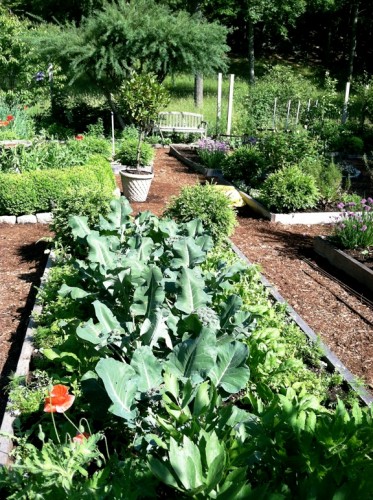
A thriving vegetable garden is the reward of fall labors.
In your vegetable garden, sow spinach for spring harvest and sow a cover crop like winter rye, which can be dug in next spring together with composted manure as green manure. Green manure produces an excellent growing environment for next year’s crop of vegetables.
Now is the time to get your fall compost pile cooking with the last of the grass clippings, spent perennials, leaves and small woody twigs.
Now is also the time to dig up, divide and replant overgrown perennials. Follow this method every three to four years to ensure vibrant bloom from these plants. Never plant or transplant any division or transplant any deeper in the soil than it is now or any deeper than the plant sits in the pot.
In the less hectic pace of fall, early autumn is the time to re-think your gardens. The garden’s pre-winter grooming will wait for a few weeks. Or you may feel that you would like to have a professional design as you have noticed that your borders are not living up to your expectations.
If that is so, then contact someone whom you trust to create a plan in the fall and winter, which can then be phased in beginning next spring. Engage someone who will listen to your thoughts and stay within your budget. I will give you a suggestion for a plantsman and that is my son Ian whose company and website is LandscapesByIan.com. I know you would enjoy speaking with him and the saying goes, ’The apple does not fall far from the tree!’ I am sure you will enjoy meeting with him and checking out his creative talents.
PEONIES
September is the month to plant and transplant Peonies. Do not plant them deeply or they will not bloom, that means have just enough soil to hold them erect with the ‘pink eyes’ on the roots barely covered. Plant them with a light application of composted manure around the plant. In November, following the first hard frost, cut down the Peony foliage to about four inches from the ground.
AUTUMN COLORS, HEALTHY SOIL and SPENT PERENNIALS
The stunning colors of fall. Photo by Dan Freeman on Unsplash.
In a few weeks, the bright vibrancy of autumn color will appear on the Maples. Fall’s brilliant autumn finery is the last hurrah, before winter sets in. Climbing up the red milk shed near the barn, the buds on the white autumn clematis are beginning to unfurl and in the herb garden, autumn crocus, asters and sedum are taking their curtain calls.
For your soil to remain healthy, add a light layer of composted manure to all the borders now or in early October, together with a two-inch layer of fine bark mulch around all newly-planted and transplanted perennials and shrubs. With the application of the manure and mulch you are continuing to build the humus component, which will ensure a rich growing environment for spring and also protect the plants from winter’s harsh conditions.
I do not cut down my spent perennials but leave them up for the birds; the ripened seed heads are a delicious treat for them to peck at. Following the vibrancy of summer bloom, I enjoy the softer subtle colors of gray, brown and yellow of the spent perennials and ornamental grasses blending naturally with the muted winter landscape, which to me offers a resting of the senses.
FALL PLANTING
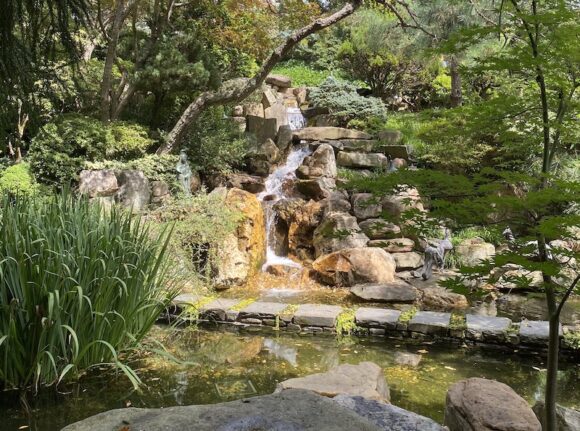
Fall is a good time to rethink your garden and perhaps consider new ideas such as a water feature.
Early- to mid-October is a great time to be planting. The benefits of fall planting for trees, shrubs and perennials gives them a head start with root development over those planted in the spring. This is especially so when we experience a late spring when planting cannot begin until late April.
In New England’s fall, the cooler temperatures and still warm soil encourages the plants to direct their energy to produce strong roots.
The following trees are not good candidates for fall planting:
Birches, Larches, Gingko, Oaks, Magnolia, and all flowering fruit and flowering trees as well as the Eastern Red Cedar. These trees have fleshy roots and their feeder roots are not large when young and take time to establish and therefore are susceptible to frost heave.
Some perennials that do not like to be planted in fall are Artemisia, Lambs Ears, Foxglove, Penstemon, Anemone, Campanula, Kniphofia, Lupines, Scabiosa, Ferns and Grasses.
Plant garlic this month for harvest next June – garlic is the antibiotic of the garden. Plant it under fruit trees to avoid scab and root disease, near to ponds or standing water to control mosquito larvae or pour garlic water into ponds, bird baths and fountains to deter adult mosquitoes.
BARGAINS
This is a good time to pick up end-of-season plant bargains. Most nurseries and garden centers have lowered their prices so they do not have to winter plants over in the nursery. If you do purchase a few plants, keep your eyes open for the following problems:
> POTBOUND PLANTS – check the bottom of the pot to see if the roots are growing through the holes. If not, gently tap the plant out of the container to see if it has a network of overlapping roots that wrap around the root ball. It is possible to salvage a root bound plant, which is suffering from water and nutrient deficiencies over the summer, but it will be slow to root. Before you plant this one in your garden, cut the encircling roots – the roots will now be shorter and will take to rooting easier.
> DISEASED PLANTS – plants that have been in containers all summer and have been fed high nitrogen fertilizers are easy targets for pests and diseases. Check for spots on the foliage, wilted or curling leaves and discolored roots. As well as visible signs of pest damage and infestation such as webbing or sticky residue on foliage. Not only would these plants do poorly in the garden but could infect your other plants and the soil. Soil born diseases are the most difficult to deal with.
> BADLY SHAPED PLANTS – Badly shaped plants are the ‘Charlie Brown’ Christmas trees of the plant world, the unwanted orphans that have been passed over year after year; these are the runts of the litter! Do not set yourself up for disappointment looking at an ugly tree or shrub just to save a few dollars.
> MIS-LABLED PLANTS – At the end of the season many plant tags have been lost or mixed up, which means you are likely to get a perennial with flowers that are not the color you expected. Or you may buy a deciduous tree or shrub when you were looking for an evergreen variety. Stick to the plants that are part of large displays of identically labeled plants or with labels so firmly attached that look like they have been there for a while.
With all the above-mentioned plants – always add composted manure around the plant and do not plant any deeper than it is in its pot or burlap wrapping. Always wear gloves when working with manure; there is bacteria in the manure – great for the soil but not healthy for you.
Please note that the bargain you get is often not worth the discount price.
NEW LAWN OR PATCH SEEDING
September and early October is an excellent time to plant new grass, the young grass plants will have the advantage over weeds. Do not buy cheap seed, you reap what you sow!
Gently de-thatch the areas that you wish to overseed or patch. Do not use the large thatching machines, which can damage existing grass. Add some composted manure to the area, broadcast the seed and cover the newly seeded grass area with salt hay (free from weed seed). Do not allow the soil surface to dry out, keep it moist. Water gently, and do not saturate the area or the seed will wash away.
When the grass appears, stay off it, do not mow and leave the salt hay to rot. Next spring, a healthy lawn will emerge and if there are a few bare patches in April, you can fill in the bare spots.
SPRING BULBS
I hope your spring bulb orders are in by now. Be adventurous this year and go for masses of a single color for the greatest impact. No matter how small your planting area, it is the intensity that counts, with two or three dozen red Tulips or a hundred Daffodils planted on your woodland edge.
Buying daffodils in large numbers is less expensive, the bulbs are usually smaller – this is not a problem as daffodil bulbs grow larger each year. Even though many say the spacing between these larger bulbs should be six inches, there is no reason they cannot touch.
Put some composted manure or bulb food on the soil where the bulbs are planted. Make sure you plant the Daffodils eight inches below the frost line, with the pointed end up. Wear gloves when you plant bulbs as they have a skin irritant, which may cause a rash.
If you cannot plant your bulbs when you receive them, store them in a cool, dry place in paper bags. The best time to plant spring bulbs in the Northeast is the end of October to the middle of November.
Lily of the Valley can be transplanted this month, but wear gloves because there is toxicity in this plant.
Dig up your gladioli corms, Calla bulbs, Elephant Ear bulbs and Dahlia tubers when the foliage turns yellow. Lay them in the sun to “cure” and store them in a cool, dry dark place. When you dig the Dahlia tubers, do not pull them, pulling can break the tubers.
HOUSEPLANTS & STONEWORK
Transfer any houseplants that you placed outside in the summer to an indoor location at this time.
In early September after their summer sojourn outdoors, take your houseplants indoors and wash the foliage gently and repot with new potting soil into a clean container. Repot those plants that have outgrown their pots to a clean container that is only one size larger.
Fall and early winter is a great time to do stonework – dry laid paths, walls and patios. As well as repairing fences, arbors and pergolas and build decks. Paint wooden outdoor furniture with eco-conscious paint before putting them undercover for winter.
September is a gardener’s paradise; the air is cooler, the soil easy to work and you will not overheat with the effort. Stay awhile in your garden and enjoy the comforting fragrance of fall.
I’ll see you in your garden next time. Feel free to e-mail me with gardening questions at MaureenHaseleyJones@gmail.com
About the author: Maureen Haseley-Jones is a member of a family of renowned horticultural artisans, whose landscaping heritage dates back to the 17th century. She is one of the founders, together with her son Ian, of, The English Lady Landscape and Home Company. Maureen and Ian are landscape designers and garden experts, who believe that everyone deserves to live in an eco-conscious environment and enjoy the pleasure that it brings. Maureen learned her design skills from both her mother and grandmother, and honed her horticultural and construction skills while working in the family nursery and landscape business in the U.K. Her formal horticultural training was undertaken at the Royal Botanic Gardens at Kew in Surrey.
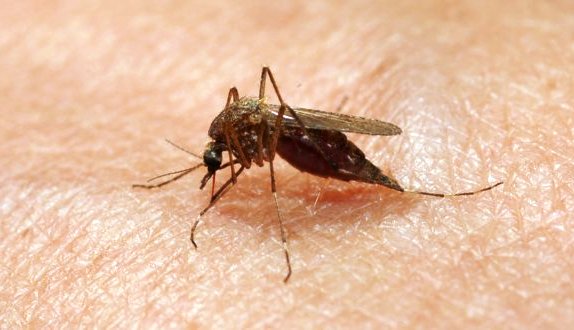
EAST LYME, CT — On Sept. 27, Ledge Light Health District (LLHD) announced that mosquitoes collected in East Lyme and from a collection station on the Waterford/New London line on Sept.14 have tested positive for West Nile Virus (WNV), and that mosquitoes collected in Ledyard on Sept. 20 have tested positive for Eastern Equine Encephalitis (EEE).
Previously LLHD announced that mosquitoes collected in Stonington on Sept. 11 tested positive for Eastern Equine Encephalitis (EEE) and West Nile Virus (WNV), and that mosquitoes collected in Ledyard on Sept. 13 tested positive for West Nile Virus.
In all these Stonington and Ledyard cases, the positive mosquito was culiseta melanura, which is known to primarily bite birds but has been known to bite mammals.
Also, LLHD announced that mosquitoes collected in Lyme, Conn. on Sept. 6 tested positive for West Nile Virus (WNV). The positive mosquito was culex restuans, which is known to bite birds and mammals.
Previously this summer, mosquitoes from North Stonington (8/21) and Waterford (8/23) tested positive for WNV.
Positive EEE and WNV mosquitoes are normally expected during the summer months, and their presence serves as a reminder for residents to take standard precautions to avoid being bitten by mosquitoes. Precautions to avoid mosquito bites:
Minimize time outdoors at dusk and dawn.
Be sure door and window screens are tight fitting and in good repair.
While outdoors, wear shoes, socks, long pants, and long-sleeved shirts. Clothing material should be tightly woven.
Use mosquito netting when sleeping outdoors.
Consider using mosquito repellent when it is necessary to be outdoors and always use it according to label instructions. The most effective repellents contain DEET or Picaridin. Oil of lemon eucalyptus is also effective for brief periods of exposure.
When using DEET, use the lowest concentration effective for the time spent outdoors (for example, 6% lasts approximately 2 hours and 20% for 4 hours) and wash treated skin when returning indoors. Do not apply under clothing, to wounds or irritated skin, the hands of children, or to infants less than 2 months.
Measures to reduce mosquitoes around the home:
Dispose of water-holding containers, such as ceramic pots, used tires, and tire swings.
Drill holes in the bottom of containers such as those used for recycling.
Clean clogged roof gutters.
Turn over objects that may trap water when not in use such as wading pools and wheelbarrows.
Change water in bird baths on a weekly basis.
Clean and chlorinate swimming pools, and cover pools when not in use.
Use landscaping to eliminate areas where water can collect on your property.
Additional resources for information on West Nile virus and mosquito management can be found at this link.
If you need assistance or advice treating standing water on your property, a member of LLHD’s Environmental Health staff can help. An Environmental Technician will visit your property and provide education on how to prevent and eliminate mosquitoes. Contact Patti Myers at (860) 434-1605 ext. 214 for more information.
Editor’s Note: This article is based on press releases issued by Ledge Light Health District on various dates in September.
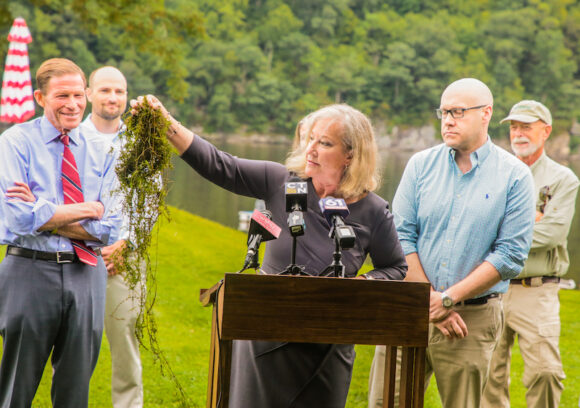
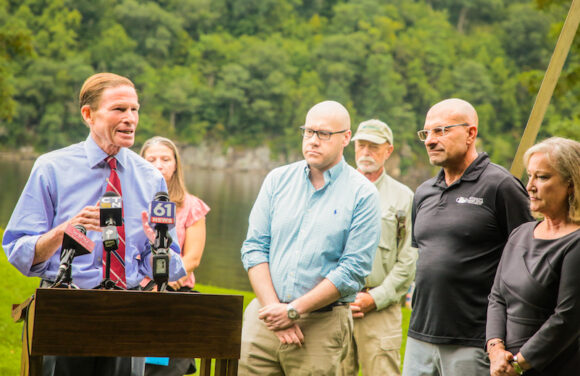
State Rep. Christine Palm (D-36th) holds up some hydrilla during Wednesday’s press conference to demonstrate how its structure chokes native plants, harms fish and wildlife habitats, and prevents recreation. All photos courtesy of CT House Democrats.
Press Conference Held to Educate Public About Harm Caused by Hydrilla, Discuss Projects to Control Invasive Aquatic’s Spread
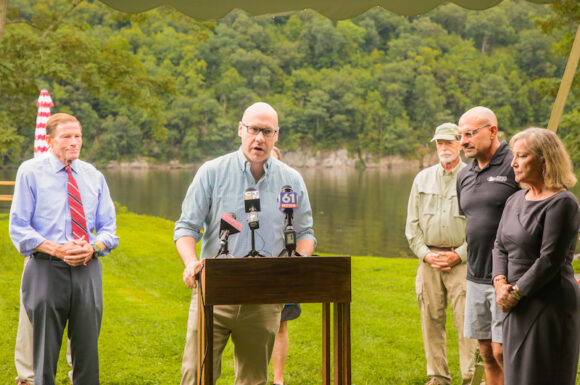
CHESTER — On Wednesday, Aug. 16, state and federal legislators, federal agencies, and stewards of the Connecticut River, met in Chester to educate the public about testing and remediation of invasive aquatic species in the Connecticut River, focusing on hydrilla (hydrilla verticillata), a highly problematic invasive rapidly spreading throughout the lower River Valley.
Experts addressed how these species cause ecological and economic harm, discussed the different research and removal projects being conducted in the Connecticut River, introduced the newly formed Office of Aquatic Invasive Species, and offered methods of prevention.
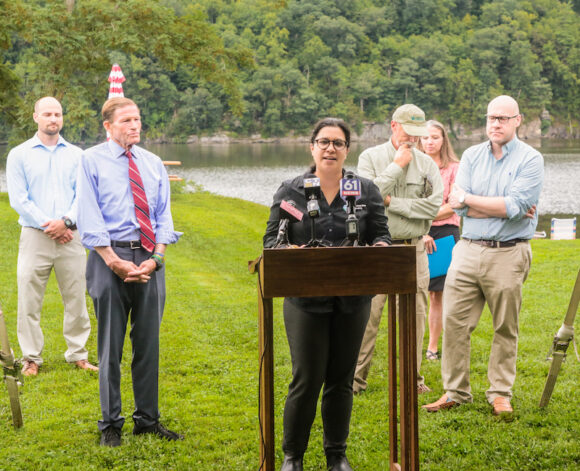
“Hydrilla is a threat to the Connecticut River as it can crowd out native plants, harm habitat for fish and wildlife, and prevent recreation,” said Rhea Drozdenko, River Steward for the Connecticut River Conservancy.
Rhea Drozdenko, River Steward for the Connecticut River Conservancy., addresses the audience at the press conference.
She continued, “I’m grateful we have strong partnerships throughout the watershed as we learn more about this species and work to protect our waterways. The Connecticut River Conservancy has worked on several related projects including the use of benthic barriers to prevent hydrilla growth and promoting preventing the spread of hydrilla through the practice of ‘Clean, Drain, Dry.'”
To improve understanding of the dynamics of water flow and exchange in the local waterways, the U.S. Army Corps of Engineers (USACE), in cooperation with the CT Agriculture Experiment Station (CAES), will be applying Rhodamine WT (RWT), a red tracer dye to the Chester Boat Basin, along with three other sites.
This dye release and study program is preparatory to the eventual release of herbicide treatment for the control of hydrilla at each site.
According to the USACE, RWT dye is a fluorescent, xanthene dye that has been used for water tracing since at least the mid-20th century to quantify time of travel in dynamic (in this case, tidal) waters. This dye has no significant effects on aquatic organisms and has been proven safe for these studies.
The dye will be applied to the sites during various environmental conditions using different application techniques at 10 parts per billion concentrations. The concentrations of the dye in the water will be collected using fluorometry equipment at certain intervals following initial dye treatment at sampling points within and just outside of the sites.
There will be impacts on the color of the water at the sites and surrounding areas as the dye is bright red in color but expected to be minimal and short-term as the dye will dilute and dissipate with the flow and tides of the river.
State Rep. Devin Carney (R-23rd) thanked State Rep. Christine Palm (D-36th) for taking the lead on the hydrilla issue and emphasized the urgency of eradicating it.
“I am grateful for the combined brain power of these biologists, engineers, and advocates,” said State Representative Christine Palm (D-36th), whose district covers Chester, Deep River, Essex, and Haddam.
She stressed, “We don’t want the public alarmed at the sudden appearance of red dye in the water, so we’re trying to get ahead of it by educating boaters, businesses, and residents. Ultimately, the goal is to eradicate the spread of this invasive, which is devastating our waterways.”
Rep. Palm, who serves as vice chair of the General Assembly’s Environment Committee, successfully introduced a bill in 2022 to establish and fund the Office of Aquatic Species at CAES.
“Hydrilla and invasive plants can and have caused significant damage across a number of bodies of water in our state, said State Senator Norm Needleman (D-33rd), whose district includes Lyme, Conn.
He noted, “By working to study how water flow and downstream activity can result in the spread of such plants, we can better prepare for and respond to the future spread of these plants, better supporting our natural resources.”
“It is vital that we continue to do what we can to prevent the spread of hydrilla and work to eradicate it,” said State Representative Devin Carney (R-23rd), whose district includes both Lyme and Old Lyme.
He said, “This is an issue that affects our environment, economy, and our overall quality of life. I want to thank Rep. Christine Palm for taking the lead on this issue and for all of the efforts by state agencies and organizations to remove this invasive species from our waters.”
U.S. Senator Richard Blumenthal said he had advocated for $6 million in federal funding to help the U.S. Army Corps of Engineers control and eradicate hydrilla.
“Hydrilla poses a significant ecological, environmental, and economic threat to the Connecticut River,” said U.S. Senator Richard Blumenthal.
He pointed out, “This invasive species is spreading rapidly – knocking out aquatic plants, choking fish and other wildlife, and making the waters unsafe for recreation,” adding, “I am proud to have advocated for the $6 million in federal funding included in the omnibus bill to help the U.S. Army Corps of Engineers control and eradicate this harmful species.”
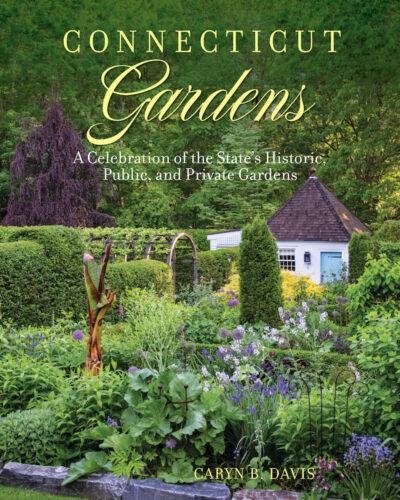
LYME, CT — Stunning photography by Lyme resident Caryn B. Davis highlights her latest book titled, Connecticut Gardens.
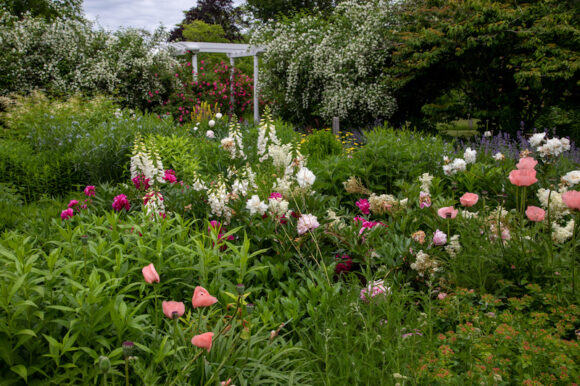
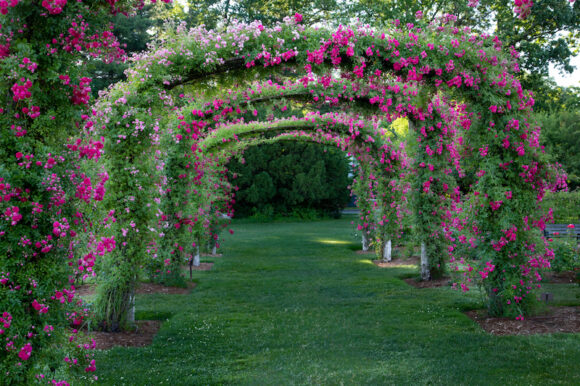
This beautiful book takes readers on a visual tour of some of the state’s most impressive historic, public, and private gardens. The pure beauty of the gardens on view in the book spans the spectrum from simple cottage gardens through remarkable botanical achievements to imposing landscapes.
The book introduces readers to the gardens created by amateurs, professional designers, and notable luminaries such as Frederick Law Olmsted, Gertrude Jekyll, and Beatrix Farrand.
I wanted to find out more about the book but due to issues with schedules and locations, we were unable to find a time to meet. I therefore ended up sending her a number of questions via email to which she kindly responded.
I asked Davis first why she decided to write this book, to which she replied, “I love photographing gardens and am quite moved by their beauty but it’s also what I do for a living along with photographing architecture and interior design.”
That response explained the reason for the book but I still wondered what the original inspiration for the book was. What had sparked the seed of thought, which ultimately turned into the reality of the book?
Davis said, “The idea for this book came to me when I was photographing a private garden for a magazine. I thought it be great if others could see some of these private gardens.”
She continued, “This is my third photography book, and as with all my books, I like them to be travel guides so anyone can pick up the book, turn to the index and visited the places in them. So that is how I decided to incorporate historic and public gardens as well. Although some of the private gardens in the book do have open days for public visits.”
Florence Griswold Museum, Old Lyme CT
I was also intrigued as to how Davis went about preparing the contents of the book? I was especially curious over what length of time she took all the photos.
She noted, “I had one season in which to produce the book. I took some images in January, a few in April to catch the daffodils, but the bulk of the work was done last year in May and June and with a few shoots in late August and early September.”
Elizabeth Park, Hartford.
Did she take the photos first and then work on the text afterwards? It turned out the text was being written as she was working on the photography. Davis added, “Once I decided which gardens to include, I gave the list to the writer and he began the process of writing.”
The question of which gardens to include in the book prompted a long answer from Davis. She carefully explained, “I did a lot of research to decide which gardens would be in the book. I looked at a lot of public parks, but made sure the park had a dedicated garden within its borders because it was a book about gardens and not about parks.”
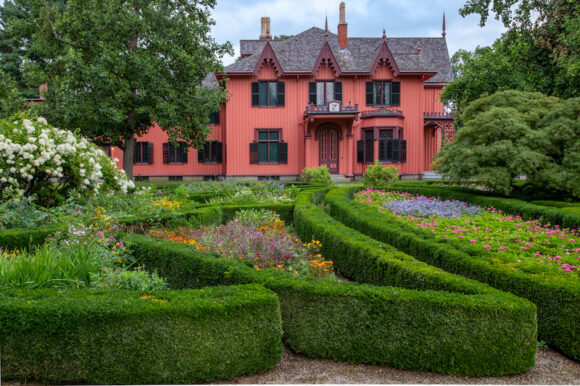
Roseland Cottage, Woodstock, CT
Davis continued, “I knew about the nonprofit organization Connecticut’s Historic Gardens, from my first book, A Connecticut Christmas. They represent 15 historic gardens and houses, so I featured all of those. Then I solicited a lot of garden clubs, the Garden Conservancy, and looked at home and garden magazines to find private gardens, and also asked people I knew for recommendations.”
It occurred to me that Davis must have viewed more gardens than she was able to include in the book. So how did she choose which gardens to exclude?
Her initial answer was a little surprising as she said, “Most every garden I chose except one was included in the book.”
Wadia Garden, Gitanjali, New Canaan, CT
But then she elaborated saying, “I did scout two or three gardens that did not make the cut because they looked too similar to what I already had, or the story behind the garden wasn’t that interesting, or the garden itself wasn’t large enough or diverse enough to be visually intriguing.”
I felt obliged to ask Davis which was her favorite garden out of all those featured in the book. This time the answer was not unexpected as she responded, “I can’t say I have a favorite garden because I like them all for very different reasons.”
Sleepy Cat Farm Greenwich CT
She did however share some further thoughts, “But some that stand out are Sleepy Cat Farm in Greenwich. It’s a very grand garden and quite unusual for Connecticut. Wickham Park in Manchester was a complete surprise. They have 10 distinctive gardens in varying themes.”
Davis pointed out that Hollister House Garden in Washington is a stunning re-creation of an English garden.
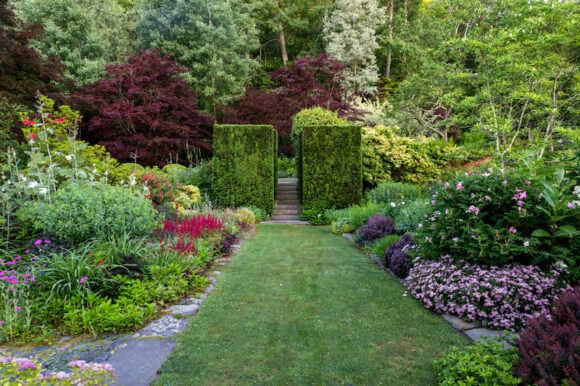
Hollister House Garden, Washington CT
“And, of course,” she added, “One of my very favorites in Lyme is a River Road Farm. That garden graces the cover of the book. It was owned by Bill Reynolds and Robb Nester. They not only created it from scratch but they also lovingly maintained it doing all the work themselves.”
She noted enthusiastically, “I also have to say they had the best coffee and warmly greeted me with a much needed cup upon my many early 5:30am arrivals!”
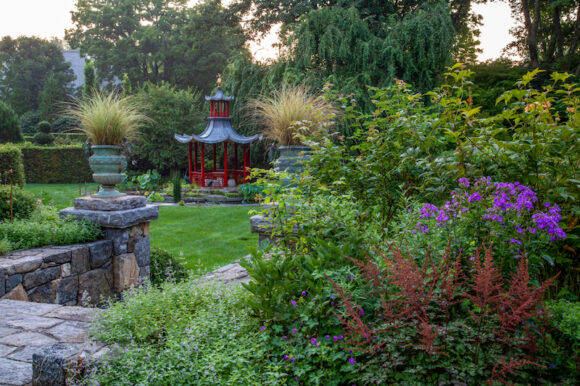
Garden at Manor House, Bunny Williams, Falls Village, CT
Since Davis is primarily a photographer, I asked if someone had assisted her with the text. And if that were the case — which it turned out it was — who then is considered the book’s “official” author. Davis helpfully clarified that situation for me noting she is regarded as the book’s author since she, “Conceived it, pitched it, and chose the content … along with a thousand other details that go into producing a 272-page-book.”
But she noted it was written by Chris Lawrie of Bluebird Designs, who was someone she personally had recommended for the task. Davis said, “Chris is a landscape designer and a landscape consultant. I knew he was a thoughtful and intelligent writer, and that his insights would enhance the book and complement the images.”
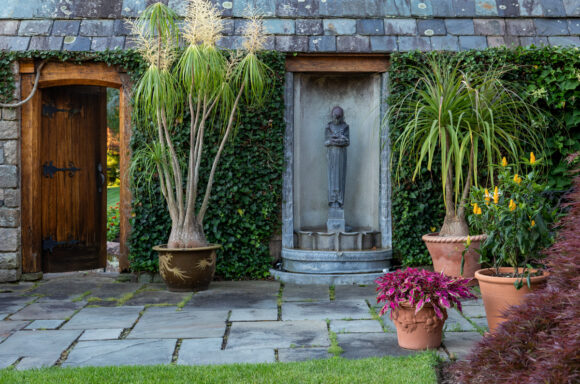
St. Edmund’s Retreat
Since the book was a combination of photos and text, who decided what the text would cover? Davis explained, “We both decided early on that the book should tell the stories of the people behind the gardens rather than being a how-to book or a description of plants.”
She went further, stating, “We also wanted to include an overview about the history, purpose and evolution of gardens in general, starting with their utilitarian roots, along with the importance of the public parks movement and how that came into being, and why we create gardens today.”
Osborne Homestead, Derby. CT
Naturally, I had to ask if she was already working on another book? She replied, “I do have some ideas I am currently shopping around,” then was obliged to add tactfully, “But I am not at liberty to say.”
I will end by thanking Caryn for taking the time to respond to my questions and allowing us to publish many of her wonderful photos from the book. Moreover, I will give the book two big thumbs up and a heartfelt recommendation to our readers to find an opportunity to look at — or even purchase — this very special book.
In conclusion, the photography is exceptional, the text engaging, and the book most definitely serves as a useful guide for discovering new gardens to explore. Enjoy!
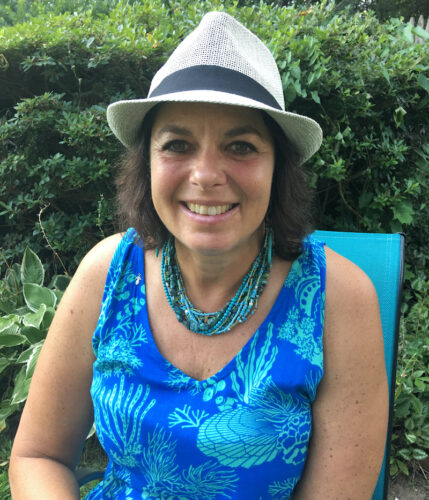
Photo by Noelle Guzman.
Editor’s Notes: i) All the photos of gardens above are by Caryn B. Davis, pictured left, and published with her permission. They are also all published in her book, Connecticut Gardens.
ii) Caryn B. Davisis an award-winning photographer specializing in architecture, interiors, hospitality, landscape design, and travel photography. Her career has spanned the globe, taking her to more than 50 countries, and her images and articles and have appeared in over sixty publications worldwide including the New York Times, Lonely Planet, Condé Nast Traveler, Town & Country, Travel + Leisure, New Zealand Geographic, and other publications. She has two commissioned photography books, A Connecticut Christmas: Celebrating the Holiday in Classic New England Style and Connecticut Waters: Celebrating Our Coastline & Waterways.Connecticut Gardens is her third book. Visit her website at this link.
iii) The book, Connecticut Gardens. A Celebration of the State’s Historic, Public, and Private Gardens is available for purchase in local and national bookstores and gift shops, and on Amazon.com and other online book retailers.Signed copies are also available directly from the author. (www.carynbdavis.com)