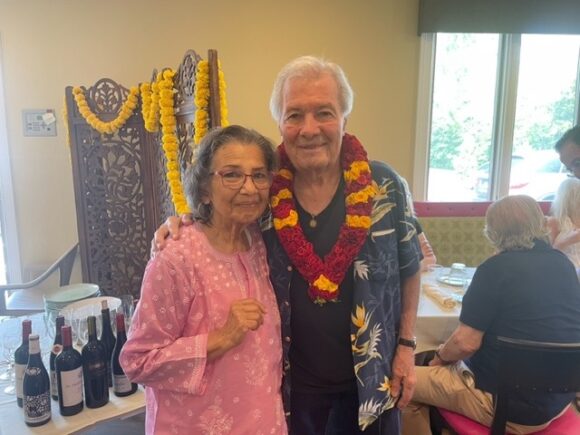
On Saturday, July 15, celebrity chef Jacques Pepin, standing at right, cut the ribbon for the official opening of ‘The Curry Queen’ restaurant in Old Saybrook. The restaurant is owned by Lyme resident Nalini Srinivasan, pictured left. Photo by H. Margules.
LYME/OLD SAYBROOK — A new restaurant, owned and managed by Lyme resident Nalini Srinivasan, has opened in Old Saybrook. Describing itself as focused on homestyle, authentic Indian cuisine,The Curry Queen, located at 93 Elm St., offers both dine-in and take-out options.
Asked to describe her menu, Srinivasan responded by email saying, “The menu is, at present, a simple one with everyday offerings such as curries, [both] vegetarian and non-vegetarian, specialities from the Tandoor, and small plates of street food samples.”
She added that exciting new additions are planned to the menu shortly but they are still under wraps at this time.
Srinivasan explains, “The intent is to expose our clientele to different regional Indian Food, including Anglo Indian Cuisine.” She also notes that an application for a liquor permit is “in the works.”
Opening a restaurant is a high-risk business. We inquired why Srinivasan felt drawn to do so after enjoying a successful career in finance. She said, “I saw a niche market opportunity. I wanted to reach out to the local community to spread the word [and have] a small business experience. I enjoy the creativity of it and anticipate good things for the future.”
When we asked whather hopes were for the restaurant, her business acumen shone through in her reply. Shrivasan stated her objectives are, “To achieve targeted Business Plan Goals and to assimilate into the economic environment of the area.”
A particularly interesting and endearing aspect of her business is Srinivasan’s decision to employ the Afghan refugee father of five, who is currently living in Old Lyme. The Afghani family is being supported by the Lyme-Old Lyme Refugee and Resettlement Committee.
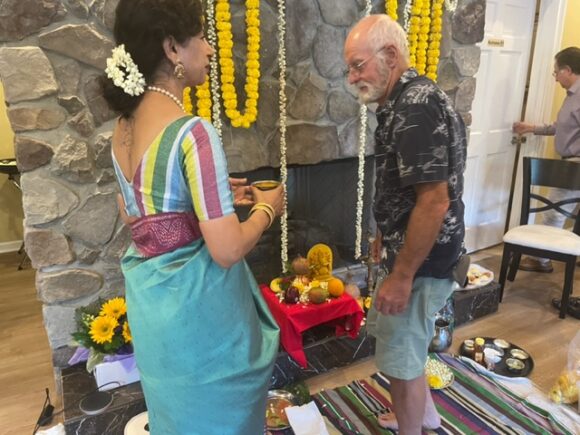
A Hindu prayer service was held at ‘The Curry Queen’ to celebrate the opening of the restaurant. Photo by H. Margules.
Why had she chosen to take on this gentleman, who clearly did not have the usual references to apply for a chef’s job due to the extremely challenging conditions surrounding his evacuation from Afghanistan?
Srinivasan replied pragmatically, “Because I thought he would have a natural flair for using the Tandoor, which is a common feature in our (Afghan and Indian) cooking methods; … I thought I could use his help while he helps himself to settle in and because I thought we could contribute to the [overarching] cause of resettling a [refugee] family.”
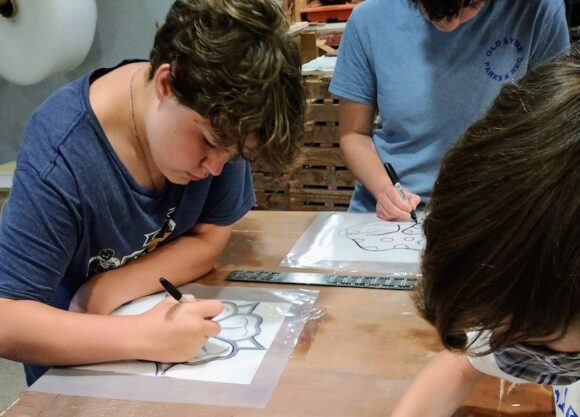
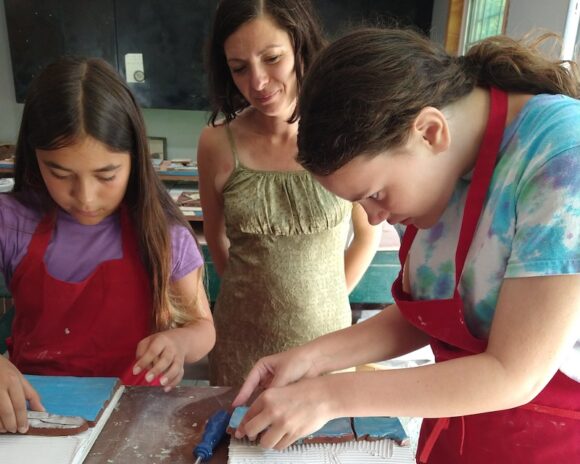
Lymes Creative Arts students focus on their designs, which will ultimately be seen on artisan tiles. All photos submitted.
OLD LYME — “Tremendously successful!” That’s how Lilywork Artisan Tile founders and owners Paul and Esther Halferty sum up their participation in this year’s Lymes Creative Arts program. Their custom-built tile studio is located in the center of Old Lyme at 56 Lyme St. and is the creative endeavor of the husband and wife duo.
The summer program, supported by mini-grants and materials provided by Lymes Creative Arts, aimed to provide transformative and accessible hands-on arts experiences to teenagers in the Lyme and Old Lyme communities.
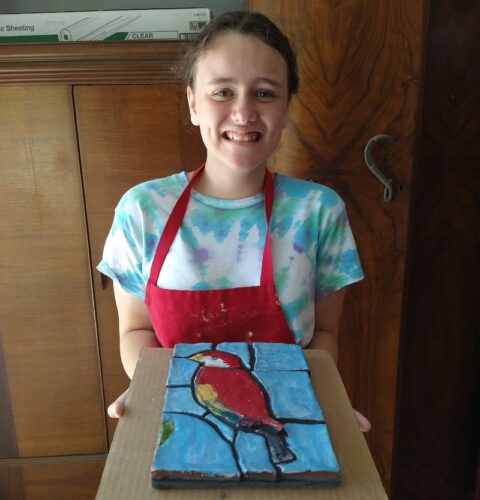
One of the summer program participants proudly displays her finished work.
The Halferty’s took on the role of instructors for this summer’s program. They guided a group of 11 enthusiastic students through the process of creating tile mosaics from start to finish.
Over the course of several weeks, these talented teens immersed themselves in the world of artisan tile making, acquiring invaluable skills and hopefully forming lasting friendships with their fellow classmates.
Summer students transfer their designs to clay.
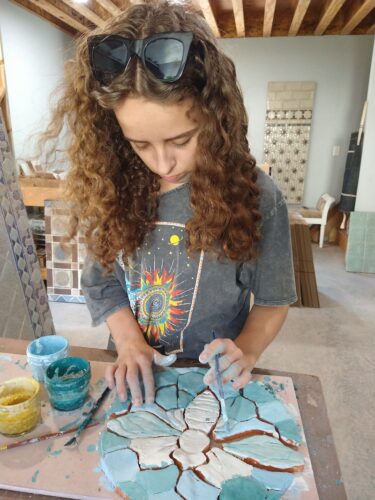
Under the guidance of instructors Paul and Esther, the students embarked on an inspiring artistic journey. From shaping clay and designing unique templates to mastering the art of mosaic cutting and glazing techniques, the students gained some insight into a day in the life of a tile artisan.
As the program drew to a close, students were eagerly anticipating the final stage of setting and grouting their colorful creations.
Happily displaying her eye-catching tile created during the summer program.
Beyond the acquisition of artistic skills, this Lymes Creative Arts summer program fostered an environment of camaraderie and friendship. The students collaborated closely with their peers, forging new connections and cherishing the opportunity to share their artistic pursuits.
The emphasis on celebrating individual artistic expression allowed each student to gain confidence in their unique artistic journey, regardless of their skill level.
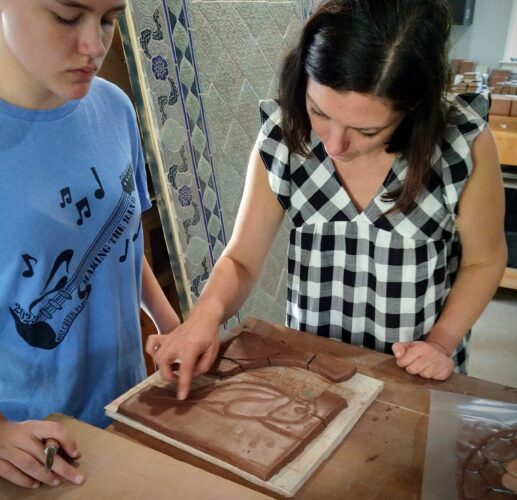
Students hard at work under the watchful eye of Esther Halferty.
Paul Halferty commented, “As artisan tile makers and instructors, it has been an absolute joy to be a part of the Lymes Creative Arts summer program.”
He continued, “We have witnessed the incredible impact of art in the lives of these talented teenagers, as they not only honed their skills but also discovered new ways to express themselves creatively. The program has been a win-win for both student and teacher and we are grateful to have been a part of their artistic journey.”
The resounding success of the Lymes Creative Arts program can be attributed to their unwavering commitment and dedication to its core objectives. By offering affordable or free programming, Lymes Creative Arts ensured that aspiring artists from diverse socioeconomic backgrounds had access to these transformative experiences.
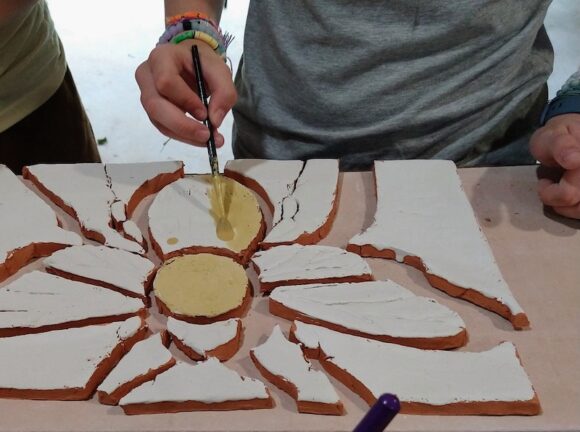
Painting a piece of clay during the summer program.
The hands-on arts opportunities provided an outlet for the students to manage stress and find fulfillment through artistic expression. The comprehensive range of art forms, including visual arts, craft making, literary arts, and performing arts, catered to a variety of interests, allowing each student to explore their passion fully.
Esther Halferty said, “We would like to express our heartfelt gratitude to Lymes Creative Arts for entrusting us with this remarkable opportunity to nurture the artistic talents of local teenagers.”
She added, “We also extend our appreciation to the Old Lyme community for their unwavering support throughout the program.”
Esther Halferty gives advice to a student during the Lymes Creative Arts summer program.
The couple acknowledges the invaluable funding provided by the American Rescue Plan, which made these transformative experiences possible for aspiring young artists in the area.
The story of Lilywork begins at Moravian Pottery and Tile Work, a living history museum in Bucks County, Pa.
Recently back from a year in Turkey, Esther started an apprenticeship at the Tile Works in the Fall of 2005. Esther came to learn the Tile Work’s traditional tile-making techniques, as well as, to create work inspired by her love of printmaking, architecture, and tile patterns seen during her time abroad.
Creativity shines through in this striking tile.
Paul, meanwhile, was working at the Tile Works as mold-maker, ceramist, and teacher.
One year later they were married … and Lilywork Artisan Tile was born.
Beautiful tiles created by Lilywork Artisan Tile. Each tile is unique.
Today, every tile is pressed by hand in Old Lyme. Because every Lilywork backsplash and custom fireplace is made by hand, no two are exactly alike. Every tile carries a story that lends meaning and authenticity to every surface on which they are placed.
Lilywork tiles are inspired by the Halferty’s love of travel and traditional design. Lilywork designs are not cutting-edge statements of current fashion, but rather a blending of what has been handed down by craftsmen and designers of the past. Paul and Esther strive to create designs and colors that have relevance across cultures and centuries.
Samples of work by Lilywork Artisan Tile grace the walls of the studio.
Over the years, the Halferty’s worked closely with homeowners, designers, and builders to bring their dreams and visions to life. Their clients come to them seeking something different and unique.
As the Halferty’s reflect on the success of the Lymes Creative Arts summer program, they remain steadfast in their commitment to fostering accessible and enriching artistic opportunities for the youth in their community. With their artisan expertise and unwavering passion, the couple eagerly anticipates future endeavors and the positive impact they will continue to have on the lives of aspiring young artists.
Learning the skills of an ancient art.
For more information about Lilywork Artisan Tile and their involvement in the Lymes Creative Arts program, visit www.lilyworktile.com or contact Paul Halferty at 860-865-5933 or lilyworktile@gmail.com.
Editor’s Note: This article is based in part on a press release issued by ‘Lilywork Artisan Tile.‘
After some sluggish early sales, there has been a considerable increase in the number of electric vehicles (EVs) on the roads in the United States. EVs comprised 5.8 percent of all new vehicle sales in the United States in 2022; up from 3.2 percent in 2021; and that’s more than three-quarters of a million of the roughly 14 million new cars and light trucks sold in 2022.
The Day reviewed EV registration data from the Connecticut DMV and reported that at the end of 2022, there were 30,186 EVs registered in Connecticut; of which 60 percent were all-electric vehicles, also known as battery electric vehicles (BEVs), which get all their power from energy stored in rechargeable battery packs.
The state registered only five fuel cell electric vehicles (FCEVs), which are powered by an on-board fuel cell that generates electricity using oxygen from the air and compressed hydrogen, emitting water vapor and heat.
Notably, in the final six months of 2022, Connecticut EV registrations totaled 6,373, the most for any six-month period over the past several years.
EV101:
I review the case for EVs in this “View”, and explore Americans’ early reluctance to make that purchase. I will also wax nostalgic on how the California car culture of the 1950s and ‘60s became embedded in the collective ethos of we baby boomers by rock bands like The Beach Boys and their contemporaries; possibly affecting our future attitudes regarding EVs; — perhaps more so, but not exclusively, the males; I will not recommend any brand.
Note: I use either “gas-powered “equivalent or “similar conventionally-powered car” in this essay to contrast an EV to an otherwise comparable car model powered by an internal combustion engine (ICE).
Why EVs?
The transportation sector of the economy is one of the largest contributors to greenhouse gas emissions in the United States, nearly one-third of the total; — most of which comes from light-duty vehicles, i.e., passenger cars and light-duty trucks that use gasoline or diesel. BEVs, on the other hand, have zero tailpipe emissions and so, are much better for the environment.
Climate scientists consider “vehicle electrification” as one of the best ways to reduce planet-warming greenhouse gas emissions. The EPA released new pollution standards for passenger cars and trucks earlier this year; and legacy automotive companies like Ford, Volkswagen, and GM have committed to increase their development of EVs or even stop the production of gas-powered vehicles.
The transition to EVs is expected to be beneficial for those who don’t even drive one. A large-scale study by investigators at USC’s Keck School of Medicine found that BEVs are associated with a statistically significant reduction in air pollution and respiratory diseases They demonstrated a 3.2 percent drop in the rate of asthma-related emergency room visits “for every 20 additional BEVs on the road per 1,000 people”.
While a 3.2 percent decrease may appear modest, the continued replacement of gasoline and diesel-powered vehicles with EVs should continue to yield substantial benefits for the public’s health; — i.e., with reductions in emissions and improved air quality, fewer people will inhale harmful quantities of carbon monoxide and nitrogen oxides, which have been linked to high blood pressure and respiratory problems.
Why the Early Reluctance?
Aside from the usual “wait and see” period associated with the adoption of any new or somewhat unproven core technology, EVs often had higher upfront prices than similar gas-powered automobiles. Further, prospective buyers were also concerned about driving range, i.e., the number of miles an EV can travel on a fully charged battery. The scarcity of easily accessible charging stations near home or on trips was also of concern.
American automakers have now focused EV production on “the heart of the U.S. auto market.” Photo by Precious Madubuike on Unsplash.com.
Turning the Corner:
The Inflation Reduction Act of 2022 provides subsidies (up to $7.5 billion in total) for the development of a national network of charging stations. In addition, federal and CT tax incentivesthat support the purchase of EVs are nowavailable.
Further, an analysis by “Consumer Reports” stated that EVs are considerably cheaper to operate and maintain; and provide sizable savings to owners over the expected lifetime of the EV, when compared to similar gas or diesel- powered vehicles.
Finally, automobile industry analysts observe that “in their first rollouts, America’s automakers targeted people who value short-range economy cars. Then came EVs for luxury buyers and drivers of pickups and delivery vans. Now, the companies are focused on “the heart of the U.S. auto market”, — the compact SUV; and promoting their new models as having the range, price and features to rival their gas-powered competitors.
It is expected that “prices are likely to more closely align with conventional vehicles, as production volumes increase and battery technologies continue to mature”.
I was a student at the MindszentySchool, a Catholic prep school inwestern New York state, when the music of The Beach Boys began to reach the northeast. This was before The Beatles had made their first appearance on “The Ed Sullivan Show” or sang live before 55,000 people at Shea Stadium; and before CBS and Ed Sullivan censored the lyrics performed by The Rolling Stones.
It was a few years after the Cuban Missile crisis brought us to the brink of a nuclear confrontation with the Soviets, which was followed just about a year later by the assassination of JFK in Dallas. Moreover, the War in Vietnam was expanding rapidly and we feared, even while completing our college applications, that those future college years would be interrupted or curtailed by a draft lottery system scheduled for implementation in our near futures.
Clearly, we needed a diversion.
I will illustrate how the music and lyrics of that era’s California-themed rock groups may have influenced the eventual EV buying decisions below with excerpts from their songs. This is not science, so if I fail in this salute to some of the music of my teen years, it is entirely feasible that “you just had to be there.”
The genre was generally referred to as the California sound, and highlighted the So-Cal culture of surfing, the beach, and high performance cars. Drag racing and street racing were prominent lyrical motifs, as were mechanical techniques for “souping up” your car. These “muscle cars” were loud, generally American-made, and highly modified for power and acceleration.
This is only a small sample selected from almost a thousand published works of The Beach Boys and their contemporaries; and included in this essay because I felt that they characterized the car culture of the time.
Let me be clear. I am not suggesting that any of their lyrics bear any resemblance to the works of Frost, Longfellow, Whitman, or even Jerry Garcia; but the group was one of the American rock bands that sustained their standing through the sneaky British invasion of our music in the mid-1960s by The Beatles, The Rolling Stones, and The Who, amongst many others.
High Performance Cars:
In the lyrics below,“409”, “413”, and “389” all refer to engine displacement, which is a measure of the cylinder volume in an internal combustion engine, and often used not only as an expression of the engine’s size, but a gauge of its power. Carburetors get highlighted in the lyrics; and “dual quads” and “three deuces” refer to the configuration of the carburetors in highly modified ICEs; — i.e., two “four barrel” and three “two barrel” carburetors, respectively.
Carburetors are/were used in an ICE to control the mix of fuel and air that then gets fired in the cylinders, powering the pistons The usual stock engine in a family car would typically have a single carburetor servicing all cylinders. Note that manufacturers stopped using carburetors in the late 1980s after the development of newer and more efficient technologies like fuel injection, which also appears below.
The few mentions of “rubber” refer to a car that is so powerful that the driver can spin the wheels or “lay rubber”, even when shifting to the higher gears.
The Lyrics:
“When I take her to the track, she really shines; she always turns in the fastest times; — my four speed, dual quad, posi-traction 409”.
“It happened on the strip where the road is wide; two cool shorts standing side by side. Yeah, my fuel injected stingray and a 413; were revving up our engines and it sounds real mean”.
“Pedal’s to the floor, hear the dual quads drink; and now the 413’s lead is starting to shrink”.
“I get pushed out of shape, and it’s hard to steer; when I get rubber in all four gears”.
“When the flag went down, you could hear rubber burn”.
“Little GTO, you’re really looking fine; three deuces and a four-speed and a 389”.
Women Drivers:
“Well, she got her daddy’s car and she cruised through the hamburger stand now; seems she forgot all about the library like she told her old man now. And with the radio blasting goes cruising just as fast as she can now. Well, the girls can’t stand her ‘ause she walks, looks and drives like an ace now; she makes the Indy 500 look like the Roman chariot race now.”
“The little old lady from Pasadena has a pretty little flowerbed of white gardenias; but parked in a rickety, old garage is a brand new, shiny, red, super-stock Dodge. Well, she’s gonna get a ticket now sooner or later, because she can’t keep her foot off the accelerator.”
The Irony of Engineering:
EVs can accelerate faster than their gas-powered equivalents, and it’s all about torque, i.e., the twisting force that that gets the gears, axles, and wheels turning. Very, very simply, torque is produced in an internal combustion engine by firing the fuel-air mix in the cylinders, which causes the pistons to slide up and down; and as they do, rotates the crankshaft that is attached to a gearbox, which in turn, powers the car’s wheels. To speed up this process and reach maximum torque, drivers may rev up the engine.
EVs, on the other hand, have a much simpler design and their electrical drive motors have few moving parts. When you step on an EV’s accelerator, electricity is sent from the battery to the electric motor, whose rotor begins spinning rapidly. The rotor is somewhat analogous to a crankshaft and it feeds torque to the wheels through the transmission via a differential. This all happens instantaneously without revving because the motor can provide instant torque at the maximum level.
A larger battery pack can provide more power to the electric motor, which can result both in faster acceleration and increased range. However, electrifying vehicles adds substantial weight; — e.g., the electric version of the Ford F-150 small pickup is much heavier than the gas version of the same vehicle, weighing 35 percent more, primarily because of the massive battery and required structural support.
Most EVs weigh about one-third more than their gas-powered equivalents, which is troubling, because EVs can be more deadly during crashes than similar conventionally-powered cars and trucks because that extra weight effectively increases the force of a crash.
Author’s Notes: Note that the above artists did not invent the car-centric genre. In 1928, recording artists Billy Jones & Ernest Hare published “Henry’s Made A Lady Out Of Lizzie.”, about the brand new Ford Model A, which replaced the Model T “Tin Lizzie”.
“No more chug chug chug chug-bang! No more cuss words, no more slang!”.
I focused on BEVs in this essay, but if you are not yet ready to commit to a plug-in; there are many great hybrid alternatives available, which combine a conventional internal combustion engine with an electric propulsion system. Many of the EVs sold today offer both hybrid and non-hybrid models.
EVs have rounded another corner in their drive to firm their position in the automotive mainstream. The first fully-electric Grand Prix racing series, the FIA Formula E Championship, was launched in 2014. and scheduled in 10 center-city street courses worldwide.
NASCAR is exploring the development of an all-electric racing series, which could operate as a companion to the well-established NASCAR Cup Series.
The Indianapolis 500 has not committed. I guess the question is whether feeling the rumble of the engines and hearing the roar of the exhaust is important to racing fans.
Editor’s Note: This is the opinion of Thomas D. Gotowka.
About the author: Tom Gotowka is a resident of Old Lyme, whose entire adult career has been in healthcare. He will sit on the Navy side at the Army/Navy football game. He always sit on the crimson side at any Harvard/Yale contest. He enjoys reading historic speeches and considers himself a scholar of the period from FDR through JFK. A child of AM Radio, he probably knows the lyrics of every rock and roll or folk song published since 1960. He hopes these experiences give readers a sense of what he believes “qualify” him to write this column.
Author’s Notes: Sources: Hallenbeck, B. “Electric vehicles continue to gain ground, —slowly”. The Day. 04/15/2023. Harto, C. “Today’s Electric vehicles offer big savings for consumers”. Consumer Reports. 10/2020 Associated Press. “Automakers targeting average households with new crop of EVs”. Hartford Courant.07/19/2022 Moritz, J. “CT lawmakers vote to add thousands of electric vehicles in decade. CT Insider. 04/29/2022 Moore, G. “Customers Are Still Slow to Adopt Innovative New Tech. Why the Lag?” Entrepreneur. 03/21/2014. Ornelas, A. “Why do Electric Cars accelerate faster?”. The Motor Digest. 01/18/2022. “Penney, V. “Electric Cars are better for the planet. – and often your budget, too”. New York Times. 01/15/2021. Puko, T. “Biden looks to remake auto industry with toughest emissions limits ever”. The Day. 04/12/2023. U.S. Environmental Protection Agency. “Inventory of U.S. Greenhouse Gas Emissions and Sinks: 1990-2021”. EPA 430-R-23-002. 2023 Shaffer, B. “Make electric vehicles lighter to maximize climate and safety benefits”. Nature. 10/12/2021. Voelcker, J. “Why are EVs So Quick?”. Car and Driver. 02/2022. Wood. J. “Electric vehicles: The 3 main factors holding back sales”. 27th United Nations Climate Change Conference COP27. 11/2022.
Set List: “409” (The Beach Boys; 1962) “Shut Down” (The Beach Boys; 1963). “Little Deuce Coupe” (The Beach Boys; 1963). “Hey Little Cobra” ( The Rip Chords; 1963). “Little GTO (Ronnie and the Daytonas; 1964). “Fun, fun, fun” (The Beach Boys,1964). “The Little Old Lady from Pasadena”; (Jan Berry and Dean Torrence, 1964).
EAST LYME — Beginning Tuesday, Aug. 1, ledge blasting along I-95 will take place Monday through Thursday for a period of six to eight weeks. As a result, I-95 Northbound and Southbound will be closed twice a day between the hours of 9 a.m. and 1:30 p.m. for 15 minutes for each blast.
During this time, motorists are encouraged to follow the posted detour.
** Note that the start of this closure can change at any time based on weather or resources. **
Two detours have been identified as follows:
I-95 Northbound Detour: Motorists should take Exit 74 and continue on Rte. 161 north (turns into Rte. 1), turn left on to Cross Road, turn left on to Waterford Parkway, and take entrance ramp to I-95 northbound.
I-95 Southbound Detour: It is advised that motorists traveling on I-95 southbound take Exit 75, follow Rte. 1 to Rte. 161 south to access the I-95 southbound entrance ramp.
The purpose of the project is to correct the vertical geometry of I-95, replace the I-95 bridge over Rte. 161, and construct new on and off ramps at Exit 74.
DOT Project No. 0044-0156 was awarded to Manafort Brothers at a cost of $148,000,000 on February 1, 2023.
CTDOT is working to inform motorists and local residents of current and upcoming construction activities through project newsletters, press notices, travel alerts, social media, as well as the project website, https://i-95eastlyme.com/.
Editor’s Note: We would like to express sincere thanks to our onsite photographers who contributed all these wonderful photos:- Michele Dickey, Cheryl Poirier and Suzanne Thompson.
OLD LYME — Humidity may have been high but so were people’s spirits at Saturday’s Old Lyme Midsummer Festival.
Photo by C. Poirier.
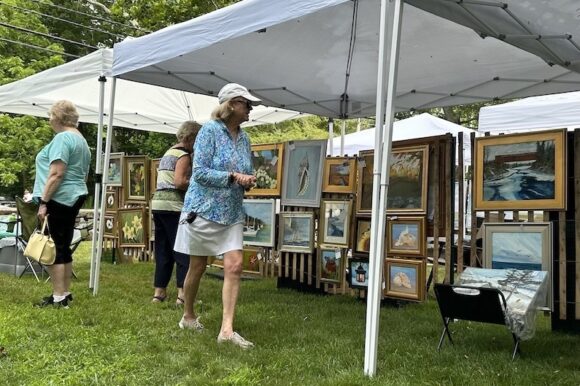
Artisans of all types were out on the grounds of the Lyme Art Association.
Photo by M. Dickey.
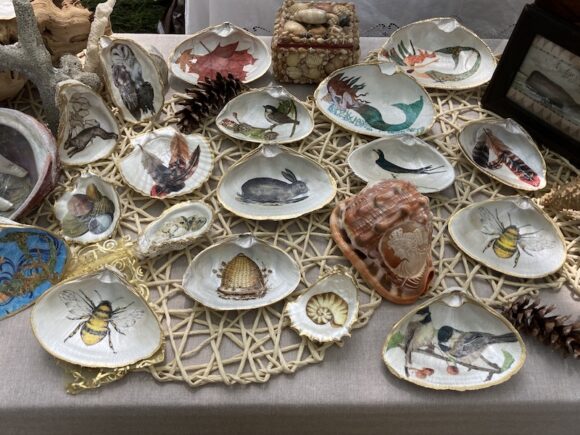
Some sold painted shells — these beauties are by Pinky Murphy, who collects the shells along beaches all the way from Old Lyme to Cape Cod, and then hand-paints them.
Photo by C. Poirier.
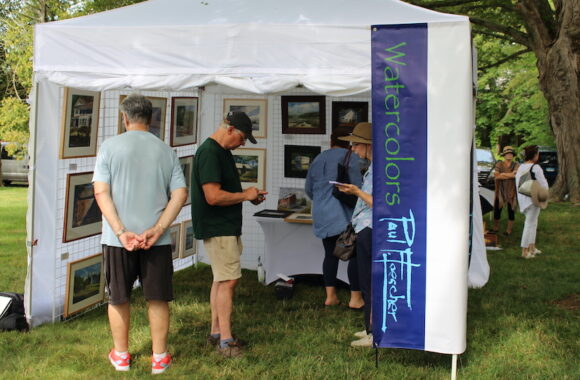
Others sold their paintings …
Photo by C.Poirier.
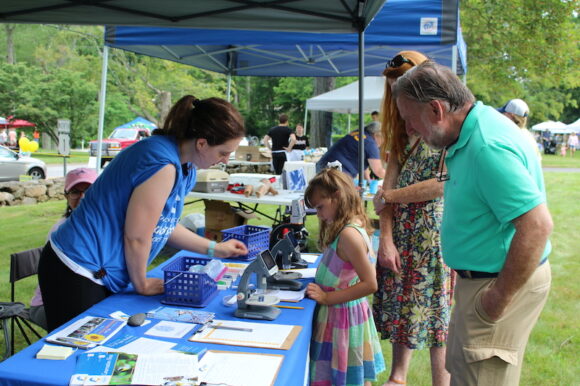
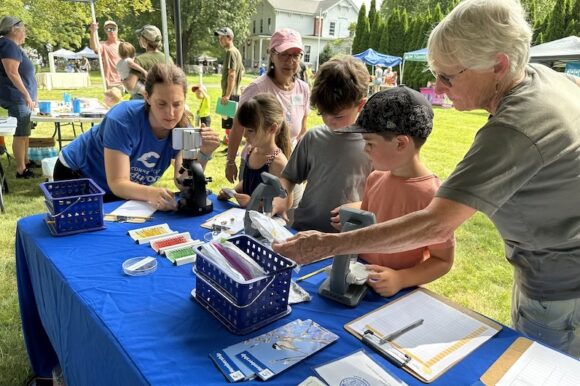
Intellectual abilities of all ages were challenged at the Hands On-Minds On event at the Old Lyme Inn. The photo above shows Heather Corbula of CT Audubon engaging with a young visitor.
Photo by C. Poirier.
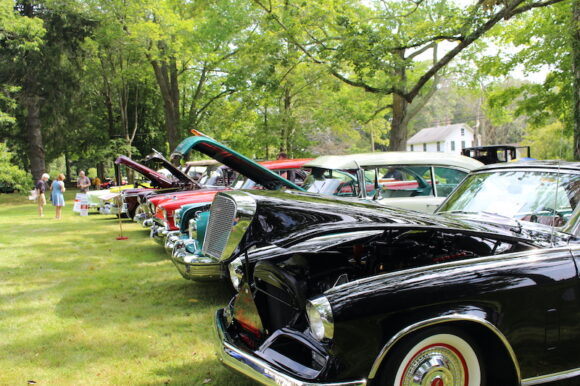
The Car Show hosted by the Lyme-Old Lyme Lions at the Roger Tory Peterson Estuary Center, formerly the Bee and Thistle Inn, was a major attraction of the Festival.
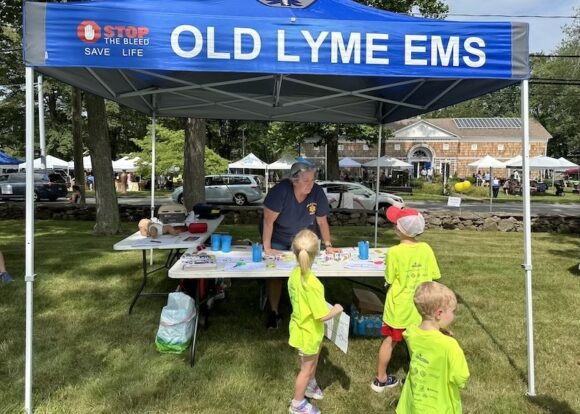
Tisha Kirk of the Old Lyme EMS discussed the vital role of the organization — and much more — with folk of all ages.
Photo by M. Dickey.
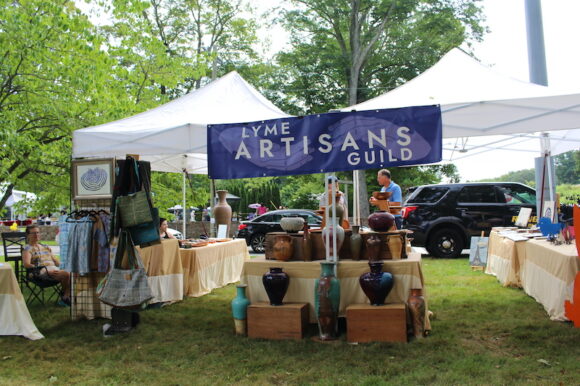
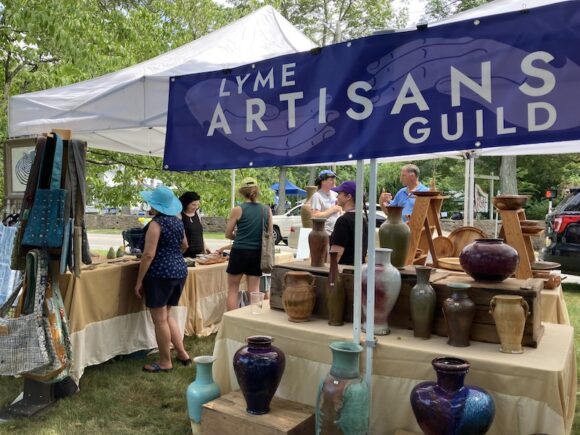
The newly-formed Lyme Artisans Guild drew a great deal of interest throughout the day. Michaelle Pearson, who stands behind the table at left, was selling her beautiful, handmade silver jewelry.
Photo by S. Thompson.
Heather Corbula of CT Audubon was kept busy at the Hands On-Minds On event with a constant stream of young visitors.
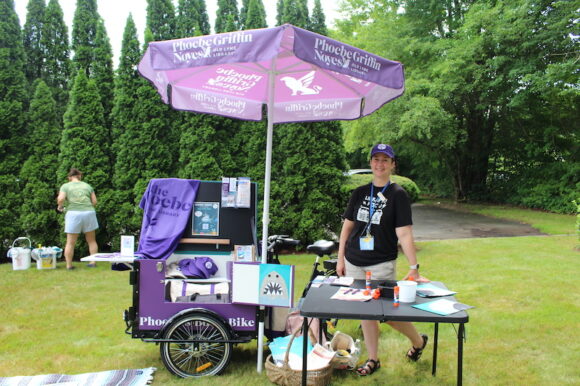
Old Lyme Phoebe Griffin Noyes Library Director Katie Huffman cheerfully greeted participants during the Hands On-Minds On event.
It was all-go on the grounds of the Lyme Art Association.
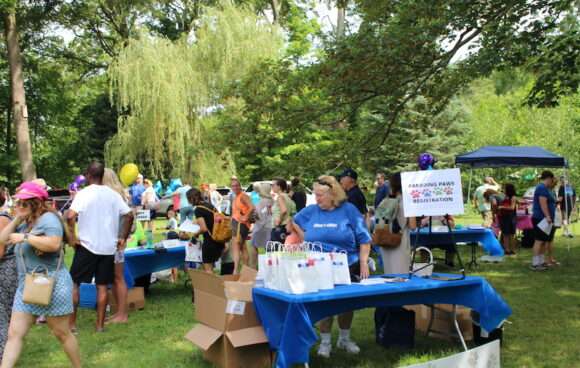
The Florence Griswold Museum’s Parading Paws event drew a large crowd of both participants and onlookers.
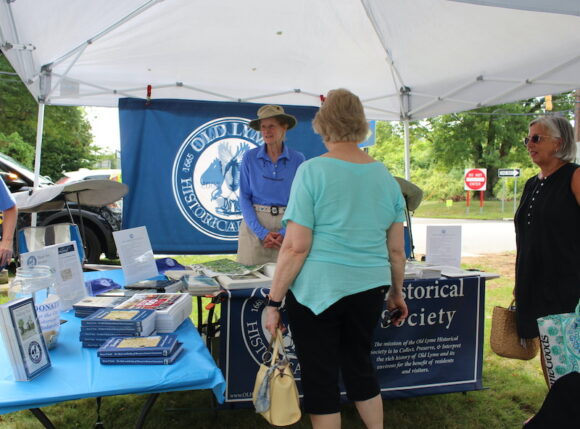
Mary Dangremond was one of the helpful volunteeres at the Old Lyme Historical Society’s tent.
Most local non-profit organizations were represented at the Festival.
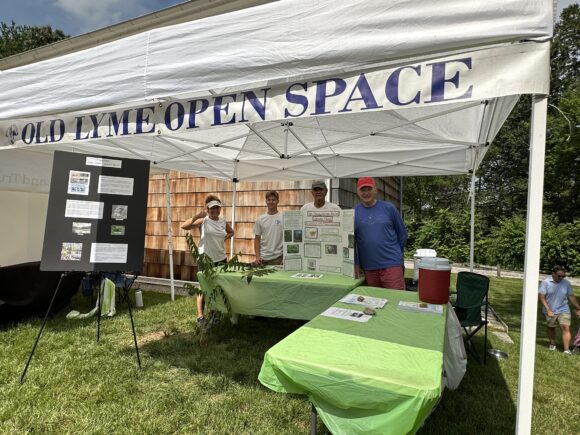
Volunteers at the Old Lyme Open Space tent had plenty of useful information to share with visitors.
Photo by M. Dickey.
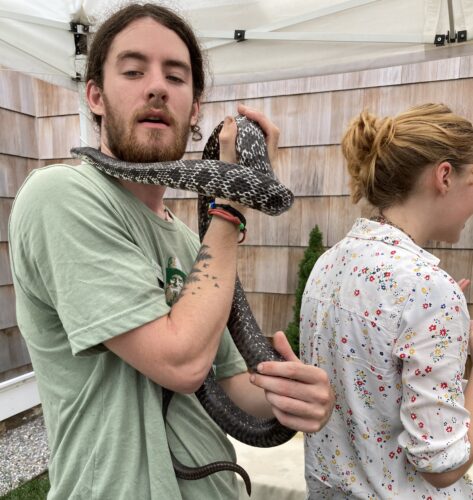
And just in case you thought the Festival was all about arts and crafts, check out this rat snake named Colby! He was featured at the Old Lyme Land Trust’s tent in front of the Lyme Art Association.
Here’s a long-distance view of the Fence Artists on the lawn of the Old Lyme Inn, which captures an iconic view of this very special Festival.
And let’s end with a sincere word of thanks to all those, who gave innumerable hours of their time to plan and organize the event, and all the additional volunteers, who ultimately made it happen. You know who are … THANK YOU!